Categories
Articles

“Touched by Padre Pio’s Guardian Angel”, by Letty Jacinto-Lopez

It was 1965. My brother and sister-in-law (“sis” for short) had wanted to have a baby in the first five years of their married life but all attempts failed. Anxious and getting desperate, my sis agreed to travel to a then-sleepy town called San Giovanni Rotondo — about a five-hour drive from Rome, Italy — to meet Padre Pio, the Capuchin friar who bore the nail wounds of Jesus on the cross.

She said, “I waited for three hours at the confessional room. Finally, Padre Pio motioned to me to speak. I was holding my knees to keep them from shaking. My confession was brief but I felt that he knew that I was there for something more important. After giving me the Absolution, he looked up and whispered, ‘Next year, you will have a baby boy.’”

“Wow!” my sis exclaimed. “He closed his eyes and made the sign of the cross on my forehead. Immediately, I felt a warm glow, both calming and comforting.”

The following year — as promised by Padre Pio — my sis gave birth to a healthy boy and she named him – you guessed it – Pio. My nephew, Pio, is now 47 years old, happily married and a loving father to two kids.

All the time, one teeny question kept popping into my head: “How did my sister-in-law and Padre Pio communicate? She didn’t speak a word of Italian, nor did Padre Pio speak English. Simple. Padre Pio’s guardian angel had acted as his translator and spokesman. “You don’t say!” I yelped. “Yes,” said my sis. “I heard Padre Pio speak to me in English!”

Still, I was not completely convinced. Maybe there was a hidden booth somewhere with UN-trained translators. That is, until I read a similar incident written by Father Alessio Parente, author of the book on Padre Pio entitled Send Me Your Guardian Angel. Here is an excerpt:

“A little American girl was brought to Padre Pio so that he could hear her first confession. Since she didn’t speak Italian, an American religious sister by the name of Mary Pyle, who was close to Father Pio, brought the little girl to him. ‘Father, I’m here to help you as this little girl doesn’t understand any Italian at all.’

‘Mary,’ said Padre Pio, ‘You can go, as the little one and I will take care of this.’ Mary Pyle waited outside and when the little girl emerged from confession, she asked her, ‘Did Padre Pio understand you?’ ‘Yes,’ came the reply. Mary, a little surprised, asked one more question: ‘Did he speak in English?’ ‘Yes, in English,’ said the little girl.”

If you enter the area called Ricordi di Padre Pio in San Giovanni Rotondo, you will walk into a room containing some of Padre Pio’s memorabilia. You will see thousands of letters from devotees all over the world encased in glass cabinets. It was a known fact that Padre Pio could only read, write and speak in Italian yet he was able to reply to these letters. How? He counted on his multi-lingual guardian angel and kept him busy and on his toes, in his “translation booth,” so to speak, all the time.

Padre Pio kept an active and vivacious relationship with all guardian angels — including his own — fulfilling a promise he made long ago to all his spiritual children that “If you are too busy to see me, send your guardian angel!” (Note: A special liaison that Padre Pio promised to continue even after his death.)

For example, there was a woman who never failed to attend the daily Mass celebrated by Padre Pio. One day, she was running late so she sent her guardian angel to Padre Pio to “delay” the Mass so she wouldn’t miss it. As a sign that her guardian angel would do this task for her, she told him to hide the skullcap of Padre Pio. When she reached the church, there was Padre Pio, indeed a little late, but ready to say Holy Mass. The woman confessed to Padre Pio what she did. Nonchalantly, Padre Pio replied, “I know that. Your guardian angel hid my skullcap and I could not find it in the usual place and only pointed me to where he kept it after a few minutes.” This guardian angel had played “hide and seek” with Padre Pio in complete obedience to his ward.

A Capuchin brother used to hear Padre Pio talking to himself in his private cubicle. This got him very curious so he asked Padre Pio, “Who were you talking to?” Padre Pio replied, “Guardian angels. They came with petitions and requests and they kept me up late again last night.”

Mind you, Padre Pio was physically beaten up and tormented by the devil, but he remained unyielding, thanks to the encouragement and protection of his personal guardian angel.

There are many more amusing stories of Padre Pio’s interaction with guardian angels and when I finished reading these inspiring stories, I was struck by Padre Pio’s consistent reminder not to forget the Virgin Mother. In the thick of all these amazing “save and rescue” operations, we must remember that our beloved Mary is the Queen of all Angels. They would not have made any move without her stamp of blessed approval (or is it blessed conspiracy?)

Incidentally, Padre Pio also had something to say about our tears. “Your tears are collected by the angels and are placed in a gold chalice and you will find them when you present yourself before God.” Now, who wouldn’t want to cry me a river or gather a bucket of tears or let the floodgates (of tears) open?

After a full day of touring San Giovanni Rotondo which included a private Mass in the same church where Padre Pio said Mass, watching videos on Padre Pio’s ministry, shopping for some religious souvenirs and posing for a group photo, Father Dave Concepcion, our tour chaplain, gave us something to think about.

“You will notice that all the saints manifest three deep loves in their lives: the love for God, the love for the Holy Eucharist, and the love for Mama Mary.”

I turned to my co-pilgrims and said, “Hey, doesn’t that apply to us as well? Could it be possible that we can also become saints, someday?”

They all laughed – nervously – but maybe hopefully, too.

This slideshow requires JavaScript.

Originally published by PHILIPPINE STAR. Other articles written by Letty>>>>>
Categories
Articles Pastoral Team

“Feast of the Most Holy Body and Blood of Christ” (Corpus Christi), by Fr. Tasang

Corpus Cbristi means above all the mystical body of Christ, the community of believers.

Background: Today’s feast is in a sense an unexpected feast for
several reasons: It duplicates Holy Thursday, we are repeating the Last supper celebration without the sadness of Good Friday. Secondly, because every Eucharistic celebration is a feast of the Body and Blood of Jesus. Unexpected, because of the origin of its feast. An Augustinian nun, Juliana if Liege reported a vision. She had seen a full moon in splendour, save for the dark area on one side. As she understood it, the moon was the Church, the area that was dark was because the Church had no feast of the Blessed Sacrament. Fifty five years later, Corpus Christi became a universal feast of the Church.

GOSPEL: Today we hear Jesus’ feeding the hungry multitude of five thousand. The actions of Jesus, taking loaves, looking up to heaven, breaking the loaves and distributing them are the very same actions of Jesus at the last supper. The memory of feeding, points to the Eucharist at the Last Supper, when Jesus finally gives the bread that comes down from heaven. The multiplication of the loaves is the same miracle that John the Evangelist uses as a starting point of his presentation of Jesus as the Bread of Life in John 6. In this sense, the feeding of the multitude is not a simple act of satisfying the people’s hunger. Early Christians gave a Eucharistic interpretation to this event, the reason was that bodily nourishment is closely linked to the nourishment of the heart. The Eucharistic bread provides nourishment of the heart only when a man is led to more intense love of ills brothers and to provide them with the bread which they lack. Within the miracle of Jesus’ multiplication of the loaves and fish is the parallel event of conversion and transformation of the disciples. From people turned only on themselves to disciples who share and are sensitive and responsive.

WORD
1. Corpus Christi means first of all the physical body of Christ. It is this body that suffered torture, bloodied by whipping. It is the same body that took all the cruelty thrown at him, the same body that was nailed and hung on the cross. Jesus took all of them not in stoic indifference neither with a revengeful spirit but in dignified silence. His body took all these without eliciting sympathy and exhibiting anger. There is serenity and strength that an only spring from a heart in communion with God – his words are only forgiveness. When Jesus took upon his physical body all the injuries inflicted on him and breathed his last on the cross, he acted out and fulfilled the words he said on the Last Supper when he said “This is my body which will be given up for you.” Therefore when we receive the Body of Christ, we want to conform ourselves to the depth of Christ’s love. We should be able to bear the suffering for the sake of others. We too are willing to give up our bodies for others. When Jesus asks us, “to do this in memory of me” he was referring to that kind of love for others.
2. Corpus Christi also means the Eucharistic body of Christ in the
Eucharistic species. In the Eucharist we have Jesus himself, body and blood, soul and divinity. When we receive Holy Communion, we have a closer contact with Jesus than was possible to anybody during his earthly life. In the Eucharist the actual distance between ourselves and Christ vanishes. The God-man out of sheer love gives the lowly bread and wine as his flesh to eat and his blood to drink. We can only respond in awe and wonder because something marvellous and enrapturing has broken into our common place world. As we grow older, most of us lose our sense of wonder. We get blase, wordly wise and sophisticated. We have grown up. Heschel saw it as modem man’s trap, believing that everything can be explained, that all of reality is simply an affair which has only to be organized in order to be mastered. All enigmas can be solved and all wonder is nothing but the effect of novelty on ignorance. The enemy of wonder is to take things for granted. We need to recover this sense of wonder. We have nothing to rely on except the words of Jesus, when he said “this is my body”. He did not say this is the symbol of his body. His words are trustworthy.
3. Corpus Christi means above all the mystical body of Christ, the community of believers. The Eucharist is essentially a meal. It intends to bring together not only us with God but with one another. When we receive the body of Christ in communion, we are also accepting the presence of Christ in one another. We can’t share fruitfully in the first if we are unmindful of the second. When we as a family have a meal at home together, we are drawn closer by that sharing more’than anything else. When we provide hospitality to friends by way of a meal or they for us, we have the opportunity for closeness too. In the Eucharist, God is providing us the same opportunity, with the addition that the closeness, intimacy and union are provided for by God in abundance. The more we eat together, the more we become his mystical body.

published, June 2, 2013 Parish Bulletin

Categories
Articles

“The Dignity of Death”, by Letty Jacinto-Lopez

It was one of those “when-women-lunch” affairs that brought together old and new friends alike. I saw an old acquaintance from school, Nini Valdez, so I waved at her and she approached my table. “Ay naku Letty, what’s happening to your batch? So many are dropping like flies!” I grinned sheepishly. It surely felt that way. When I made a statistical count, we were averaging 1.3 fatalities per month in a period of eight months. There was also a bizarre pattern where my late schoolmates suffered from illnesses that were undetected and no aggressive treatment could arrest or reverse their conditions. Wakes and funerals had become so common that like an old uniform, I was automatically reaching for the same black shirt or white dress in my closet.

I’ve noticed however, that our grief was cushioned by a consoling thought that made it easier to move on and begin the process of healing. Our departed friends had found the dignity in dying.

What is that? Father Domie Guzman of the Society of St Paul’s explained, “It was Jesus on the cross who taught us about death.” Father Domie gave three measures: “Death becomes meaningful IF –

*You have lived your mission. What is our mission in life before giving up the ghost? I still am wrestling with mine although the most obvious is my mission toward my children and those left under my care. We had been taught that every gift from God has its corresponding responsibility that moves us to nurture and put each one to good use.

If you are a mother like me, you try to raise your child to find his worth and use his beauty and strength to be the mirror of God’s grace. My mother raised us to have a healthy fear of God and spread love that reflected the love we have for God and each other. We should avoid a life of hate and envy, greed and injustice because they only lead to perdition.

What happens to those guilty of leading wicked lives full of treachery, indulgence and self-aggrandizement? Will they see the writing on the wall? What would it take to have a change of heart and let the goodness in them take control of their lives? When I hear comments like “He had three close calls yet he’s still alive! He cheated death again.” Is this person being given the chance to finish his mission? Should we not take stock of how far we’ve come to fulfilling our own missions?

*You have entrusted or you are leaving something beautiful behind. Father Domie said, “In death, Jesus left someone beautiful and most precious to him: his own mother, Mary.”

In our case, what legacy are we leaving behind? Do our children keep a healthy fear of God so that they will not do anything to hurt or offend God? This will include the value they set to follow God’s plans and how they treat others; is it with kindness and mercy? Do our children keep faith in God? No matter how much we fail, God will never give up on us. Hard as it seems, we must try our best to imitate Christ.

When loved ones talk and reminisce about you like in the good old days, would they remember you for the humility and child-like innocence that brought them closer to God? Definitely, not for any form of notoriety.

*You are coming home…to God, our Father. Lift the veil of gloom. Death is not frightening; it’s a celebration, a party and a song-and-dance extravaganza that one could not begin to imagine. That’s because our long journey on earth will culminate in a grand homecoming in heaven. That is God’s promise.

Remember too that in order for us to see and be with God, we need to become a spirit, like Him. This gives the most plausible explanation why the physical body needs to be left behind. It’s our spirit – invisible and free – that will enjoy a non-stop, permanent state of happiness.

For the one who died, it would be his reward; he is reaping honor and respect for living a life patterned after giving and spreading kindness. For those left behind, it’s a wake up call. Knowing that his dearly departed is now safe and happy in heaven will help ease the emptiness and take the sting out of letting go. Of course, you will continue to miss him but it’s a tiny sadness in this otherwise grand, victorious, and ticker-tape celebration.

Last December, a dear friend, Rosette Herrera-Hebron, succumbed to cancer. Before she died, I made a last and whimsical request. “Please Sette,” I begged, “Promise me you’ll come back and tell me what heaven is like.” She laughed and with a lilt in her voice replied, “If God would allow me.”

A few nights ago, I had a dream. Rosette and I were relaxing in lounging chairs facing the calm, blue ocean. I turned to her and asked, “Sette, how is your new home?” She raised her arms full of delight and cried out, “Ang ganda-ganda, ang sarap-sarap!” (It’s incredibly beautiful and so nice). Being lighthearted, I answered something gibberish, “The children will just have to like it, right?” Rosette laughed, “Oh yes! But not yet; in time, they will.”

That’s when she vanished and logic kicked in. Rosette couldn’t have been with me because she was dead. But, could it be? Did she return to give me a sneak preview of heaven?

I woke up crying.

Rosette kept her promise to me, and God allowed her. “Thank you God,” I whispered.

When my number is up, my loving family, as well as three darling amigas – Chiqui Recio, Jopee Gueco and Rosette – will be dancing and shrieking by the pearly gates creating a riot and making me blush. “Letty, see how we’ve kept your lounging chair warm?”

Yey! That is the life.

My seat warmers with wings: Rosette Hebron and Jopee Gueco

Letty's Seat Warmers

*************

Originally published at Philippine Star, December 2011. Other articles written by Letty>>>>>
Categories
Articles

“Congress on Liturgical Renewal”, by Letty Jacinto-Lopez

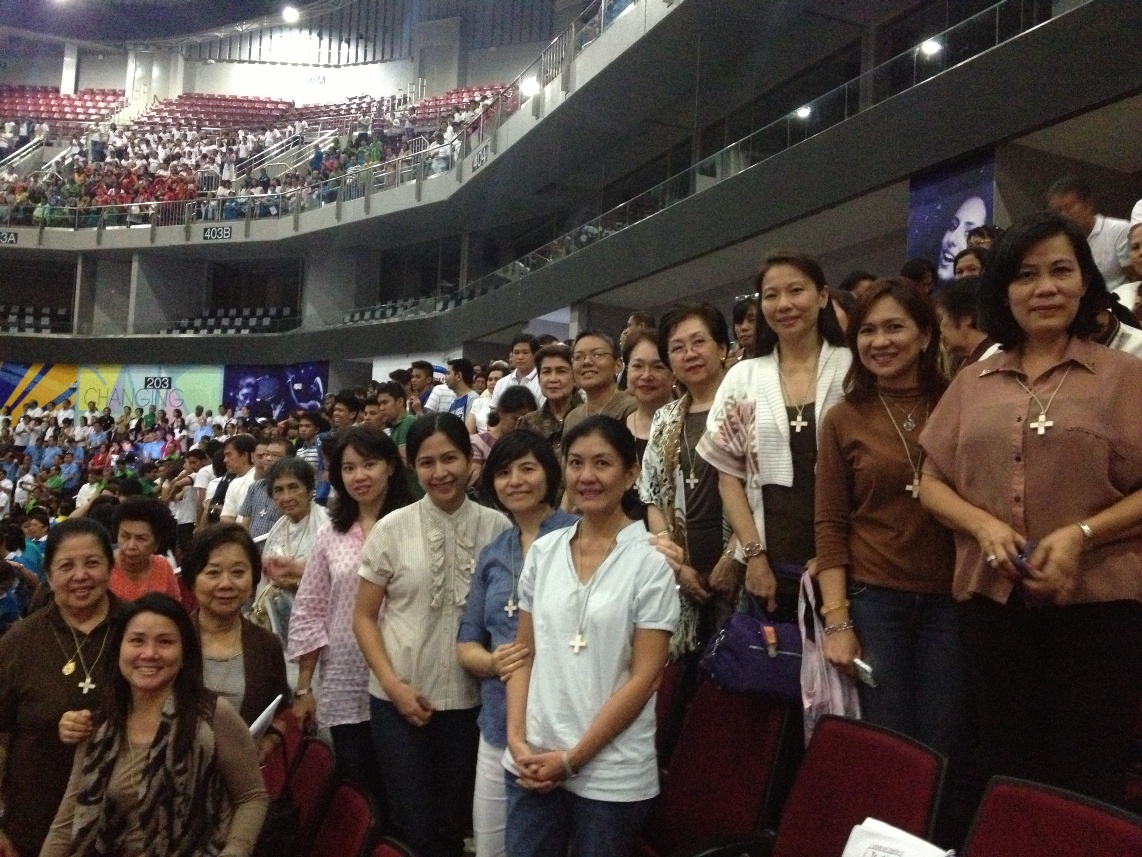
Dateline: SM Arena, May 18, 2013. Getting up with the pigeons was not easy but then eight thousand other sleepyheads did it to be at the liturgical Congress organized by the Archdiocese of Manila with the theme, Faith Celebrated and Lived.

There were three speakers:

His Eminence, Chito Cardinal Tagle began with a question: “What is a giveaway sign that you are growing old?” Answer: You always refer to the past as better than today. You love to retell your glorious past with comments like Mabuti pa noon or noong aming kabataan, etc. It was harking back at a life simple and serene.

Life indeed has become challenging and complicated especially for families plagued by migration and its harmful effects: Breakup of family depriving the children of parental care and guidance, loneliness, abuse, precious moments lost and guilt compensated by material goods.

However, if you peer past the gloom, there is a glimmer of light: Filipinos working overseas have unwittingly played a significant role in spreading and reviving the Catholic faith. Churches that were once closed have reopened and Filipinos have become a major influence for conversion and renewal of enthusiasm. It was proof that the Lord has not abandoned his children but has constantly opened opportunities to them. In an evolving world, the word of God has lost nothing of its value or brilliance.

While in the past, parents asserted their authority by skirting issues through an imperious stand – Basta! You obey – resulting in children complying but only out of fear or coercion, they grow up not fully convinced of their faith or religion. This too had to change. The youth must be inspired through a clear explanation of the teachings of Jesus that still resounds with the power: “Do not labor for the food which perishes, but for food which endures to eternal life.”

Reverend Father Genaro Diwa spoke of the reforms tackled by the Council of Vatican II held in Rome in 1962 during the papacy of Pope John XXIII. It addressed the relationship between the Roman Catholic Church and the modern world.

Time was when Holy Mass was celebrated in Latin. The priest had his back turned away from the faithful, driving home the point that he was the sole celebrant while everybody else was to remain passive and silent in their pews. Lay ministers were unheard of.

That was fifty years ago and Vatican II in the Sacrosanctum Concilium moved to change this through,

1) Active Participation of the Lay Community in the celebration of the Liturgy. It brought meaning and fulfillment below the pulpit as lay people were made to participate in the Liturgy making it relevant to their daily lives.

Active Participation is the gift of self – you are physically there! It becomes rooted in the expression of your interior faith, and its external manifestations.

But, how would this filter down to me? As a LecCom, when you stand in front of the community, make an effort to read audibly, clearly, and slowly, pausing if you must,so that the community hears, listens and is eventually moved by every word you read from God.

2) Use of the Vernacular Language. Latin was not the favored language. Other native tongues could equally express beauty in the worship of God. In fact, certain sentiments and feelings acquired a deeper meaning when spoken in the vernacular language.

Any language expressed in faith is heard by GOD.

3) In-Culturation. The diversity in forms and expressions from other culture and heritage also celebrate, worship and honor God. Their existence has been part of history and legacy, not something new or created only today.

H.E. the most Reverend Teodoro C. Bacani spoke on Faith and Liturgy drawing attention to the Mystery of Faith that we the faithful recite after the Offertory, Christ has died…has risen…will come again.

It is not a mystery because it is reality imbued with the presence of God. We believe because God revealed it and God being God always speaks the truth, never deceives, never lies. We therefore hold the word of God even if our reasoning is limited. We rely and put our trust in God. His word is indisputably true.

Every time we celebrate mass, our faith becomes the magnet that enables us to touch reality, a faith that enables us to accept for example, that the wafer and the wine have truly been transformed to the body and blood of Christ.

Obedience is part of faith. Whenever we pray, we extend an invitation to God to come into our lives in humble supplication, Tuloy po kayo Panginoon.

Although meditative prayer has its merits, there is value in connecting with our peers and our community through external manifestations, “The more we express our faith, the more it grows,” Bishop Bacani said.

He also enjoined all lay ministers to show(your faith), pray aloud, sing, praise,and burn with enthusiasm, including in the external act of paying forward, sharingand donating your blessings.

“Let us be responsible for one another because we believe that we belong to one family in Christ,” concluded Bishop Bacani.

To cap the Congress, Holy Mass was celebrated by H.E. Gaudencio Cardinal Rosales.His prayer rang loud for the Lord to increase our faith. Guide me, lead me, let my faith catch fire, deepen it, so that I may become a beacon of light to lead others to Christ.

photo(1)

published on June 2, 2013, Parish Bulletin. Other articles written by Letty>>>>>

Categories
Downloadable Forms Parish Bulletin

Protected: 2013 Parish Bulletins

This content is password-protected. To view it, please enter the password below.

Categories
Articles

60th Antioch Weekend

Last May 17-19 marked something pretty special: Antioch’s 60th Weekend – more than 30 years of “passing it on”. That’s 30 years of passing on unconditional love, understanding, peace, and the living of life anchored in our Catholic faith.

We welcomed into our ranks 30 young people from all over the city. Michael Tiong
, Renzo Ramos, Sam Sumulong, Jamie Santiago, Jules Santiago, Judd Sarao
, Jackie Ledesma, Migo Luis, Raisa Lorenzana, Celina Casas, Coco Oei, Raiyne Mangulabnan, David Dionisio, Paolo Cumagun, Zach Garcia, Mica Caunan, Kara Silva, Maia Villanueva, Kevin Kramer, Anina Caluag, Paolo Valmonte, Bea Limpo, Michelle Sarrosa, Suzie Agustin, Czai Esmani, Mhar Udarbe, Maine Gianan, Jen Tallada, Macmac Udarbe and JM Udarbe.

Shepherding them through the weekend were the members of Team A – the ones who gave talks, shared their lives, listened to them and welcomed them with open arms: Carla Gonzalez, 
Santi Ongsiako, 
Sandi Suplido, 
Leandro Banzon
, Iona Mapa, 
Zito Relova, 
Chrissie Domingo, 
Mico Macadaeg, 
Maria Cervero, 
Mig Mabanta, 
Paulina Ocampo
, Nicholas Gonzalez, 
Ellie Estrada, 
Zeno Pedrosa, 
Regina Galvez, 
Maui Uy. Prissy Relova
 and Carlo Aboboto helmed team A.

Behind the scenes, Team B handled all logistics, made sure people were well fed, and kept things clean and moving along – Rajie Guevara, Therese Valmonte, Aljohn Robles, Anna Orlina, Gab Estrada, JD Bacolod, Chino Garcia, and Cath Huang. Christine Tiu and Andy Teodoro helmed team B.

As always, the roller coasted ride that is an Antioch weekend had its share of challenges, but ultimately it is just another way for the youth of the parish to express themselves and to spread love and make change in their own little way –just as it has been for decades. We look forward to decades more of “passing it on.”

Categories
Articles Pastoral Team

“Trinity Sunday” by Fr. EJ

The fullness of redemption is to be found in the Spirit. The Spirit completes the mystery of creation and redemption, guiding us into “all truth”, bringing us all together.

After the cycle of Feasts celebrating the events and phases of Christ’s life among us, the liturgy moves into “ordinary time” But it passes through two transition Sundays: Trinity Sunday this week, and Corpus Christi next week. Ordinary time means living in “the sphere of God’s grace, where we now stand.” And it means gathering around the Eucharist to deepen our true identity, our relationship to the mystery of our redemption and to one another and the world.

What is clearly the formulated mystery of the Trinity is not found in the readings and this lack makes us wonder what the doctrine of the Trinity means and particularly what it means for us. What these readings convey is that it means for us a world transformed into a sphere of grace, the guidance of spirit of truth, and the providence of God’s own wisdom at all times.

The passage about wisdom in the book of Proverbs, is wisdom personified, a maternal figure. The text is at pain to tell us wisdom is at the source and patterns of creation. It is quoted with law of God (Torah) revealed to Israel. In Christian thought, it points to Jesus as the wisdom of God – Jesus is the same at the heart of all creation, accessible to all in the sphere of God’s grace.

In Paul’s thought (second reading) we are justified through faith brought into the realm of faith. This kind of wisdom and transforming love seems to be what Jesus promises to His disciples. In His farewell address Jesus signified to where the disciples are going. So we ask where do you find our orientation? And the answer is: the fullness of redemption is to be found in the Spirit. The Spirit completes the mystery of creation and redemption, guiding us into “all truth”, bringing us all together.

Although the scriptures do not give us a formulation of Trinitarian doctrine as such, the Scripture leads us to come to terms with the Paradox of God who is intimately known yet never comprehended, so intimately present, yet always transcendent. Such is our God, so profoundly mysterious yet dwells in our hearts – Tenere me ama!

Categories
Articles Pastoral Team

“Pentecost”, by Fr. Tasang

The Gift of the Spirit is Unity in the Midst of Differences and Diversities. The month of May is a month

The month of May is a month of festivities in many parts of the country. Last May 15, we had the famous tourist-drawing Pahiyas of Lukban, Quezon, with their colorful display of food and agricultural products in the facade of their houses. Neighboring towns that are located at the foot of Mount Banahaw have similar versions of this harvest festival. The month of May is a month of harvesting and it is the most opportune time for thanksgiving and festivities.

The feast of Pentecost is originally a feast of harvest, people thanking God for the abundance of his blessings. Later on, following the development of Jewish liturgy from the cosmic to the historic, this feast became rapidly the celebration of the deliverance from Egypt, particularly the Sinai covenant which took place fifty days after the Jews’ departure from Egypt. The Sinai now becomes the symbol of abundance of life as God considered them as his people.

Literally, the word Pentecost means fifty. Today is the fiftieth day after Easter and we celebrate the outpouring of the Spirit on the disciples. It is the fullness of God’s gifts, the abundance of God’s love. It is the beginning of the Church’s mission to the world, a harvest of people instead of agricultural produce. At its heart is the gift of the Spirit that created the Church and continued to move people to undertake the preaching of the word.

The gospel today is the same one that we read on Easter Sunday. It is an account of how Jesus gave his disciples the Holy Spirit wherein they were recreated. They in turn were sent to forgive sins. The word used is “ruah”, the same word the sacred scriptures used in the Genesis creation account. Christ in breathing on them reproduced the creative breath of the Genesis. As new creation, the disciples are empowered to preach the Good News of God’s mercy, the heart of which is the forgiveness of sins.

1. Today, the charismatic movements, especially in Metro Manila, have their annual gathering. They consider this feast as their feast day. It seems that they have also appropriated this feast as their own. Since most of us are not into the renewal/ charismatic movement, it makes us feel that we are not filled with the Spirit. There is a tendency to highlight the extraordinary manifestations of the Spirit, like gifts of tongues and gifts of healing, to the detriment of the far more numerous routine outpouring of the Spirit. There is a penchant for unabashed emotionalism, enthusiasm on prophetic trances and orgiastic frenzies. Sometimes our charismatic brothers/sisters can make us feel insecure if we don’t experience radical change in bodily temperature or what they call, “slain by the spirit” as if it is the sole mode of being Spirit-filled. The bottom line criterion for determining the authenticity of an alleged gift of the Spirit is whether it strengthens faith and the bond of unity.

2. The Spirit breathes where it wills. It is through the individual with his unique gifts that the Holy Spirit operates par excellence. Everybody has experienced his gentle urgings. Those moments in our lives when we are tempted to surpass ourselves, to do something bordering on the heroic, to reach and help out someone in trouble, to sacrifice our time and well-being for totally unselfish reasons, those are moments when we are spirit-inspired. In reality, those moments are rare and the number of times we yielded to those temptations is rarer still. Probably the real failures in our lives are not bad temptations we succumbed to, but the good we resist to do. We should give way to our generous impulses instead of pulling back at the last moment, thereby thwarting the promptings of the Spirit.

3. Most importantly, the gift of the Spirit is unity in the midst of
differences and diversities. The Acts of the Apostles implies that Pentecost is the reversal of the Tower of Babel. The biblical imagery of confusion, division and despair that reigned among the people is contrasted with the unifying gift of the Holy Spirit. With the descent of the Spirit, people of different races understood the disciples’ proclamation in their own language. Unity is not uniformity. We should see differences as enriching, not threatening the unity of the community. We should be able to harness, rather than alienate others with their various gifts, affirm and appreciate them but putting them into service for the common good.

Categories
Articles Pastoral Team

“Habilin” by Fr. Joel

“Repentance and forgiveness in his name would be proclaimed to all the nations. You shall be witnesses to this. I will send you what my Father promised. “(v.47-49)

After graduating from high school in Samar, I was determined to pursue my theological studies and readied myself to enter the diocesan seminary in our place. Since my Dad didn’t like me to pursue my dream as a priest, he encouraged me to enroll in a pre-law course in Manila. He was the one who accompanied me, making sure that I would not be going somewhere else. The night before we left, I very well remember my Mom telling me only one thing: “You will always be in my prayers. Let God do the rest for you!” This has always been my Mom’s reminder to me.

Ascension Day is a time given to the faithful to reflect on the very inspiration left by Jesus to his disciples. It is the best time of the year to reflect as well on the missions of our Church and the very inspiration attached to it – the role of the Scriptures or the words of Jesus, and the importance of worship in fulfilling the missions entrusted to us by Jesus.

What was the advice received by the disciples before he finally was ascended into heaven? “Repentance and forgiveness in his name would be proclaimed to all the nations. You shall be witnesses to this. I will send you what my Father promised. “(v.47-49) This is Jesus’ commissioning to his disciples urging them to go first to Jerusalem, and wait because because something would happen there. They followed him, and returned to the Temple in Jerusalem, the place of worship, their place of waiting.

Biblical scholars believe that the antecedent of “you” in the context of the gospel refers to either “the disciples”, “the Jewish community”, or to a broader community including ourselves. We are all encouraged not to be mere participants in a stage drama unfolding in our midst but to be active protagonists able to fulfill our roles.

Have you noticed the holy intent of Jesus? It is part of God’s plan that His intention will be completed and the divine strategy will work. This is the reason why one of the repeated themes in the context of this gospel is the understanding of the Messiah and His destiny. It is his valued mission that justicethat justice and peace may reign in humankind so much so that the Kingdom can be inaugurated. This started when they came to realize and recognize Jesus when he opened their hearts and minds about the many things he had told them, and the numerous advice he gave them.

The last part of the narrative tells us that instead of experiencing the so called “separation anxiety”, we are told that they experienced the joy of Jesus’ ascension. It was coming from the blessing given by Jesus himself (v.51). This moved them to worship him and He was their inspiration and the reason why they frequented the Temple, giving praises to God. It is in this context that we affirm the presence of God in the Holy Eucharist. We pattern our worship on this spiritual experience of the disciples. We sing hymns, recite our prayers as one community, expose the Word of God, share the holy inspiration of the Word, break and share the bread together because this was what our forefathers in faith had done. But while practicing all these, a faithful follower of Christ should not neglect the true value of being a good witness. And a good witness shows an evident presence of Christ in everything that he/she does. Likewise, a good missionary is one who possesses a virtue.

The way the mothers care for their children is one evident sign of being a true disciple of Jesus. Mama Mary championed this. Let us pray as we celebrate Mothers’ Day this Sunday, that we honor our mothers for showing us the way to become a true follower of Christ through their unblemished dedication and service to us. What is the best inheritance/advice or inspiration that we can keep in our hearts coming from our parents? It is no other than to witness the Gospel or Kingdom values that they have lived by and deeply nurtured in us. Let our lives be possessed by the same.

Categories
Articles Pastoral Team

“The Advocate Will Teach You Everything”, by Fr. Jesus

“Peace I leave with you; my peace I give to you. Not as the world gives (peace) do I give it to you.”

The Farewell Discourse of Jesus (John 13-17), to which today’s
gospel belongs, is his last will and testament, wherein he gives his
apostles precious pieces of advice in order to help them live without his physical presence, after his departure.

First, he tells them-and us too, how best to express their love for him: Not by long prayers or endless processions, rosaries, novenas and votive candles, but by “keeping my word, ” by doing his will. Love is shown in deeds, not in words. Nothing wrong, of course, with prayers, so long as they help us discern and do God’s will.

To anyone who keeps his word, Jesus promises: “My Father will love him, and we will come to him.” We tend to associate God’s presence with the temple. The temple is the house of God, his dwelling place. Some people travel to faraway places (Rome, Holy Land) to visit famous basilicas and shrines, hoping to experience God’s presence. Jesus tells us that God is not to be sought in faraway temples. We do not need to travel at all. God dwells within us. We are God’s temple-so long as we keep hisword. In the second reading, the book of Revelation tells us that in the new Jerusalem there is no temple, “for its temple is the Lord God and the Lamb.”

Then Jesus promises further to send the Advocate, the Holy Spirit, who “will teach you everything and remind you of all that I told you. ” The Holy Spirit will continue the work of Christ and will teach his disciples to apply the teachings of Jesus to new situations. We see this promise fulfilled in the Acts of the Apostles (read daily during the Easter season). And we will hear a lot more about the Holy Spirit in the coming days, as we approach the feast of Pentecost.

Some people wonder: “If the Holy Spirit teaches and explains everything, as Jesus says, how come he has allowed Christians to split into over 20,000 denominations?” The fault is not the Holy Spirit’s but ours. We have failed to understand that the Holy Spirit is with us, not just for our personal benefit but to build up the Christian community. In the first reading from the Book of Acts we hear how the Holy Spirit helped and guided the early Christian community in solving its first major crisis, namely, the acceptance of the Gentiles into the Church. Paul’s and Bamabas’ opinion ran counter to that of James, Peter and others in Jerusalem. All of
them probably thought that the Holy Spirit was on their side. However, they gathered together, and prayed and discerned together as a community. And the Holy Spirit did help them find a solution favorable to the whole community.

Lastly, Jesus bestows his peace to his disciples, and to us all: “Peace I leave with you; my peace I give to you.” Not power, not money (which are usually the primary sources of violence and war), but peace. These precious words of Jesus have become part of the communion rite. We repeat them at every Mass shortly before holy communion. Jesus, however, adds an important distinction: “Not as the world gives [peace] do I give it to you. What is the difference between the peace of the world and the peace that Jesus gives? The peace of the world is often imposed by force. It is silence imposed by the winner. It is compromise; it is un-involvement; it is playing safe. It is the passing joy of getting our wishes and our whims fulfilled.

The peace of Christ, on the other hand, is not imposed from outside; it comes from within us. It is the peace and joy we experience when we do or hold on to what is right, when we fulfill the will of the Father–even if it means persecution and suffering; when we sacrifice our personal comfort for the good of others. The peace of Christ is that sense of satisfaction we have when we spend our life at the service of God and of fellowmen.

Design a site like this with WordPress.com
Get started