Categories
Articles Pastoral Team Reflections

“Self-Idolatry And Humble Repentance” by Fr. Robert Manansala, OFM

“One achieves uprightness before God not by one’s activity but by a contrite and humble recognition of one’s own sinfulness.” – J. A. Fitzmeyer

The parable of the Pharisee and the tax collector is a story of divine reversal that challenges us to reexamine our value systems and the way we evaluate ourselves and other people. We find in it the two characters’ contrasting interior attitudes, external behaviors and their respective self evaluations.

On the one hand, the Pharisees were known for their strict religious observance. The man in the story is a model of Pharisaic practice. Religiously speaking, he is beyond reproach. Dianne Bergant says that he is perhaps accurate in his self-description and in his negative evaluation of the tax collector.

On the other hand, tax collectors were despised as traitors by the Jewish people for being part of the economic system put in place by the Roman occupiers. They were also considered corrupt for often helping themselves with their tax collections. It is significant to note that the tax collector in the parable does not deny his involvement in such common practices. In fact, his prayer for mercy can be interpreted as an admission of his culpability.

The contrast in the internal disposition of the tax collector and the Pharisee is also very evident in their respective demeanor. The tax collector stands at a distance while the Pharisee may either be standing in front or in the midst of those in the Temple. He does not raise his eyes to heaven while the Pharisee easily does this. He beats his breast while the Pharisee’s arms are highly outstretched to the heaven. His demeanor is that of a repentant sinner while that of the Pharisee shows exaggerated self-confidence and even self-righteousness.

The two characters of the parable, according to Bergant, have described themselves correctly. However, the surprise in the development of the parable is when Jesus’ evaluation turns the story upside down. The Pharisee’s self-assessment is really a self-eulogy. Some commentators say that he is actually praying to himself and not to God. While he may be living an upright life, he takes credit for this and claims superiority over others by comparing himself with the tax collector. He is making himself justified before the Lord. The repentant tax collector, on the other hand, acknowledges that justification comes only from God. He prays that his sins be forgiven and his prayer is answered. The Pharisee does not need God for anything. He is sufficient by himself and so he receives nothing from God.

According to Patricia Datchuck Sanchez, Jesus’ parable, which is directed toward “those who believed in their self-righteousness,” returns the prerogative of judgment to God. By judging himself and others, the Pharisee is not only doing self-eulogy; he is also guilty of some sort of self-idolatry. J. A. Fitzmeyer says that “one achieves uprightness before God not by one’s activity but by a contrite and humble recognition of one’s own sinfulness.” Between the two characters in the story, it is the tax collector who has been given such righteousness before God. Sanchez is definitely correct in saying that “forgiveness, reconciliation and redemption are gifts from God that only the humble will recognize and only the needy will receive.”

as published on October 27, 2013, Parish Bulletin
About Fr. Robert and his reflections

Categories
Articles Pastoral Team Reflections

“Persistence in Prayer” by Fr. Baltazar Obico, OFM

The efficacy of our prayer does not come from its form. What matters is the faith that accompanies the forms of prayer; the filial trust and confidence that we are children of God who is a Father.

In this age of charismatic renewal in the Church, a new prayer form has emerged. It is spontaneous, scriptural, accompanied by bodily gestures, raising and waving and clapping of hands. Some are hip-swaying, feet-thumping in joyful singing. Compare it to the traditional forms of prayer. It is ready made, usually read if not memorized already. It has minimal bodily gestures and movements. It is also repetitive that can lead to mindlessness. When this charismatic form of prayer was first introduced, not quite a few were turned off as they found that this movement, like dancing, borders on the disrespectful as we are used to minimal movement and herefore expect the church to be a place of quiet. On the other hand, some charismatics would frown and do away with the traditional form of prayer. Which is a more efficacious form of prayer, singing praises and thanking or the intercessory prayer of pleas and pleading?

Readings

This Sunday’s liturgical reading converges on the theme of prayer, and persistence on it and equates it with faith. Moses, sitting on the mountain with hands uplifted, while people fight in the plains below, has become a symbol of the necessity of prayer and its efficacy. (Ex. 17: 8 – 13). It illustrates that combatants as heralds of the apostolate, need, in order to emerge victorious, the prayer of the “contemplatives” who wear themselves out by praying without rest on the mountain. In the Gospel today, Luke made a surprising start by opening the Gospel account with the meaning of the parable which is the need for prayer and not to lose heart. Understood in this way, the parable of the unjust judge or the persistent widow teaches the necessity of prayer without ceasing even when the Lord seems slow to coming and deaf to our pleas. If an unjust judge finally gives the widow her due, how much more will not God, who is a Father, give justice to his elect. The lesson is that God gives justice promptly out after a long delay. Christians then in prayer must allow for the delay which God demands. They will pray “without intermission.” No longer is Christian prayer an appeal for immediate intervention. It accepts the patience of God.

Word

For a strong faith we need a strong prayer life. Our readings suggest there are things that may weigh heavily on our prayer life. We sometimes become tired and weary like Moses. Some call that spiritual burnout. It needs great effort and discipline to pray regularly. When Moses became tired, others came to support him. Do we appreciate the fact that we are supported by others? Not only do we pray for others, but others are praying for us at this moment. It is crucial not to overlook that. We are not spiritual castaways trying to survive on our own. We belong to the church, a community of faith, to support, give and transfer strength to one another. Know that someone, somebody, if not the whole community is praying for and with you.

The efficacy of our prayer does not come from its form. Whether it is a praising and singing hymn or pleading for God’s intercession. There is room for both, or any form of prayer. What matters is the faith that accompanies the forms of prayer; the filial trust and confidence that we are children of God who is a Father. If an unjust judge would relent, how much more would God, being a Father, deny us what we need. The work of intercession, praying for others is a powerful work of faith. Through it, we can touch the lives of others, the lives of our leaders, friends and people many miles part. Sometimes our form of prayer seems to be in a rut, and we need a spiritual jump-start; that is the time to turn to the Sacred Scripture. Paul today reminds us all that Sacred Scripture is inspired and useful for teaching and training. Let the word of God enliven our prayer, opening up new avenues to the Lord. There is room for both spiritual and traditional forms of prayer.

Finally, sometimes we simply become frustrated. We pray but the word doesn’t seem to change; at least not as quickly as we would want. We can became discouraged and lose our confidence in God. Our prayer does not consist in expecting God to accomplish what we ourselves fail to accomplish; give us peace; stop corruption. God is not a stop-gap. Prayer is basically a protest because war triumphs over peace, injustice over justice, evil over good. It is an entry into communion with the God of patience. In such communion the cries of protest are gradually translated into action. The perseverance asks of us is not only in praying to God, but in cooperating with Him to establish the justice we long for.

as published on October 20, 2013 Parish Bulletin
About Fr. Tasang and his other reflections

Categories
Articles Pastoral Team Reflections

“Faith: The Key to a Real Thanksgiving”, by Fr. Joel Sulse, OFM

St. Paul in his letter to Timothy tells us that God will never deny us, and He remains faithful no matter how unfaithful we are as human persons. Therefore, let it be an encouragement for all of us on how we can follow the spirit of God.

“Where are the other nine? Has none but this foreigner returned to give thanks to God? Then he said to him, “Stand up and go; your faith has saved you!” (v.18-19) I always remember this text because it reminds me of one of the advices I often received from my parents:” Be thankful to God for whatever may come along your way…” Thinking of he same advice as I was growing up, it dawned on me that it has a deeper meaning which I was not aware of. But finally making the same as my mantra, I discovered that the advice my parents told me is to “put my full trust and faith in God in everything I do and live.” I believe that the spirit hidden behind this is the faith that Jesus is reminding us of in our gospel text: “Stand up and go. Your faith has saved you!”

For years, I have kept the same in my heart. Even in moments of personal difficulties and trials, I always thank God for the same. It may seem abnormal but it makes me feel lighter anyway. And it helped me a lot actually. I always remember the words of Scott Peck about delaying gratification. I believe that it is the faith that we put into something that makes us become more patient in life. It helps us recognize the real value of self-giving, and the authentic value of Christian sacrifice.

Looking deeply into the spirit of the text, one can find that it is not only about good breeding. It is not only about sending “thank you notes” as one writer suffices. It is more than showing one’s gratitude for a favor given. True, the texts have very rich themes and they provide rich tones of conversion as well. Previous to this narrative is the reminder of Jesus to his disciples not to be a stumbling block to others, and to forgive repentant persons as many times as possible. When they asked Him to “increase their faith”, he advised them to learn from the mustard seed. The point here is, Jesus has offered to them as a model the Samaritan leper, a foreigner, one who doesn’t belong to the Jewish circle. The leper was singled out by Jesus for commendation because he went beyond his physical healing. He went back to Jesus because the leper knew very well that without Jesus’ divine power, he cannot be healed. The beautiful part in this scene however is the humanized divine spirit coming from Jesus himself which was given as a gift but affirmed to be coming from within the person- “YOUR FAITH HAS SAVED YOU!”

The dramatic healing that transpired reminds us of our capacity as human beings to become healers ourselves. When we deviate therefore from this scenario, we allow ourselves to be released or imprisoned from the possible divine nature that is in us. Again, we have to remind ourselves that we have been created in God’s image and likeness. And this scenario of the story between Jesus and the healed leper is a timeless challenge on how we can maintain a spiritual composure in accord to God’s divine will and nature. So let us be possessed therefore by this beautiful “spiritual keepsake” coming from Jesus himself.

The presence of the nine lepers in the gospel may not be an issue about the “Jewishness” of Jesus’ question having singled out the Samaritan leper. It is about the absence or lack of gratitude to God, and their failure to praise Him. Which camp do we belong to? We are reminded that we who received healing from God should follow the ways of the faithful leper. If we believe that we have been restored to the very image of Christ, we should therefore go back to God consistently, and keep the faith that He has gratuitously given us. Through this faith, we can open more possibilities in enveloping our world with that “deep gratitude” coming from God.

Our first reading tells us of the story of the gratitude Naaman gave back to God. He acknowledged Him as the one who healed him from his leprosy. Of course, he was very thankful to Elisha for the instructions given him on how he can be healed. He was thankful also to Elisha. But both of them gave back to God their complete gratitude. The responsibility on how we can give back our deep gratitude to God lies on the faith that He has given us. St. Paul in his letter to Timothy tells us that God will never deny us, and He remains faithful no matter how unfaithful we are as human persons. Therefore, let it be an encouragement for all of us on how we can follow the spirit of God. The alleluia verse summarized it: “In all circumstances, give thanks, for this is the will of God for you in Christ Jesus.”

As we celebrate Indigenous Peoples’ Sunday, I was reminded by my experience with the Agtas in Aurora. One time we were hiking with them going to their village. On our way, we experienced hunger. We passed by a guava tree bowing to the grounds with ripe fruits. We were so excited to pick the fruits with our mouths juicing with excitement. Suddenly, the tribal leader told us: “Ay bago magpitas, tayo ay magpasalamat kay Makidyapet!” (Before we pick the fruits, let us offer our thanksgiving to Makidyapet (their God and our God too)!” We were all dumbfounded!

as published on October 13, 2013, Parish Bulletin
About Fr. Joel and his reflections

Categories
Articles

“Francisfest 2013: Music of the Heart, Grateful and True” by Letty Jacinto-Lopez‏

The heavy, massive doors were flung open and I stepped inside a chamber with billowing smoke gathering under my heels. Tina Teehankee broke my gaze, “Letty, do you know where you are seated?” Standing a few steps away, Randy Limjoco, chairman of Francisfest 2013, greeted each parishioner who came to watch the show. When I looked up, the high ceiling reflected a soft glow.

“I’m seated at the 13th pew, from the main altar,” texted my husband. The rest of the pews were filling up. Barbara Go and Tessie Luz sat in front of us while Marilou Senn sat a few rows away. When parish priest, Father Joel Sulse, stood by the steps of the main altar, everyone rose and bowed in silence, “Thank you Lord for gathering us tonight to celebrate the many blessings you have bestowed on Santuario and our community,” he prayed.

The main altar was the focal point of the entire production. The set designer made good use of its beautiful and imposing structure which was very appropriate to bring alive the saga of St. Francis of Assisi.

Franco Laurel begun, “A young Giovanni nicknamed Francesco by his father, (a wealthy silk merchant), searched for conversion in San Damiano, an ancient church near Assisi. Francesco saw the figure of Christ crucified come alive, saying to him, ‘Francis, don’t you see my house is crumbling apart? Go, then, and restore it!’” (Saint Francis took action to repair San Damiano although he eventually realized that God’s message to him was to restore the Church as a whole rather than literally repair churches.)

That was the cue. Coro de San Antonio together with the OFM Friars and OLAS Seminarians appeared from different parts of the stage and formed a two-tier lineup. They sang with voices, smooth and flowing. “Come build my Church, give stones and mortars, tell of His mercy, sing of His love”. To compliment this song, Nonon Baang sang “Corner of the Sky” from the Broadway musical, Pippin.

Aside: There is a hip-hop, rap version of this song, conceived by young Franciscans, with a simple query, “Sino ba si Kiko bago nagbago?” (Who was Francis or Kiko before his conversion?)

Santuario de San Antonio was completed in 1953 to replace the one destroyed in 1945 in the walled city of Intramuros. “So, in a continuing sort of way, Santuario was likewise built by St. Francis himself,” said Franco Laurel.

Coro soloist, Renabel Baquero and Santuario’s own singing sensation, Edmund Lim, sang “At the Beginning” with support narrations from the Youth of San Antonio – Leandro, Arianna, Josh, Mitzie and Christopher.

The Youth lit the stage in their black and red outfits. When they sang in perfect harmony, Beautiful City and Seasons of Love, the long practices and late hours paid off handsomely. The 2nd song was from the musical, Rent, a runaway favorite with the younger set, “Five hundred twenty five thousand six hundred minutes, measure your life in love.”

To introduce the construction phase of Santuario de San Antonio, another young music scholar, Gaby Vasquez, took center stage. Gaby sang “One Voice” about the power of one and its rippling effect.

She was followed by the elegantly dressed group of the Vocalismo who enthralled the audience with their version of “Total Praise” and “This is the Moment” from the musical, Jekyll and Hyde. I fell in love with this song on Broadway and still am. The Vocalismo revived that sweetest, greatest moment of them all.

There was a throwback scene on the first parish priest, Father Hugh Zurat, and we listened to the anecdotes shared by Menchu Bautista and other members of her family who recalled how Father Hugh inspired churchgoers with his humble and truthful demeanor. One time, he knelt before the altar and made a public confession. He showed strength of character yet greatness in humility that many of us have aspired for. That period was also the time when relationships formed and slowly, Santuario turned into something more than a parish; it blossomed into a family.

Cocoy Laurel sang the Prayer of St. Francis, baring a heart moved with deep emotion, a fitting reminder to live in charity and compassion. George Yang, tenor, in his distinct and crystal-clear range, sang poignantly “I Dreamed a Dream” from Les Miserables while Koro Ilustrado made their appearance singing “Ave Maristella”, alluding to the loving and gentle presence of Mama Mary in our lives.

Before anyone could yield to sweet nostalgia, the Health Care Ministry’s Danzercise group filled the stage in a blazing outburst of red as they moved to the rhythm and beat of “We are Family”. It prompted the audience to hail and clap, if not tap their feet, in time. These big-hearted ladies call themselves the Young Once but they showed off their cache of vim, verve and vitality to keep the young ones on their toes if not running, to keep pace.

The Coro de San Antonio sang the double medley of “I Believe and Ave Maria”, a favorite arrangement that never fails to move the heart every time it was sang during Easter vigils. The original song “Nanay” sang tenderly by the Filipino Tenors produced a dewy-eyed response from the audience touched by motherly, nurturing love.

Scene 14 focused on the WESTY principle that described the works of the respective ministries in San Antonio: Worship, Education, SocialService, Temporality (Finance) and Youth. This part of the program brought to the fore the full performing energy of the Laurel Family represented by David and Ruby, Susie, Lynnie, Denise and Cocoy. Their upbeat and infectious song-and-dance routine of “Jesus, you are so good” reminded the audience of the unrelenting love and kindness of Christ that bring sunshine even through overcast moments.

I clapped with delight when I saw the familiar faces of our pastoral presidents who consistently dedicated a great part of their time and effort for Santuario. From Patrocino Dayrit to Imelda Cojuangco through to Mike Limpe. The various chairmen of Francisfest through the years were also flashed on the church dome, a lovely beam of light on generous and staunch supporters, from Petrona Lim, Joey Soriano, through to Ruthy Vera, etc.

A tribute to the departed Franciscan priests who served the parish followed. As the images of Franciscan Father Urban, Father David, Father Ike and Father Jerome flooded the church dome, a collective prayer of thanks was raised paying homage to these dedicated stewards of San Antonio.

What followed next summed up what the parish aims to achieve: To be a continuing, encouraging presence in the lives of the Christian community. Tina Teehankee, JJ Yulo, Micki Poe, Betty Roxas-Chua, Carina Lebron and Edmund Lim, representing the various ministries, reiterated this commitment that Soprano Reynabel Baquero lifted in a song, “Your Heart Today”.

The penultimate number gathered Coro de San Antonio – resplendent in shimmering gold, Vocalismo – in deep, royal and powder blue, Koro Ilustrado – garbed in a cool pink and lime green barong, the Youth of San Antonio-vibrant in red and black and the OLAS Seminarians – in earth brown tones, singing “Umagang kay Ganda”. Indeed, a promise of many more sun-filled tomorrows as beautiful as the next. Did anyone spot Father Joel Sulse in this power-packed assembly of songbirds?

When I checked the program and realized that we were in the Finalé, the lineup was packed with voices supreme. It came as a surprise to hear Franco Laurel announce that the new song composed by Joe Mari Chan will be sang by his better version, Jose Antonio. The young Jose Antonio didn’t disappoint. He carried the song in wings of the nightingale, moving the heart to accept Pax et Bonum in its maiden performance. Peace and all that is Good be with you. Composer, Joe Mari, stood up to acknowledge the shouts of cheer of an ecstatic audience.

“Smooth and perfect synchronization,” whispered my husband when he realized that two hours had passed effortlessly.

This astounding production would not have been made possible without the staff and crew who worked behind the curtains led by the writer and director, Joel Trinidad and the music director Onyl Torres. I spotted Onyl leading the musical ensemble in the Finale, standing in front of the video camera, but obscured by the shadows. I didn’t see Director Joel. He must have worn an invisible cloak because despite his absence (blame my dwindling eyesight), everything ran like clockwork – a sign that it was a well-thought out, well-mounted and well-put on performance. Clearly, a swelling of swell(s).

Joel, won’t you tell me how you conceived of the luminaire-illumination that captured the brilliance of the night in a symmetrical or asymmetrical way? The spectacle of music bathe in a spectrum of colors was simply entrancing.

It got me wondering why we never made use of the church dome as another medium to honor and celebrate the glory of God…until now?

To all who made Francisfest 2013 a five hundred twenty five thousand six hundred measure of a work filled with love. Maraming salamat po.

About Letty Jacinto-Lopez and some of her published articles

Categories
Articles Ministries

THEY CAME, YOU GAVE!

In the months of May and June this year, we appealed to you, our parishioners and friends, to once again support the Santuario de San Antonio JPIC Scholarship Program by sponsoring young college applicants who successfully passed our intensive screening interviews.Through the Parish Bulletin, we individually presented the profiles of our new scholars, as well as our continuing college scholars from past years.

Our prayers to our dear Lord and St. Anthony were heard for your response was overwhelming! THEY CAME and YOU GAVE! Thank you from the bottom of our hearts for your kindness and generosity, for reaching out to so many needy but deserving youth who come to our parish for help to finish their studies in college. Because of you, their dreams for a better tomorrow for themselves and for their families are becoming a reality.

With great pride and joy, and because of your support, we have again grown in numbers. The SSAP JPIC Scholarship Program for 2013-2014 has a total of 83 scholars – 25 in college, supported by your generous donations, and 58 taking vocational and technical courses, supported by the parish from funds raised during Francisfest every year. To all our benefactors – big, medium and small – our heartfelt THANK YOU!

By Millette T. Ocampo/Menchu O. Bautista
SSAP JPIC Scholarship Program Committee

Categories
Articles Pastoral Team Reflections

“We have done no more than our duty”, Fr. Efren Jimenez, OFM

The person of faith becomes so much part of the world of God that even God is one of the family, a person whom one can address in perfect familiarity, even to the point of complaining. In faith, this is the expected, the ordinary, and the “natural.”

One of the fascinating characteristics of the scriptures is the constancy with which they come up with provocative statements. The reader, on reflection, has to ask hard questions. Is this really what God is saying? Howcan He allow the inspired author to make that statement? How can I possibly make this a part of my own life?

We have especially good examples of provocative statements in our first and third readings for this Sunday. The second reading contains a more sober observation that can serve as a summary response to the other two.

The prophet Habakkuk lived at a precarious time in Judah’s history. The mighty Assyrian empire had collapsed before the Babylonians in 609 B.C. and a new enemy had arisen to threaten God’s desperate people (the “Chaldea” of 1:6 refers to Babylon). The prophet was writing at a time when this threat loomed large. The first part of the reading reflects his anguish.

What is most provocative in these verses is the manner in which the prophet challenges God. “How long, O Lord? I cry for help but you do not listen!” Our traditional notion of piety would hardly recommend this kind of prayer. But there it is in the sacred scriptures, an accusation against God!

We do find examples of this kind of human questioning of divine wisdom in other books of the Bible. The most notable, of course, is the Book of Job, where the human protagonist challenges God to appear in a court of law with him. As far as we know, Habakkuk was the first to utter words of this kind to the God of Israel.

The saying about the power of faith is clearly provocative. While Jesus does not expect us to go around commanding sycamore trees to drown themselves in the ocean, one has to admit that it is a striking illustration.

Even more provocative but in a subtler way, is the parable about the servants. They are expected to go about their ordinary tasks in an unostentatious way. They are not to expect a handsome reward every time they pour their master a cup of coffee. Jesus’ disciples are to serve him in the same way: “We have done no more than our duty.”

This is provocative because, in a sense, serving Jesus is quite extraordinary. The total dedication to him, the acceptance of the cross, the serving of others in his name – these have always caught the attention of the world. How can they be said to be no more than duty?

The answer is faith. When one makes that total surrender to the Lord, the all else follows “naturally”. The extraordinary becomes ordinary. The unexpected becomes the completely expected. Saying “of course” to the difficult is the mark of the Christian disciple, the person of faith. Thus the joining of the saying of faith’s power to the parable of the servant-disciples is no accident.

The same explanation applies to the first reading. The person of faith becomes so much part of the world of God that even God is one of the family, a person whom one can address in perfect familiarity, even to the point of complaining. In faith, this is the expected, the ordinary, and the “natural.”

The Pauline author of the second reading had this kind of faith in mind when he tells Timothy to “stir into flame the gift of God…” We are to recognize our rich heritage whereby we can address God as our Father in a familiar way and can serve Jesus as easily and as readily as children of light.

as published on October 6, 2013 Parish Bulletin
About Fr. EJ and his Reflections

Categories
Articles Hospital Ministry

PGH Artist Awarding of Prizes

The winners of our September PGH Artist contest, where they depicted “Mama Mary in My Life” as a way to honor Mama Mary during her birth month, were Judellen Naparate and Rhia Marie Ruiz, elementary students of Silahis ng Kalusugan, and Jenny Contreras and Sherllan Mamiit, patients from the pedia wards. Unfortunately, Judellen was absent from school since she hasn’t been feeling well. Sherllan was also unavailable as they live in San Pablo, Laguna and it would have been a long commute for them just to get their prize. A parent representative received the prize for Judellen while we sent the prize to Jenny and her family.

Rhia and Jenny were very excited to receive their prizes as it included: 2 tickets to Kinder Zoo in Manila Zoo (which would allow them to go up close and pet the animals and join the activities) and 2 burger meals with fries and unlimited drinks to Wham Burger in Robinsons Place.

Though a simple prize, they are looking forward to enjoying it together and doing it as a family activity. It’s always very heartwarming to see how much joy you can give to them just by simple gestures like these and which they are very thankful and appreciative of.

Thank you to all the patients and students who took part in this activity/contest. We loved all your works and it was very hard to have to choose winners among you.

Thanks, as well, to all of you who helped in choosing our winners by voting/liking the pictures of the artworks.

Looking forward to seeing pictures of their Kinder Zoo trip! 🙂

Categories
Articles Health Care Ministry

HCM holds Seminar on Stem Cell Therapy in Retinal Diseases and Age-related Eyes Diseases

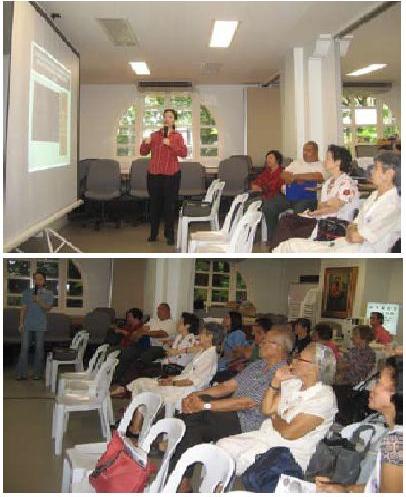
HCMThe Health Care Ministry held a half-day seminar on Stem Cell Therapy in Retinal Diseases and Agerelated Eyes Diseases with free eye check-up and cataract screening for all attendees last Sept. 21 at the St. Bonaventure Room from 8:30 to 12:00 noon. The Pacific Eye and Laser Institute sent their 11-man team, including two of their top eye specialists, Dr.Pik Sha Chan-Uy, MD, who is the first graduate of the Pediatrics and Strabismus Program from the MEE Infirmary of the Harvard Medical School, and Dr. Franz Marie O. Cruz, MD, the first Filipina to finish the Neuro-Ophthalmology Program from the Wilmer Eye Institute of the Johns Hopkins Hospital.

They shared valuable information on Glaucoma , Cataract and other eye diseases, their prevention and mitigation and other topics related to eye care. They also gave away free pouch bags with eye drops from Alcon Laboratories, Inc.

By Chuchi Quevedo

Categories
Articles

“Building at Sixty”, by Letty Jacinto-Lopez

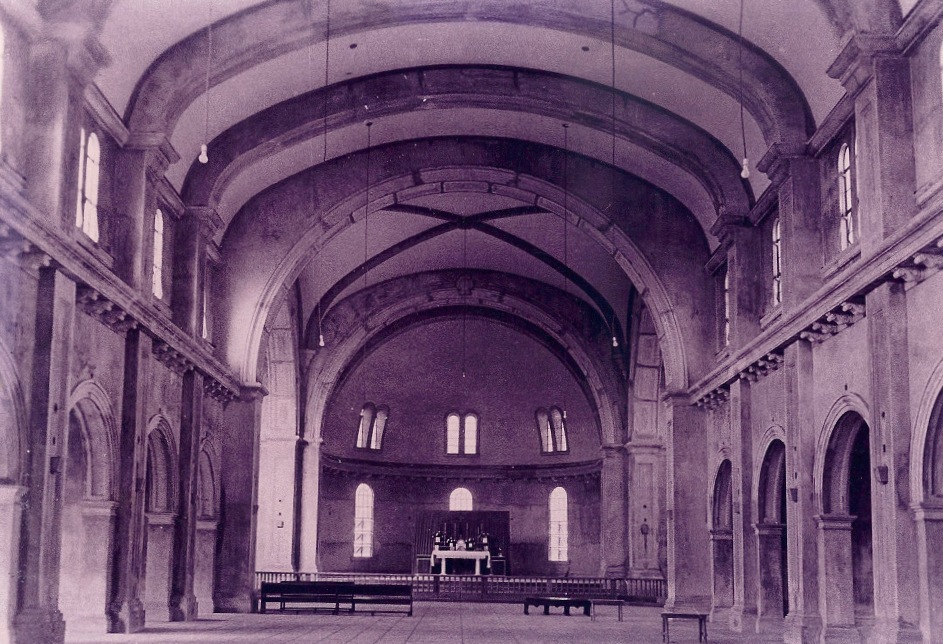
In 1951, on the far, distant side of a flourishing, booming town, a flurry of activities was reaching fever pitch. A family of landowners was laying down the cornerstone of what would become a place of worship to answer the spiritual needs and concerns of a new, emerging community. The family came from the clan of the Ayala/Zobel/McMicking and the church was Santuario de San Antonio in Forbes Park, Makati, an affluent district of the Province of Rizal.Historical Cache in the Time Capsule
In 1951, I was five years old, three years short of receiving the sacrament of Holy Communion and oblivious to the cares of the grown-ups and definitely unmindful of its exalted dreams and goals. Who would ever think that my tiny world would merge with this bigger world, sharing common values that organized religion provides?
Archive Photo of Santuario de San Antonio Church
Santuario de San Antonio has always been that hallowed place of worship for Catholics. I grew up looking at this revered structure, as a special place to celebrate life’s significant events and milestones like the holy sacraments and of course every girl’s wishful dream of walking down the aisle as a blushing bride.

When our family relocated to Makati, we were welcomed into the family of Santuario de San Antonio as brothers and sisters, linked and related spiritually.

Similarly for Jeannie Bitanga. The settling period however became quite challenging for her after having lived abroad. She went from questioning and doubting her faith to strengthening, nurturing and growing it. Jeannie, encouraged by what she saw in the parish, took the initiative to re-learn her Catholic beliefs by reading the Bible and teaching Catechism to young children, one of the outreach ministries available in San Antonio.

“It was a breakthrough,” Jeannie said. Soon, her husband, Doy, joined the Men of the Sacred Heart, where its members promote devotion to the Sacred Heart of Jesus as well as serving as a lay minister of the Holy Eucharist. Jeannie’s participation in San Antonio’s various ministries expanded when the President of the Parish Council, Mike Limpe, asked her to create and manage a website and make it accessible to the public. Something vital in this age of Internet connection for the church to remain relevant keeping up with the technical development and progress of the times.

“My husband and I have, grown spiritually since those days of uncertainty. Santuario de San Antonio made us realize we had untapped potentials,” she remarked. “It was heart-warming to be welcomed in the family of Christ and meet some of the funniest and most dedicated people around the neighborhood.”

For Tina Teehankee, a secular Franciscan, she views life as a journey with its ups and downs. “With God’s grace and guidance, I find comfort in trusting in His grand plan, whether as a servant or as His child.” Parishioners with Tina Teehankee

Sadly, there are those who have relegated the role of the church in their lives as a minor concern, the last in the overall scheme of things, so to speak. I was therefore struck by a prayer that the faithful read in one Sunday service celebrated by our parish priest, Father Joel Sulse: “May no one among us feel so superior as to exclude others or feel so inadequate as not to contribute anything. Instead, may we be mutually enriched by one another”.

The lay community has a crucial importance in fulfilling the mission of the church. While there are many anonymous and faceless volunteers who work hard – silently – preparing each day to celebrate the Liturgy of the Eucharist, there are those who have bravely taken up the cudgels to keep things rolling and rolling. All in answer to God’s call to “Build My Church”.

The mission of the Franciscan Order has made an impact on the lives of the faithful (and the least, the last and the lost) because ordinary people devoted their time, energy, talents and material resources to reach out beyond their boundaries.

Among them,

The Prison Ministry headed by Steve Lopez, who visit the inmates at the Makati City Jail and host regular activities like sports, dance and medical clinics as well as reflective and meditative invocations to give hope and renew the faith of those who were lost and are journeying towards reconciliation, spiritually and socially.

The Scholarship Ministry where indigent or low-income students with great potentials are sponsored giving them the opportunity to excel in fields of learning and thus complete and graduate and have a better chance of making it into the world as an auto mechanic, in the Food and Beverage industry, in shipbuilding, care giving, and others.

The Hospital Ministry with Father Jesus Galindo as hospital chaplain, who visit those confined in hospitals attending to their spiritual, medical, physiological and emotional wellbeing.

The Marian Cenacle and Contemplative Ministries focus on the reach of the third degree of mercy – prayer. It is said that if one cannot show mercy by deeds or words, one can always do so by prayer. Prayer reaches out even there where one cannot reach out physically.

The Music Ministry with Amelita Guevarra. Voices are lifted through song and music engulfing the heart and spirit in a deep and fervent melodious worship to God.

The Catholic Women’s League headed by Betty Roxas-Chua, who sponsors mass baptism, holy communion and wedding every year apart from charitable projects that benefit the deprived and downtrodden.

Advocacies and ministries are in constant need of moral and financial support in order to function, and function well. Every year, Santuario de San Antonio honors the patron saint, San Antonio de Padova with a feast as well as raises funds to support and maintain the various ministries, including the Franciscan Mission.
Randy Limjoco, Fr. Joel, Lita Ascalon
In celebration of the 60th anniversary of the founding of Santuario de San Antonio in 1951, this year’s Francisfest will mount a musical variety show that chronicles Santuario de San Antonio’s evolution as a dynamic and spiritual center. Performers will come from the ranks of our talented parishioners, their family and friends like Joe Mari Chan, and artists on stage and cinema like Cocoy Laurel, Joel Trinidad, etc. Randy Limjoco, this year’s Chairman, promises an evening of entertainment and delight to be held in the main church on Thursday, October 3, 2013 at 8:00 p.m.
1005377_10201479009237679_1445458697_n
Recently, I attended a mass celebrated by Father Jade Licuanan. He spoke about Cardinal Gaudencio Rosales and his Theology of crumbs. Succinctly, “All God wants is small things. Small things put together can start up a miracle. The issue is the love for the poor. Goodness is never complicated.”

I kept repeating Cardinal Rosales’ theology as I left the church. Indeed, Love can be a way of life and not just a one-shot thing.

Francisfest has taken this noble cause to heart. “May the Church and her leaders strive for humble service and simplicity rather than for power, influence and wealth.”

Remember, we leave this world empty-handed.

Let us support Francisfest, heartily and magnanimously, hand in hand and brick by brick.

_______________

For info and tickets and/or donations to Francisfest 2013, please contact the Parish Office (63-2) 843-8830 to 31 or email ssap_info@yahoo.com.

*************

as published on September 29, 2013 The Philippine Star Sunday Magazine
About Letty Jacinto-Lopez and some of her published Articles

Categories
Articles Pastoral Team Reflections

“Make Friends with Dishonest Wealth” by Fr. Jesus Galindo

Make friends with those who, when one day you find yourself in trouble, that is, before God’s throne of justice, will defend and welcome you. These friends, we know, are the poor.

This Sunday’s Gospel presents us with a parable that in some respects has important contemporary relevance: the parable of the dishonest steward. The central character of the parable is the farm manager of a landowner, a well-known figure in our countryside when the sharecropping system was still in existence. Like all good parables, this one is like a miniature play, full of movement and scene changes. The actors in the first scene are the steward and the master and the scene ends with the master firing the steward: “You can no longer be my steward.” The steward does not even try to defend himself. He knows that he is guilty of what the master has discovered.

The second scene is a soliloquy of the steward, who is now alone. He has not yet accepted defeat. He immediately thinks about what he can do to get himself out of this situation and save his future.

The third scene — steward and tenant farmers — reveals to us the plan that the steward has devised. He asks the tenants, “How much do you owe?” “One hundred measures of wheat,” is one reply. “Here is your promissory note,” he says, “take it and write down eighty.” A classic case of corruption and falsehood that makes us think of similar situations in our own society, often on a much larger scale.

The conclusion may seem disconcerting: “The master praised the dishonest steward for acting prudently.” It is the master, not Jesus, who praises the steward’s shrewdness. We need to recall the particular nature of teaching in parables. The moral doctrine that is aimed at is not in the parable taken as a whole, in every detail, but only in that aspect of the parable that the narrator wishes to pick out. And the idea that Jesus intended to bring out with this parable is clear. The master praises the steward for his resourcefulness and for nothing else. It is not said that the master changed his mind about his decision to fire the man.

Indeed, given the initial conduct of the master and the quickness with which he discovers the new scam we can easily imagine the outcome, which the parable does not report. After having praised the steward for his astuteness, the master orders him to immediately restore the fruit of his dishonest transactions or pay it off in prison if he lacks the means.

It is cleverness that Jesus also praises, outside the parable. In fact, he adds: “The children of this world are more clever in dealing with their own generation than are the children of light.” That man, when he was faced with an emergency situation in which his whole future was at stake, showed a capacity for radical decision making and great resourcefulness. He acted quickly and intelligently — even if dishonestly — to save himself. This, Jesus observes to his disciples, is what you too must do, to save yourselves, not for a worldly future but for an eternal future.

Jesus is telling us Christians to be as quick and intelligent and resourceful in doing good as the “children of this world” (the corrupt) are in doing wrong. We are all God’s “stewards,” so we have to act wisely like the man in the parable.

The Gospel itself makes different practical applications of this teaching of Christ. The one that it insists the most on is the one regarding the use of wealth and money: “I tell you, make friends with dishonest wealth, so that when it fails, you will be welcomed into eternal dwellings.” In other words, do as that steward did; make friends with those who, when one day you find yourself in trouble, that is, before God’s throne of justice, will defend and welcome you. These friends, we know, are the poor.

We know this from what Christ says about his being the recipient of what we do for them. The poor, St. Augustine said, are, so to speak, our couriers and porters: They allow us to begin transferring our belongings now to the house that is being built for us in the hereafter. (R. Cantalamessa, ofm cap).

as published on September 22, 2013, Parish Bulletin

More about Fr. Jesus and his Reflections

Design a site like this with WordPress.com
Get started