Categories
Parish Bulletin Pastoral Team

“Good Shepherd Sunday” Fr. Joel

We are celebrating the life of Jesus, His being the Good Shepherd for all of us …. we are celebrating as well His great invitation on how we can truly imitate Him.

Why are we celebrating Good Shepherd Sunday? What are we really celebrating? What makes Jesus a good shepherd for all of us?

Good Shepherd Sunday is a reminder for all of us of the distinct character of the shepherd whose exceptional life is of great value in enhancing to others. He is not too preoccupied inwardly about Himself. He busied His life in total surrender to the will of the Father, doing the great task of giving more, and more, leaving nothing for Himself. He is more after the blessings of the Father for others, thus, He spends most of His time guiding people through His parables, continuously sharing His being a gift to the world.

What are we celebrating in our communities this Sunday? We are celebrating the life of Jesus, His being the Good Shepherd for all of us. We are also celebrating His great invitation on how we can truly imitate Him. But how has He been as a Shepherd for all of us?

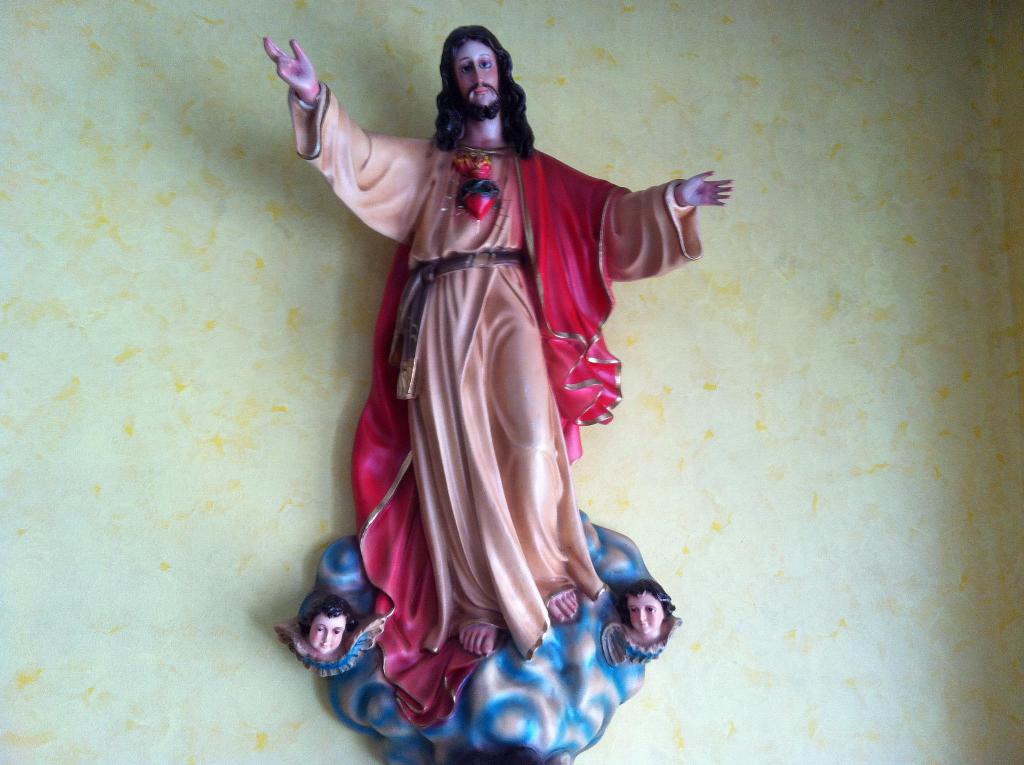
First. His way of love. He showed us His sacrificial love. He laid down His life for all of us. He stretched out His hands and showed how much more He is willing to sacrifice. Even in His Resurrection and Ascencion, He wants His spirit of love felt by all!He wants men to live this way of life, promoted to the well-being of others. Jesus’ love being communicated to the family begets in itself a transforming power that, even changes in the course of our life can never withstand that spirit of love.

Is our way of loving others patterned after the Good Shepherd?

Second. His way of life Jesus’ ministry speaks for itself that “giving life” has been His mantra wherever He goes and whenever He performs His ministry. He goes against those that contradict life. He confronts those who oppose and violate life. He is a hardline advocate and promoter of life. He brings in respect and honor for life. It is in Him that life springs forth.

Is our way of life patterned after His?

Third. His obedience to the Father. Jesus wholeheartedly followed the will of the Father for Him. As an obedient son, He remained focused on the instructions of the Father. It was engraved in His heart. Jesus professed His loyalty to the Father, thus, even the last moment of His life, He commended His spirit to the Father. When He died in Calvary, He submitted His being to the Father. And He continues to manifest His presence to us through the sacraments.

Are we obedient to the will of the Father?

As we celebrate this Good Shepherd Sunday, we pray that our communities, especially our families, will continue to show love and respect for life, freely and gratuitously given to us by God. We pray that may the younger generation learn to love, appreciate life and develop the spirit of obedience to the will of God. We pray that they may blossom to become like the Good Shepherd. As we celebrate the spirit of the Good Shepherd also, may the springing-forth of life, the concrete manifestation of God’s love and the proceeding-forth obedience to the Father inspire all our lives to make ourselves like the Good Shepherd.

published on April 29, 2012, Parish Bulletin

Categories
Articles Pastoral Team

“The First Fruits of the Resurrection”, by Fr. Jesus

…peace
…mission
…Holy Spirit
…forgiveness and
…faith

That’s how today’s gospel (In 20: 19-31) might be titled. Jesus gives to his disciples, and to all of us, the first and choicest fruits of his passion, death and resurrection.

First, he offers peace. Not once, not twice, but three times he greets his disciples with “Peace be with you!” The disciples were hiding in a locked room – “for fear of the Jews, ” says the gospel. Very likely, they were afraid of Jesus too, expecting to get a good scolding from him, like: “Where were you when I needed you most? Why were you such cowards? Peter, why did you deny me?” But they heard nothing of the sort from Jesus. Not a word of recrimination. Only a greeting of peace the first fruits of the resurrection; the peace which we need so very badly, even today-first and foremost in Jesus’ own country.

Second, Jesus conveys his own mission to his disciples: “As the Father has sent me, so I send you. ” It is substitution time. Like a runner handing the baton on to the next runner in a relay race track competition, so Jesus passes on to his disciples the mission he had received from the Father; as if he were saying: My task is finished; now it is your turn; carry on. The above text is very important from the viewpoint of ecclesiology. It helps us understand what the church is and what we, the members of the Church, are. We are extensions of Christ. He uses our hands, our feet, our tongue, our heart. He continues to fulfill his mission through us.

Third, Jesus confers the Holy Spirit upon his disciples to help them carry out their mission: “He breathed on them and said to them, ‘Receive the Holy Spirit ‘.” We know from another New Testament source that the Holy Spirit descended on the apostles on Pentecost
day. For John, however, whose gospel is not concerned with chronology but rather with theology, the ascension of Jesus and the descent of the Holy Spirit happened on Easter Sunday. For him, the Holy Spirit too is the first fruits of the resurrection. He transformed the apostles from frightened individuals into fearless witnesses. He can also transform us, if we allow him, from routine-driven churchgoers into dynamic and committed members of the Christian community.

Fourth, Jesus bestows on his disciples the power to impart forgiveness: “Whose sins you forgive are forgiven them … ” What a marvelous gift! Jesus knew that we would need it very badly. The Church is not an assembly of angels, as today’s first reading from Acts might lead us to believe, but a community of sinners in need of forgiveness. The risen Lord made that forgiveness available to us in the Church: “Whose sins you forgive are forgiven. ” Those who prefer to confess their sins directly to God (some people apparently have a direct line to heaven) rather than to priests or bishops who are fellow-sinners, should remember that Jesus gave the power to forgive, not to angels but to this bunch of “coward” disciples including Peter who had denied him a couple of days earlier.

Lastly, the stubborn refusal of Thomas to believe in the resurrection of Jesus–unless he saw and touched his hands and his side, prompted Jesus to explain to Thomas, and to us, that after the resurrection, our relationship with him will no longer be based on his physical presence but on faith: “Blessed are those who have not seen and have
believed. ” We are blessed if and when we believe that Christ is present in the Scriptures, in the Holy Eucharist, and in our brothers and sisters-even though we do not see him. Thank you, Doubting Thomas! Your hesitancy to believe the testimony of your peers elicited a most beautiful and important statement from the risen Lord!

as published April 15, 2012, Parish Bulletin

Categories
Parish Bulletin Pastoral Team

“God so loved the world…” by Fr. Greg Redoblado, OFM

Pagans cannot accept a weak and powerless God. However it is Good News to us because He is not an indifferent and distant God. A God who is not only close to us but also who truly suffers with us. I love this kind of God! God is truly regal and glorious in his cross. It may look ugly and bloody but it is beautiful because it is love.

We are now getting closer to holy week. Next Sunday is already Palm or Passion Sunday. But this Sunday’s gospel reading already actually begins this tone of the passion of Jesus with these words, “now my soul is troubled … – Father, save me from this hour.” If we pause for a while and reflect on these words, we can really feel that Jesus is in agony and pain. Yet, it touches us deeply to remember this agony with him comforting us with these words, “do not let your hearts be troubled.” Yes, it takes one, whose soul is troubled, to sympathize with those whose hearts are also troubled. A true healer is one who has been wounded. God’s glory and power are, according to the gospel of John, Jesus lifted on the cross for love of us!

This, I believe, is what the Lord wants us to see today. In the first reading from the book of Jeremiah, God wants us to write this new covenant in our hearts. The old law written on stone tablets will now be re-written and carved in our hearts. His troubled heart and ours will be forged into one.

The gospel begins with people, strangely in fact, Greeks (non believers) who “wished to see Jesus.” John, the evangelist, must already have in mind the universal call to discipleship. Lent is the season to remind us, first of all, of our call to discipleship to follow him and his mission which entails, first and foremost, to “see” and “know” him in a loving relationship – to write Jesus’ very life and mission in our hearts. To reflect on his passion story in the Via Crucis is not only for us to romantically feel his pain, but to follow him in his life offering and loving mission.

Secondly, Lent is a time, once again for us, to see a God who suffers in Jesus. As I said above, holy week is near and so Jesus’ passion looms in our gospel reading today. Jesus cries that his soul or innermost being is troubled. This and the rest of the passion story -suffering, crucifixion and death – is not only a dramatic stage play that we usually re-enact in our senakulo but Jesus’ real human experience of suffering. Our God therefore is a God who suffers in the person of his beloved Son, Jesus. The Greeks and pagans cannot accept a weak and powerless God. However it is Good News to us because He is not an indifferent and distant God. A God who is not only close to us but also who truly suffers with us. I love this kind of God! God is truly regal and glorious in his cross. It may look ugly and bloody but it is beautiful because it is love.

Finally, he wants us to see what a true disciple is: “Amen, amen I say to you, unless a grain of wheat falls to the ground and dies, it remains just a grain of wheat; but if it dies, it produces much fruit.” Lent, indeed, is springtime. We have to blossom, we have to bear fruit but that only happens when we fall to the ground and die to our sins and selfishness. For “whoever loves his life, loses it, and whoever hates his life in this world will preserve it for eternal life.” Jesus is presenting himself to us that very model to follow. Life is truly glorious and meaningful in the giving of oneself. If we claim to be Christians – followers of Jesus – we need to follow the only way to Jesus. He said, “whoever serves me must follow me, and where I am there also will my servants be.”

as published on March 25, 2012, Parish Bulletin
About Fr. Greg and a few of his Reflections

Categories
Parish Services Photo Gallery

Enthronement at San Lorenzo Ruiz Home for the Elderly

Congratulations to all the members of Men of the Sacred Heart for today’s enthronement at the San Lorenzo Ruiz Home for the Elderly. We donated P15,000 worth of Milk and Milo as well as P10,000 worth of Mercury Drug Gift Certificates.

This slideshow requires JavaScript.

Categories
Parish Bulletin Pastoral Team

“God so loved the world…” by Fr. Jesus

Love is measured by its cost, that is, by how much we are willing to
sacrifice.

The fourth Sunday of Lent has a festive character. It comes as a break in the Lenten penitential mood: “Rejoice, Jerusalem! Be glad for her!” exclaims the entrance antiphon. Some of us, many perhaps, will say: What good reason is there for rejoicing? There are a good number of reasons to be sad and to mourn: worldwide terrorism, political bickering, economic crisis, growing unemployment, rising prices of basic commodities, natural calamities, and a long etcetera. Pray tell, what is there to rejoice over?

Today’s gospel gives us a good reason: “God so loved the world that he gave his only Son.” Is that all?– you might say; we know that already; this is the most oft-quoted verse of the bible. Yes, indeed, we know that; we have heard it over and over again. But has it really sunk into our heart and mind? This is the favorite verse of our Protestant brothers. In the introductory pages of the King James Bible (the Protestants’ most revered version of the Bible) it says: This verse (Jn. 3:16) has been translated into more than
1,100 languages. It is here recorded in 27 languages, which are understood by more than three-quarters of the earths population.”

The title of Pope Benedict XVI’s first encyclical letter (2005) is “God is Love,” (Deus caritas est). Its opening words are: “God is love, and he who abides in love abides in God, and God abides in him” (1 Jn 4:16). Here we have the shortest, richest, and deepest definition of God: He is love. Therefore, he cannot do anything but to love. All his actions, from creation to redemption, are motivated by love. Again, in Pope Benedict XVI’s words: “Everything has its origin in God s love, everything is shaped by it, everything is directed towards it. Love is God s greatest gift to humanity, it is his promise and our hope.” Now we can more easily understand the words of today’s gospel: “God so loved the world that he gave his only Son.” As someone has said, “you can give without loving, but you cannot love without giving.”

When Johann Gutemberg was printing the first Bible at Mainz in 1456, his little daughter, Alice, picked up a discarded piece of paper with only one line of print: “God loved the world so much that he gave.” She put it in her pocket and kept on thinking about God being so loving. Her face lit up. Her mother notice her changed behaviour and asked Alice what was making her so happy. Alice showed her mother the piece of paper with the printed line. The mother looked at it for a while, then said, “So, what did God give?” “I don’t know,” said the girl, “but if God loves us well enough to give us something, then we need not be afraid of him.” (Remember, those were the years of the Inquisition, when people lived their faith in fear and trembling).

Love is measured by its cost, that is, by how much we are willing to sacrifice. Once a husband asked his wife: “Hon, what gift do you want for our anniversary?” The wife answered, “Anything… so long as there is a diamond on it.” Come anniversary day, the husband gave her a set of playing cards. God gave us the most precious gift he had: His only-begotten Son. He sent him, not just to pay a visit to us that would have been great in itself, but to become one like us in all things but sin, to share in our pains and sufferings, and to die for our sake. Indeed, no greater love is possible.

The gospel goes on: “God did not send his Son into the world to condemn the world but to save it.”God condemns no one. Condemnation is self-inflicted– it is our choice: “The light came into the world, but people preferred darkness.” We condemn ourselves when we refuse God’s friendship and love; when we refuse to abide by the teachings of Jesus Christ. When a patient refuses to obey the doctor’s orders or decides to leave the hospital against the doctor’s advice, he is responsible for whatever may happen to him. Same with us whenever we refuse God’s love. God loves us to the point of respecting our free choices, no matter how wrong.

published March 18, 2012, Parish Bulletin

Categories
Downloadable Forms

Downloadable Forms

Before coming to our Parish Office, pls. download, print and fill up the necessary forms, below, before submitting, together with proof of payment and other requirements listed on our Parish Services.

NEW PARISHIONERS REGISTRATION FORM
BAPTISM FORM
PARISH ANNOUNCEMENT REQUEST FORM
PARISH BULLETIN ARTICLE INCLUSION REQUEST
PARISH BULLETIN EX-DEAL REQUEST FORM
PARISH BULLETIN AD PLACEMENT RATES/REQUEST FORM
FUNDRAISING EVENT REQUEST GUIDELINE
DONATION PLEDGE FORM
LECOM COMMITMENT FORM
LECOM PERSONAL DATA FORM
PRAYERS FOR STATIONS OF THE CROSS

Categories
Fr. Robert Manansala Pastoral Team Reflections

WHOSE AUTHORITY? GOD’S!!! Fourth Sunday in Ordinary Time, Year B, Reflection by Fr. Robert B. Manansala, OFM

(Dt 18:15-20; 1Cor 7:32-35; Mk 1:21-28)
What do you think is the difference between an orator of the world and an orator of God’s Word? In the ongoing Impeachment Trial in the Senate of the Philippines as an Impeachment Court, we see a lot of orators and hear a lot of orations.

The Dominican Fr. John Francis Ku, writing beautifully on the Venerable Archbishop Fulton Sheen as Master Preacher, says that while a man becomes an orator in the world by learning how to orate, a man becomes an orator of Christ by learning how to “orare”. “Orare” is the Latin verb for “to pray.” An orator of the world is a dealer in words. An orator of Christ is a communicator of God’s Word. Fr. Ku further says that an orator of the world is like a flint that kindles its own fires while an orator of Christ is like a brand lit by the torch of God.

The Venerable Archbishop Fulton Sheen was an orator of Christ and a master preacher of God’s Word. As a master preacher, he spoke and taught as one having an authority and not as the others, as the Gospel reading today tells of Jesus.

One cannot deny that the Venerable Archbishop Fulton Sheen was truly a gifted and learned man, but his authority in preaching, as he himself would attribute it, came from God. His authority was not personal and not of his own but one that ultimately came from his deep relationship and intimacy with Jesus, especially in moments of prayer before the Blessed Sacrament.

The Venerable Archbishop Fulton Sheen is known for his personal devotion, commitment and promotion of the daily One Hour of Prayer before the Blessed Sacrament. He promoted this commitment especially to the priests and the preachers of God’s Word. In his autobiography, Archbishop Sheen entitled a chapter The Hour That Makes My Day. On the day of his ordination to the priesthood, as Fr. Ku also relates, he resolved to spend an hour of prayer in the presence of the Blessed Sacrament every day of his life, a promise he observed faithfully until the end. This nourishment served as the very root of his prayer life, his vocation, his perseverance and his fruitfulness in ministry, including his preaching. All of Archbishop Sheen’s homilies and sermons were prepared in the presence of the Blessed Sacrament. Archbishop Fulton Sheen spoke with authority because he was truly a man of God, a man of prayer, a man of God’s Word and a man of the Eucharist.

In the gospel today, Jesus’ authority was recognized not only by the people but also by an evil spirit. The gospel says, “The people were astonished at the way he taught…” “They wondered, ‘What is this?’ With what authority he preached? He even orders evil spirits and they obey him.” Indeed, the evil spirit, at the command of Jesus, came out of the man it had possessed.

The context of the teaching of Jesus was the synagogue worship. As an adult member of the community, he took his turn at teaching those gathered in the synagogue. The people were used to the manner of teaching of the other scribes. The scribes as official teachers usually relied on the authority of the others preceding them. This was not the case with Jesus. He taught as having an authority in his own right. The people recognized this and were amazed at it. The exorcism he performed was another manifestation of the unusual authority that he had.

It was actually the evil spirit which articulated the source of the authority of Jesus, both in teaching and in exorcising. While the name Jesus of Nazareth was a recognition of Jesus’ natural and human origin, as someone coming from the little and obscure town of Nazareth, the title “the Holy One of God” that the evil spirit used to refer to Jesus was a recognition of Jesus’ distinctive relationship with God and of his unique status and superiority. The evil spirit admitted this when it uttered, “Have you come to destroy us?” The evil spirit knew that it was in confrontation with Jesus and that Jesus was far more superior over and against it and the other evil spirits. Jesus was definitely more powerful than the evil spirits because he was from God, he was sent by God and he spoke the Word of God. Later on, Jesus’ followers would recognize him not only as coming from God, but the Son of God himself.

Jesus’ authority was divine as it came from God and was of God. Jesus also used this authority for the good of others, which included instructing and teaching people to turn to the Lord and to his Kingdom and freeing people from the power of Satan and his cohorts. The preaching of Jesus did not only bring about admiration, as can be seen in the reactions of the people. More important were the transformation, liberation and renewal that it brought to the man freed from the chains of the evil spirit. Jesus’ teaching was with authority not only in terms of its divine source but also because of its transforming and liberating effects on the part of the listeners and recipients.

Etymologically, the word authority comes from the Latin word auctoritas, which literally means “a producing” or “a cause.” An authority is that something that produces or causes one to do what one is doing in a particular way and with a particular result. What caused Archbishop Fulton Sheen to preach with authority? What caused Jesus to preach and expel evil spirits with authority? Ultimately, the question, in fact, is not “what” but “who”. Who caused Archbishop Fulton Sheen to preach with authority? Who caused Jesus to teach and expel evil spirits with authority? It was GOD.

Authority has also something to do with influence. What is the influence of the person on another or the others? What effects does the person with authority have on others? Again, we see in the examples of Jesus and of Archbishop Fulton Sheen the good influences and effects of their teaching and preaching on the listeners and recipients. By its fruits, we know not only the tree but also the source of one’s authority.

What does this gospel reading have to do with us? Most of us are not priests or preachers and teachers. Maybe, not in the official sense. But, whether we like it or not, we are all teachers and preachers. We are all priests, prophets and kings by virtue of common baptism. St. Francis of Assisi said, “Preach at all times, and if necessary use words.” We, ordained ministers, preach to God’s people in a more official capacity. Parents teach their children. Parents have a lot to learn from their children. We all teach and preach to one another, whether we like or not.

Don’t we often hear the following statements? “I have learned a lot from this person and from his example.” “I have been touched by his show of kindness.” “I have been inspired by his leadership by good example.” As Christians, we must preach the Word of God with words, by our deeds and by the way we live our lives. Do we really do this? Do we teach or preach with authority? Are we truly receptacles and channels of God’s message of love, peace, justice and forgiveness? St. Bernard of Clairvaux says, “We cannot be channels of God’s love unless we are first receptacles.” And, in everything that we do, do we always seek the good and betterment of others?

Some weeks ago, I saw an attempted robbery in a store in the US that had been captured on CCTV, broadcasted by TV station KDFW Fox 4, and made available on YouTube. In the presence of a client, the masked robber pointed his gun at the lone sales lady and owner and asked for money. Marian Chadwick, the sales lady and owner, did not give the robber money but instead commanded him to leave the place in the name of Jesus. She shouted, “In the name of Jesus, get out of my store. Right now! I bid you in the name of Jesus, leave my store.” The robber was taken aback and left without hurting the sales lady and owner and taking anything from the store.

Did Marian Chadwick speak with authority? More than we could ever imagine. We may never do what Marian Chadwick did. But the truth remains: We can teach or speak with authority when we allow God, his Word and his power to be the one speaking in and through us. We can witness to Christ with authority when our lives are credible witnesses of selflessness and God-centeredness. We live with authority when it is Christ who truly lives in and through us.

St. Joseph Cupertino, pointing to the preacher as God’s instrument, says: “A preacher is like a trumpet which produces no tone unless one blows into it. So, before preaching pray to God: You are the spirit and I am only a trumpet, and without your breath, I can give you no sound.”

This is true not only in terms of preaching, teaching and witnessing. This is true in the very way we live our lives as Christians. We are nothing without Christ. We have no authority without Christ. We have no impact without Christ. We can only make a difference when we allow ourselves to be humble instruments of the Lord. The paradox of human instrumentality vis-à-vis God’s initiative and action was expressed by Archbishop Fulton Sheen when he said: “Everything is done by God and nothing is done without us.” As Christians, we teach, preach, witness, minister and live in Christ’s behalf just as the prophet Moses, as the First Reading from the Book of Deuteronomy says, was raised by the Lord and spoke in his name.

The Responsorial Psalm (Psalm 95) exhorts us not to harden our hearts when we hear God’s voice. God’s voice is spoken in a very special way in the Scriptures and in the words, deeds and lives of God’s faithful servants and witnesses as they try to live God’s Word in their lives. God is proclaimed in and through the lives of people who live passionate and single-hearted lives, as the First Letter of St. Paul to the Corinthians insinuates. Indeed, when we hear and recognize God’s voice and presence, we need to heed him. God is coming not to destroy us, in contrast to the experience of the evil spirits mentioned in the gospel, but to save us and claim us as God’s beloved children.

When God speaks, he always speaks with authority. When we respond to God, we should respond with the totality of our being, with all honesty and integrity. “Speak Lord, your servant is listening.” “I come to do your will.” “You have the words of eternal life.”

About Fr. Robert and his other reflections

Santuario de San Antonio Parish
Makati City
January 28-29, 2012
Design a site like this with WordPress.com
Get started