Categories
Articles Pastoral Team Reflections

“I was in prison and you visited me…” Matthew 25:37

This Sunday is the end of National Correctional Consciousness (NACOCO) Week a national celebration held in correctional institutions across the country. For one week, the inmates through their supporters hold activities among themselves and for their families and friends.

In our parish the Prison Ministry would like to take this opportunity to share with you the activities that it does for the inmates of Makati City Jail. The most basic need of an inmate is justice, through the prison ministry; indigent inmates are assisted with legal counsel from lawyers in the SYA community as well as through volunteers who coordinate their cases with the Public Attorney’s Office (PAO).

The majority of the inmates are poor and cannot afford bail, legal fees and money for their most basic needs. Many of the inmates have very few visitors and therefore rely on the prison system for all their needs for food, clothing and toiletries. This is the second concern that the Prison Ministry addresses. In every activity that we do, we try our best to give some food, soap, toothpaste, detergent and other small things that go along way. Even used soap from hotels is well received by the inmates. We also coordinate with the City for medical missions and emergency hospitalization for serious cases.

The third concern that the Prison Ministry addresses is the need for livelihood, skills, recreation and development. In this regard, there are several projects that the Ministry does together with the SYA community such as sports (chess, boxing, futsal, dodgeball and others), cooking contests, film showing, Adult Learning tutorials, livelihood programs (eco bags and other sewn items, handicrafts), and much more.

The final concern is that of the spirit. SYA volunteers teach catechism classes to the inmates every Monday evening, there are weekly masses on Saturday afternoons that our volunteers regularly participate in, we help with special religious celebrations such as feast days, lent, Easter, Christmas and even Santacruzans. The Prison Ministry helped build a 200 person capacity chapel inside the prison grounds that is considered one of the most beautiful chapels in any correctional institution in the Philippines.

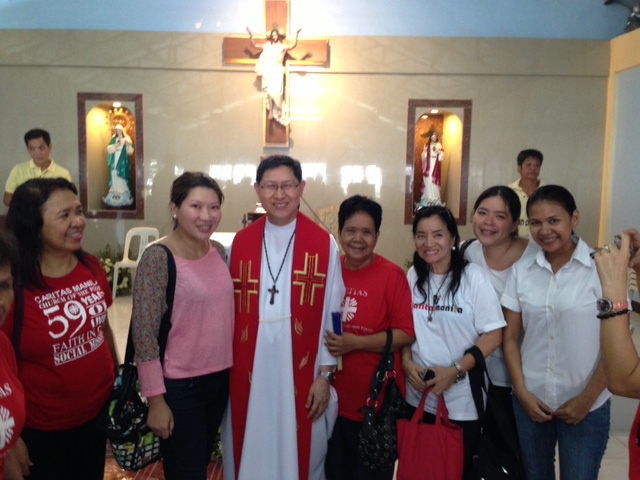
prison min photoLast September 14, Archbishop Luis Tagle celebrated mass at the chapel and the Prison Ministry was the only group that was allowed to stay inside the chapel with the inmates. In his homily he mentions how the Church is close to prisoners because Christ was a prisoner. He also mentioned that prisoners are no longer calledinmates but as temporary residents of the institution. The mass was so beautiful because one could feel the prayers of all the residents all around the small chapel. Prayers of justice and assistance, prayers of love for their families outside the walls, and prayers of thanksgiving for giving the residents a second chance.

This week’s NACOCO will have activities such as dance and singing contest, a Bible trivia contest, a basketball and volleyball tournament, medical mission, and a Family Fun Day. All of these projects of the Prison Ministry would not be possible without the generous contributions of all parishioners through mass collections and donations during the annual Francisfest. Outside the church today is a small photo display of some activities of the Prison Ministry.

For more information on the Prison Ministry Outreach Program>>>>>

Categories
Articles Pastoral Team Reflections

“Manifestation of God (in our Beloved Pope and in Us)” (Mt. 2:1-12), by Fr. Joel Sulse, OFM

Jesus is now the evident manifestation of the Father who wants to share His unconditional love and faithfulness with all of us.

This first Sunday of the year is designated by our Church as the Solemnity of the Epiphany of the Lord. This means the manifestation of our God to us. How did this revelation come about?

The letter of Paul to the Ephesians (3:2-3a, 5-6) tells us that God’s revelation come to us as a grace which can only be understood through faith, and in our belongingness to the body of Christ Himself. This means that all are called to a universal salvation, Jews and the Gentiles alike. This has been offered by God for all of us since we are all important in Him, and He wants us to be dignified all the more by experiencing his salvific grace.

The first reading from the prophet Isaiah 60:1-6 affirms in our memory about the coming of the Light. This Light will transform the world and will draw back the whole humanity to Yahweh, our source of life. It will help all peoples restore their identity back to God through their faith in Yahweh. Following this, we are all challenged to be the light to our world as well.

How can the salvific grace enrich us? How can we become a clear light for others? How can God be manifested in us?

Matthew brings us back to the memory of the great event that happened in Bethlehem years ago. This event opened the doors of our faith beyond the Jewish backyard. This was actually the purpose of the manifestation of God. This is part of His mission. He wanted us to realize that He is for all. He wanted us to know that He did not come for a limited community only. He wants us to experience the universality of His love. This love is manifested in our faithfulness to his will. And this results in unity, peace and respect for one another and for all.

How can the Wise Men become our guide in deepening our faith? What basically are the attitudes of these men? They are from Persia – experts in astrology with the capacity to interpret dreams. Why are they persistent in seeing the child? In other words, there is that sense of openness and sincerity in them. Why are they interested? It is because they are convinced that there is something in this baby. There is therefore that evident manifestation in their hearts coming from that enthusiasm and commitment burning deep inside them. We were told that the Star in the East guided them to Bethlehem through King Herod. Why is this so? Again, there must be a reminder for Herod.

One can notice that the divine will guided the search of the wise men for a purpose. The divine hand is present every inch of the way, orchestrating the event as it unfolds. And finally, seeing the child in a lowly, smelly manger, they brought in their gifts fit for royalty. Why do they have to accord Him with the gifts of frankincense, gold and myrrh? The gifts tell of who the child is and was, and his destiny.

We were told that King Herod was so disturbed. He was deeply trouble especially when the Magi did not send him any word and went the other way. His unease created a vacuum of fear and jealousy that resulted in his plotting to kill the children who are a threat to his kingdom. The imperial kingly attitude of “power hunger” blossomed in his greedy heart. His dubious intent overpowered him, thus, the killing of the infants and children. But the Magi and the the non-Jews paid homage and worshipped Jesus. They paved the way in Matthew’s special narrative: “make disciples of all nations.” They lived their faith, and followed its demands beyond reproach.

The whole story of the visit of the wise sages revolves on Jesus, an affirmation of His being the true King of Israel. And that salvation of Israel and the world comes through Him. The end of the story is a shift of us being invited like the Jewish disciples to go out to the world and bring the good news of salvation. Jesus is now the evident manifestation of the Father who wants to share His unconditional love and faithfulness with all of us.

The Magi are reminding us that we too can bring the same gifts to Jesus. They are telling us that we have that capacity as well to find “the Christ” if we have the diligence and the sincerity to look for Him. The light has been provided to us already. We just have to follow the light and faithfully manifest Him as well in our day to day living.

As we celebrate the feast of the Epiphany, let us pray to God that His gifts to us be manifested by the way we live, like our beloved Pope. Let us continue to manifest ourselves as FAITHFUL GIFTS for our family, for our community, for our country, for the Church, and for His Kingdom. Happy Feast Day of the Epiphany!

About Fr. Joel and his reflections

Categories
Articles Pastoral Team Reflections

“A BLESSED New Year (2014) to all!” by Fr. Efren Jimenez, OFM

Isang makakalikasan at makatarungang Bagong Taon sa lahat! Mabuhay ang pamilyang Filipino!
When people treasure life than despise it, when people affirm and speak values to one another, when people know they are brothers and sisters, and they keep looking for reasons to have faith in God, then family life becomes a solid place for love, security and transforming agent in our world today.

The liturgy of this feast is a troublesome mixture of so many things all at once. It continues the story of Jesus from the infancy narratives as the Gospel of Matthew relates it. It also offers general words of wisdom about human existence as shaped by family life. At the same time it presents exhortations about Christian community life as distinctively redeemed and redemptive.

The lesson from the Book of Wisdom literature offers reflectionsupon patterns of human life. Each generation shapes the conditions in which life will be lived in the future. This happens in the family circle and also in larger society.

There is a note of responsibility here, in our decision and actions, not only for the making of our lives and personalities, but in large measures also for the making of the lives and personalities of others.

When we turn to the Second Reading we seem to move to the more
particular – to some extent beyond the advise in Wisdom Literature – in the emphasis on forbearance, compassion, patience, humility, bearing with one another and forgiving one another and on top of these, put on love, that is, the bond of perfection.

One must be heroic in the exercise of virtue like humility in situations which are often unjust. Our family, when strengthened by virtue of discernment and pursuing the will of God, can mirror the quality of the Holy Family as described in the Gospel.

The feast of the Holy Family is a celebration of our human bonds with Jesus of Nazareth, and therefore of our redeeming bond of grace with all the human family in the world, but particularly the poor, the distressed, the despised, the abandoned children in the streets.

When people treasure life than despise it, when people affirm and speak values to one another, when people know they are brothers and sisters, and they keep looking for reasons to have faith in God, then family life becomes a solid place for love, security and transforming agent in our world today.

PAX ET BONUM!

About Fr. EJ and his reflections

Categories
Articles Pastoral Team Reflections

“The Birth of Jesus: An Embodiment of God’s Humility”, by Fr. Reu Galoy, OFM

Simply put, our salvation is not exclusively dependent on the divine initiative in the sense that we are completely passive recipients of this salvation. God saves humanity only through their cooperation and fidelity.

It is quite difficult to think of a God who is almighty and powerful yet humble in many ways. As human beings we tend to traverse our existence by desiring to be in control of everything. We also want to be powerful at the expense of the innocent and ordinary people. Wielding power and position seems to be what gives meaning to our lives. Or else having these is the solution that we so much need.

Our gospel this Sunday is leading us to see another perspective–how God’s plan become acceptable through his dealings that are beneficial to us as seen in the characters involved in the story of Jesus’ birth. Unlike Isaiah, John the Baptist, Mary and even the Wise Men and the Shepherds, Joseph is not a towering Advent figure. He only took the embarrassing role of taking Mary’s child that is not his. The most logical thing to do was to divorce Mary because he knew that he will not be able to publicly show the “token of virginity” (Deut 22:13-21) on his wedding night. Of course, as an honorable man, divorcing Mary quietly was an act of hope that the rightful father will seize the opportunity to claim the child and marry her.

So God through an angel had to explain to Joseph that Mary is pregnant by a spirit that is holy and made an appeal to him to take Mary as his wife and into his home. Joseph could have rejected the proposal because his human right and and his male ego have been trampled upon. But Joseph is also a servant of the Lord. He said “yes” in faith to his own annunciation of God’s will.

Prior to Joseph, God needed to deal with Mary also who even questioned God’s plan: “how can this be since I have no relation with a man? “(Lk 1:34). In the same way with Joseph, God had to explain and even convince Mary, through the angel Gabriel, before she said “yes” to God’s plan. Mary could have replied otherwise because of her situation. She was already betrothed to Joseph. She knew the immediate consequence of her decision – shameful death.

In both instances, God had to negotiate with Joseph and Mary for the birth of Jesus, the Emmanuel. This life and history-changing act of the God of love is done in the spirit of humility. God presented and submitted his plan to human freedom for cooperation and participation even when this plan was for the salvation of the human family and the rest of creation. Simply put, our salvation is not exclusively dependent on the divine initiative in the sense that we are completely passive recipients of this salvation. God saves humanity only through their cooperation and fidelity.

The birth of the Emmanuel, the “God with us” is the embodiment of a humble God in our midst. In and through humility, the love of God is made manifest.

About Fr. Reu and his reflections

Categories
Articles Pastoral Team Reflections

“3rd Sunday of Advent: Rejoice, the God is Near”, by Fr. Baltazar Obico, OFM

Real joy is no longer linked with possession of some object. Rather it is God coming in history that is the reason for rejoicing. Nothing can tarnish this joy; not even suffering and trial.

Introduction

The latest count is around 6 thousand dead, some 1700 missing and 20,000 families still in evacuation centers. The whole nation was numb and in shock, considering Yolanda swept Leyte and Samar shortly after the Bohol earthquake and prior to that the 3- week siege of Zamboanga.

Today the 3rd Sunday of Advent is called Gaudete Sun, Sunday of rejoicing. How could we rejoice? A lot of communities, employees and groups have cancelled their Christmas revelry and forfeited their budget in favour of the victims.

Isaiah tells us that God is coming to save. The desert and parched land will exult. They will bloom with abundant flowers and rejoice with joyful song. James in the 2nd reading says make our hearts firm because the coming of the Lord is at hand. Finally in the Gospel, Jesus commands, “Go and tell John what you see and hear, the blind see, lame walk, lepers cleansed, deaf ear,
dead are raised and the poor have the good news proclaimed to them.”

Jesus’ answer was in response to John the Baptist’s inquiry since his expectations of the messianic times is accompanied by force and violence. Christ fail these expectations by revealing his messianic works that are all works of peace, restoration and salvation.

John the Baptist is looking for someone. But what exactly are they looking for? What are the deepest desires of their hearts and our hearts? The fact that they went to the desert and not in palaces or places of power and wealth indicates that something more than material satisfaction will answer their deepest aspiration. Jesus probes their hearts by questioning them on why they are attracted to John the Baptist. The real longing is to get in touch with the originating mystery by connecting with a prophet, a Godgrounded man who speaks the word of God. True joy and rejoicing therefore is to be connected once more with God. We have strayed from these connections and consequently live in exile from our true selves. Hence, we limit the notion of joy to material, bodily enjoyment.

Word

1. Modern man generally seeks joy in evasions, fantasies and pleasures embracing thereby a superficial and meaningless existence. Joy is more than fun, pleasure and happiness. The world speaks of joy in the sense of sensory pleasure, like abundant food, flashy gadgets, branded products. This notion of joy is further reinforced by our consumeristic culture which has reduced our self-worth to having. You are what you have. Others experience some high in sexual pleasure, audio visual experience, fraternal meal, joy of family life, completion of a work done. No doubt joys are felt and experienced, except that they are fleeting and temporary and as one clings to it, it can become a compulsive addiction.

Real joy is no longer linked with possession of some object. Rather it is God coming in history that is the reason for rejoicing. Nothing can tarnish this joy; not even suffering and trial. And so joy can break forth in a depressed economy, in the middle of war, in an ICU, or in the midst of a devastated village. It is a realistic joy rooted in the certitude founded on the victory of Christ over death. Therefore this world is not absurd because God is in love with it and the principle of his victory has been given us once and for all in the Christ-event.

2. This joy is expressed “in the Lord,” because it is the result of his work. Nearness is not considered in the temporal sense (as in today, tomorrow or next month). It is not only the day of the Lord that is near; but the Lord himself is! He is near to all who fear him, who pray and obey. The nearness of the Lord no longer depends on events, more or less distant. It is a constant manner of presence in Christian life. The Christian who experience this
nearness is no longer subject to feverish and vain expectations. He lives calmly in prayer, peace and joy.

3. Today we are deeply touched by the overwhelming support of all people in solidarity with our typhoon victims. From unexpected people and with amazing creativity to express solidarity with us from Justin Bieber to the late Paul Walker; from Paul Gasol to Alaska Aces; from PBA stars to movie celebrities; no one is unmoved, untouched by this tragedy. Practically big business have created programs with Yolanda victims as recipients. Indeed, the Lord is near to all of us as we go out of our way to reach out to the victims.

About Fr. Tasang and his reflections

Categories
Articles Pastoral Team Reflections

“Conversion: Being Shaken To Our Authentic Identity In God,” by Fr. Robert Manansala

Conversion is a journey towards who we really are before the Lord, to our authentic identity in God: Sinful yet Beloved!

The German Jesuit priest Fr. Alfred Delp, who wrote powerful meditations from prison on “the spiritual meaning and lessons of Advent” before being martyred by the Nazis in a Nazi death camp in 1945, said that it is only when we experience being shaken and awaken that we begin to become capable of Advent. The experience of being shaken to awakening makes us realize that “all of life is Advent,” a journey towards encountering God.

On this Second Sunday of Advent, the Old Testament prophet Isaiah and John the Baptist are our Advent figures who try to shake us to conversion in preparation for the coming of the Lord. John’s call to conversion is based on an earlier summons made by Isaiah “to prepare the way of the Lord.” However, Isaiah’s original line, “A herald’s voice that cries: in the desert prepare the way,” is changed to “A herald’s voice that cries in the desert: prepare the way,” making John the voice of God calling us into the desert of conversion.

In Hebrew, the word “shubh” for conversion indicates that one has taken a wrong direction and is summoned to return to God. In Greek, the word metanoia (“change of heart”) connotes not just a static compunction but a dynamic and determined turn-around and a commitment to a new way of life in God. In both cases, conversion is not purely a human decision or endeavor but a human response to God’s prior initiative. In the New Testament, conversion is a response to Jesus in whose person, words and deeds God’s Kingdom becomes an emerging reality.

Advent is intended to shake us to conversion or on-going conversion as our response to the new dawn that Jesus Christ has brought into the world. And this cannot be a half-baked conversion. Matthew tells us that many of the Pharisees and adducees come to listen to John and to be baptized by him. But John attacks them with his strong words: “You brood of vipers! Who warned you to flee from the wrath to come?” Perhaps these Pharisees and Sadducees are toying with a change of heart, but not to the point of completely making a turn-around and committing themselves to God and to a new way of life. “Bearing fruit worth of repentance” is the only indicator of an experience of real and authentic conversion.

Fr. Delp, in his reflection on Advent on December 7, 1941, considered that one of the challenges of Advent is the call to authenticity. He said: “Someone who encounters the Ultimate, who knows about the end, must let go of every compromise. In the presence of the Ultimate the only thing that survives is what is authentic. All compromise shatters this. All cheap negotiating shatters this. All half-truths, and all double meanings, and all masks, and all poses shatter this. The only thing that stands the test is what is authentic.”

To embrace the Advent challenge of conversion is to embrace authenticity. John the Baptist shows the way to authenticity by knowing who he is before Jesus. He is not the Messiah; Jesus is the Messiah. Thus, he points to Jesus as the one who is stronger than he, the one who baptizes with the Spirit and the one who separates the wheat from the chaff.

Conversion is a journey towards who we really are before the Lord, to our authentic identity in God: Sinful yet Beloved! It is also a journey towards meeting others as we truly are in relation to one another: Brothers and Sisters in God! When we are finally shaken to our authentic identity in God and in relation to others, then we become capable of truly encountering the Lord in Himself and in others. Only when we are shaken to our true selves that we begin to become Advent people who are awake and ready for the Lord and his manifold visitations.

About Fr. Robert and his reflections

Categories
Articles Ministries

Parishioner Gifts Scholars with Bibles

Bible for Scholars
In line with its goals to provide educational and spiritual formation; the SSAP JPIC Scholarship Program scheduled its Annual Recollection for its 83 scholars on November 16 – November 17, 2013, at the Franciscan Spirituality Center, Botolan, Zambales. The recollection was facilitated by Jolly Gomez and the Youth Ministry focused on meaningful prayer worship through “Adoration, Contrition, Thanksgiving and Supplication” (ACTS) and “Praise, Ask, Listen” (PAL).

Atty. Gomez had recommended that each scholar be given a bible for scripture reading. The Committee, through Ms. Jackie, verified the posts of reasonably-priced bibles from several bookstores. This way a donation appeal for bibles could be published in the Parish Bulletin. It is through Divine Providence that a parishioner had heard of the scholars’ need for bibles. Through her benevolence never-tiring generosity to the JPIC Scholars, each scholar received an 8 by 5 inches bible in the vernacular purchased at the Philippine Bible Society along U.N. Avenue.

The SSAP JPIC scholars would like to thank our most kind parishioner for this memorable gift to mark a special event in their lives.

SSAP JPIC Scholarship Committee/Jean Chavez

Categories
Articles Pastoral Team Reflections

“Stay awake… Be prepared” by Fr. Jesus Galindo, OFM

“Prepare the way of the Lord.” The way of the Lord is none other than our way of life.

As early as September 1, there were Christmas carols being played on radio. The department stores began to display Christmas cards, trees, lights, and all sorts of Christmas décor. Now comes the Church liturgy and announces the beginning of Advent. “What Advent,” you might say. “Father, huli ka sa balita. We have already been celebrating Christmas for over two months now! Our Christmas cards are out; our Christmas trees and lights are up; our Christmas shopping is almost done. Our homes are fully decorated. What Advent are you talking about?”

Kawawang Adbiyento! It is practically non-existent for most people in the Philippines. We plunge right away into the Christmas frills and trappings. We are pushed into this by business interests who use this season as an opportunity, not to bring us closer to Christ, but to rake in fabulous earnings. Big business rules even our spiritual life. That is, if we allow it to do so. Shall we?

It is for this reason that the Church comes now to remind us to “be vigilant” and to “stay awake.” Not to be like the people in Noah’s time who were eating, drinking and having fun; which is exactly what many of us do during the Christmas and pre-Christmas season—going by the number of Christmas parties which are held these days. Hopefully this year, after so many calamities have left millions of our countrymen hungry and homeless, we will.

Advent is meant to be like a fourweek retreat to help us prepare for a meaningful and rewarding celebration of the birthday of Christ. Advent reminds us that it is Christ who is coming, not Santa Claus or the reindeers. Christ, not Santa Claus, is the reason for the season.

Our retreat masters for Advent will be mainly prophet Isaiah and John the Baptist, with their resounding invitation: “Prepare the way of the Lord.” The way of the Lord is none other than our way of life. In today’s passage (First Reading), prophet Isaiah describes the messianic time as a time of peace among nations: “They shall beat their swords into ploughshares and their spears into pruning hooks; one nation shall not raise the sword against another.” It is clear that Isaiah’s vision has not yet been fulfilled, as violence and war wrack many parts of the world. This should help us understand why we need the season of Advent and Christmas to come around year after year: To remind us of the unfinished task of building up peace among the nations.

The symbol of this Advent season is the Advent Wreath–which should be displayed well ahead of the Christmas tree. It consists of four candles, one for each week. It can be made into a powerful means of personal and family reflection and renewal. How? By giving a name or theme to each candle, for instance, Patience, Forgiveness, Unity, Peace (or any other theme of relevance to or lacking in the family). Then, each week, as the family members gather for meals or for prayer, they can have a short reflection and sharing on the theme for the week, and end with a prayer, asking the Lord to bestow on the family the value or virtue meditated upon.

In this way, the Advent Wreath will not be a mere piece of décor but a useful aid for spiritual renewal in the family, by far more meaningful and spiritually rewarding than the mere sight of the twinkling lights around the Christmas tree. A fruitful Advent to one and all!

As published on December 1, 2013, Parish Bulletin
About Fr. Jesus and his reflections

Categories
Articles Pastoral Team Reflections

“Solemnity of Christ The King: The King Who Saves”, By Fr. Joel Sulse, OFM

The underlying spirituality here is despite our wickedness and misgivings, the love of Christ will always be overflowing in us. But like the repentant thief in the gospel, we need to recognize in faith the kingship of Jesus and His holy operations and intents.

We celebrate this Sunday the Solemnity of Christ the King. The gospel during this celebration bears a royal motif narrative. It relates the political charges against Jesus that he puts influence against the Jewish nation, advocates a revolt against Rome through its tax imposition and personally claims himself as the “Messiah and King.” These claims are like provisions to a death certificate that he has signed.

Following through the words of the leaders (v.35), the soldiers (v.36- 37), and the unrepentant criminal (v. 39) as well as the inscription on Jesus’ cross (v.38), one can comprehend the very nature of the kingship of Jesus. And this kingship is being challenged by the very words of the criminal “Are you not the Messiah? Save yourself and us!”(v.39) Such challenges call for Jesus to change his vocational identity. Such is a temptation to him to become a different sort of a King (a political one) very much distinct from the call that His Father wants him to do and live.

But it is good to dwell on how Jesus agonizes on the cross. He did not think of himself alone. He rather offered salvation to the repentant thief. We see here a God who suffered much, yet, still had that capacity to save others.

The current situation in the Visayas mirrors the many faces of the suffering Christ. Despite the difficulties they have encountered and the loss of loved ones, their faith remained strong. It helped them keep their sanity. It is nice seeing victims themselves sharing the relief goods in order for their families to survive. It is good to see the “rebuilding” spirit in them, helping their families build their “makeshift” or temporary shelter. It is so nice to see smiles on their faces despite the difficulties they have encountered during the typhoon. It feels good that despite the tribulations experienced, they remain committed to start once again; to give hope to others. We can see here the face of the suffering Christ, who “in his helplessness has that power to save!” He even asked the Father to forgive those who have crucified and tormented him, even promising the repentant thief that he will be with him in Paradise (v.43).

The continuation of this gospel text tells us that “when all the people who have gathered saw what had happened, they all returned home beating their breast.” Such is an indicator of a faith inside a person who realized that there is really something in Jesus. It is a clear and evident sign of a repentant spirit who recognized the compassionate and forgiving heart of Jesus. And for sure, their story will not stop from there.

“Amen, I say to you, today you will be with me in Paradise (v.43)!” The verse is a clear indication of a forgiveness granted exceeding the prayers of the repentant thief. Jesus granted him what he asked for. The underlying spirituality here is despite our wickedness and misgivings, the love of Christ will always be overflowing in us. But like the repentant thief in the gospel, we need to recognize in faith the kingship of Jesus and His holy operations and intents. May the compassionate and forgiving heart of Jesus, the King reign in our hearts as well. Onwards to the Paradise assured us by Jesus. Amen.

As published on November 24, 2013, Parish Bulletin
About Fr. Joel and his reflections…

Categories
Fr. Robert Manansala Reflections

“CRUCIFIED KING” 34TH SUNDAY IN ORDINARY TIME, SOLEMNITY OF CHRIST THE KING by Fr. Robert Manansala, OFM

A story is told about some divers who discovered a 400 year-old sunken ship off the coast of Northern Ireland.

Among the treasures they found on the ship was a man’s wedding ring. When the divers cleaned it up, they noticed that it had an inscription on it. Etched on the wide band was a hand holding a heart. And under the etching were these words: “I have nothing more to give you.”

Of all the treasures found on that sunken ship, that ring and its beautiful inscription was what particularly touched the divers.

This story is often used when giving a wedding homily. But the inscription – “I have nothing more to give you” – could have been also placed on the cross of Jesus. Instead of the inscription, “Jesus, King of the Jews,” “I have nothing more to give” could have been a better inscription.

For on the cross, Jesus gave us everything he had. He gave us his life and his love. He gave us all that one person can possibly give to another. “No one greater love than this,” Jesus said, “to lay down one’s life for one’s friends.” This is the kind of King we have – offering everything that he had for the love of us.

The Solemnity of Christ the King is not an easy celebration. The title Christ the King has connotations of power, prestige, wealth and pomp and these values do not reflect the life and mission of Jesus. Although Jesus, in the gospels, makes it clear that his kingdom is not an earthly kingdom or of this world, the symbols that we often use and the ways we celebrate this solemnity often manifest earthly and political kingdom. When we picture Christ the King, we usually use earthly paraphernalia: a golden crown, a gilded throne, an expensive royal robe. But Christ’s Kingdom is not an earthly or political kingdom; it is a kingdom of love, peace, justice, humility and reconciliation.

The imaging Jesus Christ as King is made even more difficult by the recent Typhoon Yolanda and the untold devastations that it has brought to lives and properties. If Jesus is the King of the Universe, of heaven and earth, why did he allow such suffering to visit millions of people in the south? How can Jesus, the King of kings, seem to be powerless in the face of natural calamities? How can we accept a King who seems to be powerless in the face of different forms of evil in the society and in the world?

To even compound the matter, the Christ the King that is presented in the gospel for this year’s solemnity is the Crucified King. The Jesuit priest Fr. Mark Link, in describing this kind of king, says: “He is a king who hangs from a dirty cross instead of sitting on a gilded throne. He is not like a king who did not come to be served but to serve and to lay down His life as a ransom for all. This is our king who gave up all He has and became obedient to death, even to death on a cross (Phil. 2). He is the model of all rulers and leaders both in the Church and in society as a whole. How different our world and Church would be if our leaders were to learn to look at Him and copy his example.”

In the gospel passage today, it is precisely on the cross and in the face of the threefold mockery by the people of the Crucified King, that Jesus showed God’s saving power. The Jewish leaders taunted Jesus: “He saved others; let him save himself if he is the Messiah of God, the chosen one.” The soldiers retorted, “If you are the king of the Jews, save yourself.” Finally, one the criminals crucified with Jesus exclaimed, “Aren’t you the Messiah? Then save yourself and us.” Luke has shown us, by way of an irony, that it was the enemies of Jesus themselves who confessed the saving event of his dying on the cross.

In the dialogue between Jesus and the other criminal crucified with Jesus, Jesus’ innocence is first established. The criminal said, “We are only paying the price for what we’ve done, but this man has done nothing wrong.” Secondly, the dialogue highlights the saving effects of Jesus’ death. Jesus’ innocent dying on the cross had an effect of converting the criminal. And in the criminal’s request, “Remember me, when you enter upon your reign,” there is recognition of Jesus’s kingship that goes beyond this life and that has authority to grant eternal pardon and mercy.

On that very day, Jesus promised the repentant criminal “paradise.” In the literature of Judaism, paradise meant the realm reserved for the righteous dead. In the New Testament literature paradise referred to the realm of bliss in heaven, which was thought to have began with the inauguration of the messianic age by Jesus.

According to Luke, Jesus’s making a promise to the repentant criminal clearly shows that everything said of him was in fact true. Jesus can save. He is the Messiah. He is the chosen one and king of glory who can forgive sins, has conquered death and can grant entrance into eternal joy of paradise.

But this Jesus Christ the King is the Messiah who saves others by not saving himself. He is one who is resolutely committed to God’s will, which includes betrayal and death in the hands of men. Only in the shameful powerlessness of the cross can Jesus demonstrate that authority that ultimately saves, forgives and rehabilitates. It is on the cross that Jesus defines what sort of King he really us. The true king is one who gives his all until there is nothing more to give. The true king is one who suffers not only for us but also with us and in us.

Last Sunday, I said in my homily that what happened in the south was not God’s will, that it was more the historical results of man’s decisions and behaviors detrimental to the environment resulting to climate change plus nature’s imperfect and mysterious ways and designs. I also said that the image of Jesus I had in the face of the thousands of deaths and devastations in the south was that of a weeping Jesus. Jesus, out of love, wept over the death of his friend Lazarus and over the impending destruction of Jerusalem. In the same way, out of his love for the suffering, Jesus the Crucified King must have been weeping over the sufferings of our brothers and sisters in the south affected by the typhoon.

Can God really suffer and does God suffer when people suffer? Myron J. Taylor, following the insights of Jurgen Moltmann and Dierrich Bonhoeffer, says that because God cares—because God loves—He suffers… If God loves, then God suffers. To love is to be vulnerable—to be vulnerable means to be open to the hurts and risks that come with freedom.”

There was an old Scotsman who lost two sons in The First World and his heart was so broken that he quit going to church. He felt God had let him down. The minister of his town came by to visit and ask him why he was not in worship anymore. The old man said, “Where was God when my sons died?” The minister paused briefly, then looked up and kindly said, “Right where he was on the day his Son died, right down in the middle of it all.”

Where was God when typhoon Yolanda was hitting Tacloban and other affected places? Where is God in the aftermath of the typhoon? We must say by faith and on the basis of the Crucified Jesus: God has been right there in midst of it all – dying again with his people, suffering and suffering with his suffering people.

The theologian Jurgen Moltmann, in his powerful book The Crucified God, said: “When God becomes man in Jesus of Nazareth, he not only enters into the finitude of man, but in his death on the cross also enters into the situation of man’s godforsakenness. In Jesus he does not die the natural death of a finite being, but the violent death of the criminal on the cross, the death of complete abandonment by God. The suffering in the passion of Jesus is abandonment, rejection by God, his Father… He humbles himself and takes upon himself the eternal death of the godless and the godforsaken, so that all the godless and the godforsaken can experience communion with him.”

Dietrich Bonhoeffer wrote from prison to his friend Eberhard Bethge, nine months before his execution: “Only the suffering God can help.”

We have been witnessing, seeing and hearing stories of resilience, faith, solidarity and charity in the midst of great suffering brought about by the Typhoon. In all these, we experience a God who does not only suffer and suffer with and for us. We also experience God as light, consolation and hope.

One very touching picture I have seen coming from the south, from an evacuation center in Tacloban, is a picture of a little boy carrying a smaller boy with great difficulty. The two boys are not brothers. The older boy was protecting the younger boy for fear that he might get lost in the sea of thousands of people falling in line for relief goods. The younger boy must have been separated from his parents and family or, perhaps, he is the only surviving member of his family now. The older boy needed relief goods, but he could not just think of himself. He was also thinking of the welfare of the younger boy, perhaps even above his own needs. I dare to say the God’s goodness was reflected by the goodness of this boy in solidary with another suffering boy.

Again, Jurgen Moltmann says, “God weeps with us so that we may one day laugh with him.”

In April 1865, the slain body of President Abraham Lincoln lay in state for a few hours in Cleveland, Ohio. It was on its final journey from the nation’s capital to Springfield, Illinois.

In the long line of people filing by the body was a poor black woman and her little son. When the two reached the president’s body, the woman lifted up her little son and said in a hushed voice:

“Honey, take a long, long look. That man died for you.”

What that black mother said to her child can be said about Jesus by every mother of her child.

Pointing to the Body of Jesus on the crucifix, she can say: “Honey, take a long, long look. That man died for you.”

About Fr. Robert and his reflections
Design a site like this with WordPress.com
Get started