Categories
Lectors and Commentators

Biblical Walk Through The Mass


A Biblical Walk through the Mass is a five-part study that provides a unique tour of the Liturgy. As Catholics, the Mass is the center of our Faith. The Lectors and Commentators (LeCom) Ministry headed by Dee J. Chan encouraged ministry members to join this study program. The program which is based on the revised translation of the Mass explores the biblical roots of the words and gestures experienced in Mass and explains their profound significance.

The program started Nov. 21 and is ongoing every Friday thereafter until Dec. 12. Right now the program is open only for LeCom Ministry members.

However, future sessions for the public will be made available next year. LeCom members who have attended say the study program has shown them, perhaps for the first time, why we say what we say and do what we do at Mass. The words and gestures are seen in a new light leading to a richer, more fruitful worship experience.

The study program is facilitated by Francis Horn. He guides everyone
throughout A Biblical Walk Through the Mass with a DVD series and book of the same name by Dr. Edward Sri, an American Catholic speaker and the author of several best-selling books. Reading materials, a set of workbook and book were prepared for LeCom members for a minimal cost of P300.

Categories
CWL Fr. Robert Manansala

CATHOLIC WOMEN’S LEAGUE (CWL) ADVENT RECOLLECTION

This slideshow requires JavaScript.


The Catholic Women’s League (CWL) held its yearly advent recollection with Fr. Robert Manansala, OFM as facilitator. Fr. Robert spoke on advent spirituality to the CWL members, and reminded them that the spirit of advent helps us to live a Christ-like life and to share with others the Christ we have received. Fr. Robert explained that the advent spirit is a contemplative spirit. Seeing God in all things and seeing all things in God.

Fr. Robert also said that advent is a sense of joy. Joy is never received directly, it is a by-product of a deep relationship with God. When we are most true to ourselves, when we are most loving, we then experience glimpses of joy.

The recollection ended on a note from The Joy of the Gospel: The joy of the Gospel fills the hearts and lives of all who encounter Jesus. Those who accept his offer of salvation are set free from sin, sorrow, inner emptiness and loneliness. With Christ, joy is constantly born anew.

November 18, 2014
Theme: Advent Spirituality
Facilitated by Fr. Robert Manansala, OFM

• Advent is Adventus. This means Coming.
• The season of advent is 4 weeks. It is a time of expectant waiting. and preparation for the celebration of the nativity of Jesus at Christmas.
• Plarousia is at the end of time, all will be transformed by God.
• Advent is the waiting of Christians for Christ’s coming.
• Mother Mary is the model disciple.
• There are three types of the coming of Our Lord:
1. Historical coming of Jesus.
2. Second coming of Jesus at the end of time to judge the living and the dead.
3. Different comings of Jesus in between: Incarnation and parousia by the power of the Holy Spirit; in the sacraments, scriptures, prayer.
 In the events of ourlives, in the church, in society, in the person and lives of the poor.
• “God is at home, it’s me who has gone out for a walk.” (Meister Eckhart, Dominican mystic)
• “Advent means a heart that is ready and awake.” (Fr. Alfred Delp, SJ., priest, , outspoken critic of the Nazi regime who was martyred in a concentration camp in 1945.)
• The starting point – we are already intimately connected with God.
• The advent spirit is to celebrate Christmas more meaningfully so that we receive Christ more and more in our hearts, in our lives, in our families and in our society.
• The spirit of advent helps us to have a Christ-like life and to share with others the Christ we have received. (Fr. Robert Manansala, OFM homily, 1st Sunday of advent, Dec. 26, 2011)
• The advent spirit is about meeting Christ in the sacraments and in the scriptures and in the many other ways through which he comes to us.
• The advent spirit is a contemplative spirit. “Seeing God in all things” and “Seeing all things in God.”
• You can experience a great sense of joy even in the midst of much trouble if we know God is with us.
• The more we receive Christ, the light of the world, the more we become a light to the world.
• Only God can satisfy the vacuum in our hearts.
• Advent is a sense of joy.
• “A sad saint is a bad saint.” (St. Francis of Assisi)
• “A sense of joy is a hallmark of holiness.”
• You experience joy if you truly experience God in your lives.
• When we are most true to ourselves, when we are most loving, we experience glimpses of joy.
• Real joy is never received directly; it is a by-product of a deep relationship with God.
• Joy = Jesus – others – yourself.
• Fear, worry, anxiety – are all forms of atheism.
• Let Go, Let God.
• The mystic spirit/heart is a lived experiential awareness of God’s uniting and transforming presence, immediacy and intimacy.
• “Advent is a time of being deeply shaken, so that man will wake up to himself…The shaking is what sets up the secret blessedness of this Season and enkindles the inner light in our hears, so advent will be blessed with the promise of the Lord. The shaking, the awakening: with these, life merely begins to become capable of Advent…that the golden threads running during the season may reach us.” (Fr. Alfred Delp, SJ)
• Three advent figures: (1) John the Baptist – “The voice calling in the wilderness.” (2) Archangel Gabriel – “The angel of the Annunciation.” (3) The Blessed Mother – “A heart ready for the word to become flesh.”
• From acquiring advent spirit to becoming advent people – “Our hearts must be keenly alert for opportunities in our own little corners of daily life. May we stand in this world not as people in hiding, but as those who help prepare the way of the only-begotten Song of God.” (Fr. Alfred Delp, SJ)
• Advent wreath/candles: “Light the candles wherever you can, you who have them. They are a real symbol of what must happen in advent, what advent must be, if we want to live.” (Fr. Alfred Delp, SJ)
• “This is a peaceful, reticent, but constant shining. This is giving light at the cost of one’s own substance, so that one is consumed in the process. Anyone who wants to comprehend Christ’s message of light…must comprehend this one thing: the mission, the duty to shine, to draw others, to seek, to heal, to do good at the cost of one’s substance…(Fr. Alfred Delp, SJ. Feb. 2, 1941)
• From advent spirit to advent people to advent life: “All of life is advent” (Fr. Alfred Delp, SJ)
• “The entire life is a spiritual journey.”
• “Our hearts are restless until they find rest in you.” St. Augustine
• Joy: St. Paul – To rejoice in the Lord always in the midst of tribulations. (Phil 4:4)
• Joy – more than a feeling state or a mere heightened sense of pleasure. In Christian life it refers to a basic disposition and a fundamental attunement to the self-giving of God in Jesus Christ.
• To rejoice in the midst of suffering puts a strain on our ordinary conception of joy and enjoyment.
• The peculiar object of joy in scripture and church tradition – the revelation of God in Jesus.
• Joy is the ingredient in the very pattern of life constituted by trust in God, in, with, and through Jesus Christ. Every activity and relationship in the service of God and neighbors shares in a joyful quality.
• Serving the neighbor becomes an “enjoyment,” one of the chief ends of human existence.
• Joy is not contingent upon fortune, good or bad, but is grounded in faith that God is creator and redeemer of the world.
• In sum, joy occupies a central place among the Christian affections, yet is also characteristic of all activities begun and completed in faith.
• While ecstatic states of joy may be sought after and experienced from time to time, the principal aim of the Christian life is to serve God and neighbor joyfully. In the spiritual life, God is the supreme joy and the greatest delight.
• Third Sunday of Advent has been traditionally called Gaudete Sunday because the first word of the Entrance Antiphon of the Mass is Gaudete, the Latin word for “Rejoice.”
• The opening prayer asks us to “experience the joy of salvation.”
• The alternative opening prayer asks God to “remove the sadness that hinders us from feeling the joy and hope which Christ’s presence bestows.”
• Third Sunday of Advent, it would be a good thing to reflect on what “hinders us from feeling joy and hope.”
• Many specialists of the human heart tell us that the enemies of joy are fear, worry and anxiety.
• Ann Landers, a well-known newspaper editor with a decade old advice column in the Washington Post received an average of ten thousand letters every month. She said that in those letters, the predominant problem were fear, worry and anxiety.
• Charles Swindoll (Laugh Again): “Of all the joy stealers that can plague our lives, none is more nagging, more agitating, or more prevalent than worry.”
• Swindoll: “ We get our English word worry from the German wurgen, which means ‘to strangle, to choke.” Our Lord mentioned that very word on one occasion, ‘The sower sows the seed and the worries of the world, and the deceitfulness of riches, and the desires for other things enter in and choke the word and it becomes unfruitful.’ (Mk. 4:1 4-19)
• In a nutshell, when worry strangles our thinking, choking out the truth, we become unfruitful and unproductive. Along with becoming harassed mentally and paralyzed emotionally, we find ourselves throttled spiritually. Worry cuts off our motivaton, inspiration and sense of joy.
• John O’Brian (The Art of Courageous Living): “Worry is debilitating. Fear paralyzes the springs of action. The need for a remedy that will release soul and body from the grip of these twin evils is the paramount need of our day.”
• Luke 12:22-34 (Do Not Worry) 22 Then Jesus said to his disciples: “Therefore I tell you, do not worry about your life, what you will eat; or about your body, what you will wear. 23 For life is more than food, and the body more than clothes. 24 Consider the ravens: They do not sow or reap, they have no store room or barn; yet God feeds them. And how much more valuable you are than birds! 25 Who of you by worrying can add a single hour to your life? 26 Since you cannot do this very little thing, why do you worry about the rest? 27 Consider how the wild flowers grow. They do not labor or spin, yet I tell you, not even Solomon in all his splendor was dressed like one o these. 28 If that is how God clothes the grass of the field, which is here today, and tomorrow is thrown into the fire, how much more will he clothe you – you of little faith! 29 And do not set your heart on what you will eat or drink; do not worry about it. 30 For the pagan world runs after all such things, and your Father knows that you need them. 31 But seek his kingdom and these things will be given to you as well.
• 32 “Do not be afraid, little flock, for your Father has been pleased to give you
the kingdom. 33 Sell your possessions and give to the poor. Provide purses for yourselves that will not wear out, a treasure in heaven that will never fail, where no thief comes near and no moth destroys. 34 For where your treasure is, there your heart will be also.
• The First Reading tells us that we can rejoice heartily when “the spirit of the Lord is upon us” (Is 61:1) because God is the joy of our souls.
• In the Gospel, we have a glimpse of joy in the life and example of John the Baptist. John the Baptist is the one who knows his identity and mission before God; he knows he is not the Messiah; neither is he Elijah. He is the voice crying out for the coming of the Messiah. When we know who we are before God, when we know our identity and place in the world, when we know and do what God wants us to do with our lives, then we find real joy ad happiness.
• True joy is a by-product of having a deep relationship with God and Jesus. It is a by-product of making Jesus the center of who we are, of what we do, of what we have, and of all our relationships, endeavors, and plans. Joy is found in living a holy and loving life. It is found in love, simplicity, innocence, trust, service of God and of others. It is found in losing ourselves in Christ and others.
• Did not Jesus Christ say that the person who loses his life, because of the love he has for Christ, will find it? (cf. Mt 16:25; Lk 17:33) Joy and its increase in our hearts come directly from Jesus Christ, working through the Holy Spirit, His first gift to those who believe in Him. On the night before He offered His life for us, He said, “I have told you this so that my joy may be in you and your joy may be complete.” (Jn 15:11) Joy is a by-product and not something that we pursue directly. It is a God-given gift.
• “If we let Christ into our lives, we lose nothing, nothing, absolutely nothing of what makes life free, beautiful and great…Only in this friendship are the doors of life opened wide. Only in this friendship do we experience beauty and liberation. And so, today, with great strength and great conviction, on the basis of long personal experience of life, I say to you: Do not be afraid of Christ! He takes nothing away and He gives you everything. When we give ourselves to Him we receive a hundredfold in return. Yes, open wide the doors to Christ – and you will find true life.” (Pope Benedict XVI, April 24, 2005)
• “The joy of the Gospel fills the hearts and lives of all who encounter Jesus. Those who accept His offer of salvation are set free from sin, sorrow, inner emptiness and loneliness. With Christ, joy is constantly born anew. “ (The Joy of the Gospel)

Categories
Fr. Baltazar Obico Reflections

“JOHN THE BAPTIST AS ADVENT COMPANION,” A SUNDAY GOSPEL REFLECTION for the 2ND SUNDAY OF ADVENT (B) By Fr. Baltazar Obico, OFM

Introduction: There is something in the Christmas season that the Church has difficulty dealing with;the preparatory character of Advent to Christmas. This ambiguity is seen here in the Church as two contrasting colors, signifying contrasting moods juxtaposed here. We have the bright colors of Christmasand the sober purple of advent. I think the Church has yielded the animation of the season to the business community. It has adapted itself to the early and immediate celebration of Christmas, thus effectively
glossing overadventus’necessary prelude to Christmas. The market place has dictated the dizzying tempo of the season. John the Baptist was relegated to obscurity and Santa Claus was thrust into prominence as the symbol of the season; symbol of abundance, fecundity and generosity; someone well fed (overeaten), well clothed (overdressed) and bubbling with joy.

GOSPEL:Today the Gospel gives us the figure of John the Baptist to help us prepare towards a meaningful, fruitful celebration of Christmas; not only joy brought about by material abundance but the joy of being reconciled with God and with one another. What Santa Claus is,John the Baptist is not.John appears eccentric when youlook at his wardrobe and diet. He wears a garment of camel hair with leather belt and his food is locust and wild honey. It is not the “eat all you can” burst you will find in buffet meals so much in fashion nowadays. His ascetic dress and wild diet is associated with the wilderness. He breaks its silence with his unsettling call to repentance. His own life is his message. It is in the desert that they become God’s people. It was in the desert that they intimately experienced the providence and nearness of God, something they did not realize when they were enjoying the comforts of Egyptian civilization. Gradually it dawned on them that they are one people, not 12 tribes of Jacob.

WORD:
1) Call to repentance: The Greek word for repentance is metanoia. It carries a double connotation of changing your mind and behavior. It signals a need to go beyond your mindset and allow a new mindset to drive new actions. Repentance begins by entering the desert, far from the maddening crowd. Desert experience would lead us to the appreciation that if people survive it is not because of their own talents and efforts but because of God’s providence. Until we enter into solitude and do some inner work, we will always be a one-sided creation of other people. It is not a question of simple remorse but positive commitment to the way shown him by God. It does not mean simply going to confession; it is asking why I transgressed God’s commandments at all.

2) Bear fruits of repentance: One of the dangers of equating repentance or metanoia to simple
confession and admission of guilt is the absence of change behavior. The same transgressions are repeated again and again. True repentance means new behavior, a new way of living. If Christ were to come to us in a.meaningful way, if Christ is to be more than “ho, ho, ho and a bottle of rum” we Christians have to change our minds with a corresponding change of behavior. The inner voice says we are children of Abraham and that is enough. There is noneed for repentance for they claim physical descent. They are part of the 56chosen people and the fact of their birth takes precedence over inner repentance.

3)New life in Jesus: Metanoiaor repentance literally means a 180 degreeturn; it is turning back to God from a life centered on oneself. A life centered on oneself loses its spiritual character and reducesit simply to its material dimension. Without being conscious of it, the materialistic orientation of one’s life makes us consumeristic, greedy and selfish. This is the root of our transgressions of God’s commands. In our consuming desire to satiate our material satisfaction, we alienate ourselves from our true selves. No amount of material things can fully satiate us; not the 12 thousand Peso Burberry shirt, not the hundred thousand Peso Herrnesbag nor a 30 thousand Peso Iphone; not even your Maserati sports car which can get you in trouble with trafficenforcers. It can only lead us to compulsive addiction to branded products.

4)Brothers and sisters, Santa Claus as a Christmas symbol of generosity, sharing and abundance becomes meaningful only as a result of our response to John the Baptist’s message of repentance. It is not abundance as such that makes this season joyful. Imagine you have all you wish for in your Christmas list, from small gadgets and latest accessories to more expensive amenities, but you have no one to share it with. Imagine how pathetic it would be if you are alone for nochebuena at Solaire or Resorts World. It is abundance shared with others that make this season joyful. We cannot luxuriate in the midst of want and misery. Santa Claus is not any longer in the liturgical calendar.

About Fr. Tasang and his reflections.

Categories
Pope Francis

The Latest From the Pope

11

Tea and cake for Pope Francis as he celebrates 78th birthday.

Shouts of “Tanti auguri” – or, “Happy Birthday!” – filled St. Peter’s Square as Pope Francis circled around throngs of pilgrims on his pope mobile during the weekly general audience.

The Holy Father, who turned 78 on Dec. 17, stopped to blow out the candles on a cake given to him by group of Legionaries of Christ seminarians. He also took a sip of mate tea – a traditional South American drink popular in Argentina – offered to him by pilgrims.

One of the lucky little pilgrims to receive a kiss from the Pope on his birthday was a small baby girl named Gaia who has been in Rome receiving medical treatment at the nearby Bambino Gesu’ hospital.

Gaia’s mother, Daniella from Cortona, Italy, has tried to come every week for the Wednesday General audience since arriving in Rome several months ago – in fact, she told CNA this is the second time her baby has been kissed by Pope Francis.

Daniella added that she hopes Pope Francis will “inspect the Church,” because she believes “he has the capacity.”

“I like this Pope very much. For this reason I come to see him.”

Standing nearby was Richard Tirocke from Maryland in the United States. He told CNA that even though he did not practice his Catholic faith as seriously as he used to, it was nonetheless “incredible” to have had such a close encounter with Pope Francis. “I watched him kiss that baby,” he said. “I got to touch the baby’s head!”

Alex and Flora Apulsen from Florida arranged their vacation in Rome to ensure that they could be in the Square with the Pope. “We wish all his wishes will come true” on his birthday, Alex said. “This is truly a Pope for the people. It’s a very specially experience to be here.”

“He is a very great Pope,” said Flora. “We wish him happy birthday and all good things happen to him.”

Joe Pender from Sydney Australia told CNA he came to the Audience in the hopes of getting close to Pope Francis, and to receive a blessing.

“I wish him a good day, first of all, but most of all that he’s filled by the Holy Spirit today, and really blesses everyone as he continues to do every day.”

By Ann Schneible
Vatican City, CNA/EWTN News

_________________________________________________

Only a repentant heart will receive salvation, Pope Francis says.

Pope Francis touched on the importance of being humble and open to the Lord’s correction, encouraging the faithful to offer him their sins to God in order to be saved.

“The humble, poor people that trust in the Lord: these are the ones who are saved and this is the way of the Church, isn’t it?” the Pope asked during his Dec. 16 daily mass in the Vatican’s Saint Martha Guesthouse.

“This is the path I must follow, not the path in which I do not listen to His voice, do not accept correction and do not trust in the Lord.”

Pope Francis centered his reflections on the day’s readings, taken from the Book of the Prophet Zephaniah and from the Gospel of Matthew, which the pontiff said both speak of a “judgment” on which both salvation and condemnation depend.

While Zephaniah in the first reading talks about a “rebellious and polluted” city, there is still the presence of some who repent of their sins, the Pope observed, saying that this group is the “people of God” who possess the “three characteristics (of) humility, poverty and trust in the Lord.”

However the people in the city who refused to trust in the Lord and accept the corrections he gave him cannot receive salvation because they are closed to it, he said, while it is the meek and the humble who trust that will be saved.

“And that is still valid today, isn’t it? When we look at the holy people of God that is humble, that has its riches in its faith in the Lord, in its trust in the Lord – the humble, poor people that trust in the Lord: these are the ones who are saved.”

The Pope then turned to the gospel reading in which Jesus tells the chief priests and elders the story of a father who asks his two sons to work in their vineyard. While the first son says that he will go and does not, the second initially denies his father’s request, but later goes to work.

In telling this story, Jesus makes it clear to the chief priests and elders that they were not open to the voice of God preached by John the Baptist, adding that this is why tax collectors and prostitutes will enter the kingdom of heaven before they do.

This statement from Jesus echoes the situation of many Christians today who feel “pure” simply because they go to mass and receive communion, the Pope noted, explaining that God asks for more.

“If your heart is not a repentant heart, if you do not listen to the Lord, if you don’t accept correction and you do not trust in Him, your heart is unrepentant,” he said, observing how the Pharisees were “hypocrites” for being scandalized at the attention Jesus gave to prostitutes and tax collectors.

Although they were affronted at Jesus acceptance of the sinners, they then “secretly approached them to vent their passion or to do business,” the pontiff explained, saying that because of their hypocrisy they are not welcome in paradise.

Pope Francis said that this judgment gives hope provided that we have the courage to open our hearts to God, even if that means giving him the full list of our sins.

He recalled the story of a Saint who believed that he had given everything to God with great generosity. However in a conversation with the Lord, the saint was told that there was still something he was holding onto.

When the saint asked what it was that he still had not given, the Lord replied “Your sins,” the pontiff recalled.

The moment in which we are able to tell the Lord “these are my sins – they are not his or hers, they are mine…take them” will be the moment when we become that “meek and humble people” who trust in God, the Pope said, and prayed that “the Lord grant us this grace.”

by Elise Harris
Vatican City, CNA/EWTN News

_________________________________________________

Pope: Mary and Joseph exemplify mission,
vocation of family life.

Pope Francis spoke about Jesus’ choice to be born into a family, saying that it shows the importance of the vocation, which Mary and Joseph epitomized through their everyday holiness.

“We can learn so much from Mary and Joseph, and especially from their love for Jesus. They help us to rediscover the vocation and mission of the family, of every family,” the Roman Pontiff told pilgrims present in St. Peter’s Square for his Dec. 17 general audience.

Jesus, he noted, “was raised in an atmosphere of religious devotion (and) he learned from the words and example of Mary and Joseph.”

In his second catechesis on the family, Pope Francis revealed that in preparation for next year’s ordinary synod of bishops on the family, the entire year’s weekly catechesis would be dedicated to that theme.

Advent, he said, is a time of prayerful expectation for the Lord’s coming, and it invites each person to think about how the family, God’s gift since the beginning of creation, is honored and confirmed through Christ’s incarnation.

“The closeness of Christmas reminds us that God wanted to be born into a family, in a small, remote village of the Roman Empire,” the Pope explained, noting how Jesus remained “in the bosom of a pious, working” family in Nazareth for close to 30 years before starting his public ministry.

Although the gospels don’t say much about Jesus’ childhood, it’s safe to assume that Jesus led a very normal family life, he said, noting how the Gospel of Luke tells us that Jesus grew “in wisdom, age and grace” and learned from Mary and Joseph.

“Among other activities of everyday life, (Jesus) was dedicated to the fulfillment of social and religious duties: working with Joseph, listening to Scripture and praying the psalms,” the Bishop of Rome said, noting how Mary and Joseph “welcomed Jesus with love” despite having to overcome many difficulties for him.

“His was not an unrealistic family, a fable,” the pontiff said, explaining that Mary and Joseph are a prime example of how to live the mission and vocation of family life, particularly in the love they had for Jesus.

Pope Francis then called on every Christian family to make a place for Jesus in their home, because “it is through the love of such ‘normal’ families that God’s Son quietly comes to dwell among us, bringing salvation to our world.”

The Roman Pontiff concluded by praying that each family would have the desire to welcome Jesus with pure and grateful hearts.

He then greeted pilgrims present from numerous countries around the world and gave his blessing.

After the audience, tango dancers lined via della Conciliazione, the street leading up to St. Peter’s, as well as the square itself in order to honor the Pope for this 78th birthday.

By Elise Harris
Vatican City, CNA/EWTN News

_________________________________________________

Pope Francis to media: People are more valuable than ‘hits.’

Catholics working in media would do well to remember that communications is about informing people – not collecting “hits,” Pope Francis told representatives from the Italian station TV2000.

Journalists, editors, and technicians from TV2000, the Italian Bishops’ Conference broadcasting station, met with the Pope in the Vatican’s Paul VI Hall on Dec. 15.

Addressing those who work in Italian Church television, Pope Francis presented three points of consideration which lie “at the heart” of communications.

First, the Pope said, Catholic media has the “challenging mission” of trying to protect social communications from being “twisted and bent” for other purposes. Rooted in conviction, good communications come from the courage to speak candidly and freely. Otherwise, what is communicated comes across as fake, uninformative, and bland.

Communicators should also, through an openness to the Holy Spirit, work toward unity and harmony. By this, he said, they should avoid saturating the public with an “excess of slogans,” and simple solutions, which do not take into account the “complexities of real life.”

Last, Pope Francis stressed that communicators should not be concerned with the number of “hits” they receive but rather with speaking “to the whole person.”

The Pope also highlighted the “three sins” which communicators must avoid: misinformation, slander, and defamation. While the most “insidious” of these would appear to be slander, he continued, the most serious, in terms of communication, is in fact misinformation, for it “leads you to believe only one part of the truth.”

Pope Francis concluded his address by thanking those present for their work in the field of Catholic television, entrusting them to Mary and Saint Gabriel – “the great communicator,” who “communicated the good news.”

By Ann Schneible
Vatican City, CNA/EWTN News

Categories
Articles

“The Feast of the Presentation of the Blessed Virgin Mary” submitted by J’net B. Zulueta

9
Mary’s presentation was celebrated in Jerusalem in the sixth century. A church was built there in honor of this mystery. The Eastern Church was more interested in the feast, but it does appear in the West in the 11th century. Although the feast at times disappeared from the calendar, in the 16th century it became a feast of the universal Church.

As with Mary’s birth, we read of Mary’s presentation in the temple only in apocryphal literature. In what is recognized as an unhistorical account, the Protoevangelium of James tells us that Anna and Joachim offered Mary to God in the Temple when she was three years old. This was to carry out a promise made to God when Anna was still childless.

Mary’s presentation has an important theological purpose; It continues the impact of the feasts of the Immaculate Conception (December 8) and of the birth of Mary (September 8). It emphasizes that the holiness conferred on Mary from the beginning of her life on earth continued through her early childhood and beyond.

Prayer to the Blessed Virgin Mary

Most holy Virgin Immaculate, my Mother Mary, to thee who art the Mother of my Lord, the queen of the universe, the advocate, the hope, the refuge of sinners, I who am the most miserable of all sinners, have recourse this day.

I venerate thee, great queen, and I thank thee for the many graces thou has bestowed upon me even unto this day; in particular for having delivered me from the hell which I have so often deserved by my sins. I love thee, most dear Lady; and for the love I bear thee, I promise to serve thee willingly forever and to do what I can to make thee loved by others also.

I place in thee all my hopes for salvation; accept me as thy servant and shelter me under thy mantle, thou who art the Mother of mercy. And since thou art so powerful with God, deliver me from all temptations, or at least obtain for me the strength to overcome them until death. From thee I implore a true love for Jesus Christ.

Through thee I hope to die a holy death. My dear Mother, by the love thou bearest to Almighty God, I pray thee to assist me always, but most of all at the last moment of my life. Forsake me not then, until thou shalt see me safe in heaven, there to bless thee and sing of thy mercies through all eternity. Such is my hope.

Amen.

by Saint AlphonsusLiguori

Categories
Special Events

ECUMENICAL THANKSGIVING 2014

This slideshow requires JavaScript.

An ecumenical thanksgiving service and dinner was celebrated November 23 at the Holy Trinity Church, Mckinley Road., Forbes Park. The event was sponsored by Santuario de San Antonio Church, Union Church of Manila and the Episcopal Church of the Holy Trinity. Officiants of the thanksgiving service were Pastor Charlie Pridmore, Fr. Reu Jose C. Galoy, OFM – represented by Fr. Efren Jimenez, OFM – and the Rt. Rev. Dixie Taclobao.

The readers were: Old Testament – Lance Masters; New Testament – Rebecca Oxley ; Gospel – HE Ambassador Akinyemi Farounbi. The address was given by Pastor Steve Ruetschle. Music was provided by the joint choirs of the Union Church of Manila; Santuario de San Antonio and Holy Trinity Church, with choir directors Eudenice Palaruan, Bob Grant and Domino Marcos. The guest choir – The Singing Christians under choir director Domino Marcos -gave an inspiring performance. Organist Ricky Salazar accompanied the choirs in their beautiful songs.

Special guests were HE Ambassador Philip Goldberg, Ambassador of the United States of America; HE Ambassador Asif Ahmad, Ambassador of the United Kingdom; and Ms. Tshireletso Ku, Charge d’Affaires Embassy of South Africa. An offering of thanksgiving from Leviticus 7:11-15 and its importance was the theme of the worship service. Pastor Steve in his sermon gave ways on how to give thanks offering:

(1) Give multiple thanks.
(2) Give thanks even for the sour things of life.
(3) Giving thanks is lifting it up to God.
(4) Give thanks for the atoning sacrifice – Jesus.
(5) Give thanks every day.

Concrete ways to practice thanksgiving such as saying thanks at every meal, keeping a thanksgiving journal, saying thank you in the morning upon waking up were a few of the practical suggestions given by pastor Steve.

A traditional thanksgiving dinner of turkey with stuffing, and cranberry, mixed vegetables, candied yams, pumpkin and apple pies with Caesars salad was served to the guests after the service.

Categories
Random Thoughts by Peachy Maramba

R A N D O M T H O U G H T S Voices of yesterday and today . . . By Peachy Maramba

2

SAINT BARBARA
3rd or 4th Century: December 4

It is amazing how a saint who was once one of the most popular and venerated saints of the Greek and Roman Catholic churches during the early Middle Ages is today believed to not having ever existed at all. Maybe it’s because the original Greek accounts of her martyrdom are nowhere to be found. However the Syriac, Latin and other versions are still extant.

Our saint became very popular when her story appeared in great detail in the book The Golden Legend which became a best seller during that time. Because of her fame she became venerated as one of the 14 Auxiliary Saints or Holy Helpers especially as the patroness of artillerymen and firemen among many others such as architects, builders, masons, armorers, gunsmiths, miners and even gravediggers. She is also invoked as protection in times of lightning, thunderstorms, fire, artillery bombardments, explosions, injustice, violence and against sudden death. She is even believed to bring Holy Communion to the faithful at times of death.

It was no wonder that her statue was to be found in almost every home and business as a talisman or protection against all sorts of evil happenings. Like our beloved Michael the Archangel she assured the people of universal protection and justice.

And yet despite her widespread popularity so that she became one of the greatest saints of the Eastern Orthodox Catholic Church because of doubts about the historical accuracy of the accounts about her, her feast on December 4 was removed from the universal liturgical calendar in 1969.

Once again we have to rely on tradition and legend to reproduce the story of this saint who to this day has a set of loyal followers.

Her Story
It is believed that she lived and died during the 3rd or 4th century in either Rome, Heliopolis, Antioch, Tuscany or Nicomedia. While many chroniclers disagree on her time and place they agree on several important details of her life.

According to an elaborate legend Barbara was the beautiful daughter of Dioscuros, a wealthy pagan or non-Christian official in the time of Emperor Maximian who was placed by her father to live guarded in a high tower.

The reason for his doing this is varied. Some say that it was because Barbara rejected her many suitors and resisted her father’s demand that she marry. Some say that as she was an only child her father wanted no man to see her. Others believed it was to protect and isolate her against the considerable social upheaval and growing Christian movement that was taking place at that time.

Whatever the reason was Barbara was committed to live in that tower. However it was no prison or dungeon nor was she forced to live in total isolation. One writer said she even entertained her friends and got a great education tutored by excellent teachers.

Because she had so much time for meditation and contemplation she begun to question the necessity of worshipping a pantheon of gods instead of just one. As her father was away on a business trip she sent to Alexandria for the famous teacher Origen to give her religious instruction. It was due to his teaching that Barbara was converted and became a Christian.

As her father was then having constructed as a gift to Barbara a new bathhouse on the grounds of the tower Barbara changed the design and ordered a third window be installed to symbolize the Holy Trinity. All pagan statues and images she had taken out and replaced by a simple cross.

So when her father returned and saw what had happened, he demanded to know the reason for the changes. Bravely Barbara admitted that she had the third window installed because “Grace comes to us through three channels, the Father, the Son and the Holy Spirit.” The three windows were like the Holy Trinity which brings light to the world.

On hearing this her father became so enraged on knowing that his worst fear had happened. His beloved daughter Barbara had become a Christian!

Dragging her to the provincial prefect the fanatical father denounced her as such. She was immediately tortured for refusing to sacrifice to the pagan gods.

Some say that the judge then condemned her to die by beheading. Others say that it was the infuriated father who not satisfied with her punishment decided to mete out his own justice. Taking her up the mountain he took out his sword and himself beheaded her.

On coming down from the mountain he was struck by lightning and consumed by fire.

Because Barbara prayed fervently before her death she was believed to be an intercessor for those about to die without the sacraments.

In the Philippines we have many towns, churches and girls named after her.
1

SOURCES of REFERENCE
St. Barbara
December 4
Butler’s Lives of the Saints – Vol. IV – pp. 487 – 489
The Illustrated World Encyclopedia Saints – p. 100
The Book of Saints – p. 302
Pocket Dictionary of Saints – p. 61
The Watkins Dictionary of Saints – p. 27
A Calendar of Saints – p. 234
Illustrated Lives of the Saints – Vol. II 549 – 550
Saints for Our Time – pp. 245 – 246
The Big Book of Women Saints – p. 364
Saints – A Visual Guide – pp. 126 – 127
The Everything Saints Book – p. 223
Book of Saints – Part 4 – pp. 28 -29
Novenas – pp. 82 -83

Categories
Cathechism of the Catholic Church

Catechism of the Catholic Church

Isn’t praying a flight from reality?
Someone who prays does not flee from reality; rather, he opens his eyes for reality as a whole. From Almighty God himself he receives the strength to cope with reality. Prayer is like going to a gas station where we get free fuel for our long journeys and extreme challenges. Praying does not lead out of reality but, rather, deeper into it. Praying does not take time away from other things but, rather, doubles the remaining time and fills it with intrinsic meaning.

Is it possible to pray always?
Prayer is always possible. Prayer is vitally necessary. Prayer and life cannot be separated. You cannot keep God content with a few words in the morning or evening. Our life must become prayer, and our prayers must become life. Every Christian life story is also a story of prayer, one long attempt to achieve ever greater union with God. Because many Christians experience a heartfelt longing to be with God constantly, they turn to the so-called “Jesus prayer”, which has been an age-old custom particularly in the Eastern Churches. The person who prays it tries to integrate a simple formula – the most well-known formula is “Lord Jesus Christ, Son of God, have mercy on me, a sinner” – into his daily routine in such a way that it becomes a constant prayer.

Can you pray anywhere?
Yes, you can pray anywhere. Nevertheless a Catholic will always look also for those places where God “dwells” in a special way. Above all these are Catholic churches, where our Lord is present in the tabernacle under the appearance of bread. It is very important for us to pray everywhere: in school, on the subway, during a party, in the midst of our friends. The whole world has to be drenched with blessings. But it is also important for us to visit sacred places, where God waits for us, so to speak, so that we can rest in his presence, be strengthened, replenished, and sent forth by him. A genuine Christian is never just sightseeing when he visits a church. He lingers a moment in silence, adores God, and renews his friendship and love for him.

When should a person pray?
From the earliest times Christians have prayed at least in the morning, at meals, and in the evening. Someone who does not pray regularly will soon not pray at all. Anyone who loves another person and all day long never gives that person a sign of his love does not really love him. So it is with God, too. Anyone who truly seeks him will keep sending him signals of his longing for his company and friendship. Get up in the morning and give the day to God, asking for his blessing and to “be there” in all your meetings and needs. Thank him, especially at mealtimes. At the end of the day, place everything into his hands, ask him for forgiveness, and pray for peace for yourself and others. A great day full of signs of life that reach God.

Categories
Fr. Sergio Santos Reflections

A SECOND CHRISTMAS, A SUNDAY GOSPEL REFLECTION for the FIRST SUNDAY OF ADVENT By Fr. Serge Santos, OFM

Our pilgrim church is a strategist. Why so? Let’s take a look. Last Sunday we celebrated the Feast of Christ the King, which declares that our Lord Jesus Christ is the King of Kings and the Lord of Lords. This really means Christ rules the world and the universe and the Controller of our lives and Mother Earth. Today we celebrate the First Sunday of Advent, the beginning of the Advent season and the new liturgical year. Advent comes from the Latin word Adventus, which means Coming. What is this Coming? This is the Second Coming of Christ, which would happen on the day of Final Judgment, when  Christ would turn over humanity to God the Father and Creator. We prepare for this coming so that when this spectacular day arrives, we are ready like the five Wise Virgins fully prepared heart, mind, body and spirit to meet the Bridegroom Jesus Christ. If we are ready and prepared for this Second Coming, which is considered the Second Christmas, we will be prepared for the First Coming, which is the birth of Jesus Christ in Bethlehem. This what makes the church that designed the liturgical calendar strategist.

I quote from the ORDO 2015: “ADVENT has a twofold character, for it is a time of preparation for the Solemnities of Christmas, in which the First Coming of the Son of God to humanity is  remembered, and likewise a time when, by remembrance of this, minds and hearts are led to look forward to Christ’s Second Coming at the end of time. For these two reasons, Advent is a period of  devout and expectant delight.” (Universal Norms on the Liturgical Year and the General Roman Calendar, 39). The church divides Advent in two parts. The first part, which begins today until December 16th, urges us to prepare for the Second Coming of Christ. The second part from December 17th until Christmas Eve highlights the preparation for the celebration of his birth. (cf. Calendarium Romanum, p. 61)

As we begin Advent today, the church reminds us that Christmas is coming. But it seems that the church is late in announcing this event. Shopping malls and stores and houses have been decorated beautifully since October. Many children have made a list of presents they want to receive. Many adults have bought gifts. Christmas carols are in the air. It’s about time the church tells us to get ready and be prepared.

And yet, in the scriptural readings today we cannot find any idea about the birth of Jesus Christ. Why? Because there are two Christmases we can prepare. The first is the one we are very familiar with, the First Christmas (Nativity). We know Jesus Christ was born like us but without sin. By following his words and example we give meaning to our human existence. Christ has gone to the Father but he will return. This is the Second Coming, the Final Judgment Day (Parousia), which is the coming of Christ at the end of time.

Maybe many of us don’t give enough thought to this Second Christmas so the church calls attention to this event. We want  for sure to go to Heaven. Therefore it is fitting and right to be found worthy for this momentous event. This Last Day is still a secret to us.

“Watch” is the warning of Jesus Christ. We will be prepared if we remain faithful to Christ and to our Christian faith. This holy season of Advent is a great opportunity to look into one’s life and check how one stands with God. Christmas should remind us of the Second Christmas. Question oneself: How would I fare if I were called today from this world? Have I followed the teachings of Christ? Could I get a passing grade? If we find ourselves lacking in preparedness, this is the season to put things in order.

We have the capacity to make the Second Christ either joyful or terrifying. Our loving God does not will evil for us. Jesus Christ wants us to be SAVED! God is giving a wonderful Christmas gift, which is ETERNAL LIFE. The spirit that we can adopt is the spirit of the Second Christmas which is highlighted in our prayer following the recitation of the “Our Father”: “Deliver us, Lord, we pray, from every evil, graciously grant peace in our days, that, by the help of your mercy, we may be always free from sin and safe from all distress, as we await the blessed hope and the coming of our Savior, Jesus Christ.”

About Fr. Serge and his other reflections.

Categories
OFM

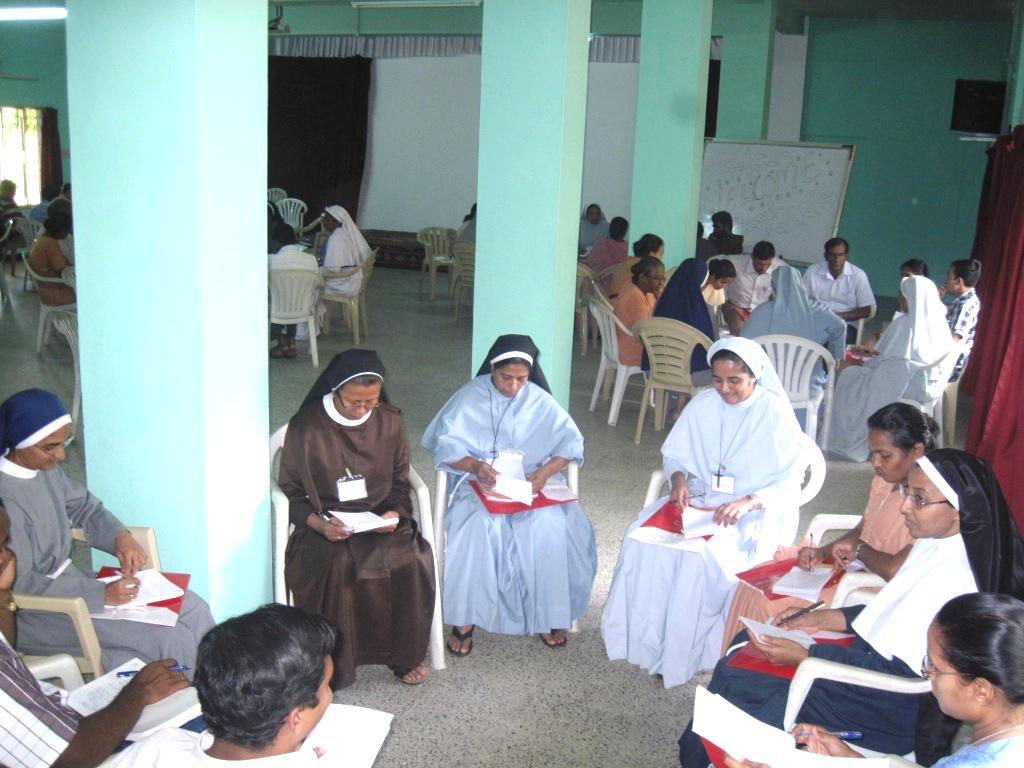
Plans for the year of Consecrated life: 2015 (Open to all Franciscans)

20

TOWARDS AN EFFECTIVE FRANCISCAN CONSECRATED LIFE TODAY

The Religious Congregations that follow the life and rule of St. Francis and St. Clare of Assisi are totally 52 with 165 Provinces with membership of around 50000 Religious priests, brothers and sisters. They are both cloistered and apostolic; serving through institutions as well as through their humble dwellings amidst the marginalised. Lot of Indian Franciscan Missionaries are spread out in Africa and other continents. There is still a great demand among the youth to follow Franciscan life.

The Association of Franciscan Families of India – AFFI has built up a strong structure at the National level, Regional/State levels and local levels. They come together for periodical reflections, seminars and updating their life of witness and Apostolates. The National executive council consists of the President Fr. A.J. Mathew OFM.Cap and Vice President Sr. Sinclare FCC, Secretary Sr. Apoline Cordiero UFS, Treasurer Fr. Praveen OFM.Cap and the National Programme Coordinator Fr. Nithiya ofm.cap. This team gathered in Mysore UFS house in Bogati on 18-19 October, 2015 and has come up with a plan for coming year.

The council reviewed the activities of the AFFI in the past one year of their four major National Training programmes, with follow ups at the Regional and Congregational levels. These workshops and seminars were focused on the Formators, Superiors, those in Educational apostolates, Health ministry and Social action. The council then focused on the forthcoming year of the Consecrated life, 2015. They are:

National Programme I: The Celebration of Franciscan Consecrated life and mission will be held in Veilankanni from 1-4 March, 2015 for all the provincials and their coordinators for the year of Consecrated life. This is a Training as well as live-in experience programme. The delegates from all over the country will be focusing on Vita Consecrata, Evanglii Gaudium, the document for the Year of Consecrated life.

21

National Programme-II: Renewal of Consecrated life based on the Rules and Manuals of Third Order Regular of St. Francis of Assisi. It will be held in Alwaye from August, 3-6, 2015 for all the Franciscan Religious following the Third Order of St. Francis. This programme is meant for Provincials, Those in charge of ongoing formation, Animators of Third Order, Retreat preachers, Franciscan Scholars etc

National Programme III: Campaign against Violence on women: This be held in September, 4th week in Bhopal for those involved in the apostolates of education, health and social welfare. The delegates will also focus on a strong network of Lawyers, Doctors, educationists, Inter religious leaders, Govt. Officials, NGOs, BCCs etc. at the national, Regional and local levels.

National Programme IV on Servant Leadership – Training & workshop based on the life and mission of St. Francis and St. Clare. This will be held in the first week of December, 2015 in Andhra or Goa. Special attention will be given to motivation, leadership skills, various types of leadership, prophetism, Servant leadership, Emotional Intelligence, etc.

Series of Regional Programmes at State level: Almost every state of India has a network of the Franciscan congregations. Soon after the first national programme, they will in turn come together to renew their consecrated life and mission through similar programme leading to concrete action plans in their apostolates. These will be held in their respective states and if needed in local language. These are focused on strengthening their vocation, witness and commitment to the poorest and the needy. A special focus will be to check on how to make our consecrated life effective in our Formation Stages, in the apostolates of Education, health and social welfare etc

-Nithiya ofm.cap,
National Programme Coordinator

xxxxx
Br. Nithiya ofm.cap
National programme Coordinator, Association of Franciscan Families of India – AFFI

Design a site like this with WordPress.com
Get started