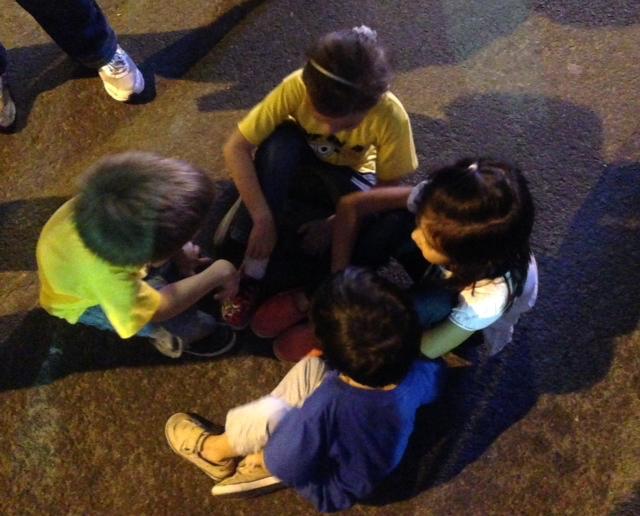
Everyone has their own story about how Pope Francis has moved them this weekend. For me this was when I heard what Pope Francis said to Iris Palomar, one of the street children at UST. In tears she asked the pope, “Why is God allowing bad things to happen, even if it is not the fault of children? Why are there so few people helping us?” Iris and many street children suffer from drugs, sexual abuse, hunger, prostitution, theft – numerous and daily injustices.
Pope Francis had no words to say, and the only answer he could give was a compassionate embrace for a child who had suffered so much. Then he told everyone gathered that “Only when we too can cry about the things you said can we come close to answering that question: why do children suffer so much?” Today’s world doesn’t know how to cry.
“If you don’t learn to cry”, the Pope said, “you cannot be a good Christian… Be courageous: don’t be afraid to cry.”
Tears will not remove world hunger. Tears will not protect children from abuse. But tears will let us suffer with them. To feel what they feel – in a mysterious but also real way.
On his flight back, Pope Francis recalled an ancient prayer begging the Lord for the grace of tears. And so we can pray with Pope Francis, “Lord, you who have made it so that Moses with his cane could make water flow from a stone, make it so that from the rock that is my heart, the water of tears may flow.”
Photos by Rocky Chan, Crissy Castillo, Shelli Manuel-Tomacruz,
Fr. Antonio Spadaro, SJ.
 When Pope Francis boarded the plane back for Rome, we were filled with mixed emotions: great joy and gratitude for having the chance to see him, at the same time, sadness that he was leaving our country.
At the moment, we are emotionally high and spiritually recharged. Yet soon, the “Pope fever” will gradually die down. So what happens next? Cardinal Tagle said, “The event (of the Pope’s visit) is so deep – so deep.
There is so much to reflect on, so much to pray over, so much to learn. And it is only in meditation, in prayer, in silence, that we can really get to the depths of the profound meaning of this event.” We can reflect on the Pope’s contagious smile, his gestures of humility, kindness and sincerity, and his messages on sanctity of family, caring for the poor, suffering, respecting women, corruption, among others We can reflect on the emotional plea “why God allows children to suffer” of a young girl, the six million people that trooped to Luneta despite the rain, the private plane carrying government officials that skidded off the Tacloban runway, and the father’s acceptance of the death of his daughter from a scaffolding collapse.
We need to make time and find a quiet place to pray each day. As Pope Francis said we need to “rest” in the Lord so that we can hear His voice and understand what He asks of us, especially from the pontiff’s visit. Once we have heard His voice, we must get up and act. This way, we bring God’s love to others through our love and good works. We become witnesses and missionaries of the joy of the Gospel, in Asia and the whole world.
The “Pope fever” will live on when we rest in prayer and use the three languages of the mind, heart and hands in harmony. Pope Francis has brought us “awesome sunshine to last us many lifetimes.”
Reference: Press Conference at Villamor Airbase (January 19, 2015); Pope Francis’ messages at Mall of Asia and UST and (January 16 & 18, 2015); Pope’s homily at Luneta (January 18, 2015); Speech of Archbishop Soc Villegas after the Luneta Mass (January 18, 2015 )
What a fitting theme after the visit of our Pope Francis to the Philippines, particularly for the victims of the Yolanda (Haiyan) storm in Tacloban and Palo, Leyte. Pope Francis said, among many things, that we have to use “the languages of the mind, the heart, and the hands” to effect a change in our Christian life.
The time is now to do this as we hear Jesus Christ in the Gospel of Mark: This is the time of fulfillment. The kingdom of God is at hand. Repent, and believe in the gospel.”
The first important element for becoming members of the messianic kingdom on earth is CONVERSION – a change of life from one of darkness (SIN) to one of light (GRACE). It requires one to be holy, a true return to God. Secondly, anyone in the kingdom of God BELIEVES IN and PRACTICES the message of Jesus Christ. This is the message of SALVATION which tells us how we were given ETERNAL LIFE in heaven which the coming of Christ on earth brought to us.
At the very beginning of Christ’s ministry, we know that he first disciples of Christ and later became apostles were Peter, Andrew, John and James. They were fishermen and they became “fishers of men.” The first disciples preached the good news of Jesus Christ about the eternal plan of God for the salvation of humanity. This was attained through the birth (INCARNATION), suffering (PASSION), DEATH, RESURRECTION, and ASCENSION of Jesus Christ.
If we accept the divine message of SALVATION and live by it, then we too are assured of our own resurrection. However, we know that as human beings, we are weak and mortal. This is when we need Divine Mercy and Compassion.
We know at times we fail and sin…we stray from the LIGHT and go to DARKNESS.
What Jesus Christ said to the people of Galilee applies also to us in this day and age. We need to repent.
What do we need to be truly repentant, thereby deserve the MERCY and COMPASSION of God!
1. Firstly, we accept we are sinners, no exception no matter what. Acknowledge our individual responsibility in our state of sin. We need to REGRET – be sorry for our commission of these sins. Honestly accept we failed Jesus Christ; that we need his MERCY ad COMPASSION.
2. We are responsible for the sins and/or wrongs we have done. There is a need for REPARATION or RESTORATION. This means we are willing and capable to make up for the damages or harm we have caused to others. Avoid RATIONALIZATION, JUSTIFICATION, and projection of GUILT to others.
3. RECONCILIATION. The estranged or broken relationships are mended or made whole again. This requires the humility of a little child – begging for FORGIVENESS from the wronged person/s and/or restoring the material thing or resources taken from the aggrieved person/s to the fullest extent possible. Our reconciliation with each other is a RECONCILIATION with God, the Father and our Lord Jesus Christ.
4. RENEWAL. Once we follow the above-mentioned three steps, we will then be led to a RENEWAL – there is a change within us that is reflected in a change of behavior. This means a new way of feeling things. Result? PEACE and JOY in our spiritual life. This then will to conversion.
5. CONVERSION. This is a change of direction – turning away from SIN (Darkness) and turning towards GRACE (Light). Many saints shared in personal stories that this is a continuing struggle in spiritual life. Even St. Francis of Assisi, from the moment he received a message from the Crucified Jesus in the San Damiano chapel “to rebuild his church,” continued on the process of conversion in the events of life till his deathbed. Conversion is a process that starts with the acknowledgement of SIN or WEAKNESS and then moving on with prayer, patience, and perseverance to overcome the SIN or WEAKNESS, not only through one’s effort but also with the help of Jesus Christ, through the power of the Holy Spirit.
We need CONVERSION to become faithful disciples of Jesus Christ. Hear the insight of St. Paul: “Time is running out.” The time is NOW! REPENT and BE FAITHFUL TO JESUS CHRIST.

BLESSED JOSEPH VAZ: MISSIONARY EXTRAORDINAIRE
1651 – 1711
January 16
His Dream
Can you imagine wanting to go to a place where there was not a single Catholic priest for halfa century because they were all expelled by the authorities, no Catholic churches and you were forced to send your children to Dutch Calvinist school? Well this was the situation in Ceylon, now called Sri Lanka that Blessed Joseph Vaz wanted to correct.
This situation came about in the sixteenth century through an arrangement with the papacy known as the Padroadao whereby the (Catholic) Portuguese crown enjoyed extensive jurisdiction over the local churches. But by the following century the Protestant Dutch came and seized most of Portugal’s Asian properties and the Catholic priests were expelled and fled.
Early Life
Joseph Vaz was born on April 21, 1651 at Benaulim, Goa (India) one of the few Portuguese enclaves left. His Parents who belonged to the Brahmin (upper) caste were Catholic converts who brought him up loving God. Because he loved to tend the village’s poor backward children his mother called him her “little saint.”
After Ordination
After ordination as a priest in 1676 because he was considered a “native” he could not join the mainstream religious orders who preferred priests of European blood.
So he travelled all over Goa barefoot as an Indian sanyasi. Because of his austere life style, perennially steeped in prayer, reflection and self-denial he was much sought after not only as a priest, confessor and preacher but as a friend. His great regard and respect for local customs endeared him to the people that he brought nearer to God.
So he could better be understood he learnt the local language Sinhala and so that his companions could do the same he compiled a dictionary (English – Singhala). Because his practice of the Christian faith drew rather than repulsed non-Christians to the faith his whole life came to be regarded as “an object lesson in missionary methods.” And because he treated all people the same irregardless of their rank or race he earned the distinction of being regarded as “the perfect model of an apostle.”
Devotion to Virgin Mary
He also earned another title as being the perpetual slave of the Virgin Mother of God” which he himself wrote in his “Letter of Bondage” a year after his ordination to express his phenomenal devotion to Our Lady. It was while in front of her statue that he wrote this letter pledging himself to be Mary’s slave and to do whatever her son Jesus wanted.
Pursuing His Dream
But Joseph never forgot his dream of going to Sri Lanka where the ruling Dutch Calvinists were attempting to eradicate Catholicism. So he asked permission from his superior to allow him to go and help rescue them. Unfortunately his request was denied and he was instead sent to the Capital Kanara (now called Colombo) as vicar apostolic where there was already a vicar apostolate occupying the seat hired by the Propaganda Fide. To solve the problem Joseph asked the vicar apostolate for conditional jurisdiction. When the archbishop died he asked to be relieved of his post.
Founds Institute of the Oratory, India
When he returned to Goa on September 25, 1685 he decided to join a group of Goanese clergy seeking to lead an ascetical life at the Church of the Holy Cross of Miracles. After helping them to adopt the Rule of the Oratorians founded by St. Philip Neri he became its superior and the founder of the Institute of the Oratory in India, the first ever indigenous institute in the Third World. This pioneering effort of his not only ensured Goa of a steady supply of priests but actually helped Joseph to continue his work in reviving the church in Sri Lanka and save it from complete extinction.
Leaves for Sri Lanka
Since the burning desire to serve the Catholics in Sri Lanka never left his soul fired by the Holy Spirit in 1606 he resigned his post as superior and left for Sri Lanka at the risk of his life. On the long dreadful crossing he learnt to speak Tamil. With a former family servant named John Vax they managed to enter Jaffna in the north of Sri Lanka where the Dutch East India Company controlled the ports and allowed no Catholic priests to land on the island.
In Sri Lanka
Disguised first as coolies (porters) then as beggars they went looking for surviving Catholics. When he found them he was impressed by how they had managed to preserve their faith through all kinds of hardships. By keeping him hidden in their homes and having secret meetings in the dead of night they managed for ten years to have the only priest in Sri Lanka. Going barefoot all over the island with a rosary round his neck he was priest, confessor, preacher and friend.
Imprisoned
In 1692 Joseph entered the capital city of Kandy as he had received a permit from King Vimaldharna Surya II. Unfortunately he was denounced by a Calvinist who accused him as being a spy and was thrown into prison for four years. There he learnt Sinhala. Because of the leniency showed him he even managed to set up a church dedicated to Our Lady in the prison grounds.
Accomplishments
When a serious drought took place in 1696 the Buddhist monks tried to obtain rain through their prayers but failed. So the King called on Joseph who erected an altar with a cross and placed it in front of the palace and began to pray. Torrential rains begun pouring down. Gratefully the Kind allowed Joseph to preach the Gospel everywhere and urged the Ceylonese to convert to Christianity.
Soon Oratorian missionaries began arriving from Goa. When an epidemic of small pox broke out they helped Joseph care for the sick. Once more the King and later his son gratefully allowed Joseph to establish the Catholic Church everywhere in Sri Lanka.

Working till his last breath Joseph was able to build 15 churches, 400 chapels with schools, dispensaries and hospitals all over Sri Lanka.
To communicate the truths of the faith Joseph translated the Church’s books and catechism into the native language. He also composed hymns and prayers in Singhalese and Tamil. He reached out humbly to communicate with the leaders of Buddhism and Islam. His work even reached the ears of Pope Clement XI who offered him a bishopric which he politely refused.
His Death
Tragically on a return trip to Kandy Joseph fell from the carriage and became seriously ill and died on January 16, 1711. The king declared a three-day mourning for him.
It is due to Joseph Vaz that there is a strong Catholic presence in Sri Lanka. The Catholic bishops said, “When humanly speaking there was no help possible from any quarter, God in his mercy sent us assistance in a most unexpected manner. He sent us an “apostle from India.”
His Beatification
The cause of his beatification began a mere two years after his death but because of politics, etc. it did not become a reality until 284 years later in 1995 when Pope Paul II himself beatified him in a special papal visit to Sri Lanka. Blessed Joseph Vax is indeed “one of the greatest missionaries Asia has ever produced.”
SOURCES of REFERENCE:
Butler’s Saint for the Day – pp 23 – 24;
Saint Companions – pp 30 -32;
Saints for Our Time – pp 36 – 37;
Lives of Saints – Part 2 – pp 120 – 125;
Saints of Asia – pp 23 – 24.
Noong ika-6 ng Disyembre, muling idinaos ang FOSA (Friends of San Antonio) Christmas party with Fr. Reu Jose C. Galoy, OFM, nasiyang nanguna sa opening prayer. Then followed by a raffle draw and parlor games. At ito’y dinalohan ng mga kasambahay na sakop sa parokyang SSAP. Halos tatlong daan na dumalo. Mula sa FOSA, taos puso po kaming nagpapasalamat sa lahat na support kay Fr. Reu at sa Parish Pastoral Council. Maligayang Pasko at Manigong Bagong Taon mula sa FOSA!
The Altar Ministry would like to thank Architect Conrad Onglao for his time and effort in preparing the advent wreath, main altar decorations and for the beautiful Belen Christmas season 2014. Together with Conrad, our heartfelt gratitude goes to Ms. Zsazsa Padilla and their staff for all the help they extended to us. Also to Mr. Onet Limchoc for the Belen shed. Thank you too to the Dasmarinas Village Association Office for lending us the star! Our Altar Ministry family is growing! Till next year!
The pastoral visit of Pope Francis to our country is indeed a blessing – a once in a blue moon opportunity especially for those who cannot afford to go and visit the Vatican City in Rome. I wonder who are those who will have the chance to get closer to the Pope and those who will be relegated to the sidelines. My only prayer is that after his visit there will be no story of people being given the special privilege due to Connection, Hype, Influence, Lobbying and Donation because to some extent this is blatant disregard to what Pope Francis wants as well as a betrayal to the theme of his visit, compassion and mercy.
The gesture of Pope Francis to be closer to people especially the poor is driven by his ability to see Christ among the least, last and lost. It is not an opportunity for Pope Francis to mingle with the ordinary people. It is rather a privilege for Pope Francis to celebrate with his flock as a shepherd, Christian faith-life together with the faithful amidst the struggles to living life lovingly and finding faith fraternally. Such an encounter is ministry in reserve – the condition of the faithful becomes the source of inspiration to the pope in exercising his office as servant-shepherd-steward.
Pope Francis is humbly and seriously taking his office as both an encounter and communion with God. Most often than not, positions of authority and function alienates the person holding it in name of protection and security and sometimes ending up as prisoner of it. That is why Jesus wanted people including children to have access to him and would like to teach his disciples to learn a lesson and all of us – our role is to help the people become closer to Christ than to us, including the Pope himself.
The powerful words of Jesus, “Amen, I say to you, whoever does not accept the Kingdom of God like a child will not enter it” (Mk. 10:15). Again, Jesus is making use of contrasting images to lead people to understand his point. The image of the kingdom connotes power and prestige. The child on the other hand, represents the inferior and insignificant. Jesus did so to convey his message that the basis to enter God’s kingdom is to be childlike which to me is a call and a challenge to be Compassionate, Humble, Inclusive, Loving and Dependent on God’s grace.
The child Jesus brought light into the world through his birth. May we also try to give birth to a CHILD-friendly environment in our parish and nurture it through sharing the light that Jesus brings in our homes and workplaces.
SSAP PAPAL MASS DELEGATION UPDATE
For those who have registered to join us for the Papal Mass in Luneta, we plan to meet at SSAP at 3AM on Sunday, January 18 and go to Luneta at 4AM sharp and wait it out until the 4pm mass. Pls. click and read this Primer-for-the-Papal-Mass carefully for specific instructions.
The Route plan tomorrow for Papal Mass delegates: Be driven to Philippine Sports Comm. From there, walk down Adriatico until Faura (past PGH), right on Faura and then left on Maria Orosa Ave.
Plan B: if we cannot enter Luneta, we will turn left and start heading towards Roxas Blvd, where pope francis will be passing.

_________________________________________________
CANCELLATION OF AFTERNOON/EVENING MASSES ON SUNDAY, JANUARY 18
In solidarity with all Philippine Churches and to show our fraternal support to the pastoral visit of His Holiness Pope Francis, afternoon/evening masses 4:30PM and 6:00PM in the main church and 7PM in Urdaneta Village have been cancelled on Sunday, January 18.
Please come to the anticipated masses scheduled on Saturday, January 17 or the morning masses on Sunday, January 18 to fulfill your Sunday mass obligation. Thank you for your kind understanding!
_________________________________________________
LIVE BROADCAST FEED AT
ST. BONAVENTURE, CONVENTO HALLWAY
A live broadcast feed of the Papal mass celebrated by The Holy Father Pope Francis on Sunday, January 18 from 3PM will be held at the St. Bonaventure in the Convento Hallway. Pls. note that this DOES NOT fulfill the Sunday mass obligation and NO communion will be distributed.
Categories
Saints of the Week
January 15
St. Arnold Janssen
Arnold Janssen, a German diocesan priest, founded the Society of the Divine Word in 1875, the Holy Spirit Missionary Sisters in 1889, and the Holy Spirit Sisters of Perpetual Adoration in 1896. The mission of the priests and Brothers of the Society of the Divine Word and the Holy Spirit Missionary Sisters is to proclaim the Gospel where it has not yet been heard or has not been proclaimed adequately. The mission of the Sisters of Perpetual Adoration is prayerful support for the missionaries.
January 16
Franciscan Martyrs of Morocco
During the General Chapter of 1219 Francis sent a group of six friars to the missions of North Africa. Their names were Vitale, Berardo, Pietro, Accursio, Adiuto and Ottone. Vitale, the superior, fell sick in Spain, and had to abandon his resolve to go to Morocco to evangelize the moors. The others proceeded under the leadership of Berardo. They first went to Seville, in southern Spain, which was occupied by the moors, and preached Christ publicly. They were taken in front of the emir, who gave them freedom to proceed to North Africa. They crossed over to Morocco, and preached in front of the king Miramolin. The king expelled them from his country, but they returned in their resolve to preach the Christian faith. On 16 January 1220, after cruel torments, they were slain by the king himself. Pope Sixtus IV canonized them in 1481. The account of their martyrdom is found in Analecta Franciscana III, pp. 579-596.
References: Franciscan Saints and Mystics; Society of the Divine Word.
 Santuario de San Antonio Parish