Categories
Special Events

SSAP EMPLOYEES’ OUTING 2015 by Edgar Sanchez, SSAP Consultant for Property and Facilities Management

This slideshow requires JavaScript.


Last April 13 and 14, 2015 we finally pushed through with our much-anticipated employees’ outing. It was this time of the year wherein all employees and 3 OFM priests, namely, Fr. Reu Jose C. Galoy, our Parish Priest, Fr. Tasang Obico, our Parish Guardian and Fr. Serge Santos, our resident priest attended the event. Our destination was the Little Bridge Resort and Reflection Center in Lemery, Batangas. A 2-hour drive from SSAP, the resort boasts of several facilities like mid-size swimming pools, a beachfront, air-conditioned apartments, cabanas, huts, a basketball court a dining area and several spacious open areas used to hold team buildings and religious activities.

We started the day with a mass officiated by Fr. Serge Santos. Fr. Reu proceeded with the announcement of the 2-day sports activities and games. Distribution of the SSAP T-shirts with the the 40th anniversary theme was done in preparation for the sportsfest and fun games. The group was divided in two, the Green Team and Yellow Team. Each team battled for the most number of points garnered in basketball and volleyball. Winning points were likewise added to the total score of the group for the fun games which were facilitated by Nimfa and Jackie. Fr. Tassang also joined both the mini sportsfest and the battle of the videoke singers with Fr. Serge. The Green Team eventually won.

After dinner, a mini raffle/bingo was presided by Fr. Reu wherein Ms. Estrella Magnaye and Benjie Oriol won a twin-tub washing machine and mini refrigerator respectively. Another highlight of the occasion was the recognition given to our resident cook, Mr. Rey Benusa for his 27 years of employment with SSAP.

It was a most memorable and fun-filled activity that most of us believe is a heavenly way of recharging our weary minds and hearts through these bonding moments that everyone looks forward to every year.

Many, many thanks to our beloved parish priest, Fr. Reu, the architect of this very noteworthy and motivational event. We also extend our utmost appreciation and gratitude to all parishioners, friends and donors who, in one way or another made a significant contribution in order to make this event a very unforgettable one. Maraming salamat po! God bless you all! 1 FAITH, 1 PARISH & 1 FAMILY

Categories
Health Care Ministry

THE HEALTH CARE MINISTRY OF SANTUARIO DE SAN ANTONIO PARISH By Pia Gomez-Chuidian

We all know about the importance of good health. In order for us to know and understand what goes on in our bodies as well as how our mind and heart functions, it is important to keep up with the different ways in which we can take better care of ourselves. Being physically well, as well as emotionally healthy, is of prime importance not only for ourselves but also for our loved ones. All of us come from a family and most of us take care of our family in the best way possible. This can only be achieved if we are aware of what really goes on inside us as well as how our emotions play an important part to staying well and maintaining a healthy life style.

We at the Health Care Ministry provide educational as well as practical talks for our parishioners, among other services, in order to help each person create a productive, healthy and fulfilling life style. Our second talk for this year was on STRESS: A Journey to Emotional Wellness. Each and every person undergoes stress in many different ways. The talk zeroed in on the How to understand stress. What are the factors in our life that contribute to stress? What are the different types of stress/stressors? How can we cope and what life skills can we practice in order to deal effectively with stress in order to provide not only physical but also emotional balance and well-being?

Our speaker Ms. Milagros R. Reyes, PhD. is a licensed Psychological Counselor in areas of Marriage and Family, Addictions After Care, Co-dependency, Stress Management, Career Counseling, Job Consultant, etc. She is also a certified training facilitator for the Central Bank of the Philippines since 2005 and a certified consultant trainer in Human Organizational Development for Inter Care Health Care Services since 1997 as well as other civic and church organizations, local and multinational businesses.

Categories
Fr. Reu Galoy

“Love one another as I have loved you.” A Sunday Reflection, 5th Sunday of Easter B By Fr. Jesus Galindo, OFM

During the early centuries of the Church, when Christians were being persecuted and martyred, some of them offered to die in place of others (just like St. Maximilian Kolbe did during World War II in the concentration camp of Auschwich). The pagans were amazed at this and remarked, “See how they love one another.” Reading today’s papers or watching the news on TV, all we can say is, “See how they kill one another. See how they cheat one another. See how they insult one another.” (Wait till the electoral campaign begins.)

The great Mahatma Gandhi, when asked to express his views about Christianity, said: “ I have great respect for Christianity. I often read the Sermon of the Mount and have gained much from it. I know of no one who has done more for humanity than Jesus. However, the trouble is with you, Christians. You do not being to live up to your own teachings.”Another Hindu monk who read the story of Jesus in the gospel said to a Christian: “If you can live what is taught in this book, you will convert the whole of India in five years.”

Of course, not everything is dark and negative about us. There are also some good things going for us. Fr. Joseph Dau Vu, SVD, chaplain to Vietnamese refugees in Morong, Bataan, tells how the “boat people” were abused, robbed and even killed by fishermen from neighboring countries. But when Filipino fishermen spotted them, they offered them food and shelter. Why – they wondered? Because they are Christians. (Cf. Bel San Luis, SVD, Word Alive, Year C. p. 57)

“I give you a new commandment: love one another.” Jesus made this pronouncement in his farewell discourse, during the Last Supper. Hence, it is his last and most urgent wish. As if he were saying: “I am going now. You might forget all the other things I did and said. Just don’t forget this one. This is the summary of everything I have told you.” And so it is indeed; for this is what our final “exam” will be about: Not about doctrines, not about catechism, not about the Bible, but about LOVE: “I was hungry and you gave me food. I was thirsty and you gave me drink.” Etc.

Why is this commandment called new? What is new about it? Love of neighbor is found in the Old Testament: “You shall love your neighbor as yourself.” (Lev.19:18) All other religions (Hinduism, Buddhism, Islam) teach about love also. What, then, is new in Christ’s commandment? “As I have loved you,” that’s what is new. Our love has to be like Christ’s, that is, sacrificial. Not emotional, not romantic, but self-sacrificing – to the point of death.

Love means different things to different people. It is perhaps the most used and abused word in the dictionary. In the name of love, young lovers elope, or steal. In the name of a newly-found “love” some spouses abandon home and children. That might be passion, infatuation or lust; but certainly not Christ’s love.

“This is how all will know that you are my disciples, if you have love for one another. ”We usually recognize people by their uniform or attire, by which we can tell whether a person is a doctor, a policeman or a security guard. In church we wear habits, pins or crosses. We know well, however, that these external symbols can be quite deceiving. We often hear stories about truants disguised as priests, policemen, collectors etc. whose sole purpose is to extort money.

Christ did not choose any external mark or symbol to identify his followers. Love is, or should be, the mark of our identity, our uniform and our habit. We may wear crosses or pins, recite rosaries and novenas, receive holy communions, etc. If then we go home and abuse or insult our household help, our yayas, our drivers…we simply are not true disciplesof Christ. Discipleship is not a matter of external attire; it is a matter of a loving heart.

About Fr. Jesus and his other reflections…

Categories
Random Thoughts by Peachy Maramba

R A N D O M T H O U G H T S Voices from yesterday and today. . . by Peachy Maramba

st1

ST. ZITA: PATRONESS of DOMESTIC WORKERS
1218 – 1278
April 27

Her Early Life
Even a servant can become not only a saint but also a patroness of people like her and other domestic workers!

The fact that Zita (surname unknown) was born to an extremely poor farm labourer in Bozzanello, Mon-sagrati near Lucca, Italy did not prevent her from becoming as devout as the rest of her family. In fact her elder sister was a Cistercian nun and her uncle Graziano became a hermit whom the local people regarded as a saint.

Growing up in such a household it is no wonder that besides going to daily mass Zita was ever ready to obey and do God’s will as pointed out by her devout mother who taught her not only how to pray but how to discern right from wrong. Zita consoled herself with the knowledge that if they were extremely poor there were certainly a lot more people worse off than they.

Her Life as a Domestic
When she was just twelve years of age her career and life as a domestic servant began. Hired by Pagano di Fatinelli, a well-to-do weaver in the Tuscan city of Lucca, Italy who lived just eight miles from her native village of Monte Sagrati,the family were so overjoyed that she had landed such a prized position in such a rich household that they brought along with them a basket of fruit to thank them.

Her Troubles
While Zita was so happy at the fact that her new home was just next door to Lucca’s basilica still all was not easy sailing for her. First of all because the city was soon put under an interdict so all churches were closed. So for the next three years Zita had to walk 1.5 miles to Pisa to attend mass. Then the other servants in the house initially resented the fact that because Zita was so hardworking and industrious she made them all look bad. However Zita deeply believed in the adage that, “A servant is not pious if she is not industrious: work-shy piety in people of their position is sham-piety.” She also regarded her job as her Christian vocation.

Besides resenting her diligence and conscientiousness as a silent reproach to themselves they also disliked her for her holiness, austerities and abhorrence of foul language. Thus for some time they succeeded in even prejudicing her employers against her. However she endured every contempt, calumny and trial uncomplainingly with great meekness and patience so that eventually her humility and attitude of forgiveness overcame their enmity.

Instead of eating all of the good food that she was meant to eat or even eating anything at all she would save the great portion of it to give away to the beggars and poor folk of Lucca. Once more at first her fellow servants would make fun of and laugh at her piety and kindness but in the end she won them over and even gained their admiration.

As to her relationship with her employers understandably in the beginning they were upset by her gifts of food to the poor and destitute. Once when there was a local famine Zita had secretly given away much of the family’s store of beans. Unbelievably when her master made a surprise inspection of the kitchen cupboards the beans had been miraculously replaced to the utter relief of the terrified Zita. This was just the first of several miracles that figured in her life.

Besides bearing the cruel insults of her master and the bullying tactics of her mistress and the continued harassment of the children Zita remained ever patient, kind, faithful and sweet of character.
Her Rewards

Finally realizing what a pearl they had in Zita one by one they began to regard and treat her differently. She was entrusted with the care of the whole household, became their close confidant and could even cure her master’s loss of temper with just a look.

Because they all now realized the value of her presence in the household she was allowed to rearrange her time to give her more time to visit the sick and those in prison.

More and more people began to hear of Zita – her good works and even the supernatural heavenly manifestations that appeared to her. Not only did angels supposedly bake her bread while she was busy praying, but even the water in the pitcher that she intended for some pilgrims, turned into wine. It’s no wonder that even the prominent people sought her out.

A Most Phenomenal Experience
But the most phenomenal experience she ever had happened one Christmas Eve after the interdict had been lifted.

Her master upon seeing Zita leave home to go to mass on that freezing Christmas Eve hurriedly followed her and insisted that she borrow his fur overcoat. Of course he told her to be sure to take good care of it.

But when kind-hearted Zita saw this shivering poor old beggar standing outside the church door she unhesitatingly took it off to lend it to him. Imagine her horror and dismay when she couldn’t find a trace of him after the mass!

Naturally her master was visibly irate and extremely furious when he saw her come back without his coat. Some stories say that as he sat down to his Christmas dinner (others say the next day) a stranger – an old man – came to return the fur coat to Zita and then quickly vanished. Since then the portal of the church of St. Frediano, Lucca where he first appeared became known as the “Angel’s Door” or “Angel Portal”.

Her Death and Canonization
Zita was to remain the rest of her life (48 years) with the Fatinellis. When she became fatally ill on April 27, 1278 her now foster family wanted to lavish her with luxuries but she steadfastly refused.
st
However on the night she died at the age of 60 after having served the same family for forty-eight years,the mansion was all lit up by a star as if it were the middle of the day. People took this to mean that Zita was already in heaven and so they acclaimed her already as a saint.

Canonized on 5 September 1696 by Pope Innocent III St. Zita became the patron of domestic workers on 26 September 1933. If you’re losing your keys try calling on her to help you.

St. Zita is also the patron of housewives and waiters. She is venerated for her devotion (being a lifelong servant) and for her care of the poor and condemned convicts.

It is said that if you visit Lucca in the spring you will find the city abloom and fragrant with daffodils. This is supposedly in honor of St. Zita. Her body still lies in the church of San Frediano at Lucca which she attended so regularly during her lifetime.

SOURCES of REFERENCE
ST. ZITA

April 27

Butler’s Lives of the Saints – Vol. II pp 173 – 174
The Illustrated World Encyclopedia of Saints – pp 90, 91, 247
Pocket Dictionary of Saints – p 516
The Watkins Dictionary of Saints – pp 254 – 255
A Calendar of Saints – p 80
Illustrated Lives of the Saints – Vol. I pp 179 – 180
Saint Companions – pp 152 – 153
The Big Book of Women Saints – p 129
Saints – A Visual Guide – pp 224 – 225
The Everything Saints Book – p 270
Book of Saints – Part 7 – pp 10– 11

Categories
The ABC’s of Catholic Doctrine

The ABC’s of Catholic Doctrine By Lianne Tiu

abc
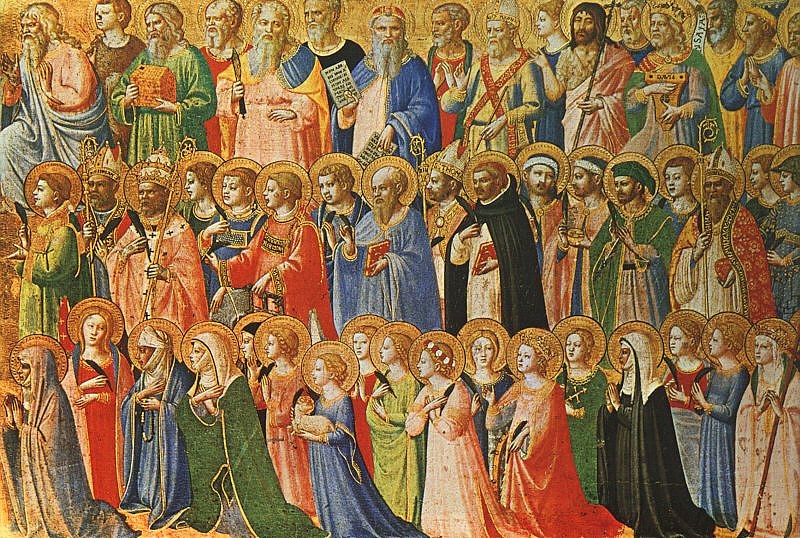
Not all can become rich, wise,famous, … yet, all of us are called to be saints!

Our Lord wants all of us to be saints. He asks all men and women, without exception, to be perfect as His heavenly Father is perfect (Mat 5:48)

To be holy is to be a good Christian. It is to make our actions consistent with the demands of our faith. It is to resemble Christ. It isn’t easy, but it isn’t difficult either. Our Lord gives us graces to achieve it; although He needs us to cooperate with them.
abc1
The main thing we are asked to do is to love: “charity is the bond of perfection” (Col3:14). We are asked to love the Lord with our whole heart, with our whole soul, and with our whole mind. (Mat 22:37)

To love and serve God, there is no need to do anything strange or unusual. Although some of us are called to the religious (or consecrated) life, majority of us are called to be holy in the middle of the world. We try to sanctify ourselves in the midst of our ordinary work and duties, doing them the best we can for love of God.

To love God more, we have to get to know Him through prayers and in reading and contemplating His life in the Gospels.
abc3
We cannot achieve holiness in a stroke. We will commit many mistakes and sins along the way; but this should not discourage us. We begin again each day in our struggle until the moment of our death.

St. Josemaria wrote: “Don’t wait until you are old to start becoming a saint. That would be a great mistake! Begin right now, in earnest, cheerfully and joyfully, by fulfilling the duties of your work and of your everyday life.
Don’t wait until you are old to become a saint. Because — I insist — apart from its being a great mistake, you never know whether you will live as long as that.”
(The Forge # 113)
abc3
(Reference: “On Retreat with St. Josemaria Escriva” by John O’Dogherty; “The Way; Furrow; The Forge” by St. Josemaria Escriva; “Novo Millennio inuente” by St. John Paul II)

Categories
Articles

SSAP 40th Anniversary Declaration as a Parish Community Gathering by Jayme Blanco

This slideshow requires JavaScript.


Last 15 April 2015, our parish kicked-off the 40th Anniversary Declaration as a parish of Santuario De San Antonio with a community gathering at the quadrangle after the 6PM mass where parishioners get together with drinks and food booths. Also, our parish priest Fr. Reu Galoy introduced the 40th anniversary prayer and the new logo.

The original Santuario De San Antonio was located in the walled city of Intramuros, Manila but was destroyed during WWII. The Ayala family thereafter donated the current parcel of land to the Franciscans and in 1953 the church was built. But it was only on April 16, 1975 that the Archdiocese declared the church as a parish. The importance of the aforesaid is that all the sacraments can be celebrated as defined by the juridical boundaries.

Anniversary activities for the year includes the Manila Symphony Concert on June 11, 2015 with Vocalismo, the installation of the relic of St. Anthony on June 13, 2015 and Fund Raising projects for the continuity of the outreach programs for our less fortunate brothers and sisters.

We would like to thank the following parishioners for giving their time for the sharing interview: past PPC Presidents – Manny Dizon, Petrona Lim, Joey Soriano, Randy Limjoco and wife Cecile. Jose Mari and Mary Ann Chan, Jolly Gomez, Rocky Chan, Ria Campos, Mimi Morelos, and PPC Vice President Edmund Lim. Further, we would like to thank food booths: Aling Nene’s by the Secular Franciscan Order, Melo’s Steak House (7712288), Koyen Dela Cerna’s Paella (0917.814.6124), and SSAP Single Young Adults (SYA) drinks and dessert booths. Special mention to Janine Puno for the logo design, VT Roman for the photos, Robert Espiritu, Alli Raval, Jonathan Cruz and Pisha Banaag for assisting in organizing the event.

Categories
Family and Life Ministry

My “Salubong” Experience By 10 years old Yani Ledesma

This slideshow requires JavaScript.


It was my first time to do this so I was a bit nervous. But when I made new friends, it became more fun. I was really happy that I had friends to talk to while waiting. We had to learn Latin verses and different tunes. It was hard at first, but after a few practices, I got to learn it and remember it easily.

I am thankful that I had the chance to do this. It was my way of thanking and showing my love to Jesus.

Yani Ledesma was one of the soloists during the Angels Salubong held just this Holy Week.

Categories
Fr. Baltazar Obico Reflections

Good Shepherd, SUNDAY GOSPEL REFLECTION 4th Sunday of Easter By Fr. Baltazar Obico, OFM

The English language uses the word “herd mentality” – it comes from the pastoral setting of tending the sheep. It means a mindless grouping/congregation of people very similar to our political phenomenon called HAKOT system, where people are grouped together in a place not knowing why they are there in the first place, except that everybody is there. The basic disability of the sheep is its lack of vision, hence it is almost half blind. Therefore their security is being together. Their sense of smell is their source of action. No other reason except vulnerability and survival instinct put them together.

Today the fourth Sunday of Easter, the image of the shepherd and the sheep dominate the readings from Psalm 100 to the second reading: Revelation 7 from the gospel acclamation as well as the very short gospel proclamation John 10:27-30. The early church has no symbol including the cross more prominent than the Good Shepherd. There is no better image to illustrate the intimate nature of our relationship with God than the image of shepherding.

When the image of the sheep is applied to us it signifies dependence, that we are weak and in need of help. Sheep are not endemic to us except those who get to eat roast lamb in fine dining places. It may not occur to us that the sheep are the dumbest of all animals. They go to the gullies, become entangled in brambles, fall into ditches and wander into predators’ territory. It is because they do not know any better, they could hardly see. No domesticated animal is as defenseless. A dog has enough intelligence to find his way home. (Remember Japan’s Hachiko.) It has some acute sense of smell and hearing to find food; it can defend itself against other animals or run away from one if need be. A cat is a loner with enough cunning to take care of the worst situations. It has been said that cats have nine lives (Harold Buetow).

It is neither of those ways with the sheep. It is so trusting that he mistakes anybody as his shepherd including the marauders. It can be beaten black and blue, bloodied without giving a fight or signs of pleas for help. Hence we hear the expression “like a lamb led to the slaughter.” No groan, no sigh, only tears in its eyes when it is being slaughtered. This is how vulnerable the sheep is with out a shepherd to guide him to the grazing lands and protect him from the predators.

For us to admit that we are sheep is to put our trust completely, unreservedly in Jesus, the Good Shepherd. The relationship between this kind of shepherd and his sheep is a power of connectedness, of empathy. The relationship between the Good Shepherd and his sheep is so intimate that it is an extension of the relationship between the Father and the Son. The Father’s omnipotence is the guarantee of Jesus’ promises; his promise of eternal life, that we shall not perish, that no one can take us out of his hands as promises to his flock that can be fulfilled by the Father. With him we shall not only “never perish,” not only protected from danger and harm, but will be led to eternal life where we would not want anything for God is the only necessity in our life.

1. Like sheep, we are almost half blind. We would not be able to see what lies beyond the horizon that awaits us. Neither can we see the dangers around us trying to exploit and mislead us. It is Jesus alone who can lead us to the eternal pasture. The grind of daily life can lull us to contentment and we lose sight of the beyond. We can get so engrossed with daily cares and concerns that we are not able to see the marvelous future ahead of us.
2. Jesus is not only content in giving us the vision. Aside from images of security of giving us the basic necessities, he leads us to the right paths, to mean all danger averted. At the moment of greatest danger, God still provides, thus the Psalmist can say “fear no evil.” God’s scepter/rod connotes royal authority hence his guidance and provision are reliable because God is sovereign. Jesus as Good Shepherd will put his life at risk in the face of danger.
3. The caring and tending of the sheep includes knowing the sheep personally, each by name. An intimate relationship between the Good Shepherd and the sheep binds them in an inexplicable way, The shepherd knows each one. Who is missing, who is sick, who has no appetite. There is no stranger in the flock. We are all known. None should feel she/he is unrecognized. But more than recognition, knowing means involvement in our lives.

In this age where many communities, neighbors are strangers to one another, whose neighbors scarcely know the name of those living next door and when many in fact seek anonymity, let us put away our isolation and alienation. Let us start hearing the voice and follow the Good Shepherd that we may become one flock where one knows and is known in the process.

About Fr. Tasang and his reflections…

Categories
Articles

CATECHISM OF THE CATHOLIC CHURCH

Why is the Church holy?
The Church is holy, not because all her members are supposedly holy, but rather because God is holy and is at work in her. All the members of the Church are sanctified by Baptism.

Whenever we allow ourselves to be touched by the Triune God, we grow in love and become holy and whole. The saints are lovers not because they are able to love so well, but because God has touched them. They pass on the love they have received from God to other people in their own, often original way. Once God takes them home, they also sanctify the Church, because they “spend their heaven” supporting us on our path to holiness.

Why is the Church called catholic?

“Catholic” (Greek kat’ holon) means related to the whole. The Church is catholic because Christ called her to profess the whole faith, to preserve all the sacraments, to administer them and proclaim the Good News to all; and he sent her to all nations.

Who belongs to the Catholic Church?
Anyone who, in union with the Pope and the bishops, is united to Jesus Christ through profession of the Catholic faith and reception of the sacraments is in full communion with the Catholic Church. [836-838]

God willed one Church for all. Unfortunately we Christians have been unfaithful to this wish of Christ. Nevertheless, even today we are still deeply united with one another by our faith and common Baptism.

What is the relation between the Church and the Jews?
Jews are the “older brethren” of Christians, because God loved them first and spoke to them first. Jesus Christ as man is a Jew, and this fact unites us. The Church recognizes in him the Son of the living God, and this fact separates us. In awaiting the final coming of the Messiah we are one.

The Jewish faith is the root of our faith. The Sacred Scripture of the Jews, which we call the Old Testament, is the first part of our Sacred Scripture. The Judeo-Christian concept of man and morality, which is informed by the Ten Commandments, is the foundation of Western democracies. It is shameful that for hundreds of years Christians were unwilling to admit this close relation to Judaism and for pseudo-theological reasons helped foment an anti-Semitism that all too often had lethal effects. During the Holy Year 2000, Pope John Paul II expressly asked forgiveness for this. The Second Vatican Council clearly states that the Jews as a people cannot be charged with any collective guilt for the crucifixion of Christ.

How does the Church view other religions?
The Church respects everything in other religions that is good and true. She respects and promotes freedom of religion as a human right. Yet she knows that Jesus Christ is the sole redeemer of all mankind. He alone is “the way, and the truth, and the life.” (Jn 14:6)

Whoever seeks God is close to us Christians. There is a special degree of “affinity” to the Muslims. Like Judaism and Christianity, Islam is one of the monotheistic religions (monotheism). The Muslims, too, revere God the Creator and Abraham as their father in faith. Jesus is considered a great prophet in the Qur’an; Mary, his Mother, as the mother of a prophet. The Church teaches that all men who by no fault of their own do not know Christ and his Church but sincerely seek God and follow the voice of their conscience can attain eternal salvation. However, anyone who has recognized that Jesus Christ is “the way, and the truth, and the life” but is unwilling to follow him cannot find salvation by other paths. This is what is meant by the saying, Extra ecclesiam nulla salus (outside of the Church there is no salvation).

What happened on Pentecost?
Fifty days after his Resurrection, the Lord sent the Holy Spirit down from heaven upon his disciples. The age of the Church began.

On Pentecost the Holy Spirit transformed fearful apostles into courageous witnesses to Christ. In a very short time, thousands had themselves baptized: it was the birthday of the Church. The miracle of the languages on Pentecost shows that the Church is there for all peoples from the very beginning: She is universal (= the Latin term for the Greek kat’ holon, catholic) and missionary. She speaks to all men, overcomes ethnic and linguistic barriers, and can be understood by all. To this day the Holy Spirit is the “soul” of the Church, the essential principle of her life.

What does the Holy Spirit do in the Church?
The Holy Spirit builds up the Church and impels her. He reminds her of her mission. He calls people into her service and sends them the necessary gifts. He leads us ever deeper into communion with the Triune God.

Even though the Church during her long history has often seemed “abandoned by all good spirits,” the Holy Spirit has been at work in her despite all the human failings and inadequacies. The mere fact of her two-thousand-year existence and the many saints of all eras and cultures are the visible proof of his presence. The Holy Spirit is the one who maintains the Church as a whole in the truth and leads her ever deeper into the knowledge of God. It is the Holy Spirit who works in the sacraments and brings Sacred Scripture to life for us. Even today he gives his gifts of grace (charisms) to those who are completely receptive to him.

What does the Holy Spirit do in my life?
The Holy Spirit makes me receptive to God; he teaches me to pray and helps me to be there for others.

Augustine calls the Holy Spirit “The quiet guest of our soul.” Anyone who wants to sense his presence must be quiet. Often this Guest speaks very softly within us and with us, for instance, in the voice of our conscience or through other interior and exterior promptings. Being a “temple of the Holy Spirit” means being there, body and soul, for this Guest, for God in us. Our body is therefore God’s living room, so to speak. The more receptive we are to the Holy Spirit in us, the more he becomes the master of our life, the sooner he will bestow on us even today his charisms for the upbuilding of the Church. And so, instead of the works of the flesh, the fruits of the Spirit grow in us.

Categories
Articles

R A N D O M T H O U G H T S Voices from yesterday and today . . . by Peachy Maramba

Untitled

ST. ANSELM OF CANTERBURY: Father of Scholasticism
1033 – 1109: April 21

Early Life
St. Anselm was born of a noble Old Burgundian family in Aosta, northern Itaty in 1033. Deeply influenced by his pious mother Ermenberga St. Anselm knew even at the early age of 15 that he preferred the monastic life over the career in politics that his father, Gundolf, a Lombard nobleman, and landowner had chosen and insisted on for him.

Prevented from his dream by his father’s opposition and his consequent non -acceptance by the monks in an abbey where he was born due to apprehension of his Father’s displeasure, Anselm lost interest in religion and instead led a worldly and dissipated life. When his mother died Anselm who could no longer stand the harshness of his father left home. He bided his time and instead furthered his education. So intense were his studies that it caused him ill-health which was to plague him in his later years. He received such an excellent classical training that he became one of the best Latinists of his day.

Anselm finally realized his dream when he took his monastic vows in 1061 at the age of 27 in the Benedictine monastery of Bec in Normandy, France where he went attracted by the fame of its great abbot Lanfranc whose pupil, disciple and friend he became. Within just a span of three years he was made Prior because of his outstanding learning. When many of the monks resented his appointment because he was much young than them, he won them over with his gentleness, firmness and teaching skills.

Great Educator
A great believer in education, Anselm had very modern views regarding the training of the youth. He believed that no educational method should deprive the young of any freedom. He tried to instill in the other monks the great teaching skills he possessed and to lead their students by loving exhortation and wise example rather than by punishment or harsh discipline. It is no wonder that under Anselm Bec became an excellent monastic school famous for scholarship.

In 1078 when the saintly founder of the abbey of Bec died the monks unanimously chose Anselm as their abbot which he very reluctantly accepted.

Original and Creative Thinker
But it is as one of the world’s greatest and most important original independent and creative thinkers of his age that Anselm made his mark in theology and philosophy making him the greatest theologian of his age and “father of Scholasticism”. His new ideas and new approaches placed him as one of the most important “luminous and penetrating intellect” between Augustine and Thomas Aquinas.

In Theology
But it is Anselm’s contributions as a theologian that earned him a place in history. Anselm’s masterpiece and his most famous work in theology is Cur Deus Homo (Why God Became Human). The book explains the wisdom, justice and necessity of the Incarnation. It is not only an exposition of the doctrine of the Incarnation but the most famous treatise on the Incarnation ever written. According to Anselm because Adam had infinitely offended God the guilty party which was humanity had to pay the price. Therefore our Redeemer had to combine the natures of God and man. Thus Christ, the Savior of mankind, is both God and man.

Furthermore the book is the classic treatment of the Redemption.

His first book Monologium (1077) is essentially a restatement of all the logical metaphysical arguments he could find in writings by other theologians that God truly exists. It is claimed that in theology there is nowhere a more penetrating study of the divine essence and attributes of God.

In Philosophy
Historians regard Anselm as the first of the scholastic philosophers. These were philosophical and religious teachers of the Middle Ages who pressed philosophy into the service of theology in its effort to reconcile the claims of faith and reason. Thus Anselm is best remembered for his efforts to “derive Christian doctrine from pure logic.” And he is known as “the Father of Scholasticism for his efforts to analyze and illumine the truths of faith through the aid of reason.”

Many experts in philosophy consider Anselm to be the author of the ontological argument for the existence of God. He declared that “God is a Being than which nothing greater can be conceived. Moreover a Being that exists in fact is greater than one that exists only in thought. Therefore God necessarily exists.”

This ontological proof of God’s existence is found in Chapters 2 and 3 of his second book Proslogion or Prologue (1078). In this book, too, he defined the task of theology as “faith seeking understanding” because he firmly believed that theological understanding was ultimately rooted in the gift of faith. In his plan to use reason to better understand the truths of faith. “Faith seeking understanding” because Anselm’s life theme.

A believer in the beauty of perfection Anselm maintained that God exists as the source of our perfection and our ideas of perfection. This reasoning had a great impact and influence on many thinkers after him right up to today. However others such as Thomas Aquinas and Kant rejected it.

To this day Anselm is remembered as “an intellectual and philosophical man.”


In Psychology and Other Fields of Learning

One of the most creative and forward-looking thinkers of his age Anselm investigated and wrote on free will, truth, the immortality of the soul, the ability to reason in his investigation of even divine mysteries and on faith. Thus his formula could very well be: “I believe so that I may understand; I understand so that I may believe.” Faith enlightens reason while reason aids faith by answering objections, defining terms and providing proofs. For Anselm faith was also the precondition of the right use of reason. Having therefore been informed by faith we are aided to understand revealed truth.

However another important component of his understanding and faith was LOVE. It helped him become not only an effective brilliant writer but more importantly a profound and original thinker.

Archbishop of Canterbury
In 1093 compelled against his wishes Anselm became archbishop and primate of England. Since it was a time of great dispute with then King William Rufus over the independence of the church Anselm spent most of his time and energy defending the rights of the Church against royal aggression. For this fact he became known as one of the most “strenuous defenders of the rights of the Church against the usurpation of kings.” In fact because of this feud with the tyrannous king Anselm was exiled several times only returning back to Canterbury for the last time in 1106.

In 1102 at a council in Westminster called by Anselm to resolve this never ending dispute, a far reaching and remarkable resolution came up denouncing the slave trade. Anselm stands out in history as one of the first high ranking official to denounce the buying and selling of human beings.

When Anselm died in 1109 he had spent at least his last two years in peace.


A Saint and Doctor of the Church

This compassionate, charming, sincere, loving and highly intellectual man was canonized in 1494. Clement XI declared him a Doctor of the Church in 1720 called by the introduction of the Encyclical “Doctor Anselm of Aosta, most vigorous exponent of the Catholic truth and defender of the rights of the
Church. . .”

His feast day is celebrated on April 21, the day he died.

SOURCES of REFERENCE
ST. ANSELM of Canterbury

April 21

Butler’s Lives of the Saint – Vol. II pp. 138 – 141
The Illustrated World Encyclopedia of Saints – p. 139
Pocket Dictionary of Saints – pp. 43 – 44
The Watkins Dictionary of Saints – p. 16
A Calendar of Saints p. 75
All Saints – pp. 176 – 178
A Year With the Saints – April 21
Butler’s Saint for the Day – pp. 181 – 183
Illustrated Lives of the Saints – Vol. I pp 170 – 171
My First Book of Saints – pp 82 – 83
Saint Companions – pp. 145 – 147
Saint of the Day – pp 80 – 81
The Doctors of the Church – Vol. II pp 15 – 28
The 33 Doctors of the Church – pp 264 – 279
Voices of the Saints – pp 340 – 341
Ordinary People, Extraordinary Lives – Group 6 Card 64
The Way of the Saints – pp. 43 – 44

Design a site like this with WordPress.com
Get started