Categories
Youth of San Antonio

YSA Game Fest By Iona Mapa

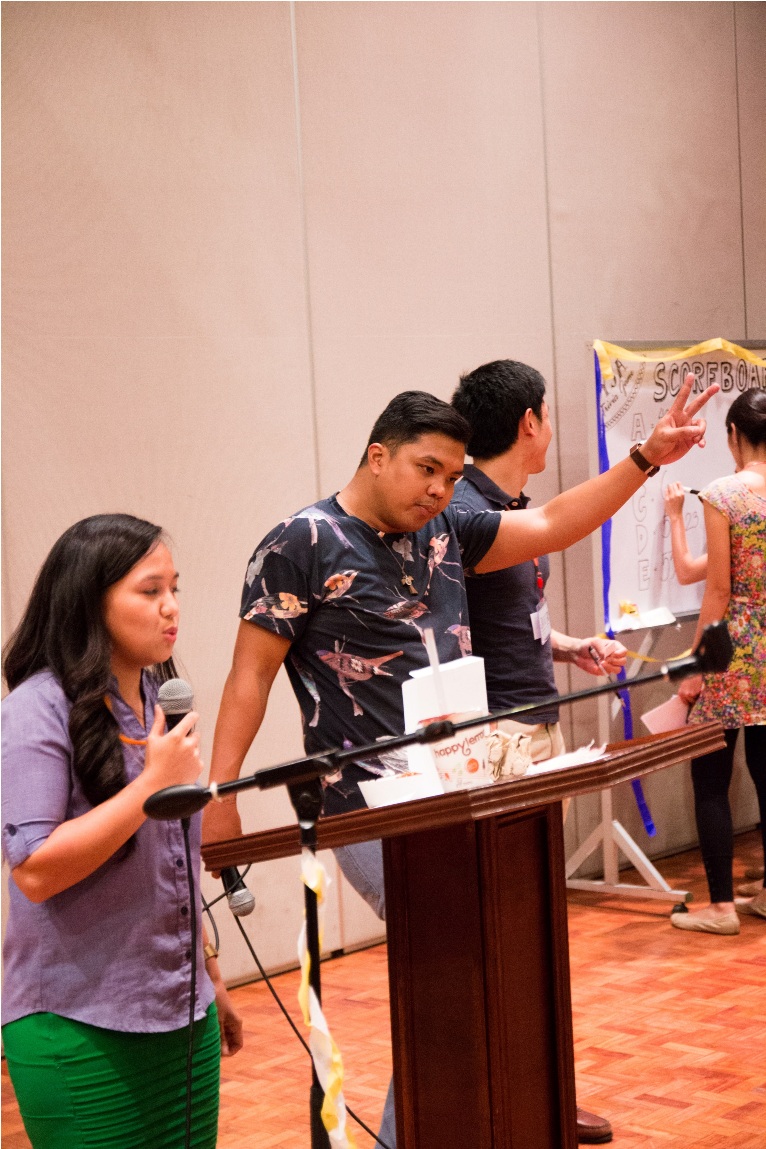
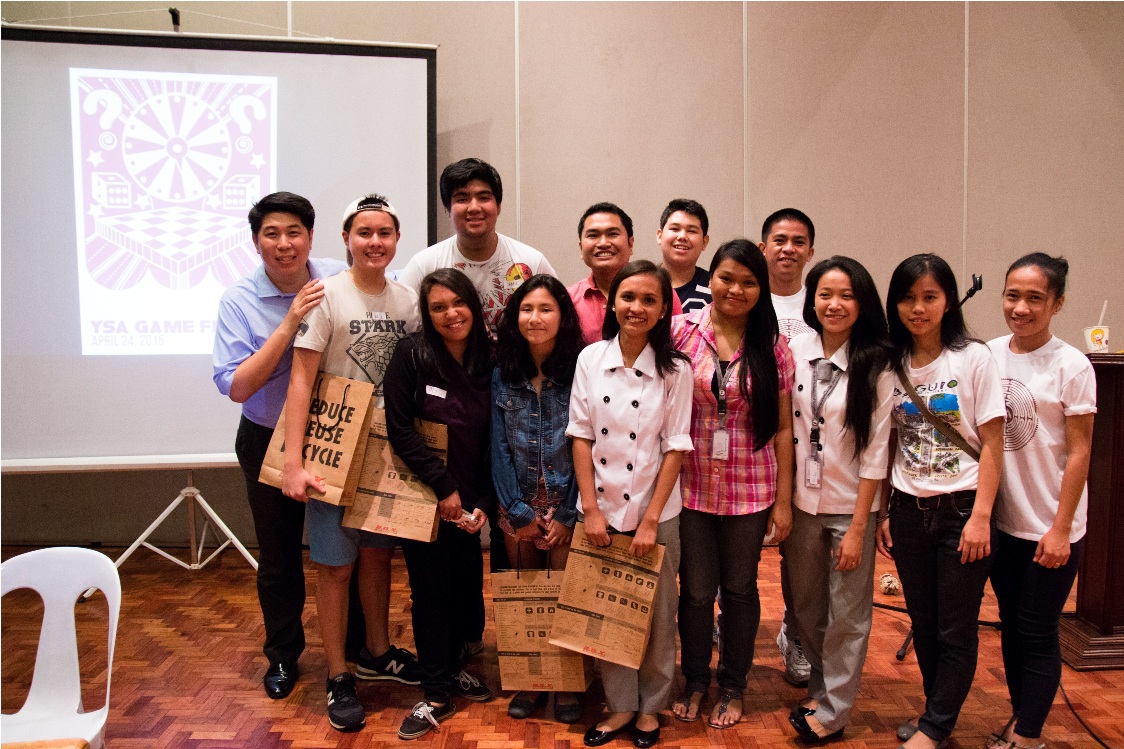
Last April 24, members of the 3 YSA Communities (Single Young Adults (SYA), Antioch, and Luke 18) and the JPIC Scholars came together for YSA Game Fest! The night was planned to strengthen the bonds between these communities while raising funds for YSA-JPIC Projects such as recollections and catechism classes.
1a
We kicked off the night by joining hands in a prayer led by Antiocher, Carlo Aboboto. Carlo lifted up the night to God and thanked Him for the love that we feel within our little YSA community. SYA member Javier Gomez officially welcomed everyone to the event with remarks on what the night meant for the community. He spoke of the importance of our faith family’s mission, inspiring YSA to continue spreading God’s love. Then, a night of games began! Everyone joined in the fun, battling it out in the YSA Trivia Game and playing rounds and rounds of board games.

The JPIC scholars at the event opened up about how they are grateful not only for their scholarships, but also of projects such as this. They shared that these events help them grow spiritually and truly make them feel included in the faith family. Photo 11
“It was a joy to serve with Antiochers and Lukers, whom I never got to work with until recently. Their energy, enthusiasm, and creativity are very refreshing. I was very happy to hear that many of our attendees enjoyed themselves too. It was also great that many YSA-ers gave donations and came to show their support. All of these made it worthwhile to me.” – Mara Boquiren, SYA

“As a “Bridge Builder” or “Ate” in Luke 18, I felt incredibly happy and proud to see so many Lukers come out that night and have fun with the older members of the community. Even if they were the youngest of the group, the Lukers held their own. They gave their best efforts in all of the games and eagerly met and spoke with everyone at the event!” – Iona Mapa, Luke 18 Bridge builder

“The YSA Game Fest was very fun! I was part of the planning stages and I can honestly say that I did not expect so many participants. I interacted with members from the different YSA communities and JPIC, which is something I haven’t been able to do before because there was never any opportunity. The trivia game was intense! The board game part of the night also allowed us to bond with everyone. I hope that we have an event again soon for YSA!” – Kat Aldaba, Antiocher


The night’s witty and energetic hosts, Carlo Aboboto (Antioch) and Alex Li (SYA), kept everyone laughing and enjoying throughout the night! Photo 7
Endless support was given by Parishoners in the form of donated food, drinks, and was given by Parishoners in the form of donated food, drinks, and prizes!

Categories
Special Events

Philippine Diary: St. Anthony Shrine in Forbes Park by Friar Jack Wintz, O.F.M.

My previous Friar Jack’s E-spiration (May 28, 2008) told of the tragic 1945 bombing and destruction of the old Church of St. Francis in Intramuros, Manila’s old walled city. Because the old church had become a popular center of devotions to St. Anthony, the sudden absence of that church had an effect on other Franciscan sites in the Manila area. For example, the old Franciscan church in Sampoloc, also destroyed by the bombings, changed its name to St. Anthony Shrine upon being rebuilt (see the previous E-spiration: “Philippine Diary: How St. Anthony Came to Sampaloc”).
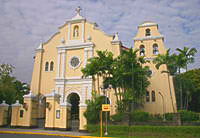
06_08_IMG_1798In this month’s E-spiration, we will look at a second popular shrine of St. Anthony located in the metro Manila area, known as Santuario de San Antonio. This shrine also came into existence because of the disappearance of the old St. Francis Church in Intramuros. The task of building this shrine to St. Anthony was entrusted to a Spanish Franciscan, named Father Jose Martinez, O.F.M. I personally remember encountering Father Jose during my first tour of duty in the Philippines (1969-1972) to teach English and literature at our Franciscan seminary in Quezon City. Father Jose told me that he remembered clearly how in 1945 he was standing in the bell tower of St. Francis Church in Intramuros watching the American bombing raids going on in the distance—obviously some days, weeks or hours before the church’s actual destruction.

After the Church of St. Francis in Intramuros was destroyed, the friars of the Manila-based Franciscan province decided to replace that church and build a new one somewhere outside Intramuros. And Father Jose Martinez was the friar commissioned to supervise the construction of the church. Father Jose’s intention from early on was to build a shrine to St. Anthony. The money for funding the construction of the church came from the sale of the lot where the old, revered church once stood in Intramuros.

Building a second St. Anthony shrine
When Father Jose first saw the swampy grassland on which the future Santuario de San Antonio of Forbes Park was to be built, he was quite disappointed. It seemed to him like “a lonely place, far from the center of population.” In the early phases of construction, Father Jose visited the work site daily from the Franciscan friary in which he was living. But progress was clearly being made. The cornerstone was blessed in August 1951, and the new Santuario de San Antonio was solemnly blessed by Archbishop Rufino J. Santos of Manila on December 8, 1953.

06_08_IMG_1780By the time the church was built and in operation, Father Jose was appointed pastor of the growing congregation. Ironically, what was built on lonely, swampy grassland would in time welcome an affluent congregation. Many members of the congregation would become top-ranking officials, businesspeople and politicians, living in beautiful homes with wide streets and tree-studded lawns. Thus, the area eventually known as Forbes Park became synonymous, in the minds of many, with wealth and prosperity.
06_08_IMG_1795And yet, the popularity of St. Anthony, as well as the family-creating skills of friendly friars and staff, have encouraged thousands of people—rich and poor alike—to flow through the church’s doors and feel at home in the parish family. Week after week these people participate in the Masses and devotions and many other functions of this popular parish and shrine of St. Anthony. For more than 50 years, Franciscan friars and co-workers have striven, with God’s help, to minister to the needs of all who seek help, whether they are affluent or disadvantaged.

Visiting the Forbes Park shrine
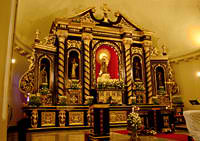
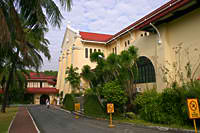
When I visited Santuario de San Antonio last February, I had several opportunities to see the beautiful church and friary, as well as the various images of St. Anthony and other art work. I also witnessed the immense crowds participating in Sunday Mass. In addition, I had a chance to meet several of the friars who live or minister there and to sit down and chat a bit with Father Joel Sulse, O.F.M., head of the Franciscan community there.
06_08_IMG_1791Father Joel explained that a nine-day solemn novena leads up to the feast of St. Anthony (June 13) each year. “This novena is very popular,” the 38-year-old friar told me. “The faithful come in large numbers. Between 700 and 800 people attend each of the four Masses and devotions each of the nine days.” This means that as many as 3,000 or so people might come for Mass on each day of the solemn novena. The 6 p.m. Mass is designated as the daily solemn novena Mass. “Of course, on the feast of St. Anthony itself, all the four Masses are well attended,” he said. In addition to the solemn novena before the feast, people can attend during the year the ordinary novenas for nine consecutive Tuesdays—and these are also quite popular, affirmed the friar.

There are other popular customs associated with the feast of St. Anthony, according to Father Sulse. For example, on the feast day, there might be an orchestra playing festive music after one (or some) of the Masses. Also, there is a colorful procession that goes around to a designated village in the vicinity of the shrine. The procession goes for about 2½ miles, and a statue of St. Anthony is pulled along on a carosa (or float). Tables are placed along the route with statues of St. Anthony on them. Another tradition at the shrine is the blessing of bread at all Masses during the feast day itself.
06_08_IMG_1777Another custom that many anticipate, most especially the workers in the villages, is the free breakfast served by members of the Secular Franciscan Order and the Catholic Women’s League. These meals, often a great blessing for the poor and disadvantaged, are served each day during the entire nine-day novena after the 6:15 a.m. Mass in front of the church. Normally, between 600 and 700 people are served each day. Among the workers enjoying these breakfasts are maids and gardeners employed by the well-to-do, security guards, construction laborers and workers in nearby shopping malls, as well as taxi and jeepney drivers.

More about Father Joel
Father Joel was born in Pandacan, Manila, but has lived a good part of his life on the Island of Samar in the Visayas. He was ordained in Santuario de San Antonio, where he was later given his present assignment. He also served earlier at the St. Anthony Shrine in Sampaloc, Manila, and at San Pedro Bautista Parish in San Francisco del Monte.
06_08_IMG_1800“St. Anthony is a very attractive saint,” said Father Joel, “because he is a miracle-worker. I believe St. Anthony became very popular because he touched and continues to touch people from all walks of life—rich and poor, young and old, scholar and simple person. And in contemporary times, many people come to pray to him because they feel lost.”

Copyright © Franciscan Media. Taken from Friar Jack E-spirations on http://www.AmericanCatholic.org and used with permission. All rights reserved.

Categories
Cathechism of the Catholic Church

CATECHISM OF THE CATHOLIC CHURCH

How will the world come to an end?
At the end of time, God will create a new heaven and a new earth. Evil will no longer have any power or attractiveness. The redeemed will stand face to face with God as his friends. Their yearning for peace and justice will be fulfilled. To behold God will be their blessedness. The Triune God will dwell among them and wipe away every tear from their eyes; there will be no more death, sorrow, lamentation, or trouble.

Why do we say “Amen” to the profession of our faith?
We say Amen “Yes” to the profession of our faith because God appoints us witnesses to the faith. Anyone who says Amen assents freely and gladly to God’s work in creation and redemption.
The Hebrew word amen comes from a family of words that mean both “faith” and “steadfastness, reliability, fidelity.” “He who says amen writes his signature.” (St. Augustine) We can pronounce this unconditional Yes only because Jesus in his death and Resurrection
has proved to be faithful and trustworthy for us. He himself is the human Yes to all God’s promises, just as he is also God’s definitive Yes to us.

Categories
Random Thoughts by Peachy Maramba

R A N D O M T H O U G H T S Voices from yesterday and today. . . by Peachy Maramba

2

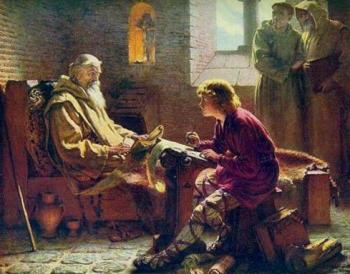
ST. BEDE THE VENERABLE
Father of English History and Doctor of the Church

672 – 735
May 25

Did you know that our current way of dating time from the birth of Christ as B. C. and A. D. or anno domini which means “in the year of the Lord” is attributed to St. Bede, probably the most learned man of his time and the only English Doctor of the Church? Although Bede himself tells us that it was a system actually devised by Dionysius (Denis), an aged Roman abbot. It had laid unused for 200 years until Bede popularized it by adopting it in his works on time and histories.

Early Life
It is interesting to note that what little we know of St. Bede’s life comes from a short account written by Bede himself and from a description of his last hours written by Cuthbert, a monk who was one of his disciples.

He was born at Monkton, in the county Durham within the territory of Wearmouth, Northumbria, England in 673. Nothing is known about his parents or family except that at age seven his relatives or parents, who lived in the lands of that monastery, gave to-be- educated Bede to Benedict Biscop, abbot of Wearmouth and one of the leading scholars of his time. He and later Abbot Ceolfrid took charge of Bede’s education. (This happy combination of Bede’s inquiring intellect and willing able teachers made him undoubtedly one of the most learned men of his time.)

Like the other fellow oblates he would help in the kitchen or barn gathering eggs. However his chief interest would be prayer and study.

When St. Benedict Biscop built a second monastery dedicated to St. Paul at Jarrow on the River Tyne Bede went there while still a young boy.

An extra ordinary scholar he soon became well-versed not only in the sciences, natural philosophy and astronomy but in arithmetic, grammar, the philosophy of Aristotle, the lives of saints and history as well. He attributes his great learning to the good men like Ceolfrid who guided him in his younger days.

Little did Bede realize that except for a few visits to other places he would in the sixty or so years he lived, except for the first few years of his life, never leave the monastery, spending the rest of his life behind the cloistered walls in peaceful isolation. This meant that whatever education he had he got while at the monastery. But then at that time the only place where the great intellectual traditions were preserved were the monasteries.

While it seemed that Bede grew up in extreme isolation he surprisingly became “one of the most influential man of his day.”

He was first an oblate in the Benedictine order and later ordained a deacon when he was 19 and finally a priest at the age of 30 “always writing, always praying, always reading and always teaching.” Besides saying the mass he was also a great preacher (about 50 of his authentic homilies that he gave in the last part of his life are still preserved to this day). As our Lady’s homilist he wrote all the lessons for the Common of her feasts.

However he declined the office of abbot because he felt it would interfere with his chosen path of “learning, teaching and writing.” Because of his dedication he never held positions of great dignity devoting all his efforts to the study of Scriptures and in charge of the daily singing in the Church. His title of “venerable” by which he is most popularly known is a traditional term of respect for his scholarship and also on account of his holiness. Imagine being honored as a saint even in your own lifetime!

His Learning
It’s no wonder that because he had the mind, aptitude, interest and dedication to his vocation he became one of the most learned men and influential people of his day. His writings covered almost all fields of human knowledge at that time. Because he had a universal interest he “collected the treasures of knowledge”. Thus his books covered almost all fields of human knowledge at that time including history, meteorology, physics, mathematics, grammar, astronomy, medicine, music, natural science, poetry, philosophy, rhetoric and prosody. His works on mathematics were regularly used and copied for five centuries after his death!

But it was the Bible that remained the chief study not only of Bede but of his fellow monks. It is no wonder that four-fifths of his writing were commentaries on the Scriptures. Thus Bede wrote in his short autobiography: “I spent the whole of my life within that monastery devoting all my pains to the study of the Scriptures.” Because of this the most correct manuscript of the Vulgate came from this monastery.

His Teaching
Besides learning and writing Bede’s other delight was teaching. He himself taught all the subjects necessary for the service of the church such as music, rhetoric and languages. It is said that he was greatly loved by his pupils because he taught with vivacity and charm. Hundreds of scholars were drawn to him because of his piety, learning and gentle character. Because of his fame as a teacher his monastery and the whole of Northumbria became a great center of learning in Europe.

His Writing
Bede did not actually begin writing until he was ordained a priest and his writing originated from his teaching. The manuals that he wrote and compiled for his pupils were so good that his beloved mentors Ceolfrid and Bishop Acca urged him to write that he might be able to teach a wider group of people.

So he abridged larger works to make acquiring knowledge of them easier for his countrymen. In this way did the Englishmen learn in simplified form the teachings of the four great western Doctors: Sts. Jerome, Ambrose, Augustine and Gregory.

He passed on to countless generations the “sum of the day’s knowledge” as he was especially clever at working out what had actually happened in the past and what was only legend or gossip. His writings are even said to be major influences on English literature.

His writing style was meant for teaching not for show. Thus his words were not ornate but simple with a passion for truth and exactness. His aim was “to lead people to moral goodness, to help them praise and thank their creator better.” His whole effort was to teach history and doctrine exactly.

Besides this, Bede, a voluminous writer, wrote over 40 treatises on almost all fields of human knowledge especially on theology, science and history. He also wrote Latin poetry and a hymn in verse. His writings are thus regarded as major influences on English literature.

Because he wrote the lessons for the common on Our Lady’s feast Bede had the enviable distinction of being Our Lady’s homilist.

Bede’s life was capsulized by an old Benedictine breviary which said, “He always read, he always wrote, he always taught and he always prayed.”

Father of English History
However since he believed that it was not only in Scripture but in the history of his own people and the stories of holy lives that the handwriting of God could be discerned, his most important monumental and authoritative work Historia Ecclesiastica is a complete history up to 731. Ecclesiastical History is not only a history of the English Church but of the English People and nation. His reading of the handwriting of God became his own path to sanctity. Considered one of the greatest history books ever written it is regarded as the primary source of the history of Christianity in England up to that time and is still in print.

Because he wrote this first English language history book he came to be known as the “Father of English history” and became the most respected historian in medieval Western Christendom. As one writer said, “He made his mark on the pages of history and he wrote about history.” Written in Latin but later ordered translated into Early English by King Alfred this most important account of early English history covers from 55 B.C. to 731 A.D. It is considered one of the most valuable, thorough, scholarly and beautiful of historical works. It is said Bede’s simplicity, goodness, zeal, humility and honesty shines through his writings with unusual charity!

However because Bede was always a prayerful man he closes his book with a formal prayer.

Called Venerable
In recognition of his saintliness, holiness, wisdom and learning Bede was called “the Venerable”, a term of respect infrequently bestowed on the religious. But he was officially called this while he was still living by the Council of Aachen in 836 (some say in 853) because of his holiness. When not studying or teaching he would spend long hours in prayer often shedding tears when overcome with devotion.

It is no wonder that noblemen and even the pope sought his advice and counsel.

He certainly merited his name Bede which in Anglo-Saxon means prayer. The title “Venerable” means “worthy” and is given to people who are likely to be made saints in the future. Few people are bestowed this title in their lifetime. He was also called an Admirable Doctor for Modern Times.

But because it seemed peculiarly suitable to a man like Bede it has clung to him even during succeeding centuries. Even to this day it remains his special designation.

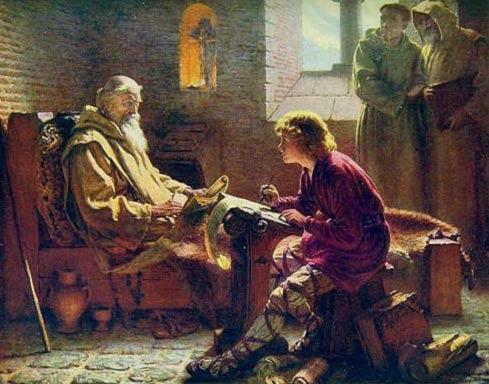
It is said that in his later years Bede became blind. He was taken one day as a prank by a boy to a lonely and stony place where he was to preach. Believing there were people there Bede preached his sermon. When he had finished the stones responded with a great cry of “Amen, Venerable Bede.”

His Death
Up to the very end Bede remained a teacher and writer. However during his last years he was constantly ill. When he was already experiencing the pains of his last illness he chided his students several times, “Learn your lesson quickly, for I do not know how long I shall be with you nor whether my Maker will soon take me from you.”

In the forty days before his death on May 25 he managed to dictate two new books. When he thought he had finished his last book, a translation of the gospel of St. John from Greek into English he asked his assistant or scribe to run and get quickly his things of value in his chest such as peppercorns, napkins and incense. Then he told him to bring the other priests to him so that he could distribute among them the gifts that God had given him.

Having done that he asked the priests to pray for him.

But that evening the scribe noticed that the translation was not quite finished missing one sentence untranslated. Hurriedly he dictated the last passage.

Then he said, “All is finished.” He died on the floor of his cell singing, “Glory be the Father. . .” Just as he said “Holy Ghost” he breathed his last. What a happy and peaceful death! Bede had worked and prayed till the very end.

Ironically Bede who was one of the most influential people of his day and who was honored as a saint while still living was not canonized and named a Doctor of the Church until 1899 by Pope Leo XIII. However the title of Venerable remains his special designation to this day. His feast day is celebrated every May 25. His relics are to be found in the Galilee chapel of Durham Cathedral.

He is the only English doctor of the Church and the only Englishman who sufficiently impressed Dante to name him in his Paradiso. He is also probably of all the saints the one doctor of the Church who lived the most peaceful life.

And in spite of the fact that he hardly left his monastery he became well known throughout England and far beyond. In fact his homilies are still read everywhere in the Western church.

It was St. Boniface who aptly described Bede as “a light of the Church lit by the Holy Ghost.” It is aptly said that to know Bede was to love him!

SOURCES of REFERENCE
ST. BEDE

Butler’s Lives of the Saints – Vol. II – pp 402 – 405
The Illustrated World Encyclopedia of Saints – p 126
Pocket Dictionary of Saints – p 66
The Watkins Dictionary of Saints – pp 30 – 31
All Saints – pp 229 – 230
A Year With the Saints – May 25
Butler’s Saint for the Day – pp 237 – 239
Illustrated Lives of the Saints – Vol. I – pp 221 – 222
My First Book of Saints – p 104
Saint Companions – pp 187 – 188
Saints for Our Time – pp 109 – 110
Saint of the Day – pp 114 – 115
Voices of the Saints – pp 292 – 293
The Lion Treasury of Saints – pp 210 – 211, 122 – 123
The Way of the Saints – pp 66 – 67

Categories
Calendar of Saints

CALENDAR OF SAINTS FOR THE WEEK

May 25: St. Gregory VII, pope
Hildebrand was born in Tuscany about the year 1028. He was educated at Rome and entered the monastic life. He helped the popes of his time through many missions on behalf of Church reform, and in 1073 ascended to the chair of St. Peter
under the name of Gregory VII. Besieged by King Henry IV, he died a refugee at Salerno in 1085.

May 25: Mary Magdalene de Pazzi, virgin
St. Mary Magdalene was born at Florence in 1566 and after a religious upbringing she entered the Carmelites. She led a solitary life of prayer and self-denial, praying fervently for Church reform and directed her fellow sisters on the road to perfection. She was blessed by many gifts from God and died in 1607.

May 26: Philip Neri, priest
St. Philip Neri was born at Florence in 1515. He went to Rome and began to work with young men among whom he fostered Christian life and formed an association for the poor and the sick. Ordained to the priesthood in 1551, he founded the Oratory where spiritual reading, singing and works of charity were practiced. He excelled in his love of neighbor and in evangelical simplicity along with a joyous service to God. St. Philip died in 1595.

May 27: Augustine of Canterbury, bishop
St. Augustine was sent in 597 from St. Andrew’s monastery in Rome by St. Gregory the Great to preach the Gospel in England. He was aided there by King Ethelbert and chosen bishop of Canterbury. He converted many to the faith and established many dioceses, especially in the kingdom of Kent. He died on May 26 about the year 605.

Reference: Christian Prayer: The Liturgy of the Hours. Published and distributed by Paulines Publishing House, Daughters of St. Paul, 2650 F.B. Harrison St., 1300 Pasay City, Phil. 13th printing 2010. ISBN 971-590-357-6.

Categories
Pope Francis

A Pentecost Sunday Reflection on Acts of the Apostles 2:1-11 By Fr. Reu Jose C. Galoy

An excerpt of the thoughts of Pope Francis on the working of the Holy Spirit: newness, harmony and mission.
Untitled
First thought: Newness always makes us a bit fearful, because we feel more secure if we have everything under control, if we are the ones who build, programme and plan our lives in accordance with our own ideas, our own comfort, our own preferences. This is also the case when it comes to God. Often we follow him, we accept him, but only up to a certain point. It is hard to abandon ourselves to him with complete trust, allowing the Holy Spirit to be the soul and guide of our lives in our every decision. We fear that God may force us to strike out on new paths and leave behind our all too narrow, closed and selfish horizons in order to become open to his own. Yet throughout the history of salvation, whenever God reveals himself, he brings newness and change, and demands our complete trust: Noah, mocked by all, builds an ark and is saved; Abram leaves his land with only a promise in hand; Moses stands up to the might of Pharaoh and leads his people to freedom; the apostles, huddled fearfully in the Upper Room, go forth with courage to proclaim the Gospel. This is not a question of novelty for novelty’s sake, the search for something new to relieve our boredom, as is so often the case in our own day. The newness which God brings into our life is something that actually brings fulfillment, that gives true joy, true serenity, because God loves us and desires only our good.

Let us ask ourselves: Are we open to “God’s surprises?” Or are we closed and fearful before the newness of the Holy Spirit? Do we have the courage to strike out along the new paths which God’s newness sets before us, or do we resist, barricaded in transient structures which have lost their capacity for openness to what is new?

Second thought: the Holy Spirit would appear to create disorder in the Church, since he brings the diversity of charisms and gifts; yet all this, by his working, is a great source of wealth, for the Holy Spirit is the Spirit of unity, which does not mean uniformity, but which leads everything back to harmony. In the Church, it is the Holy Spirit who creates harmony. One of Fathers of the Church has an expression which I love: the Holy Spirit himself is harmony – “Ipse harmonia est.” Only the Spirit can awaken diversity, plurality and multiplicity, while at the same time building unity. Here too, when we are the ones who try to create diversity and close ourselves up in what makes us different and other, we bring division. When we are the ones who want to build unity in accordance with our human plans, we end up creating uniformity, standardization. But if instead we let ourselve be guided by the Spirit, richness, variety and diversity never become a source of conflict, because he impels us to experience variety within the communion of the Church. Journeying together in the Church, under the guidance of her pastors who possess a special charism and ministry, is a sign of the working of the Holy Spirit. Having a sense of the Church is something fundamental for every Christian, every community and every movement. It is the Church which brings Christ to me, and me to Christ; parallel journeys are dangerous! When we venture beyond (proagon) the Church’s teaching and community, and do not remain in them, we are not one with the God of Jesus Christ (cf. 2 Jn 9).

So let us ask ourselves: Am I open to the harmony of the Holy Spirit, overcoming every form of exclusivity? Do I let myself be guided by him, living in the Church and with the Church?

3. A final point. The older theologians used to say that the soul is a kind of sailboat, the Holy Spirit is the wind which fills its sails and drives it forward, and the gusts of wind are the gifts of the Spirit. Lacking his impulse and his grace, we do not go forward. The Holy Spirit draws us into the mystery of the living God and saves us from the threat of a Church which is gnostic and self-referential, closed in on herself; he impels us to open the doors and go forth to proclaim and bear witness to the good news of the Gospel, to communicate the joy of faith, the encounter with Christ. The Holy Spirit is the soul of mission. The events that took place in Jerusalem almost two thousand years ago are not something far removed from us; they are events which affect us and become a lived experience in each of us. The Pentecost of the Upper Room in Jerusalem is the beginning, a beginning which endures. The Holy Spirit is the supreme gift of the risen Christ to his apostles, yet he wants that gift to reach everyone. As we heard in the Gospel, Jesus says: “I will ask the Father, and he will give you another Advocate to remain with you forever.” (Jn 14:16) It is the Paraclete Spirit, the “Comforter,” who grants us the courage to take to the streets of the world, bringing the Gospel! The Holy Spirit makes us look to the horizon and drive us to the very outskirts of existence in order to proclaim life in Jesus Christ.

Let us ask ourselves: do we tend to stay closed in on ourselves, on our group, or do we let the Holy Spirit open us to mission?

Source: http://whispersintheloggia.blogspot.com/2013/05/for-pentecost-three-words-newness.html

About Fr. Reu and his other reflections…

Categories
Fiesta

Philippine Diary How St. Anthony Came to Sampaloc (Manila) by Friar Jack Wintz O.F.M.

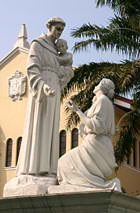
St. Anthony is alive and well in the Philippines! With the feast of Anthony of Padua approaching on June 13, it’s a good time to recall my February visits to two Franciscan churches in metro Manila. Both churches honor St. Anthony as their patron saint, and both are popular shrines. As we shall see, St. Anthony, who holds the Christ child in his arms, draws many people to Christ.
16
The St. Anthony Shrine in Sampaloc is featured first, not only because it was built before the second one (Santuario de San Antonio in Forbes Park), but also because the historical roots of the Sampaloc Shrine stretch back to a very old and venerable statue of St. Anthony that once stood inla Iglesia de San Francisco(the Church of St. Francis). This huge church, built of stone in 1739, is directly linked with the very first church built (in 1578) of bamboo and nipa by Spanish Franciscan friars shortly after they arrived in the Philippines. This large stone edifice, like its humble predecessor, stood in Intramuros, the old walled city of Manila. The large church, named after St. Francis, attracted many Catholics because of its very popular St. Anthony devotions and because of Anthony’s highly revered statue there. This massive stone structure, like many others in Intramuros, was totally destroyed by bombings at the end of World War II.
17
St. Anthony’s transfer to Sampaloc
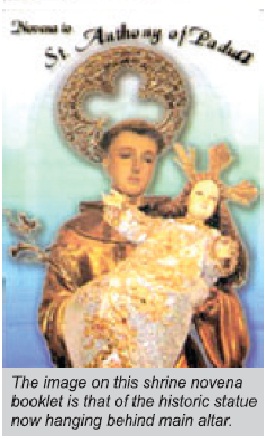
In the eyes of some, it seemed miraculous that the statue of St. Anthony survived the bombings of 1945 and was found intact amidst the crumbled ruins of the church. The statue was taken for safe keeping to the Franciscan church in Santa Ana (featured in last month’s E-spirations), but was ultimately transferred to St. Anthony Shrine in Sampaloc. According to Father Cielo Almazon, O.F.M., present rector of the shrine, the old, venerable statue of St. Anthony thus came to be mounted on the wall behind the main altar of the Sampaloc shrine.
25
On February 12, Father Cielo graciously took me on a tour of the shrine and spoke of the amazing number of people that St. Anthony draws into that church each week. St. Anthony devotions are held each Tuesday. Father Cielo estimates that some 5,000 people (collectively) attend the 10 Masses on ordinary Tuesdays. The first Mass begins at 5:45 a.m. and the 10th at 7:30 p.m. During the solemn novena held on the 13 Tuesdays preceding the feast of Anthony, Father Cielo estimates that the number of people attending rises to 8,000 each of those Tuesdays, with as many as 200 people standing outside during these Masses. The Prayers to St. Anthony are said after the gospel/homily of the Mass. According to Father Cielo, “the popularity of St. Anthony helps draw the faithful to the celebration of the Eucharist, which is the center of Catholic prayer and worship.”

Father Cielo points out that the thousands who come to the shrine represent a wide range of people—poor and rich. “There are beggars and street vendors, as well as retired professionals, students and teachers. The shrine is surrounded by various schools and colleges,” he adds, “with a good number of people traveling to the shrine from remote places far beyond the metropolitan area.”
18
More about Father Cielo
Father Cielo is a 55-year-old native of Northern Luzon. He holds a licentiate in sacred scripture from the Pontifical Biblical Institute in Rome and has taught scripture for 23 years at Our Lady of the Angels Franciscan Seminary in Quezon City and at the Inter-Congregational Theological School in New Manila. Father Cielo told me that he would like to see “St. Anthony Shrine become a place for expanded evangelization projects—in light of St. Anthony’s own charism and success as a great evangelizer.”

Father Cielo says that he sees St. Anthony “as a powerful intercessor on behalf of both the rich and the poor. The rich come here and give thanks to St. Anthony because he made their business prosperous and their families happy. The poor pray to St. Anthony invoking his assistance to pass board exams and help cure their sicknesses, and to have children. Most of all, Anthony helps us become better followers of Christ. As a prayer in the shrine’s novena booklet expresses it: ‘O Holy St. Anthony… pray that we may fulfill the will of God and live the way Jesus shows us in the gospels.”

A brief history of the Franciscan presence in Sampaloc
The first Franciscan Church in Sampaloc was Our Lady of Loreto, dedicated to Our Lady under that title in 1616. The pastor was Father Augustin de Tordecillas, one of the first 15 Franciscan friars to arrive in Manila from Spain. During the next 300 years, the church of Our Lady of Loreto experienced many challenges: destruction by fire (1639) and by earthquake (1880), though it was rebuilt in both instances—only to be abandoned because of the Philippine revolution (1896-98) and legal disputes that followed. Our Franciscan presence in Sampaloc survived at times only through the presence of Third Order Franciscans and their well-known VOT (Third Order) Church, located nearby. Today the Third Order of St. Francis is known as the Secular Franciscan Order (SFO).
19
Near the end of World War II (1945), the Franciscan friary and the VOT Church in Sampaloc, as well as many other buildings in Manila, were totally destroyed by bombings of the U.S. armed forces (to eliminate the hideouts of the Japanese occupiers). As noted earlier, the destruction included the old Church of St. Francis in Intramuros, as well as many others within those same old walls.

Not long afterwards, Father Mariano Montero, O.F.M., a Spanish friar once stationed at St. Francis Church in Intramuros, came up with the idea of transferring St. Anthony devotions (so popular in Intramuros) to Sampaloc, where the rebuilding of Sampaloc’s destroyed church was about to begin. Father Mariano decided to have the church’s name changed to the Shrine of St. Anthony. Finally, in 1947, the rebuilding of the church was completed and it was rededicated to St. Anthony of Padua.

Copyright © Franciscan Media. Taken from Friar Jack E-spirations on http://www.AmericanCatholic.org and used with permission. All rights reserved.

Categories
Random Thoughts by Peachy Maramba

R A N D O M T H O U G H T S Voices from yesterday and today by Peachy Maramba

22

ST. ISIDORE the FARMER or HUSBANDMAN:
Patron of Farmers and
Patron of Madrid, Spain

1070 – 1130
May 15

His Canonization
Our saint of the day – St. Isidore – always has to have the qualifying title – “the farmer” – after his name to distinguish him from his illustrious namesake St. Isidore, Bishop of Seville who was also their patron saint. Little did his parents dream that their son – poor as they were – would someday become not only a saint, but also a patron saint of Madrid, Spain.

Yet their Isidore who was not well educated and remained a simple farm worker all his life – accomplishing no great deeds, inspiring no disciples, nor leaving behind any profound unforgettable saying or teaching became a saint. In fact he was canonized in a magnificent ceremony by Pope Gregory XV in March 1622 on the same day as four of the giant figures of the Catholic Reformation: St. Ignatius, St. Francis Xavier, St. Teresa and St. Philip Neri.
What, you might well ask, was this obscure, virtually unknown farmer doing among these “great saints”?

His Simple Pious Lifestyle
Born of poor pious parents at Madrid, Spain he spent his entire life working as a simple farm laborer on the same great estate just outside of Madrid of the same rich landowner named John de Vargas. Though his parents were so poor that they could not send him to school, they early instilled in him a great horror of sin and love of prayer.
23
Because his parents instilled in him a great love of prayer he continually prayed while working, loving his communing with God and the saints. He also early developed the habit of waking up at the crack of dawn to go daily to mass.

Because he was an excellent fine hardworking ploughman his boss allowed him to go and worship in church daily and even treated him as a brother.

However when his fellow laborers complained that his daily mass – going and other religious practices such as visiting the other churches of Madrid during holidays caused him to often come late for work, John decided to see for himself if this was really true.

One day as John himself came to watch he observed that Isidore did indeed come in late after his co-workers. But as he stepped out to take him to task for his lateness he noticed something very strange. He saw white oxen plowing the field parallel to that of the team of Isidore. He realized that supernatural help probably from angels was sent by God to help Isidore make up for the work he missed in return for his attending Mass so faithfully.

However Isidore vigorously denied this saying, “I work alone looking only to God for my strength.” As for the accusation that he neglected his work in order to go to mass he told his boss, “I know, Sir, that I am your servant, but I have another Master as well, to whom I owe service and obedience.”

Great Love for the Poor
Isidore was well known for his great love for the poor. Though poor himself he was always generous giving whatever he could to those even poorer than him. His generosity was so great that his table was always open to the indigent only saving for himself and his good wife the scraps of food left over.

One day Isidore came late for a confraternity dinner so his hosts saved his portion. To their consternation Isidore arrived bringing with him a large group of beggars. When the hosts informed Isidore of the lack of food he told them not to worry as there would be plenty for himself and for Christ’s poor. There was – to the extent that there was food left over. So many miracles such as this was attributed to Isidore that he had a lasting influence on the people of Spain.
21
Great Love for Animals
Another of Isidore’s great love was for animals. He was known for his great good care of them. A story often told about Isidore recounts that one wintry day as he was on his way to have his sack of grain to be milled he saw on the branches of a tree some birds who were obviously starving and very hungry. Moved by the sorrowful noise of the hungry birds and ignoring the taunts of his companions Isidore sat his sack down and immediately opened it and shared what he had by pouring out half of its contents for them. The strange thing was that when he reached the mill they found the sack to be still full. Not only that it was discovered to produce double the usual amount of flour.

Other Miracles
So many other similar stories are told about this simple holy peasant who died in May 15, 1130. Since that time many other miracles were attributed to him.

About eighty years after his death Isidore is said to have appeared to the King of Castile who was then embroiled in a fight with the Moors. Because he showed him a hidden path the King’s soldiers were able to surprise and defeat the enemy.

Another intercession of Isidore brought gravely ailing King Philip III of Spain back to good health snatching him from the brink of death simply by the bringing of his relics to the King’s sick room. It was then that King Philip petitioned for his canonization.

So many miracles took place in his shrine in Madrid that his aid has been sought over the centuries and granted to several Spanish monarchs.

But the greatest miracle of all is his being included as one of the “five saints of Spain.” Of the five saints canonized that March 1622 by Pope Gregory XV only Isidore founded no order and accomplished no great deeds. Neither did he not being well educated leave any teachings nor left any disciples. He was just a simple farm worker. But because his faith was attended by visible signs and wonders such as miracles and celestial visions and he was famous for his generosity even to animals he was declared a saint. Not only is he the patron of farmers, but of Madrid, of laborers and of the National Rural Life Conference in the United States. So though just one of the “little ones” so beloved of God living a very ordinary life who was not even a monk his type of sainthood is surprisingly rare in the list of canonized saints. However the Church has an “instinct of celebrating ordinary as well as extraordinary people’s lives.”
24
Isidore’s Message
“It matters not to God what station you have in life as long as you use the talents which He has given to you in His service – in most cases this means service to your neighbor.”
His Wife

Isidore had married a lovely girl named Maria Torribia who was as pious and simple as himself. Unfortunately they had an only child, a boy, who died young. It is said that after his death they agreed to live in continence.

Because Maria shared her husband’s devotion, poverty and generosity she too is honored as a saint under the name Santa Maria de la Cabeza because her head is often carried during a procession in time of drought.

Depictions of Isidore
Generally Isidore is represented as a peasant carrying a farm implement as a spade or a sickle. Sometimes he is depicted at work in the field accompanied by angels.

SOURCES of REFERENCE
ST. ISIDORE the FARMER
May 15

Butler’s Lives of the Saints – Vol. II – pp 323 – 324
Pocket Dictionary of Saints – p 258
The Watkins Dictionary of Saints – p 121
A Calendar of Saints – p 94
All Saints – pp 213 – 214
A Year with the Saints – May 15
Butler’s Saint for the Day – pp 220 – 221
Illustrated Lives of Saints – Vol. 1 – pp 207 – 208
My First Book of Saints – pp 100 – 101
Saints for Our Time – pp 105 – 106
Saint of the Day – pp 106 – 107
Saints – A Visual Guide pp 204 – 205
The Everything Saints Book p 271
Book of Saints – Part 3 – pp 6 – 7

Categories
The ABC’s of Catholic Doctrine

“Looking for what the family can do this summer?”, The ABC’s of Catholic Doctrine By Lianne Tiu

9
It is May, the month of Mary. A Marian pilgrimage can be a wonderful family event. We do not have to go on a journey to Lourdes, Fatima, Guadalupe, or Loreto. The family can make a trip to a Marian shrine or church in the city. We can choose an outdoor shrine or an area in the church which has an image of our Lady.
12
A pilgrimage is done for different reasons: to show our love for the Blessed Mother, to ask for specific favor, to thank God or Mary for favor granted, or to do penance. A pilgrimage ultimately brings us closer to our Lord.
11
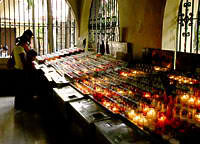
What does the family do in a pilgrimage? We drive or walk to the destination of our pilgrimage with prayer in mind. A common practice is to say the entire fifteen decades (3 Mysteries) of the Rosary. We “travel” with Jesus and Mary through the mysteries. We pray aloud one of the Mysteries on the way to the pilgrimage site, then pray the Mysteries of the day at the church or shrine. And on the return trip, we pray the other Mysteries. Children can take active roles in the prayers. We may place flowers and light candles at the shrine or in front of the image.
13
When the family takes a vacation to a different province or country, it will be a beautiful practice if parents make a small pilgrimage a part of the vacation. It teaches the children that love for Jesus and Mary takes priority in family life.

(Reference: “The How-To Book of Catholic Devotions” by Mike Aquilina and Regis Flaherty)

Categories
Cathechism of the Catholic Church

CATECHISM OF THE CATHOLIC CHURCH

Why do we believe in the resurrection of the dead?
We believe in the resurrection of the dead because Christ rose from the dead, lives forever, and causes us to share in this eternal life. When someone dies, his body is buried or cremated. Nevertheless, we believe that there is a life after death for that person. In his Resurrection, Jesus showed that he is Lord over death; his word is trustworthy: “I am the resurrection and the life; he who believes in me, though he die, yet shall he live.” (Jn 11:25b)

Why do we believe in the resurrection of the “body”?
In Jesus Christ, God himself took on “flesh” (Incarnation) in order to redeem mankind. The biblical word “flesh” characterizes man in his weakness and mortality. Nevertheless, God does not regard human flesh as something inferior. God does not redeem man’s spirit only; he redeems him entirely, body and soul. God created us with a body (flesh) and a soul. At the end of the world he does not drop the “flesh” like an old toy. On the “Last Day” he will remake all creation and raise us up in the flesh – this means that we will be transformed but still experience ourselves in our element. For Jesus, too, being in the flesh was not just a phase. When the risen Lord showed himself, the disciples saw the wounds on his body.

What happens to us when we die?

In death body and soul are separated. The body decays, while the soul goes to meet God and waits to be reunited with its risen body on the Last Day. How the resurrection will take place is a mystery. An image can help us to accept it: When we look at a tulip bulb we cannot tell into what a marvelously beautiful flower it will develop in the dark earth. Similarly, we know nothing about the future appearance of our new body. Paul is nevertheless certain: “It is sown in dishonor, it is raised in glory.”

How does Christ help us at our death, if we trust in him?

Christ comes to meet us and leads us into eternal life. “Not death, but God will take me.” (St. Thérèse of Lisieux) In view of Jesus’ suffering and death, death itself can become easier. In an act of trust and love for the Father, we can say Yes, as Jesus did in the Garden of Gethsemane. Such an attitude is called “spiritual sacrifice:” the dying person unites himself with Christ’s sacrifice on the Cross. Someone who dies this way, trusting in God and at peace with men, and thus without serious sin, is on the way to communion with the risen Christ. Our dying makes us fall no farther than into his hands. A person who dies does not travel to nowhere but rather goes home into the love of God, who created him.

What is eternal life?
Eternal life begins with Baptism. It continues through death and will have no end. Even when we are simply in love, we want this state of affairs to last forever. “God is love,” says the First Letter of John. (1 Jn 4:16) “Love,” says the First Letter to the Corinthians, “never ends.” (1 Cor 13:8) God is eternal because he is love; and love is everlasting because it is divine. If we are in love, we enter into God’s endless presence.

Will we be brought to judgment after death?

The so-called particular or personal judgment occurs at the moment of death of the individual. The general judgment, which is also called the Last Judgment, occurs on the Last Day, at the end of the world, when the Lord comes again. In dying every man arrives at the moment of truth. Now it is no longer possible to repress or conceal anything; nothing more can be changed. God sees us as we are. We come before his tribunal, where all is made right, for if we are to be in God’s holy presence at all, we must be “right” with him – as right as God wanted us to be when he created us. Perhaps we will still have to undergo a process of purification, or maybe we will be able to fall into God’s arms immediately. But perhaps we will be so full of wickedness, hatred, and denial of everything that we will turn our face away from love forever, away from God. A life without love, however, is nothing but hell.

What is heaven?
Heaven is the endless moment of love. Nothing more separates us from God, whom our soul loves and has sought our whole life long. Together with all the angels and saints we will be able to rejoice forever in and with God. If you have ever observed a couple looking at each other lovingly or seen a baby nursing who looks for his mother’s eyes as though it wanted to store up every smile forever, then you have some inkling of heaven. To be able to see God face to face – that is like one, single, never-ending moment of love.

What is purgatory?

Purgatory, often imagined as a place, is actually a condition. Someone who dies in God’s grace (and therefore at peace with God and men) but who still needs purification before he can see God face to face is in purgatory. When Peter had betrayed Jesus, the Lord turned around and looked at Peter: “And Peter went out and wept bitterly” a feeling like being in purgatory. Just such a purgatory probably awaits most of us at the moment of our death: the Lord looks at us full of love and we experience burning shame and painful remorse over our wicked or “merely” unloving behavior. Only after this purifying pain will we be capable of meeting his loving gaze in untroubled heavenly joy.


Can we help the departed who are in the condition of purgatory?

Yes, since all those who are baptized into Christ form one communion and are united with one another, the living can also help the souls of the faithful departed in purgatory. When a man is dead, he can do nothing more for himself. The time of active probation is past. But we can do something for the faithful departed in purgatory. Our love extends into the afterlife. Through our fasting, prayers, and good works, but especially through the celebration of Holy
Eucharist, we can obtain grace for the departed.

What is hell?
Hell is the condition of everlasting separation from God, the absolute absence of love. Someone who consciously and with full consent dies in serious sin, without repenting, and refuses God’s merciful, forgiving love forever, excludes himself from communion with God and the saints. We do not know whether anyone at the moment of death can look absolute Love in the face and still say No. But our freedom makes that decision possible. Jesus warns us again and again not to separate ourselves definitively from him by shutting our hearts against the need of his brothers and sisters: “Depart from me, you cursed … . As you did it not to one of the least of these, you did it not to me.”

But if God is love, how can there be a hell?
God does not damn men. Man himself is the one who refuses God’s merciful love and voluntarily deprives himself of (eternal) life by excluding himself from communion with God. God yearns for communion even with the worst sinner; he wants everyone to convert and be saved. Yet God created man to be free and respects his decisions. Even God cannot compel love. As a lover he is “powerless” when someone chooses hell instead of heaven.

What is the Last Judgment?
The Last Judgment will take place at the end of the world, at the second coming of Christ. “All who are in the tombs will hear his voice and come forth, those who have done good, to the resurrection of life, and those who have done evil, to the resurrection of judgment.” (Jn 5:29) When Christ comes again in glory, his full splendor will shine upon us. The truth will come plainly to light: our thoughts, our deeds, our relationship to God and to other men – nothing will remain hidden. We will recognize the ultimate meaning of creation, comprehend God’s marvelous ways for the sake of our salvation, and finally receive also an answer to the question of why evil can be so powerful if God is in fact the Almighty. The Last Judgment is also our day in court. Here it is decided whether we will rise to eternal life or be separated from God forever. Toward those who have chosen life, God will act creatively once again. In a “new body” (see 2 Cor 5) they will live forever in God’s glory and praise him with body and soul.

Design a site like this with WordPress.com
Get started