Categories
liturgical committee

“Look at our Daily Lives from a Spiritual Perspective” By Javier Luis Gomez

 Javier Luis Gomez
Javier Luis Gomez
“In our world today, so many people feel lost and confused. We are all search for meaning in our lives.” These are the opening words of Fr. Phil Estrella for his Adult Lay Spirituality Talk. Though, he usually gives his talks over a weekend, he compressed it into a single day for the parishioners. It was a jampacked afternoon filled with wisdom for the spiritual life.

His talk draws from many of the spiritual masters in the Church’s tradition. He says, “Mysticism in not just for a chosen few but for all. We each have to learn how to look at our daily lives from a spiritual perspective.” This teaching comes from the wisdom of St. Ignatius of Loyola, who teaches about discernment and St. Francis of Assisi, who sees God in every created thing.

Fr. Phil wants to inspire a shift to a more mature faith. This means seeing our lives for what it is, and then responding to it in the right kind of way. The first step to this is to know what we our lives are like. He says, “No matter who you are, there are givens that we need to know about. Firstly, happiness does not last. Secondly, we all encounter disappointment. Finally, we all suffer loss, both in the things and people that we love.”

This is a part of what it means to be human. In this valley of tears, we cannot avoid having these experiences. They are a part of our lives. Everyone goes through it. Fr. Phil goes on, “A mature faith is one that has moved away from asking God to remove these problems – or to remove the givens from our lives. Instead, a mature spirituality means making sense of these trials in the right kind of way. It is a matter of changing our perspective.”

Fr. Phil Estrella
Fr. Phil Estrella
Borrowing from St. Ignatius, he says, “Sanctity then does not depend on removing these given from our lives, but making the right decisions in the face of these trials. Ignatius calls this discernment. How we look at the challenges, pray and think about them, and finally make a decision to act is the process of good discernment and the mark of a mature faith.”

Finally, he says that we must always look to Jesus. He is the one who became human, not to take away suffering but to transform it. A big part of a mature spirituality is being able to see how Jesus’ experiences are connected to our own. Fr. Phil ends saying, “There are many gifts that Jesus can give us, but the best one is the fact that he experienced what we experience. He is the one that gives meaning to our own individual struggles.”

Categories
Fr. Baltazar Obico

Holiness as Wholeness, SUNDAY GOSPEL REFLECTION By Fr. Baltazar Obico, OFM 22nd Sunday in Ordinary Time (B)

Introduction: Last month we have many cases of food poisoning in the various parts of the country; from Surigao,Caloocan, Calamba. The victims are mostly public school children. A television ad coming from the DOH (also doubling as media exposure of the department head) warns the public to be extra careful in their eating habits foremost of which is to maintain the cleanliness of hands as they are the conduits by which the bacteria enters into our system. We need to maintain our hygiene to prevent unnecessary disease. Of course no one can argue with that common sense reminder, because it is almost second nature for all of us to observe cleanliness. We have a saying cleanliness is next to Godliness.

GOSPEL: The Gospel today is the interchange of Jesus and the Pharisees regarding ritual purity which is an essential dimension of Pharisaic religion. It is an effort to claim Jewish identity in a world happier with polytheistic style. The Pharisees argued that the practice of eating with undefiled hands was an obligation imposed not only on the Temple only but also on all Jewish people who sought to be the holy people they are called to be. To heed the stipulation of the oral law like this was not to escape into trivialities but to demonstrate how seriously the law of God has to be taken. Since Jesus is obviously a religious teacher, why do his disciples not take seriously the tradition of the elders, which is intended as a fence around the law to protect it? Why do they avoid this concern, which is so characteristically Jewish?

1. Jesus’ first response was an attack on the notion that the laws of God needs to be protected
by the traditions of the elders. The Pharisees are making void the word of God through their tradition. The elevation of the oral law to a place of parity alongside the Torah ultimately undercuts.

2. The second response of Jesus,however is even more substantive. “There is nothing outside a person that by going in can defile, but things that come out are what defile.” The whole notion of ritual purity or holiness based on food laws is undermined in one precise statement. What matters is the heart, the seat of the will where decisions are made about one’s neighbor. The condition of the heart, whether debased or pure, is far more critical that the food one eats or whether one attends to the washing of the hands.

3. The broader context in which this interchange occurs presentsan interesting backdrop. On the one hand, there are the two generous feedings of the multitude and an extravagant summary of Jesus healing in and around Gennesaret. On the other hand it is followed by the persistent faith of the gentile woman who asks only for crumbs and the restoration of hearing and speech of a deaf man living in a gentile area of Decapolis. These events pose a sharp contrast to the restrictive issue of the washing of hands before eating. (W.Brueggmann, et al.)

WORD: There is a need to distinguish between the will of God and his commandments and on the hands the oral traditions. We have many of them, especially in the matters of worship and liturgy. A concrete example would be the reception of the Eucharist. Should we receive it in our hands or through our mouth? How long should our exposition and benediction be? And yet these traditions can get into the way of loving relationships among parishioners.

The criticisms of Jesus against unnecessary emphasis on oral traditions liberates us from scrupulosity of conscience and the burden of guilty conscience. Many of what we considered sinful and therefore matters for confession are in fact non compliance with traditions. For example not observing fast before communion. Jesus wants us to forsake scrupulosity about good and evil and rediscover unity with the word of God.Instead of distinguishing between good and evil and passing judgments on man’s actions we should be trying to know God himself and be known by him. The tragedy of the Pharisees is that of all of uspretend to a knowledge outside its compass. We have it whenever people are judged on the basis of a knowledge of good and evil that ignores God. Living in conformity with God’s will setshim free from all casuistry about good and evil and made us closer to the sinner. We examine our conscience not so much to analyze the good and the evil but whether in our hearts we find the word of God. The cure of the daughter of the Syro-Phoenician woman and the restoration of the hearing and speech of the man from Decapolis depict the gracious way God operates. Neither character knows much about the ritual purity or tradition of the elders, but both know about the divine grace that made them whole. Jesus is not only patching up the old to make it more serviceable. He inaugurates something entirely new.

About Fr. Tasang and his other reflections…..

Categories
JPIC Prison Ministry

“BRINGING THE FIESTA IN TAGUIG CITY JAIL” By Alli Raval – Prison Ministry Head

The Prison Ministry together with Fr. Reu Galoy, the SYA Volunteers and JPIC Scholars brought the fiesta to Taguig City Jail by having a “Master Chef” cooking challenge last May 30, 2015. For one day, inmates bring back happy memories of cooking for their loved ones. A total of 400 kilos of vegetables, 120 chickens, 25 dozens of eggs, and so much more were given for them to cook a 3 course meal to share with their fellow inmates numbering to about 1,000.


This cooking challenge is the jump start of more activities for the TCJ inmates. We are currently in the process of helping them build a “Multi-faith Purpose chapel.” We are finalizing the plans and will start construction soon.

This will be the second chapel that the Prison ministry will help build. The first one was in Makati City Jail completed last 2013. This chapel will enable the residents to have a venue where they can have catechism lessons, recollections, teachings and the like. We will help them build not just the chapel but also their relationship with God.

We would like to appeal to you and to your generous hearts to support our Francisfest 2015, a fund raising project featuring CECILE B. LICAD with the ABS-CBN Philhamonic Orchestra for the benefit of Santuario de San Antonio Parish Foundation’s outreach and charity programs.

“COOKING FROM THE HEART”
by Marco Joson Merencillo – SYA Member

Life can be tedious at times. The daily grind to work can drain the energy we have. That’s why we look forward to the weekend because it’s the time to unwind, meet friends and eat out. But for a moment, imagine yourself in jail… what will you look forward to? Your freedom? Your visitors? Or your food?

In Taguig City Jail (TCJ), I found out that the inmates are fortunate enough to have breakfast, lunch and dinner. Surprisingly, the menu changes everyday, which consists of chicken, beef, pork, fish, vegetables and rice. A variety of Filipino staples such as tinapa, menudo, chopsuey, adobo, lomi, sinigang and tinola are served. All of these seem nourishing enough but I believe it’s not as satisfying as a homemade meal nor even surpass a restaurant dish.So imagine the delight of the inmates upon learning that they will have a cooking competition called Master Chef, a contest organized by the Prison Ministry together with Single Young Adults (SYA) with the participation of JPIC scholars of Santuario de San Antonio Parish.

May 30, 2015 was the day of the cooking competition. As I went inside the jail premises,the entrance was decorated with bamboo sticks and flowers made from colored paper. Moreover, rainbow-like flags hanged above the tents to create a fiesta atmosphere. The place did not resemble a prison at all.

Piece by piece, our volunteers brought inside the penitentiary all the items for the contest. We unpacked and distributed the ingredients into 12 tables. Each working area has a team of 5 members of the same gender. Hmmm… will the men win? Or will it be the females who are mostly the cooks in the house?


Following a few words of encouragement from our leader Jolly Gomez, our host Alli Raval started the contest by shouting “Game on!” Then the participants rushed to finish a minimum of three viands: appetizer, main course and dessert. After more than an hour of cooking, each team presented their dishes to the judges: Chef Nino Laus and Chef Isaac Bravo. Suprisingly, the meals looked and smelled delicious. At the end of the taste test, the judges declared Table #9 as the winner of the competition! Later on, I asked the judges why did that group win? For them, the team’s menu of pinakbet, pochero and turon stood out from the rest, which can even be served in a restaurant.

As a volunteer, I was fortunate to witness such a rare day of camaraderie amongst the prisoners and guards. The officers enjoyed taking pictures of the festivities and mingling with the participants.There were no rowdiness or fights that occurred. Smiles and laughter filled the premises. It was apparent that the inmates enjoyed the Master Chef competition. I saw how they lovingly prepared the meals as if they were cooking it for their own family. At the end of the day, what mattered most was the event reminded the inmates of their own home… where in the food is more delicious when you cook from the heart.

“ANG AKING KARANASAN SA TAGUIG CITY JAIL”
By Albert Puyoc – JPIC Scholar

Isang magandang karanasan ang aking nakamtan nong panahon ng kami ay pumunta sa Taguig City Jail. Excited at may halong kaba at takot ang aking naramdaman nang kami ay papunta pa lang sa aming distinasyon. Noong kami ay papasok na sa Taguig City jail unting-unting nawala ang nararamdaman kong kaba dahil sa aking mga nakita. Tinutulungan kami ng mga preso buhatin at ihanda ang mqa gamit para sa aktibidad. Ngunit hindi pa rin nawala ang nararamdaman kong takot sa maaring mangyari sa aming sa loob ng preso. Nang nagsimula na ang aming aktibidad para sa mga preso, unting-unting napalitan ng saya ang takot na aking nararamdaman. Napagtanto ko na hindi naman pala ganuon kasama ang mga taong nasa loob, tulad ng aking inaakala. Kinalaunan may mga preso kami nakilala at nakausap. Sa naramdaman ko habang kinakausap sila, sila ay simpleng tao tulad natin na nagkamali lamang. Kaya dapat nating silang patawarin at bigyan ng pagkakataong magbago. Kung ang Diyos nga ay pinatawad tayo sa mga kasalanan ating nagawa, tayo pa kayang mga tao. Masaya at naging matagumpay ang aktibidad na ginawa ng Prison Ministry at ng SYA at ng Santuario De San Antonio Parish. Dahil sa aktibidad na ito nalaman ko na myroon din palang aking galing sa pagluluto at iba pang mga bagay ang mga preso katulad nila. Nabago ang aking paniniwala at pagtingin sa mga preso dahil sa karanasan na iyon. Napagod man sa huli, naging masaya pa rin ako dahil naging bahagi ako sa aktibidad na tulad nito at nakatulong ako sa aking kapwa.

Categories
Fr. Sergio Santos Reflections

Jesus Christ has the Words of Eternal Life, SUNDAY GOSPEL REFLECTION 21st Sunday in Ordinary Time By Fr. Serge Santos, OFM

Around the year 90 A.D. when St. John wrote the Gospel, the doctrine and practice of the Eucharist was well established. The discourse on the Bread of Life given by Jesus Christ at Capernaum foretold the installation of the divine gift of the Eucharist. The Christians at that time accepted the Mass and Holy Communion as the essential act of Christian worship.

In today’s Gospel the “disciples” murmured because they could not accept that Jesus Christ came down from heaven and offered himself as the bread so that they would live forever. They must partake of his body – flesh and blood – if they want true life in them.

The “disciples” were a group different from the apostles. Their reason was the same as the multitude i.e. Jesus Christ was a mere human being. It seemed natural for them not to accept this teaching of Jesus Christ to eat his body and drink his blood.

Christ said that they lack faith due to the fact that he gave enough proof that he was more than a human being. These “disciples” closed their minds to the evidence; this is their guilt. Faith is a gift from the Father, as Christ said to them: “No one can come to me unless it is granted him by the Father,” but the Father offered this gift and they refused to accept it; otherwise they would not have been guilty. The divine spirit which produces “faith” is alone capable of giving life and meaning to his words.

We in this day and age accept that Jesus Christ is both human and divine. It is easy for us to believe he left us himself in the Eucharist as a sacrifice and a sacrament. We may not understand this act of divine power in its fullness due to our limited comprehension. However, we do understand and believe in the words of Christ. JESUS CHRIST HAS THE WORDS OF ETERNAL LIFE.

“In Galilee he promised to give his body and blood – in the Eucharist – Communion – and our means of offering an absolutely pleasing sacrifice to God every time his body and blood are made present by the words of the ordained minister. He fulfilled that promise at the Last Supper. He gave to his apostles and their successors the power to repeat this act of divine love when he said: “Do this in memory of me.”

When Jesus Christ asked the twelve apostles, “Do you also want to leave?” Simon Peter answered, “Master, to whom shall we go?” You have the words of eternal life.” This statement of faith was not only for the apostles but also for all Christians who truly believe that CHRIST IS THE INCARNATE SON OF GOD. Peter was convinced that Christ was intimate with God and his words are TRUTH.

At this point in time for some of us it would be wise to examine ourselves how we appreciate this gift of the Blessed EUCHARIST. When we come to Mass, do we acknowledge that Christ offers himself to the Father for our SANCTIFICATION and for all humanity?

Do we know that through the priest at the altar we are also offering thanksgiving, adoration, petition, and atonement to our eternal Father in heaven through the sacrifice of his divine son in the Holy Sacrifice of the Mass. Ask ourselves if we receive Holy Communion with a clear conscience.

We can APPRECIATE with gratitude and THANK always what Jesus Christ has done for us and still continues to shower blessings to us. Joyfully, we proclaim JESUS CHRIST HAS THE WORDS OF ETERNAL LIFE.

(Ref. Kevin O’Sullivan, OFM, The Sunday Readings)

About Fr. Serge and his reflections>>>>>

Categories
Random Thoughts by Peachy Maramba

R A N D O M T H O U G H T S Voices from yesterday and today . . . by Peachy Maramba

7

ST. HYACINTH: Apostle of the North; Apostle of Poland
Founder of the Church in Poland
1185 – 1257
August 17

Of noble ancestry Hyacinth was born at Oppeln, Silesia (then belonging to Poland) in 1185. His name is actually a corruption of his Polish name Jacek (a form of John) by which he was baptized that same year.

Studying at Cracow, Prague and Bologna Hyacinth received his doctorate in law and divinity. Bishop Vincent of Cracow then hired him as Canon of his See needing his assistance in the administration of the diocese.

When the pious Bishop resigned, Yvo, Hyacinth’s uncle was appointed to succeed him. When for some reason he had to go to Rome he took with him Hyacinth and Ceslas, another nephew.

Becomes a Dominican
It so happened that St. Dominic was in Rome at that time (1218). Because Hyacinth already a priest was so impressed by his strength of faith and compassion that he felt a profound conversion he asked to be received among the first disciples into Dominic’s newly organized Order of Preachers together with his compatriot Ceslas (who later became a saint too). They both received the Dominican habit from St. Dominic himself in the convent of Santa Sabina. This was for Hyacinth the crucial moment of his life.

After a brief novitiate of only six months by special dispensation they were allowed to make their vows. Hyacinth was then appointed superior of their mission by the holy founder and made to lead a small band of missionaries to preach the faith in Poland.

Being a great preacher Hyacinth was highly successful in changing the hearts and lives of many, and bringing a great number into the faith. Besides having the gift of speech Hyacinth was also endowed with the gift of miracles. However since he preferred to convert the people and receive new members by the word rather than by signs and wonders he did his best to keep accounts of his miracles quiet.

Since he was determined that the work he began so well continue, to ensure their long-term success he founded Dominican convents and friaries wherever he went. Thus Hyacinth, one of the key first-generation evangelizers of the Dominican Order spearheaded the expansion of their Order across Northern and Eastern Europe.

Over a lengthy period Hyacinth, our determined missionary and his band of missionary preachers traveled great distances to preach the Gospel and help to establish Christianity in many places on the way to their homeland Poland. Everywhere they went they managed to touch the lives of many both rich and poor, nobility as well as peasants. Long standing quarrels were patched up and even the nobility humbled.

Finally they reached Cracow which at that time badly needed them as it had become a city of much immorality. Once more Hyacinth’s persuasive preaching and good example did its magic and affected an entire change of morals in Cracow. So even here Hyacinth founded 5 Dominican monasteries as centers of learning as he did at Sandomir and at Plock to continue the good work he started. He can therefore be rightfully called the founder of the Church in his native Poland.

Apostle of the North
Hyacinth, a determined missionary, then made three missionary journeys that spanned 40 years and covered a wide area which in those days was a remote and wild place. Always traveling tirelessly on foot this adventurous traveler and missionary was ever in grave danger from barbarians and wild beasts. Because of this he was called and venerated as the “Apostle of the North” although his work was not just limited to the north.

First reaching the Baltic Sea he evangelized Pomeranis and Lithuania. Then he crossed over into Denmark, Norway and Sweden in the North. After energetically preaching to them and establishing new convents there a steady flow of preachers followed in his wake to consolidate and continue his work.

Besides evangelizing the north our indefatigable preacher then continued his work in Russia and the Ukraine in the south. However invasions from Tartar hordes severely hampered his missions. Because the Mongols when they crossed the Volga had destroyed in 1238 many Dominican missions Hyacinth had them restored.

After reaching as far as the Black Sea and the Aegean he returned in 1231 to Cracow.

However after two years our energetic missionary set out again – this time to see how the convents he had founded were faring. Then bravely penetrating among the Tartars he even carried the Gospel to far-off Tibet and China in the east!

Death and Canonization
By the time he got back to his central monastery at Cracow in 1257 he was already an old man of 72. Knowing that his end was near he exhorted his brothers to ‘esteem poverty as men who had renounced all earthy things.’

After receiving his last Sacrament on 8 August – the feast of St. Dominic himself – our missionary – preacher extraordinaire died on the feast of the Assumption in Cracow.

He was canonized by Pope Clement VIII in 17 August 1594.

Thaumaturgus of his Age
Because of the many miracles he wrought Hyacinth was called the Thaumaturgus (worker of miracles) of his Age. He even raised from the dead a young man who drowned while on his way to call the saint to come and convert his master’s servants and tenants.

This happened in the year 1257 the same year that Hyacinth died.

He is also known as the Apostle of Poland.

Sources of Reference
ST. HYACINTH
August 17

Butler’s Lives of the Saints – Vol. III – pp. 338 – 339
The Illustrated World Encyclopedia – p. 153
Pocket Dictionary of Saints – pp. 248 – 249
The Watkins Dictionary of Saints – p. 116
A Calendar of Saints – p. 158
Lives of Saints – pp 342 – 343
Saint Companions – pp. 306 – 307

Categories
The ABC’s of Catholic Doctrine

Dying Young? THE ABCs OF CATHOLIC DOCTRINE By Lianne Tiu

3
If “lola”dies at the age of 95, we normally do not question her death. Rather, we are eager to know her secret for long life. However, if a young person dies, we are often “shocked” and may even experience a crisis in our faith, blaming God for the death.
4Sometimes when a person is diagnosed with an incurable illness such as cancer, aside from seeing a doctor, he goes to an albularyo (faith healer), mangtatawas (an “occult practitioner” who drips molten candle wax into a basin of water and interprets the resulting form as the cause of an illness), manghihilot(a masseuse who use incantations to invoke the help of spirits to heal a patient), or mananambal(an “occultist” who uses sorcery to treat maladies) hoping to get cured by them. According to Fr. Jose Syquia,* the devil is behind these rituals so we should not be deceived by them.
6We have to understand that although we want physical healing, Jesus never promised everyone a long life. He instituted the sacrament of anointing of the sick which gives spiritual as well as physical strength. But He did not institute it to eliminate death. He instituted this sacrament to give sick people the strength they need to face death. The Church never promises to work miracles to heal an incurable sickness.
5Anointing of the sick heals the soul, and the body if it is expedient. If the recovery is not good for the person dying, God will not grant recovery. Only God can judge. Maybe the sick person is ready for heaven. Maybe he will suffer setbacks in the spiritual life if he lives. God will cure the sick person if it is spiritually good for him. However, we should not expect a sudden miraculous recovery, as if the sick person will just rise up from bed and resume a normal life. Our Lord usually works through natural causes.
2God is more interested in our eternal salvation. We may die young or we may live long – we just have to trust His infinite wisdom.

*Fr. Jose Francisco Syquia, director of the Archdiocese of Manila Office of Exorcism

(Reference: “The Faith Explained Today” by Fr. Joe Babendreier; “Occult, Pagan Practices Ruin Faith in God, says Exorcist” inquirer news)

Categories
The ABC’s of Catholic Doctrine

Are you suffering from sickness or old age? The ABC’s of Catholic Doctrine By Lianne Tiu

11It is hard to accept physical decline and the limitations that come with ailments or with aging. One must reject the temptation to think that his life is no longer of any value or that he is no longer important to others.

In itself, illness is a trial of faith. It can destroy some and strengthen others. Some go into rebellion or plunge into night of despair. Some take it calmly because they put all their trust in the Lord.
9 A person suffering from sickness or old age still has his appointment with “tomorrow”. However, it is a “tomorrow” that is not centered on success or on public recognition of his personal merits. Rather, it consists of God’s positive judgment of him. God is pleased not so much on the results of one’s action but on the love he puts into it.

Thus, the key to the problem is to adjust, to accept one’s situation and to try to find meaning in it. In the face of pain, sickness, fatigue and old age, the only proper attitude is that of loving acceptance (after employing all human means to overcome them). These sufferings can be opportunities to express one’s love for God, to unite himself with Him, to pay for his past sins, to gain virtues, and to send graces to his friends.

8
This should be the goal: to transform the suffering into an offering. When he knows how to accept it, it purifies.

(Reference: Ethical Practices in Health & Disease by Michael Monge, M.D.)

Categories
Random Thoughts by Peachy Maramba

R A N D O M T H O U G H T S Voices from yesterday and today . . . by Peachy Maramba

5

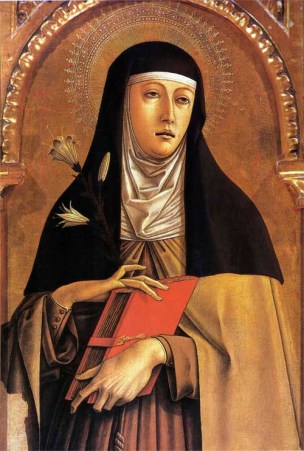
ST. CLARE: FIRST WOMAN FRANCISCAN,
FIRST WOMAN FRANCISCAN SAINT

1193 – 1253
August 11

Clear Light
It all began with Clare beautiful young daughter of Count Faverone Offreduccio and Countess Ortolana di Fiumi. When her mother was pregnant with her she was praying before the crucifix for a safe delivery when she heard a voice assure her, “Do not be afraid, for you will joyfully bring forth a clear light which will illuminate the world. “This is why her mother named her CHIARA or Clare which means “Clear light” and why she had always known the fate of her daughter.

One of Clare’s earliest biographer said that the century Francis and Clare were born in was one of darkness because the eye of faith had grown dark. “But,” she wrote, “God sent Francis, the resplendent Sun of Assisi and then Clare, a most luminous lamp for all women.”

Her Early Life
It’s hard to believe that a beautiful rich girl would give up everything we consider to be the “good” life for a life of extreme poverty and penance.

Yet this is what Lady Clare born Claire Scifi of the noble Offreducci family in Assisi, Italy in 1194 did. Profoundly impressed and deeply moved by the Lenten sermons of St. Francis in 1212 that portrayed his deep spirituality she was inflamed with a love for the poor and suffering Christ that she secretly begged the astounded Francis to take her under his wing and allow her to follow in his footsteps living “after the manner of the holy gospel.”

Her Conversion
Convinced of her sincerity and earnestness in her desire to leave all things of Christ, Francis met her surreptitiously and gave her the spiritual counseling and guidance she ached for.

After a year on March 18, 1212 on Palm Sunday (she was by now a mere eighteen years old) Clare secretly left her comfortable home and presented herself to Francis and his companions. But it was not to Francis she went to. He merely provided the meeting place and the means for her assignation which Christ. She came to consecrate herself to the Lord at the Porziuncola, St. Francis’s headquarters outside Assisi.

Snip, snip – off came her beautiful long hair. Swish, swish – off cam her luxurious fine clothes and jeweled belt which she exchanged for – of all things – a coarse tunic of sack cloth with an unglamorous common rope with knots in it as a belt.

Becomes First Woman Franciscan
Before Francis and his band of followers Clare took the vows of the Franciscan order thus making her the first woman Franciscan follower of II Paverello (the poor one) and the founding moment of the Order of Poor Clares, the second Franciscan order.

Francis had long dreamt of establishing a community of women that would correspond with his fraternity. He found in Clare the perfect partner he was seeking.

Since he had no convent yet for women he placed Clare in an old Benedictine convent near Bastia. When her parents tracked her down there they tried to bring her back as they considered Franciscan poverty not only degrading but also a disgrace to their good name. They only gave up trying to forcibly bring her back when she showed them her shorn head.

Francis then moved her to Sant’ Angelo di Panzo convent. Sixteen days later Clare’s younger sister Agnes joined her. Others came.

Made Superior
Francis then placed them and the other girls in a poor house belonging to the church of San Damiano on the outskirts of Assisi where he appointed Clare the superior and where she remained for forty years as abbess until her death on August 11, 1253. This became their convent and first community house and still is the Motherhouse. This is why they were called the Poor Ladies of San Damiano. It was only after Clare died that they were called Poor Clares after their foundress.

In time even Clare’s widowed mother and Beatrice, another sister, joined them. So did three members of one of the most influential families of Florence.

They lived a simple life according to the rule of “formula of life” that Francis gave them as the Second Order.

Poor Ladies
Perfect Poverty
They were called “poor ladies” because they practiced a life of perfect poverty. Since they owned nothing possessing no property even in common they subsisted only on what a few of them got by begging and alms. Yet they would reject donations of whole slices of bread content to accept only the crumbs. They were given this right by the Pope’s granting them the Privilegium Pauperitatis.

When Clare inherited a fortune from her father she gave everything to the poor and to hospitals unbelievably keeping nothing for the Poor Ladies.

Strict Penance
They also lived a life of strict penance. Living in complete seclusion they went barefoot even in winter, slept on the bare floor, ate no meat and observed complete silence. While the greatest emphasis was on Gospel poverty, they dedicated themselves to prayer, work, meditation and self-mortification although Clare went further than most of her nuns.

The Penance of Clare
The penance of Clare was hard and unbelievable. Her fastings were long and alternated with total abstinence of food. St. Francis had to intervene telling her to eat at least an ounce-and-a-half of bread daily.

Her haircloth was unbearable.

She spent long nights prostrated on the floor for hours on end.

Everyday at about three in the afternoon uniting herself to the death of Jesus she would flog herself very severely.

However no one ever saw her sad. She would always keep a joyous countenance.

The extent to which she was severe with herself is the extent to which she was kind and loving to her sisters.

Later in life she grew less harsh with her followers. In fact she wrote Agnes of Prague not to be quite so rigorous “since our bodies are not of brass.”

However she herself remained austere.

She kissed the feet of those who brought the goods they had begged in the streets.

At night she would walk round her nunnery to make sure that the Poor Clares were warmly covered up in bed.

“They say we are too poor. Can a heart which possess God really be called poor?”
6
First Woman Franciscan Saint
Miracles
Clare was given many gifts by God so she is credited with many miracles – even cures. But her most famous ones were the ones (in 1940 and 1941) when she saved her nuns and the city of Assisi from the marauding Saracens of Frederick II. Though sick at the time she asked to be carried to the convent walls where she placed the Blessed Sacrament in full view of the enemy. Praying fervently to the Eucharistic Lord the terrified Saracens fled.

When Pope Gregory was having breakfast with Clare he asked her to bless the only food they had – a basket of bread. As she did so the loaves of bread cracked and there appeared on them a well defined cross.

One Christmas when she was too weak to attend mass at the Basilica more than a mile away she saw and heard it all in a miraculous vision. This is why Clare was named the patron of television.

Spread of the Order
It is surprising that the rigors of their hard life did not deter others from joining the order. In fact under Claire’s guidance and supervision it grew and grew till its branches reached all over Europe.

Clare’s example so inspired rich and poor women alike to join the Poor Clares. After her father’s death even her own mother and another sister came ready to change their life for Jesus. Even three of the illustrious and influential Ubaldine family in Florence responded to the call of the Gospel.

To this day the Poor Clares are flourishing not only in Spain, Italy and France but throughout the world – even in the Philippines called Santa Clara.

Poor Clares
They were called Poor Clares because of the way they lived the virtue of holy poverty.

Clare tried so hard to emulate Francis – whom she called her Father, Planter and Helper in the Service of Christ – that she adopted and strove to carry out her ideal and mentor’s Rule of perfection: “that his order should never possess any rents or other property even in common, subsisting on daily contributions.”

Thus these poor ladies lived and supported themselves solely by begging alms. When given whole slices of bread they would even go to the extent of accepting only the crumbs.

Pope Gregory IX tried to soften her rule by offering to dispense them from the vow of strict poverty and provide them with a yearly revenue instead.

Clare was adamant in her refusal and instead told the pope, “I need to be absolved from my sins, but I do not wish to be absolved from the obligation of following Jesus Christ.”

Clare then set to work to draw up her own rule that would express in no uncertain terms that the sisters shall possess no property, either as individuals or as community (as proposed to them by Pope Innocent IV in 1247). In so doing Clare became the first woman founder of an Oder for which she wrote her own Rule.

It is ironic that the approval of her Rule came only two days before she died. It is said that the Papal letter granting his permission for them to live in gospel poverty relying wholly on god for their sustenance was found in her hands upon opening her tomb in 1893.

Death and Sainthood
Clare had to pay the toll for the austerities, which she imposed on herself suffering serious illness for the last 27 years of her life, mostly confined to bed in the convent of San Damiano in Assisi, which she never left.

Little Flower of St. Francis
On August 11, 1253 the living impersonation of Lady Poverty died at Assisi at the age of 60.

At her death there were already at least 120 Poor Clare monasteries.

The Assisi motherhouse, became a nursery of Saints. Her own sister Agnes became a saint like Clare who was solemnly canonized by Pope Alexander IV on 15 August 1255.

Just before she died Clare said. “Blessed be you, O God, for having created me” – the first Woman Franciscan saint.

Poor Clare proved to be not very poor after all. She was rich in the love of God and all that knew her. She was rich in the blessed life she led.

Patron Saint
St. Clare is the patron of embroiderers and of television. She is also patron of eye diseases, gilders, goldsmiths, laundry workers, oculists and telephones.

She is invoked against fever and blindness.

SOURCES of REFERENCE
ST. CLARE of ASSISI
August 11

Butler’s Lives of the Saints – Vol. III pp 309 – 313
The Illustrated World Encyclopedia of Saints – p. 152
The Book of Saints – p. 208
Pocket Dictionary of Saints – pp. 119 – 120
The Watkins Dictionary of Saints – pp. 56 – 57
A Calendar of Saints – p. 153
All Saints – pp 345 – 347
Saints for Everyday – pp. 289 – 291
A Year With the Saints – August 11
Butler’s Saint for the Day – pp. 375 – 377
Lives of the Saints – pp. 332 – 334
Illustrated Lives of the Saints – Vol. I – pp. 356 – 358
My First Book of Saints – pp. 178 – 179
Saint Companions – pp. 296 – 298
Saints for Our Time – pp – 168 – 169
Saint of the Day – pp. 201 – 203
Lives of Saints – Part I – pp. 251 – 257
The Big Book of Women Saints – pp. 240 – 241
Meditation on the Saints – Vol. 4 pp. 86 – 111
Saints – a Visual Guide – pp. 216 = 217
Saints and Heroes Speak – Vol. I pp. 90 – 96
Voices of the Saints – pp. 374 – 375
Ordinary People, Extraordinary Lives – Group 4 Card 10
The Lion Treasury of Saints – pp. 212; 144 – 145
Servants of God – pp 18 – 19
Best – Loved Saints – pp. 80 – 82
The Way of the Saints – pp 117 – 119
33 Saints for Boys and Girls – pp. 245 – 252
Book of Saints – Part 3 – pp. 12 – 13
Saints – Ancient and Modern – pp. 88 – 93
Saints of the Roman Calendar – pp 238 -239
Saints and their Symbols – pp 161 – 162

Categories
Francisfest JPIC

Francisfest 2015 Beneficiaries: JPIC Scholarship Ministry

“In so far as you did this to one of the least of these brothers of Mine, you did it to Me.”

By the grace of God and our Blessed Mother, Santuario de San Antonio Parish has been blessed by the inception and continuation of its JPIC Scholarship Ministry, allowing its parishioners and churchgoers to be instruments of God’s peace and making a difference in the lives of young men and women who have applied and been accepted in the Program. In turn, those of us who have committed to work in this particular area of our Lord’s vineyard have been doubly blessed as our lives continue to be enriched by this Ministry.

For almost two decades, the Santuario de San Antonio Scholarship Ministry has provided Tuition (full or partial), Food and Transportation allowances, and also implemented a Spiritual Moral Values Formation Program during the 1st and 3rd Saturday Monthly Meetings. One of our favorite activities during our 1st Saturday Monthly meetings is breaking up into Cluster Groups. Our scholars’ spirits are lifted as they are given their voice. This interaction helps us to form bonds and personal relationships with our scholars, and establish a more personal connection with them. They are not just faces and names, but real people, our brothers and sisters in Christ.

In many cases, we see this even five or ten years after, as our scholars return, give their testimonials — confirming that affirmation produces good results — and stand up to be role models to our current batches. Their dreams and goals have become a reality for them, and they have been able to uplift their lives and that of their families. This is Empowerment by the Holy Spirit!

Testimonial – Jeffrey San Miguel
WHERE DREAMS ARE WITHIN REACH

I am Jeffrey San Miguel from Laguna, youngest to my four brothers and two sisters. My father died when I was 6 years old, so my Super Mother with the help of my siblings had to survive. Back then, our source of income were my mother’s small Carinderia, and sometimes she accepts sewing orders like pillow cases, set covers and dresses to earn extra income. My brothers drive a tricycle after school.

When I was in high school, I wanted to be an Engineer. So when I entered College my mother had to borrow money for my 1st year tuition fee.I planned to work while studying and to apply for a scholarship. I was able to pass the ROTC officer scholarship but unfortunately on my second year, the ROTC was abolished; thus, my scholarship was terminated. My siblings wanted to help me but that time they couldn’t and because we don’t have enough money, I had to stop.

In about four years, I worked on different jobs – factory, super market, construction and even as a tricycle driver, but these were still not enough to continue my studies. God is good because one of my brothers assured me that if I would be accepted in Don Bosco-Makati, he would shoulder my monthly fee for my board and lodging. When I was reporting in Don Bosco Makati for the screening,my brother would lend his tricycle in order for me to earn and use it as my transportation from Laguna going to Don Bosco-Makati. I was able to pass the entrance exam and screening in Don Bosco. Then Brod. Elmer Rodriguez recommended me to Santuario de San Antonio Parish – JPIC Scholarship Program.
2
I was interviewed by Mrs. Rose Lopez and I remembered when she asked me, HOW DO YOU DESCRIBE YOURSELF AFTER FIVE OR TEN YEARS FROM NOW? Then, I replied that I will progress Ma’am. They granted me the scholarship and I became a JPIC Scholar. Through the scholarship, I was privileged to have transportation and food allowances every week and tuition fee, which truly is a very big help for me and for my mother. Even we just meet on the 1st Saturdays; there were so many things I’ve learned from SSAP JPIC Scholarship Program like how to be a Kristyanong Mamamayan, the mentoring of the Committee members during Cluster groupings, participating in Parish Involvement and other useful activities of the Parish.

The SSAP JPIC Scholarship did not stop in helping us even after we graduated. They helped us to look for On-the-Job Training and possible employment. I was fortunate also that they shouldered the cost of my Safety of Life Above the Sea (SOLAS) training in order to have a Seaman’s book. I would like to say a million THANK YOUs to Santuario de San Antonio Parish – JPIC Scholarship Program, to all the generous sponsors and to the staff for BELIEVING and for NOT GIVING UP on us.
3
Now, my mother is very proud of me but I should say that I am much proud for having her. I have my own house and lot, I helped my mother reconstruct our old house and with God’s grace my niece graduated Commerce last March, 2012 at FEU and is currently employed. Before, I worked in KGJS Fleet Makati in a Gear bulk vessel going around the world. Then, last March I applied and was hired by Magsaysay Shipping. Now,I am on board in a Gear bulk vessel.

Thank you very much Lord for all that I have now. And to all the scholars, ALWAYS PRAY TO GOD and DON’T EVER GIVE UP in your dreams. May God bless you all always.

Testimonial – Maila Nosora

“Every new day is another chance to change something in your life. Every new day is a chance to feel blessed for what you have”

These challenges brought me to what I am today with the moral support of my family, the financial assistance offered by the Santuario de San Antonio Parish JPIC Scholarship Program family, the academic formation of Monark Foundation Inc., the training conducted by Prestige Cars BMW Makati and Foton Motor Philippines and the grace of God Almighty.
11
After I graduated from high school at Trece Martirez City National High School in Cavite, I was quite confused whether to continue my college studies or not. I knew that my parents could not afford to give me a college education. I went around trying to look for a scholarship until one day, my father, who is a casual employee in an elementary school in Mandaluyong told me about SSAP JPIC Scholarship Program, which he heard about from his co-employee.

Reading the Program’s mission of “providing technical or vocational skills, spiritual and moral values formation, enabling to become economically and self-reliant to work productive and live with dignity in our society” gave me hope and direction that led me to the world of the Automotive Industry.

With God’s grace and self-confidence, I passed the interview conducted by the Scholarship Committee. Then, I started searching for a school and decided to choose Monark Foundation Inc. (formerly Monark Foundation Technical Institute) since I believed that Monark could provide me the possibility to grow and develop.
9
Fortunately, I passed Monark’s screening test. The second day of orientation was difficult. We were asked to remove and install tires. I never expected to undergo this physical experience. My body ached terribly and I felt sick. The next day, I admit that quitting school crossed my mind. However, the thought of this being an “astig” (popular) career path and “kakaiba” (different) challenged me more.

While undergoing in-school training, I became a model to my classmates since I was inspired by the Parish Involvement Activity (PIA) in Santuario de San Antonio Parish. I ran for office, was elected and served as Vice-President of the Student Council that school year. It was hard for me to study and conduct major school activities and events at the same time but I went on.

The very important part of our formation came. It was the on-the- job training program. I was one of the scholars chosen to report to Prestige Cars BMW in Makati. Luckily, I passed the interview conducted by the Manager and officially I became a trainee. I was assigned to the Service Department as Administrative Assistant. Here, I applied the rule of “learning by doing.” I did my best in the company for 13 months since this would be reflected on our In-plant Training subject. Our training contract ended three months before graduation and I was offered a job by the company. However, I did not accept the offer. Neither did I want to stay in school waiting to train for another three months under a possible company since I was very excited to work immediately to be able to help my family.
8
I decided to inquire about a newly-opened company, Foton Motor Philippines, a commercial China trucks distributor. Even though it was not an industry partner of Monark Foundation Inc., I accepted the offer to train here and with God’s grace, and with my perseverance and determination, Foton Motor Philippines recognized my capability and I was absorbed by the company even before graduation. Currently, I am the Customer Relations Officer.

On our graduation day, I was surprised and teary-eyed to receive two recognitions; the “Outstanding In-plant Trainee” and the “Leadership Awardee” of our batch, which I treasure and apply up to this date.

A lot of inspiration I have received from my family, from the SSAP JPIC Scholarship Program Committee and from benefactors for their selfless devotion to this Program, from Mr. Jan B. Banson, the former Monark Equipment President, who took some time to share with us his thoughts about his life’s experiences and lessons, and from our beloved instructors, who did their best to impart the knowledge and skills we need.

The mission of SSAP JPIC Scholarship Program came true. I have a stable job and a promising future. Everywhere I go, I feel proud to be a scholar of this Program, in this vocation I have chosen, I do not mind what others say about comparing degree holders to what I have studied. What is important is that I have a positive sight with which to embrace God’s blessings and appreciate all of them.

Maila Nosora (SY 2007-2008)

For more on the JPIC Scholarship Ministry >>>>>

Categories
Fr. Reu Galoy Reflections

POPE FRANCIS: JESUS IS THE BREAD OF LIFE, SUNDAY GOSPEL REFLECTION By Fr. Reu Jose C. Galoy, OFM

(Pope Francis has urged the faithful to look beyond material needs and turn to Jesus who is “the bread of life.” The Pope’s words came as he addressed the crowds gathered in St. Peter’s Square for the Sunday Angelus.)

Taking his cue from the Gospel reading which tells of the crowd that went looking for Jesus, not because they saw the signs but because they had eaten the loaves of bread and were filled, Pope Francis pointed out that those people gave more value to the bread than to He who gave them the bread.

He explained that before this spiritual blindness, Jesus highlights the need to look beyond the gift and discover the giver. God himself – the Pope said – is the gift and is also the giver.

Jesus invites us – the Pope continued – to be open to a perspective which is not only that of daily preoccupation and material needs; Jesus speaks to us of a different kind of food, food which is not corruptible and that we must search for and welcome into our lives.

He exhorts us not to work for food that perishes but “for the food that endures for eternal life which the Son of Man will give us,” he said.

With these words – Pope Francis continued – He wants us to understand that beyond a physical hunger, man has a different kind of hunger – “we all have this hunger” – a more important kind of hunger that cannot be satisfied with ordinary food.

“It is the hunger for life – the hunger for eternity – that only He can satisfy because He is the bread of life,” he said.

And pointing out that the true meaning of our earthly existence is to be found at the end, in eternity, Pope Francis said that to be open to meeting Jesus every day of our lives will illuminate our lives and give meaning to small gifts, sufferings and preoccupations.

And quoting from the Gospel of John, the Pope said “Jesus said to them: I am the bread of life; whoever comes to me will never hunger, and whoever believes in me will never thirst.”

“This – he said – refers to the Eucharist, the greatest gift that fulfills body and soul.”

To meet and to welcome Jesus, “the bread of life” – Pope Francis concluded – gives meaning and hope to our lives that are sometimes tortuous; but this “bread of life” – he said – also gives us the duty to satisfy the spiritual and material needs of our brothers.

To do this – he said- we must announce the Gospel everywhere, and with the witness of a fraternal attitude of solidarity towards our neighbor, we can make Christ and his love present amongst men.

About Fr. Reu and his other reflections…..

Design a site like this with WordPress.com
Get started