Categories
Hospital Ministry

PGH TOY GIVING by Sabrina Soriano

This slideshow requires JavaScript.

The Hospital Ministry visits the various hospitals it supports on a weekly basis to give medicines to the patients. This past week though, we were blessed by a kind family that donated toys that were gifts for their child’s birthday. They also added toys that their daughter didn’t use anymore so that other kids could use and enjoy them. Though the medicines are much needed to ensure their recovery from their illnesses/infections, you could really see the kids’ faces light up when they received a toy. One of those kids (the cute little boy sitting on the wooden cart) was actually abandoned by his parents after bringing him to the hospital for treatment. Despite his situation, receiving a toy made him break out into a huge smile!

So nice to be able to help them, not just with their medical needs, but also to bring smiles to their faces. Thanks so much Pia Lacerna and family for this!

If you have old toys, books, school bags and supplies that you can spare, to give and to share, I hope you can consider donating them to our Hospital Ministry (you can look for Nimfa Dumago at the parish office). Such a small gesture means a lot to these charity patients. Their big smiles are proof this.

Please also support our upcoming Francisfest fundraising this first week of October. We have a slew of activities lined up for all of you.

Categories
Fr. Robert Manansala Reflections

19th Sunday in Ordinary Time, Year C, A Reflection by Fr. Robert Manansala, OFM

The gospel passage this Sunday, which contains a teaching on treasures in heaven and three parables on vigilance and faithfulness, can be summarized by the following line that we read in the text: “For where your treasure is, there also will your heart be.” The Jesuit biblical scholar Joseph A. Fitzmeyer says “this maxim has parallels in secular Greek literature, but none of them is so succinctly put as this.”

Gerald Cowen, in his beautiful elaboration of the significance of the heart in the Bible, speaks of the heart as “the center of the physical, emotional, mental, moral and spiritual life of humans.” According to him, “the conscience, for instance, is associated with the heart.” On the negative side, depravity is said to issue from the heart. In Matthew 15:19, Jesus speaks that out of the heart comes evil thoughts, murder, adultery, fornication, theft, false witness, slander. “In other words, defilement comes from within rather than from without.”

Cowen further notes that “because the heart is at the root of the problem, this is the place where God does His work in the individual.” For example in Romans 2:15, St. Paul speaks of the work of the law as “written in their hearts,” and conscience is the proof of this. In some gospel parables, “the heart is the field where seed or the Word of God is sown. Finally, the heart is the dwelling place of God. God resides in the heart of the believer.

Jesus does not say in the Gospel, “Where your heart is, there will be your treasure also.” He says, “Where your treasure is, there also will your heart be.” Jesus knows that if we want to know what is in people’s hearts, we first find out what is in their treasure boxes or what they consider as their treasures.” Considered as the seat of human yearning or longing, the heart is attracted and directed towards that which it considers its treasures.

Etymologically, treasure comes from the English term “thesaurus,” a word that refers to a “storehouse.” Literally, it means “a receptacle of valuables.” What one keeps, maintains, safeguards, protects and accumulates as his valuables are his treasures. Indeed, what we store is our treasure. Denis McBride is right in saying that if we want to know the condition of one’s heart, find out what one stores in his treasure box. Tell me what you consider as your greatest treasures and I will tell you about the condition of your heart.

Last Sunday, Jesus warned against storing treasures up that do not last. More concretely, he warned against greed and strongly reminded that one’s life does not consist of possessions. What is important is to be rich in what matters to God.

Biblical revelation, Christian spirituality and theology tell us that the heart’s proper and prime attraction must be God. The New Catechism of the Catholic Church starts by declaring that the longing for God is planted in the heart of every person. In Matthew 6:33, Jesus tells us “to seek first his Kingdom and his righteousness, and all these things will be given to you as well.” In the gospel today, Jesus says that the Father is giving us this treasure of the Kingdom of God, “the inexhaustible treasure in heaven than no thief can reach nor moth destroy.”

If we anchor the rest of the Gospel on this fundamental challenge of receiving and making the God and Kingdom of God as the greatest treasure of our hearts, we then find at least three important lessons on the basis of our gospel passage.

First, everything, including material possessions and even basic needs that we have, becomes relative to the absoluteness of God’s Kingdom. We seek God and His Kingdom first and above all else. If we truly believe that God’s Kingdom has already started with the coming of Jesus, and the present is oriented towards the completion of this Kingdom in Jesus’ return or second coming, we strive to cooperate with God’s grace to really make God the center of our lives. One of the results of this is that we become more trusting in the providence of God and we acquire a more non-clinging and non-accumulative attitude towards everything, including possessions.

The gospel passage last Sunday made it very clear, “One’s life does not consist of possessions” and thus, we must avoid greed in any forms. In the spirit of St. Francis of Assisi and many other saints, everything is a gift from God and everything ultimately belongs to God. Obsessive and greedy appropriation and accumulation of goods are not traits of people who trust in God as their loving and benevolent Father. If God takes care of the sparrows, how much more he will take care of us.

Second, knowing that one’s greatest treasure is God’s Kingdom leads one to share what one has and possesses with others, especially with the poor. The relative and fleeting character of possessions makes one share with others and impels him to work for transformation of the world so that what truly reign in the world are the Kingdom values of love, peace, justice and equality. God the Father of all humans and of all creation has given the resources of the world to be shared by all. This experience of the Fatherhood of God and the absoluteness of his Kingdom makes us work for a new world order where no one is neglected, oppressed, abused and dehumanized.

Finally, because God and His Kingdom are our greatest treasure, the proper disposition in this world is that of a faithful and prudent servant and steward who is always ready to make an accounting to the Lord for the life and resources that He has given us and for the quality of lives that we have lived and the quality of persons that we have become. The gospel passage has a strong reminder on this: “Much will be required of the person entrusted with much, and still more will be demanded of the person entrusted with more.” At the hour of our death and at the eschatological coming of Jesus at the end of time, an accounting has to be made. Blessed is the servant and steward who is faithful, prudent and wise for living well and for relating well with others, especially the poor and the weak, according to the Kingdom values of love, peace, justice and equality.

A faithful and prudent servant and steward is vigilant. The first reading from the Book of Wisdom reminds us of the need for preparedness for the ultimate coming of the Lord as the Israelite people waited and prepared for their liberation from the slavery of Egypt.

A faithful and prudent servant and steward also possesses faith. The person who knows that his real treasure is God and His Kingdom will possess the faith exemplified by Abraham as recounted in the Letter to the Hebrews. Maryanne Williamson says that “the greatest treasures are those invisible to the eye but felt by the heart.” One can only apprehend these treasures by faith for “faith is the realization of what is hoped for and evidence of things not seen.”

We find in St. Augustine of Hippo, the sinner turned saint, an embodiment of the heart’s search for what can truly satisfy it. In his life story, we find a succession of desperate searches for fulfillment: excessive pleasures, false religions, philosophy, dissipation and distractions—futilities that left him so weary of himself he could only cry out, “How long, O Lord, how long?” In the midst of this cry for divine help, the Scriptures showed him that he could be freed from sin and that he could start living a godly life. The transformation of St. Augustine began when he finally believed in and surrendered himself to God.

In his beautiful work entitled Confessions, considered one of the greatest autobiographical testimonies of God’s interaction with a soul that has found rest in its Creator, with a heart bursting with the reality of God, St. Augustine directly addresses the Lord. He declares: “Great are you, O Lord, and greatly to be praised, great is your power, and your wisdom is infinite.

In contrast to God, he asks, “What is man?” Yes, he finds the connection between God and man. In spite of sin, each person feels the longing to reach out to his Creator. Whys is this so? St. Augustine realizes that this itself is God’s doing: “You have made us for yourself, and our hearts are restless, until they find rest in you.”

Blaise Pascal, the 17th century mathematician, philosopher and author declared: “There is a God-shaped vacuum in the heart of every person which cannot be filled by any created thing, but only by God, the Creator made known through Jesus.”

Our hearts know that nobody and nothing in this world can completely satisfy us. St. Poemen knew this very well when he said, “Give not your heart to that which does not satisfy your heart.” If we give our hearts to God, we give God everything and God becomes our All.

Almighty God,
you have made us for yourself,
and our hearts are restless till they find their rest in you:
pour your love into our hearts and draw us to yourself,
and so bring us at last to your heavenly city
where we shall see you face to face;
through Jesus Christ your Son our Lord,
who is alive and reigns with you,y
in the unity of the Holy Spirit,
one God, now and for ever.

About Fr. Robert and his reflections

Categories
The ABC’s of Catholic Doctrine

The ABC’s of Catholic Doctrine by Lianne Tiu

Marriage, like diamond, is forever.

Most videographers capture the most important part of the wedding rite when the bride and groom express their consent in church, “…for better, for worse, for richer, for poorer, in sickness and in health, until death do us part.”

As years go by, the “happily ever after” seems to exist only in fairy tales, but not in real life. We realize that loving someone for one’s entire life can actually be difficult. These difficulties, which come in all shapes and sizes, may be an aspect of the other’s personality that gradually emerged when the knot is tied, differences in beliefs, priorities, and value systems, different ways of dealing with conflict, changes in mind and body as we age, etc.

Today, there is prevalence of marital infidelity and extra-marital affairs, of marriages ending in separation or divorce (especially in the Western world). The blame is not entirely with the couple, however, but with the narcissistic society that promotes the violation of marital vows, which is no longer pleasurable or easy to fulfill. The media and a “Me” generation contribute to a kind of mind-set, which seeks a life that is free from pain, discomfort, boredom, or unhappiness. Short-term affairs or extra-marital affairs become normal; while divorce becomes acceptable, and even commendable.

It’s about time we lovingly remind people of the word “commitment” – that we honor a marriage vow for life. In the present age, people are getting used to trendier terms, like “freedom,” ”choice,” and “having it our way.” Commitment, however, is to stay married because we vowed we would. It requires self-giving to continue when we don’t always “feel like it.” It entails patience to bear with each other’s faults until death. It needs loyalty to be faithful as long as we live. It requires humility and forgiveness to continue when there are hurt and anger. And most of all, commitment needs help from God, the author of marriage, to continue being one in flesh through prayers and the sacraments.

Our family, which we claim we truly love, is worth the struggle in spite of the obstacles and differences. Our children and grandchildren may gather some fortune and fame from us, but they will definitely inherit an immeasurable trust through our examples of faithfulness and commitment.

Pop star Rihanna sings about shining bright like a diamond. Marriage is like this precious diamond, which comes the Greek word adámas meaning “unbreakable”. It is a beautiful partnership; it is a lifetime commitment.

(Reference: “Raising Catholic Children” by Mary Ann Kuharski; “Marriage is Love Forever” by James Socias; Catechism of the Catholic Church; Wikipedia)

Categories
Luke 18

63rd Luke 18 Weekend by Alexa Tordesillas and Henry Tordesillas Harrison

An event very special in the hearts of the members of our Faith Family happened last August 1-3. It was the 63rd Luke 18 Weekend.The Luke weekend is a retreat for 11-15 year olds who want to meet new friends and find a new home in the church. We, the Lukers, have one important goal in mind and that is to spread God’s love.

This slideshow requires JavaScript.

Alexa Tordesillas – Last May, I remember receiving a message from Tita Yenyen Chan asking me to team for the 63rd Luke 18 Weekend in August. At first, I wasn’t so sure because I still had school to manage. But looking back at it today, I am glad to say that I took that chance because teaming for the weekend proved to be one of the best experiences of my life. Although it was my second time to team (the last time being the 59th weekend) and I already knew how the process and preparations went, it was still much different because this time, I was a team leader along with Franco Celiz. All of us 14 teamers seemed very different from each other at first but as the months went by, we were able to develop a special bond that helped us manage the weekend and make it a great and worthwhile experience for the candidates. After 2 months of learning how to sing in the right tune, memorizing lyrics and writing talks, the weekend we were all waiting for finally came.

Before we welcomed candidates into the room, we, including the Adult Leaders and Bridge Builders said prayers to guide us throughout the whole weekend. Those 3 days had gone by so fast. Before I knew it, we were standing up after the mass and jamming to all the songs we knew by heart, and are now stuck in the heads of the new Lukers. All the new people that I met have changed my life in one way or another. Seeing everyone there just made me so happy. One thing’s for sure, I’ll be at the meeting this week, bonding with everyone and spreading God’s love.

Henry Tordesillas Harrison – During this past weekend, I had the time of my life. Even though it only lasts 3 days, team had to meet every Friday and Saturday for two months to prepare for the weekend. Our preparations included: work-shopping talks, practicing for share-groups, singing the Luke songs (over and over again)and, most importantly,praying. Getting to know the 13 other people on team during the meetings was some of the best time spent in my life. After the first meeting, it was like I had already made 13 new friends who I could talk to whenever I wanted without thinking about whether they thought I was weird or too quiet. Everyone on team was so accepting of each other and we all grew to love one another as if we were all brothers and sisters.

When the weekend finally came, I was equally excited as I was nervous. I was nervous about singing, nervous about meeting the candidates. “Will the candidates like me?” “Will they listen to my talk?” questions like these were running through my head on Friday night, while waiting for everyone to arrive. When everything was finally underway and all the lessons we learned in Team meetings started to make sense, I realized that everything was alright and that my previous worries were useless. The candidates were all so nice. They shared their experiences with us, laughed with us, cried with us and, for the most part, sang with us. The 25 candidates I met and talked with over the weekend are some of the most warm-hearted, loving and wise people I have met since joining Luke. Although I didn’t have much time to talk with all of them, I will hopefully be getting to know each and every one of them in the upcoming meetings.

After everything was done and we had all returned to our normal lives, I couldn’t help but miss the weekend. I missed the candidates, I missed the SS and I missed my fellow teamers. Not seeing them every Friday and Saturday is going to take some getting used to, but I pray that we will all stay as close as we were before and during the weekend. This weekend and the time spent preparing for it helped develop me not only as a Catholic but as an individual. I learned so many things that I previously didn’t know about myself. I came out of my shell and started to interact with everyone more than ever before. Without the 63rd weekend and all the people involved, I don’t think I would be the person I am today.

For those interested to join the next Luke 18 weekend, pls. contact Rocky Chan (rocky.wangchan@gmail.com). There will be one, tentatively, set for November this year. Applications will be available closer to the event.

Categories
Random Thoughts by Peachy Maramba

R A N D O M T H O U G H T S: Voices from yesterday and today . . . by Peachy Maramba

6

ST. LAWRENCE of ROME :
Patron of Cooks

d. 258:
August 10

A Likely Tale
If you believe that all saints are dry, sedate joyless types you should hear the tale about St. Lawrence. No one is really certain how much of this story about him is true but as the Italians say,“Se non e vero, e ben trovato” or “Even if it isn’t true it makes a fascinating story.” Famous Christian writers such as St. Ambrose, Damasus and St. Augustine thought so as they faithfully recounted the details of the martyrdom of one of the earliest martyrs of the church in Rome to show how early Christians viewed the prospect of dying for their faith.

Not only did the account of Lawrence’s martyrdom amuse people, more importantly it made such a deep and lasting impression on the early Church that many were converted to the faith on hearing the oral tradition about this saint.

According to Tradition
Lawrence, it is said, was born in Huesca, Spain around 230. He was the first of seven deacons (clerics ranking just below a priest) who served the Roman Church in the third century. Besides assisting the Pope when celebrating Holy Mass and giving Holy Communion to the people, Lawrence was tasked with being the almsgiver who had the grave responsibility of being in charge of Church property and distributing to the poor the offerings and alms given by the Christians.

He was a deacon of Pope Sixtus II with whom he was on intimate terms. When Sixtus was condemned to die at the Catacombs of St. Calixtus in 258 during the oppressive persecution of the Christians conducted by Emperor Valerian, Lawrence was overwhelmed with grief that he could not die along with him.

But as the Pope together with four other deacons were being led out to die, the Pope said, “Do not cry, my son. I am not leaving you. In three days you will follow me.”

Overjoyed and believing wholeheartedly his beloved pope’s prophecy, Lawrence immediately began to prepare for his own leave-taking. Following the order of the pope he first sold many of the treasures of the Church such as the chalices and even the sacred vessels. Then he assembled as many of the 1,000 unfortunates of Rome the church had been caring for. To them he distributed all the money he had amassed.

You can imagine the anger of the prefect of Rome when he heard of Lawrence’s unheard of charity and mass disposal of Church valuables as he felt that the Church’swealth should rightfully go to the government to maintain the Emperor’s forces.

Being a “worshipperof gold and silver” the prefect also thought of all the other treasures the Church must have in hiding. So he summoned Lawrence andtold him, “I am told that to adorn your ceremonies you Christians burn tapers in silver candlesticks and that your priests make offerings in bejeweled cups of gold. Bring these and your other treasures out of hiding. The emperor needs them.”

On being commanded to immediately reclaim and hand over the other treasures of the Church in his charge, Lawrence begged for three days time to be able to reassemble and inventory them.

By the third day he had gathered all the poor, crippled, orphaned, blind, ill, old, lepers, widows and dispossessed of Rome that the Church maintained. Instead of the gold and silver the prefect was expecting these he presented grandly to the prefect of Rome as the riches of the Church. “These seeming wretches are truly what our Church treasures most,” Lawrence insisted.

Martyrdom
Failing to see the humor in this and enraged beyond belief the prefect shouted at Lawrence, “I know that it is your mad wish to die a martyr and so you shall. But not in the way you imagine. You will not die quickly as I will make sure that your flesh will be destroyed bit by bit, inch by inch.”

Immediately ordering a huge gridironto bebrought forth he had hot coals placed under it. Then after having Lawrence stripped he had him bound to this red-hot griddle where his flesh would be roasted in slow motion. He wanted to be sure Lawrence would die a slow and painful death.

However after some considerable time Lawrence now bathed in light but apparently feeling no pain seemingly immune to the tortures of his persecutors smiled at the prefect and said, “I think I am now well done on this side, so you can turn me over.”

After complying with his macabre request and when he was near death. Lawrence again spoke and cheerfully said, “There. I believe that I am now thoroughly cooked. Let the feast begin.”

Wide-awake to the end, Lawrence bore the agony with unbelievable equanimity and even prayed for the conversion of Rome and the spread of the faith throughout the Roman world. And on that note he breathed his last.

It is said that several people including some senators and soldiers who witnessed the final moments of Lawrence were so moved by his heroic death that they immediately became Christians on the spot. It is said that it was they who gave Lawrence a decent burial on the Via Tiburtina. According to the poet Prudentius it was the death and example of Lawrence which signaled the end of paganism and led to the conversion of Rome. God had answered Lawrence’s prayer! His death which had inspired a great devotion in Rome spread quickly throughout the Church. In keeping with his name Lawrence won great “laurels” for the Church.

Veneration
Thus the beautiful basilica of San Lorenzo was built over his grave just outside the walls of Rome in a cemetery on the Via Tiburtina by Emperor Constantine. It became one of the centers to which the newly baptized were taken during Easter week.

Few martyrs have been as venerated as Lawrence with a cult growing up quickly around him probably because of his sense of humor in the midst of his fiery end. His rare courage which encourages others in times of persecution could only come from a firm faith in the promises of the Lord and made him one of the most famous Roman martyrs.

In the 4th century the name Lawrence was included in the Canon of the Roman Mass immediately after Saints Peter and Paul.

St. Lawrence is understandably the Patron of the Poor as his job as deacon was to distribute alms to them.

He is named Patron of Firefighters because of his fiery death. And with a hint of his own humor, Lawrence was appropriately named Patron of Cooks.

His feast day which falls on August 10 was first observed early in the 4th century.Falling shooting fiery stars which are periodic swarms of meteors often seen in Rome at that time of his feast are known as “the tears of St. Lawrence.”

He has even given his name to a river in Canada, a cathedral in Spain and to many churches the world over.

However while later historians revealed that our saint was actually beheaded, his death (or the likely tale of his death) did actually lead to the conversion of Rome. This is probably why while little is known about him the Church has given him extraordinary honor.

His burial place in St. Lawrence Outside the Wall (San Lorenzo fuori le Mura) has become not only one of the seven principal churches in Rome but a favorite pilgrimage site in Rome. It is said that in Rome alone there are 30 Roman Churches dedicated to him and countless churches worldwide.

SOURCES of REFERENCE
ST. LAWRENCE of ROME
August 10

Butler’s Lives of the Saints – Vol. III – pp 297 – 299
Pocket Dictionary of Saints – p 304
The Watkins Dictionary of Saints – p 141
A Calendar of Saints – p 152
A Year With the Saints – August 10
Butler’s Saint for the Day – pp 374 – 375
Illustrated Lives of the Saints – Vol. I pp 355-356
My First Book of Saints – pp 176-178
Saint Companions – pp 295-296
Saints for Our Time – pp 167-168
Saint of the Day – pp 200 – 201
Saints – A Visual Guide – pp 84-85
Voices of the Saints – pp 66 – 67
The Everything Saints Book – p 270
The Lion Treasury of Saints – p 215; p 64 – 65
The Flying Friar – pp 54-57
Best Loved Saints – pp 38-40
The Way of the Saints pp 274-275
Book of Saints – Part I – pp 16-17

Categories
Special Events

Koro Ilustrado: Higher

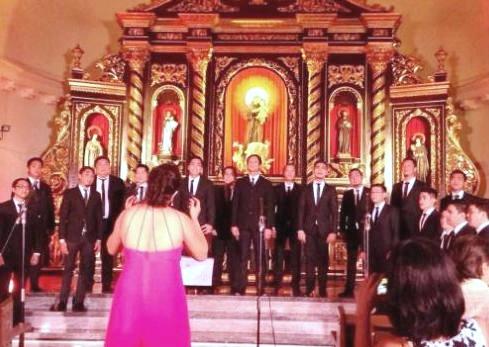
4The torrential rains did not dampen the spirit of Koro Ilustrado nor did it stop their family, friends and supporters from the parish – headed by our beloved Parish Priest, Rev. Fr. Reu Jose C. Galoy, Music Ministry Head Mr. Edmund Lim and other members of the Parish Pastoral Council – as the all-male choir staged their fourth major concert last Saturday, August 2, with higher aspirations and a higher purpose.3
Dubbed as Koro Ilustrado: Higher, the concert was both a kick-off to the choir’s fundraising activities — as it aspires to participate in festivals and compete at international choral competitions abroad next year — and also share part of the proceeds with the disadvantaged children of the Bahay-Ampunan nina Hesus, Maria at Jose.
5
Bahay-Ampunan was founded in 1998 and situated within the convent grounds of the Blessed Sacrament Missionaries of the Poor Brothers by providing for the primary needs of disadvantaged children like food and medicine. Five boys from Bahay-Ampunan accompanied by a brother were part of the audience. One of the boys even rendered a song, acapella, as their way of participating in the night’s musical treat and showing gratitude for the generosity of all donors that evening.
2
Meanwhile, Fr. Efren Jimenez led the opening prayer and Koro Ilustrado praised and thanked God with the first song “Confitemini Domino” (Psalm 106:1), a sacred motet by Giovanni Pierluigi de Palestrina. The Ilustrados sang their hearts out throughout the evening with a broad repertoire which included a German Lied by Franz Schubert “Die Nacht,” contemporary arrangement in Latin of the prayer “Anima Christi” (by John August Pamintuan) and a text from the Canticle of Simeon “Nunc dimittis” (by Joy Nilo), a modern Ilocano folk song “Ubing a Battit,” as well as 80s hits like Bill Withers’ “Lean on Me,” John Lennon’s “Imagine,” the inspirational “Warrior Is A Child” and Depeche Mode’s “People are People.” Koro Ilustrado, known for their flair for entertainment, also showcased their versatility by belting out and dancing up to recent hits like Beyonce’s “Halo” and Carly Rae Jepsen’s “Call Me Maybe” mashed up with Psy’s “Gangnam.” 1
The rains may have continued heavily outside but the support and appreciation for the Ilustrados were similarly outpouring inside the Santuario de San Antonio.In the end, Koro Ilustrado obliged two encore numbers and ended with a high-energy, celebratory rendition of Shakira’s “Waka-waka.”

The concert was not made possible without the full support of the parish and with this, Koro Ilustrado is sincerely grateful.
Koro Ilustrado is a member of the Santuario de San Antonio Parish Music Ministry and serves during the 4:30pm Mass every 2nd and 4th Saturdays of the month. For information on their activities and other performances, you can check out http://www.koroilustrado.weebly.com or add them on Facebook (facebook.com/KoroIlustrado) and/or Twitter (twitter.com/KoroIlustrado).

Categories
Serra

SERRA NEWS by Tessie V. Castaneda

untitledThe 72nd Serra International Convention was held in Sacramento, California last July 10 – 13, 2014 with 350 delegates from all over the world. The 2013-2014 president, Mr. Sean Yeo, is from Singapore. Five from the Philippines attended. The theme of the convention was “The Path to Holiness – A Serran Guide.” The mission of Serra International is clear and focused because of the following objectives:

(1) To foster and promote vocations to the ministerial priesthood in the Catholic Church as a particular vocation to service, and to support priests in the sacred ministry.
(2) To encourage and affirm vocations to consecrated religious life in the Catholic Church.
(3) To assist its members to recognize and respond in their own lives to God’s call to holiness in Jesus Christ and through the Holy Spirit.

Serra International is formally recognized by the Vatican as the lay vocation arm of the Catholic Church. Pope Benedict once was asked what could be done to encourage vocation. “Teach them to pray.” Prayer is the vocation. In prayer we will discover God’s trust. Pray for more vocations and inspire others to do so.

One of the main agendas in this convention was a spiritual retreat conducted by Very Rev. John Horn, SJ. He taught the delegates how to do “Lectio Divina” a method where the Word of God is read and meditated on that it becomes prayer. He said that there is nothing more refreshing than receiving the Living Word of the Sacred Scripture.

It was reported in the conference that Serra International raised US$20,000.00 to help rebuild Sacred Heart Seminary in Palo, Leyte.

Categories
Health Care Ministry

Health Care Ministry’s Annual Recollection

photoThe Health Care Ministry members held its annual Recollection at the Pico de Loro Country Club, Nasugbu, Batangas last July 22.

Accompanied by Fr. Jesus Galindo, OFM, the group left Makati at 7:30 am. Upon arrival at the beautiful cove resort, they were treated to a welcome drink and were immediately escorted to a special function room where the recollection and mass were held. The original venue (an all-glass chapel) was slightly damaged by typhoon “Glenda,” hence the change in venue.

After the recollection, lunch was served and the group decided to take a tour of the place, play bowling, and simply take the opportunity to unwind, commune with nature and make themselves ready to be at the loving service of the Church and Community when they get back to Makati.

Categories
Random Thoughts by Peachy Maramba

R A N D O M T H O U G H T S: Voices from yesterday and today . . .by Peachy Maramba

4

ST. IGNATIUS of LOYOLA:
Founder of the Society of Jesus

1491-1556
July 31

PART I

First Period – 1491-1521
A Knight and Soldier

Christened Iñigo Lopez de Loyola he was born in the ancestral castle of Loyola at Azpeitia in the Basque province of Guipuzcoa, Spain in 1491 the youngest of 13 (some say11) children of an ancient noble and wealthy family. His father Don Beltran was lord of Oñaz and Loyola.

As a youth he first served as a page in several courts where he was trained in the code of honor and chivalry. Taking his profession as a soldier very seriously at the age of 25 he entered the military service and determined to be an outstanding soldier of the Duke of Nagara. In the unsuccessful defense of Pamplona against the French he suffered a grievous injury when he was struck in the leg by a cannonball that broke his right shin and tore open his left calf. This marked the turning point in his life. At the young age of 30 his ambition of pursuing a military career and his dreams of glory came to an abrupt and crashing end.

This ends the first period of his life when he describes himself in his Autobiography as “a man given to the vanities of the world whose chief delight consisted in martial exercises with a great and vain desire to win renown” in spite of his short stature (under five feet two inches in height).

Second Period – 1521-1524
A Soldier of Christ

This second period could well be called the most decisive and critical stage of his life. Back home in the family castle his condition became so serious that he was given the last sacraments after he had undergone several excruciating painful operations on his leg that was badly set. Fortunately he recovered but it left him with a permanent limp followed by a prolonged and painful convalescence.

To combat sheer boredom he requested for something to read like the books of chivalrous romances he was fond of. Unfortunately he had to settle on the only two books available – a Carthusian Life of Christ and the other The Golden Legend, a collection of the biographies of saints.

He became so fascinated and impressed by the life of Christ that he decided to devote himself to Him thereby becoming a knight and soldier of the Cross instead of the Crown. Since the book of saints by an anonymous writer contained prologues to the biographies that conceived the Service of God as holy chivalry – this view of life profoundly moved and attracted him that he vowed to imitate their lives imagining what a great honor it must be to serve to the greater glory of God (this became his motto later in life). He asked himself: “These men were of the same frame as I why then should I not do what they have done?”

Spurred on by a vision he had of the Mother of God surrounded with light holding baby Jesus in her arms and full of zeal to start his holy life he decided that as soon as possible he would do penance for his sins by imitating the holy austerities practiced by the saints.

As soon as he sufficiently recovered he mounted a mule, and went to Our Lady of Montserrat, a Catalonian shrine of pilgrimage in the mountains above Barcelona in northeastern Spain. It was on the way here that he traded his rich robes for a beggar’s sackcloth, and then made an all-night vigil pledging himself as a knight in God’s service before the famous statue of the Virgin Mary.

After 3 days confessing his sins in the Benedictine abbey of Monserrat he hung near the statue his sword and dagger as symbols of his abandoned military ambitions. Thus did he instead become a soldier of Christ.

The following day he went to the nearby small town of Manresa where he lived ten months in a cave on the banks of the river in solitary reflection living as a hermit-beggar, scourging himself of sinful attachments, fasting and praying.

While on the banks of the Cardoner river while searching for God’s will God gave him knowledge of himself aided by several mystical visions such as the sight of a blinding light emanating from the Eucharist. He came to understand and know many spiritual things as things of the faith.

But after enjoying much peace of mind and heavenly consolation he was soon affected by the most terrible trial of fears and scruples. He found no comfort in prayer, fasting nor even from the sacraments. Overwhelmed with sadness he felt himself on the brink of despair.

It was at this time that he began to jot down notes of what was happening to him and what he was doing to cure his scrupulous conscience. As he wrote his notes for what was to become his famous book of Spiritual Exercises his soul once more began to overflow with spiritual joy and his tranquility of mind was eventually restored.

The Spiritual Exercises

He trained his mind to get mentally fit by praying seven hours a day. He kept notes of what he was doing describing it as his spiritual exercises. He later wrote down his religious experiences of his own conversion and this became the fundamentals of his famous manual The Spiritual Exercises. This how-to book, which was not published until 1548 is still used for spiritual retreats and for spiritual formation of his followers and has had a profound effect on the lives of Christians. In fact one author described it as “the book that shook the Catholic world.”

It remained one of the most famous and fruitful work of Ignatius.

Pilgrimage to the Holy Land

In February 1523 Ignatius started on his pilgrimage to the Holy Land by begging and walking all the way in spite of a permanent limp caused by his war injury. However his plans to stay in Jerusalem was foiled when the Franciscan guardian of the Holy Places commanded him to leave Palestine for his own safety. This was because his reckless attempts to convert the Muslims there could cause him to be kidnapped and held to ransom.

He thus returned to Barcelona, Spain in 1524 determined to become a priest in order to help souls. So he forced himself to enter school and study when what he really wanted to do was to go out in the streets preaching about God and teaching catechism.

Third Period – 1524-38
Years of Belated Studies

Because he was convinced that a well-trained man would accomplish more in God’s service, Ignatius spent the next 11 years diligently applying himself to his studies in Barcelona, Alcala, Salamanca and Paris. In Barcelona at the age of 33 years he sat in a class of eleven-year olds to learn Latin stoically bearing the jeers and taunts of the little boys. Financially he was assisted by the charities of a pious lady of that city called Isabel Roser.

But because he exhorted his fellow students to live a life of heroic piety he gathered around him a band of followers who even wore a distinctive coarse grey garb. He was imprisoned and tried on suspicion of heresy. Found innocent he was forbidden to teach until he had finished his studies.

PART II

Founds the Society of Jesus

Leaving his disciples behind Ignatius went to the University of Paris where living on alms he finally got his coveted master of arts degree at the age of 43 in 1534.

At that time six students in divinity associated themselves with Ignatius in his spiritual exercise. They were: Francis Xavier, a Basque like Ignatius (who would become the great missionary to the East), Simon Rodriguez a Portuguese, Peter Faber a Sauoyard, Laynez and Salmeron, both fine scholars and Nicholas Babadilla.

In a chapel on Montmarte on August 15 of the same year Ignatius together with his six fervent fellow students founded the Society of Jesus (or the Jesuits as they were popularly known) whose members vowed to live in poverty and chastity and to return to the Holy Land (but still without the express purpose of founding a religious order). However, for reasons of health he left the band to finish his theological studies by studying privately while on pilgrimage through Spain and Italy.

On January 8, 1537 his Parisian “companions” joined him in Venice eager to make the pilgrimage to Jerusalem. It was here that they (just ten men) were finally ordained and the formal title of Society of Jesus adopted. Then using his own innovative spiritual manual, Spiritual Exercises, Ignatius began instructing his new “soldiers of Christ.”

Fourth Period 1539-1556
Governing the Society

Unable to go as planned on pilgrimage to Jerusalem as the war between Venice and the Turkish empire made it an impossibility they went to Rome as they had earlier vowed and offered their services to Pope Paul III. It was while in Rome that our saint changed his name of Iñigo to Ignatius after St. Ignatius of Antioch. But they called themselves simply as “Companions of Jesus” because they were united to “overcome worldliness and ignorance and counteract the untruths being spread by the Church’s enemies.

It was also on the way to Rome that he had the famous vision of La Storta in which Christ promised him that all would go well in Rome.

On September 27, 1540 Paul III solemnly approved their venture. The Society (or Company) of Jesus became a new form of apostolic religious life. Unlike other religious orders they had no monastic choir, no fixed religious garb and a strong emphasis on mobility and flexibility in the service of the church as a whole. Their battle cry was Ad Majorem Dei Gloriam – For the Greater Glory of God.

To achieve this, the organizational structure was highly centralized with the superior general elected for life and the professed Jesuits taking besides the vows of poverty and chastity an additional vow of obedience. The first vowed to obey the order not to aspire to become superiors. However their Constitution composed by Ignatius required easy communication with higher superiors.

The group took their final vows in 1541 and Ignatius was elected against his will as their first Superior General. However he immediately took on the job of cook (maybe to show his humility). Under his able hand the Society developed very rapidly so that in the fifteen years that he served as general of the order the Jesuits increased from 10 to 1000 Jesuits scattered in 12 provinces from Italy to India. At the same time his order became one of the most dynamic in the Church.

He had 3 goals for the church using his method of “contemplation in action:”
1) reform especially through education and more frequent use of the sacraments;
2) widespread activity in the missionary field; and
3) fight against heresy.

Ignatius took for his motto “To the greater glory of God” as he often said, “Lord, what do I desire, or what can I desire, besides thee?” Because he believed that true love is never idle, always to labor for God, or to suffer for His sake was all his happiness.

Education

Besides founding the Roman college and the Germanicum, a seminary for German candidates for the priesthood, Ignatius laid the foundations of the system of schools (like the Ateneo) which was to earmark his order as primarily a teaching order. The Jesuits were in time “renowned for their prowess in the intellectual sphere and in the field of education” as well as their zeal and military discipline.

Reform

Ignatius and his men of action and learning played a leading role in the preserving and renewing of Catholic Reformation or Counter Reformation during the sixteenth and subsequent centuries. Thus it was the Jesuit Order that started Europe back toward the Church having finally turned the tide against the Protestant Reformers.

They were even among the first to bring the faith to North America. In fact the first bishop there was John Carroll, a Jesuit.

Missionary

Ignatius decreed that the Society was to be above all a missionary order of apostles “ready to live in any part of the world where there was hope of God’s greater glory and the good of souls.” Long and thorough and arduous training of his followers was a MUST as was their special vow of obedience to the pope. However the Society’s main thrust under Ignatius was to establish missions in Asia and South America. Thus no sooner had they been established did many of the original Jesuits leave on perilous missions to India, Brazil, China and the Congo as well as Asia, New Spain and Protestant England. Sadly Ignatius had to remain behind in Rome where he spent the rest of his life.

CONSTITUTION

Probably the most important work of the later life of Ignatius was his composition of the Constitution of the Society of Jesus which is still used today to regulate the lives and aspiration of Jesuits scattered all over the world.

Other Accomplishments

Besides founding one of the most powerful and dynamic orders in the Church noted for their commitment to education and social justice Ignatius for fifteen years directed the battles of his Society. He even established a home for fallen women and one for converted Jews. The Jesuits have also been in the forefront of the modern ecumenical movement. However he resolutely excluded a female branch of the order because he believed that women are better ruled by women.

His writing and teaching were able to draw believers back to the Roman Catholic Church after the Reformation.

The Jesuits’ battle of transforming society was fought not only in the pulpit and in the fields of mass media and education but in culture, the arts, which they patronized and even in the political arena.

Death

Frequently sick Ignatius begged to be allowed to resign but his petition fell on deaf ears. He directed the order till the summer of 1556 when he suffered from fever. While his doctors did not think it serious Ignatius knew that he was near death. Almost blind at 65 he asked for a last blessing but his request was ignored as he didn’t seem to be in any imminent danger. He died the next day on July 31, 1556 so suddenly and so unexpectedly that he did not even get to receive the last sacraments he had asked for.

Ignatius was beatified by Pope Paul V in 1609 and canonized by Pope Gregory XV in 1622.

He was declared patron of all spiritual exercises and retreats in 1922 by Pope Pius XI who described Ignatius’ most important single writing The Spiritual Exercises as “the wisest and most universal spiritual code for guiding the soul on the path of salvation.” This manual molded 27 canonized saints including 3 intimates of Ignatius – Francis Xavier, Peter Canisius and Francis Borgia.

His feast is celebrated on July 31, the day he died.

Prayer
St. Ignatius leaves to us his prayer which he often said:

Dearest Jesus, teach us to be generous;
To serve Thee as Thou deserves;
To give, and not to count the cost;
To fight, and not to heed the wounds;
To toil, and not to seek for rest
To labor, and to seek for no reward
Save that of knowing that we do Thy
Holy Will.

SOURCES of REFERENCE
ST. IGNATIUS of LOYOLA

July 31

Butler’s Lives of the Saints – Vol. 3 – pp 221-227
The Illustrated World Encyclopedia of Saints – pp 176 – 177
Pocket Dictionary of Saints – pp 251 – 252
The Watkins Dictionary of Saints – pp 118 – 119
A Calendar of Saints – p 144
All Saints – pp 327 – 328
A Year With the Saints – July 31
Butler’s Saint for the Day – pp 355 – 357
Illustrated Lives of the Saints Vol. 1 – pp 337 – 339
My First Book of Saints – p. 165
Saint Companions – pp 277-279
Saints for Our Time – pp 159 – 160
Saint of the Day – pp 183 – 184
Children’s Book of Saints – pp. 211 – 214
Saints – A Visual Guide – pp. 250 – 251
Saints and Heroes Speak – Volume 3 – pp 100 – 114
The Way of the Saints – pp.208-209
Saints – pp. 176 – 177
Voices of the Saints – pp. 470 – 471
Ordinary People, Extraordinary Lives – Group 6 Card 3
The Everything Saints Book – pp. 113 – 116
The Lion Treasury of Saints – p 214, 162 – 163
The Flying Friar – pp. 46 – 49
Servants of God – pp. 38 – 39
Best – Loved Saints – pp 107 – 110
The Way of the Saints – pp 208 – 209
Book of Saints – Part 5 – pp 18 – 19

Categories
Men of the Sacred Heart

Experience the love of the Sacred Heart in Nature By Carl Lopez

Then God said, “Look! I have given you every seed bearing plant throughout the earth and all the fruit trees for your food. And I have given every green plant as food for all the wild animals, the birds in the sky, and the small animals that scurry along the ground-everything that has life.” And that is what happened. (Genesis 1:29-30)

We are called to be good stewards in exercising dominion over the creation of God. This is the resounding call that the Lord has been prompting me through his Holy Spirit for the past many years. In my childhood, I lived and experienced the lush green forests of Mindanao in Compostela and Malaybalay, Bukidnon, and the haciendas and waterfalls in the haciendas of Negros Occidental.

These childhood experiences exposed me to nature. I vividly recall bathing and playing in clean rivers, beaches and water falls in virgin forests inhabited by deers, rabbits and squirrels. At sunset, big ants and fireflies would show up. The weather was cool and the air crisp. The sweet smell of trees and grass filled the air.

The call of the Sacred Heart is to see his love very present in the wonders of his creation. A quote by Theodore Roosevelt compels all of us to do our part in preserving the rich bio diversity of our natural resources. “Here is your country, cherish these natural wonders, cherish the natural resources, cherish the history and romance as a sacred heritage, for your children and your children’s children.“

For lack of exposure to nature, the children of today’s generation have become jaded and detached from it. Their idea of the outdoors is limited to the malls and what they see on TV or the internet using the gadgets they play games with or watch videos from.

As a public servant, I have seen kids in the barangays who have to make do with swimming in murky rivers, unaware that the water is not fit for bathing. Our rivers and seas are polluted because they have been used for bathing, washing clothes and dumping personal wastes. People have dug deep wells and jetmatic pumps wantonly turning them into virtual trash dumps that eventually contaminate fresh water supply that in turn, result in countless illnesses.It should be each ones goal to bring to the realization of our people the ill effects of their actions and to put a stop to them, and preserve our environment as gifts from God.

The task is daunting but being a man of faith my formation as a member of the Men of the Sacred Heart, and the (SFO) Secular Franciscan Order, I seek inspiration from St. Francis of Assisi and St. Anthony.

carl mike & jun(L-R) Carl Lopez, Mike Limpe, Jun Rodriguez.

Like the good saints, may our people understand that we can experience God everywhere even in nature. If we can see God in nature then we will probably start to treat our natural resources with respect and love.

“For all things were created by God, and things exist through God and for God.” (Romans 11:36)

Let us do our part and make small steps toward our goals, trusting in the full guidance of divine providence that, He who has began a good work in you will see through its completion.

As St. Francis says. “Start by doing what is necessary; then do what’s possible; and suddenly you are doing the impossible. “ (St. Francis)

Truly, nothing is impossible with God as we have seen in many places in the Philippines including the Iloilo River, Ilog Pasig and Estero de Manila. We, too, can make a difference if we become willing instruments of God, and in the process discover his love in a very concrete, real and personal way. Let us start by discovering him in nature.

As a saying goes,
“To fall in love with God is the greatest of all romances.
To seek Him is the greatest of all adventures.
To find Him is the greatest of all achievements.”

(Fr. Raphael Simon, A Trappist Monk)

As seraphic father St. Francis said, “I have done what is mine to do. May Christ teach you what is yours to do. Let us live the challenge to apply the teaching of applying the gospel to life and life to the gospel”.

Pax et Bonum

The Men of the Sacred Heart invites all men to experience the promises of the Sacred Heart by being a member of the ministry. Email: menofsacredheart@gmail.com

Design a site like this with WordPress.com
Get started