Categories
Articles Health Care Ministry

SEEING CHRIST IN ILLNESS AND POVERTY By: Barbie Lu Young

health careLife’s crosses are a universal reality. Man is not spared from the crosses and trials of life. We all suffer in one form or another, whether rich or poor, young or old. However, the patients of Rizal Medical Center are worse off than most because of the two crosses of sickness and poverty that they have to carry.

We, the volunteers of the Health Care Ministry, try as much as possible, to meet their temporal needs by giving free medicines, as well as meet their spiritual needs by instructing them on sound doctrinal values. Helping them to offer their pain to God and to sanctify it, and making sure that they receive the sacraments are two of the main points that we always emphasize. It is usually difficult for them to understand the redeeming value of their sicknesses because most of them can hardly make ends meet, let alone deal with the difficulties of sickness. But, we continue to enlighten them to particularly bear illnesses gracefully and to realize that the sick are God’s favored children.

Six months ago, a mother, burdened with the birth of a baby girl with a tumor in the middle of her face, abandoned said baby because she could not handle the disgrace of the abnormality of her child in addition to her abject poverty and state of penury. In this baby, we see the infant Jesus, born in a manger among the animals, because no home or inn would take Him in. Likewise, in the sick and the poor, we see Christ Himself imploring us to take Him and them into our hearts. He wants you and me to be a “Simon of Cyrene,” to help the sick and the poor carry their crosses, as He says to us: “As you did it to one of the least of these brethren, you did it to me.” (Matthew 25:40)

If the Lord moves you to help alleviate the crosses of poverty and sickness that our brethren have to bear and in so doing, emulate Simon of Cyrene, kindly course your donations to the parish office and please indicate that it is for Rizal Medical Center, care of the Health Care Ministry.

Categories
Articles Prison Ministry

CARRYING THEIR CROSSES By: RJ Limpo

IMG_4899Here is a quick look into the day-to-day crosses that a prison inmate carries:

ACCOMMODATIONS
The average size of a prison cell is about 30 square meters (about the size of a condo studio unit) Each cell usually houses about 50 people, sharing 1 bathroom. Beds are arranged in double decked and in some cases situated inside the bathrooms.

MEALS
All meals are single pitched, either sautéed vegetables or fried fish at best. Rice is of the lowest quality and the utensils of the worst kind. Plastic plates and unmatched silverware and thick-lipped glasses are what are normal in jail situations.

RECREATION
Some jail cells have it better than others. But during the Christmas Outreach in Taguig City Jail (TCJ) last December, one inmate was thankful for our mass and activity at the quadrangle as she said she has not been outside her cell since 6 months prior to our coming.

MASSES
In TCJ, due to the absence of a chapel, masses are only held once a month. And attendance is also by chance as only about 20% of the population can be accommodated to hear mass at the quadrangle.

THE ICING ON THE CAKE
All these crosses though weigh much less than the cross of judgment. Living with guilt and the feeling of being judged is perhaps the heaviest cross anyone can bear. Ours is a harsh society —quick to judge and convenient to neglect. Some inmates experience abandonment even from their own family members. There are inmates who do not have “dalaw” from years on end.

This Lenten season is a reminder of the aftermath of judgment. The result of judgment is the cross itself. Jesus reminds us not to condemn but to forgive so we too may make our own crosses lighter for ourselves.

Should you wish to donate or participate in any of the Prison Ministry affairs please get in touch with RJ Limpo () or Teng Jorolan ().

Categories
Articles

GOING BEYOND OUR OWN CROSSES By: Ella Tan

image

The most beautiful site I have ever encountered visiting the PGH Children’s Charity Ward was when I witnessed 2 men giving a sponge bath to a feverish child suffering from a severe infection. What was so special about this was that one of the men happened to be the father of the child while the other man was a father of another patient under the care of our PGH Hospital Ministry. These two men taught me two beautiful life lessons. From the father of the suffering child, while he is beset with worry and anxiety over the condition of his son, he went beyond himself with a love so pure and selfless as he humbled himself to untiringly give his child a sponge bath. As for the other father, while he too was carrying his own cross as his own child was fighting for dear life on the other bed, without any hesitation ran to the aid of the other and assisted in trying to lower down the temperature of the feverish child. When asked why he did that, his response was “I learned to go beyond myself from the love and support my family has received”.

This is a clear proof that with everyone’s unwavering support to our Parish’s PGH Hospital Ministry, we must not limit ourselves in unraveling their hearts but also our own for the good of all. Come join us during our regular Tuesday hospital visits and be a direct witness of this heartwarming experience.

Categories
The ABC’s of Catholic Doctrine

“All I wanna say is that they don’t really care about us.”, The ABC’s of Catholic Doctrine By Lianne Tiu

8
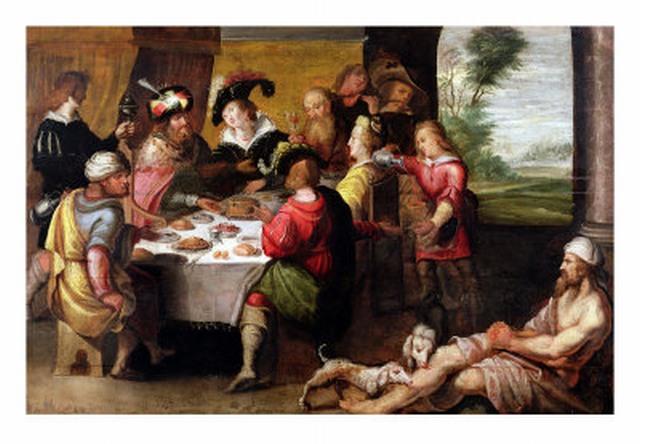
Michael Jackson’s song, “They don’t care about us,” reminds us of Pope Francis’ message for Lent about the “globalization of indifference.” We have become accustomed to the sufferings, poverty, and inequality of others; and they don’t affect or concern us anymore. We fail “to see the Lazarus sitting before our closed doors;” for there are some things in life we just don’t want to see – as the song goes.

In UST, the Pope spoke that today’s world doesn’t know how to cry, how to experience compassion, i.e. suffering with others. He said, “There is a worldly compassion which is useless. It’s a compassion that makes us put our hands in our pockets and give something to the poor” (and walk on). It is possible that some works of charity are done without love. Thus, St. Paul said that even if we give away to the poor all that we have … but have no love, we don’t gain anything. (1 Cor 13:3)
7
True charity is more the giving of what we are than of what we have. It is to go out of our comfort zone, to willingly inconvenience ourselves or make sacrifices for our neighbors for God’s sake. What people really want is a portion of our hearts.

To counter-act the culture of indifference, there are three things we can do. First, we pray together with the Church (in heaven and on earth) for a new era of mercy and compassion for the world. Second, we reach out to others with our acts of charity. Third, we try to have a change of heart. We ask Jesus to ”make our hearts like yours.” We wish to receive hearts, which are firm and merciful, attentive and generous; hearts which are not closed and indifferent.
6
Although poverty and sufferings will never be completely eliminated, love can transform the world and make it a better place to live. Love can change lyrics; for when people experience our kindness, compassion, and selfless love, they can only exclaim, “They DO really care about us!”

(Reference: Message of His Holiness Pope Francis for Lent 2015; Homily of Holy Father Francis, July 8, 2013 (Visit to Lampedusa); “Pope Francis’s Critique of Indifference” by Jonathon Mansell; “The Hidden Power of Kindness” by Lawrence Lovasik)

5

Categories
Pope Francis

POPE FRANCIS’ LENTEN MESSAGE 2015 Part 3

o
(Previously: And since we are united in God, we can do something for those who are far distant, those whom we could never reach on our own, because with them and for them, we ask God that all of us may be open to his plan of salvation.)

2. “Where is your brother?” (Gen 4:9) – Parishes and Communities

All that we have been saying about the universal Church must now be applied to the life of our parishes and communities. Do these ecclesial structures enable us to experience being part of one body? A body which receives and shares what God wishes to give? A body which acknowledges and cares for its weakest, poorest and most insignificant members? Or do we take refuge in a universal love that would embrace the whole world, while failing to see the Lazarus sitting before our closed doors (Lk 16:19-31)?

In order to receive what God gives us and to make it bear abundant fruit, we need to press beyond the boundaries of the visible Church in two ways.

In the first place, by uniting ourselves in prayer with the Church in heaven. The prayers of the Church on earth establish a communion of mutual service and goodness which reaches up into the sight of God. Together with the saints who have found their fulfillment in God, we form part of that communion in which indifference is conquered by love. The Church in heaven is not triumphant because she has turned her back on the sufferings of the world and rejoices in splendid isolation. Rather, the saints already joyfully contemplate the fact that, through Jesus’ death and resurrection, they have triumphed once and for all over indifference, hardness of heart and hatred. Until this victory of love penetrates the whole world, the saints continue to accompany us on our pilgrim way.

Saint Therese of Lisieux, a Doctor of the Church, expressed her conviction that the joy in heaven for the victory of crucified love remains incomplete as long as there is still a single man or woman on earth who suffers and cries out in pain: “I trust fully that I shall not remain idle in heaven; my desire is to continue to work for the Church and for souls” (Letter 254, July 14, 1897).

We share in the merits and joy of the saints, even as they share in our struggles and our longing for peace and reconciliation. Their joy in the victory of the Risen Christ gives us strength as we strive to overcome our indifference and hardness of heart.

In the second place, every Christian community is called to go out of itself and to be engaged in the life of the greater society of which it is a part, especially with the poor and those who are far away. The Church is missionary by her very nature; she is not self-enclosed but sent out to every nation and people.

Her mission is to bear patient witness to the One who desires to draw all creation and every man and woman to the Father. Her mission is to bring to all a love which cannot remain silent. The Church follows Jesus Christ along the paths that lead to every man and woman, to the very ends of the earth (cf. Acts 1:8). In each of our neighbours, then, we must see a brother or sister for whom Christ died and rose again. What we ourselves have received, we have received for them as well. Similarly, all that our brothers and sisters possess is a gift for the Church and for all humanity.

Dear brothers and sisters, how greatly I desire that all those places where the Church is present, especially our parishes and our communities, may become islands of mercy in the midst of the sea of indifference!

Conclusion next week…

Design a site like this with WordPress.com
Get started