Categories
Fr. Baltazar Obico Reflections

The Cross as Symbol of God’s Love and our Sinfulness, Gospel Reflection for the 4th Sunday of Lent (B) John 3:14-21 By Fr. Baltazar Obico, OFM

Introduction: In Greek mythology, the rod of Asclepius is a serpent-entwined rod wielded by Greek god Asclepius, a deity associated with healing and medicine. In modern times the symbol has continued to be used as the symbol of the medical profession. The significance of the serpent has been interpreted in various ways; sometimes the shedding of the skin as symbolizing rejuvenation while others see the serpent as a symbol that unites the dual nature of the work of physicians; life and death, sickness and health. The ambiguity of the serpent as a symbol and the contradictions it is thought to represent and reflect the ambiguity of the use of drugs which can help or harm (drugs as in medicine and drugs as in addiction). Even the ancient meaning of the term “pharmacon” has that ambiguity attached to it; it can be medicinal or poisonous at the same time. Products from bodies of snakes have some medicinal properties and can be prescribed as therapy just as venom can be fatal if it enters the bloodstream.

Gospel: Today’s gospel from John is Jesus’ encounter with a pharisee in Nicodemus. Jesus immediately connects the lifting up of the Son of Man with the story of Moses raising up the serpent in Num. 21. The bronze serpent saves those who look on it after having been bitten by a poisonous serpent; Jesus likewise saves human beings by virtue of being lifted up. Being lifted up refers to the human act of crucifying Jesus. The serpent which caused the death of many became also the source of life for those who believe. To the unbelievers, the cross is foolishness to the Greeks as it is humiliation for the Jews. With the eyes of faith, it is the cause of our salvation. The gospel reminds us of the life giving serpent to demonstrate to us that the cross is the sign not of suffering, not defeat, not humiliation but the depth and breadth of God’s unconditional love. “For God so loved the world that he gave his only begotten son, so that everyone who believes in Him might not perish but might have eternal life.” Try gazing at the cross and linger for a while. Imagine Jesus on the cross. With all the taunting and insults being heaped upon his person, when all the possible cruelty was being thrown at him. Jesus took all of them not in stoic indifference, neither by revengeful spirit but by dignified silence and royal acceptance. He does not elicit sympathy nor exhibit anger. There is serenity and inner strength that can come only from a heart in full communion with a compassionate God. Hang on the cross he has nothing but words of forgiveness, and nothing else. There is something beyond human capacity not only to endure but to exude graciousness in the midst of pain and isolation. In the cross Jesus reveals fully his divinity. God as love reaches its apex when he freely lays down his life to ransom us from death.

If the cross is the fullness of God’s revelation as love, the cross is also symbolic of our refusal to obey God’s command of loving others through self-denial. We refuse to carry our own crosses. It is a chilling reminder of our selfishness, therefore our sinfulness, our rebellion against the will of God. It is humanity’s sin that nailed Jesus on the cross. We likewise continue to nail other people on the cross as we aggressively pursue our selfish interests. The cross reminds us that we have not really loved enough; that we have not really loved like God, ever willing to take the pain that love entails, willing to sacrifice for the sake of the beloved.

This season we are not only reflecting on who Jesus was, the Jesus of history, but who Jesus is, the Jesus of mystery. Jesus at this very moment across the universe.Jesus deep in the hearts if believers. Today we are invited to see the cross being replayed a thousand times in the lives of the outcasts, the marginalized and the excluded, all because the self is the overriding value in our lives…are we timidly silent, nonchalantly watching from the sidelines as we witness suffering being perpetuated by unjust structures and vested interests of the few? The gruesome truth of the crucifixion of Jesus is well known in history. Most evil in the world is done by people thinking they are doing good and doing their best. Today the cross is being reenacted in he stomachs of the children swollen by hunger, in the faces, not so much by soldier combatants in wars, but in the faces of the women and children torn in those war zones, in the indigenous peoples displaced by excessive exploitation of their ancestral lands, in the informal settlers whose makeshift dwellings were demolished by unscrupulous developers, in the underpaid workers and the thousands of able unemployed. To them Jesus of mystery is continuously being crucified because of our love of self.

Brothers and sisters, the cross is not an amulet to ward off evil spirits, not as a sign of resignation to suffering as part of God’s plan, not a mysterious object that can be relied upon in moments of danger. The cross is a sign of our willingness to die to self that others may live.
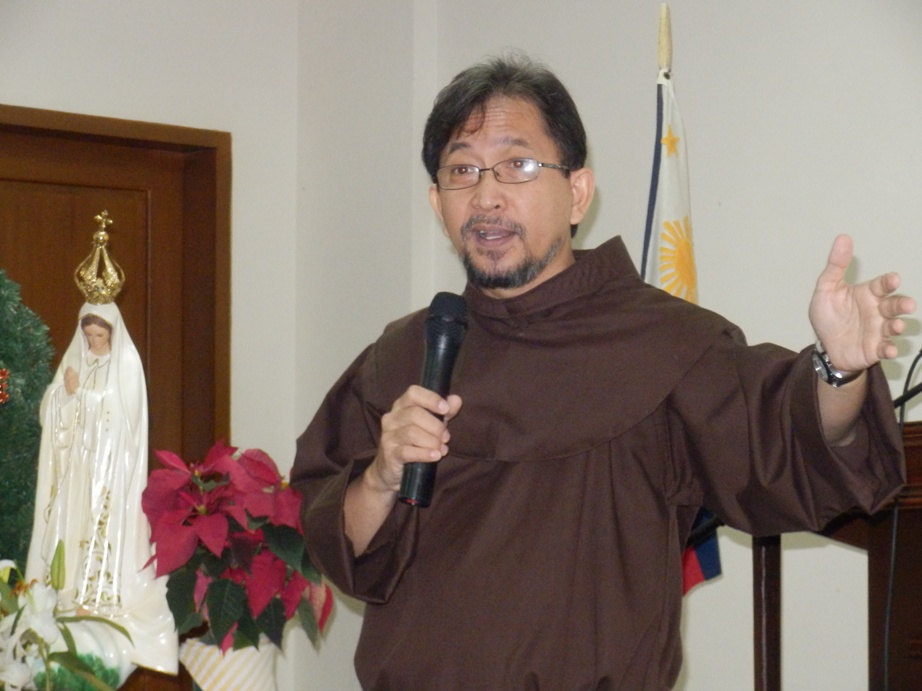
About Fr. Tasang and his other reflections.

Categories
Fr. Sergio Santos Reflections

GO FOR IT!, Sunday Gospel Reflection 3rd Sunday of Lent by Fr. Sergio Santos, OFM

Our Lord Jesus Christ in his public ministry had spent time preaching in Galilee and its neighborhood, as well as Jerusalem. He gave the “leaders of the people” in Jerusalem lots of chances of hearing his message and mission. He performed miracles in and near the city.

His miracles: The man crippled for 38 years (Jn 5); the man born blind (Jn 19); the raising of his friend Lazarus from the tomb for 4 days (Jn 9).

The Gospel writer St. John emphasized that the leaders (priests and Pharisees) in Jerusalem were given the opportunities to know who Jesus Christ is and to believe in him. However, they did not listen to him and therefore lost due to their fault.

In the Gospel scenario, it is clear that he is extraordinarily unique; he is very intimate with God and the Son of God. This was the first time that Jesus Christ got angry with those in the temple area selling oxen, sheep, and doves as well as with the money changers. He “spilled the coins of the moneychangers” and overturned their tables. To those who sold doves he shouted, “Take these out of here and stop making my Father’s house a market place.”

In a mysterious language, Jesus Christ revealed to them that he would be put to death but would rise again. Some of the leaders seemingly remembered this saying after he was put to death at Calvary; they requested Pontius Pilate to post a guard by his tomb lest his disciples might remove his body and pretend he had risen.

This event of Jesus Christ’s RESURRECTION did not make the majority believe he is the Son of God. They had closed their minds and thought he was supernaturally gifted and believed he was juts a miracle worker. Whatever their reasons for not believing in Jesus Christ as the Son of God could be the same for the millions of this present day and age who refuse to believe and live the Christian faith. Like those leaders in the year 28, they are engrossed in worldly affairs, ambitions, and desire for wealth, fame, and power that they neglect their own spiritual life. They literally sold their souls to the devil.

The priests and the Pharisees were hoping for a Messiah who could build a world empire, including limitless wealth, fame and power. They wanted more than political freedom from Rome. Worldly ambitions and allurements are the priority in life, thus forgetting the spiritual realm of life.

In our present day and age, there are many little or big events in life, things, nature, and people that should tell us of the power and grandeur of God, as well as the LOVE of God shown in his MERCY and COMPASSION. There are many beautiful temples and churches in the whole world that could remind one of spiritual life.

In the Roman Catholic Church, the agnostics and the scientists of this digital age would one day realize that Jesus Christ was sent by God the Father out of LOVE to save humanity from sin and death. The saving events of the INCARNATION of Christ, PASSION, DEATH on Calvary, RESURRECTION and ASCENSION into heaven are the fulfillment of our SALVATION. Jesus Christ did not leave us orphans because he made us the in-dwelling of the Holy Spirit and thereby we have GOD WITH US eternally. As Roman Catholic Christians we admit that Jesus Christ is the center of our life and the CONTROLLER o the world and the universe.

We are greatly blessed with our spiritual heritage from the Old Testament to the New Testament down to the present digital generation. If we could only be always thankful and grateful to God by living our lives according to his will, with expectant HOPE for his grace of MERCY and COMPASSION, so that on the Last Day (Final Judgement), we would be allowed to enjoy the dwelling place reserved for each of God’s children who are FAITHFUL to him. This is the CHALLENGE for everyone. “Do not be afraid” and GO FOR IT!

About Fr. Serge and his other reflections.

Categories
Fr. Robert Manansala

Lenten Recollection Alert! By Javier Gomez

OLYMPUS DIGITAL CAMERA
We would like to invite anyone interested to a short Lenten Recollection this coming Saturday, March 7 from 10am to 12noon to be given by Fr. Robert Manansala OFM.

Our goal for this brief talk is to take some time to reflect a little on the seeds that have been sown by Pope Francis. We’re soon approaching the two-month mark since Pope Francis’ historic visit to the Philippines. For most of us by now, the spiritual euphoria that everyone felt has subsided and we’ve gone back to our everyday routines. There is a danger then that we will start to treat the graces of this visit like lightning in a bottle – something that happened once and we cannot recapture ever again. Certainly this is not the goal of Pope Francis himself! It would be more fruitful to think of the graces we have received as seeds – planted deep down by Francis the laborer. Thus, these seeds need to be nurtured, cared for and allowed to grow and blossom.

Our vinedresser will be Father Robert, and he will guide us in nurturing the seeds of Pope Francis’ visit. He will lead us in reflecting on the wisdom that Pope Francis gave us while he was here. Together, let us explore the words of Francis to use the language of the mind, the heart and of the hands in our Christian lives. “To think – To Feel – and to Do.” This is the wisdom that Pope Francis has given us.

Let us reflect on these words together, and see how we can apply them to our lives during this season of Lent. Again, March 7 from 10am to 12nn at the Parish Center. We hope to see you there!

Categories
Fr. Reu Galoy Reflections

“TRANSFIGURATION: A MOMENT OF GRACE TO LISTEN, LEARN, LIVE LIKE JESUS” SUNDAY GOSPEL REFLECTION By Fr. Reu Jose C. Galoy

“No One Lives ‘on Tabor’ While on Earth”

Pope Emeritus Benedict the XVI said – When one has the grace to sense a strong experience of God, it is as though seeing something similar to what the disciples experienced during the Transfiguration: For a moment they experienced ahead of time something that will constitute the happiness of paradise. In general, it is brief experiences that God grants on occasions, especially in anticipation of harsh trials. However, no one lives “on Tabor” while on earth.

Human existence is a journey of faith and, as such, goes forward more in darkness than in full light, with moments of obscurity and even profound darkness. While we are here, our relationship with God develops more with listening than with seeing; and even contemplation takes place, so to speak, with closed eyes, thanks to the interior light lit in us by the word of God.

This is, therefore, the gift and commitment for each one of us in the Lenten season: To listen to Christ, like Mary. To listen to him in the word, preserved in sacred Scripture. To listen to him in the very events of our lives, trying to read in them the messages of providence. To listen to him, finally, in our brothers, especially in the little ones and the poor, for whom Jesus himself asked our concrete love. To listen to Christ and to obey his voice. This is the only way that leads to joy and love. (Vatican City, March 13, 2006 – Zenit)

“We Need to Climb the Mountain, But We Cannot Stay There”

Pope Francis spoke on the importance of listening, of being attuned and attentive to the Word of God; and the movement of ascent and descent that characterizes the Gospel episode (Mt. 17:1-9), in which the Lord takes Peter, James and John to the top of Mt Tabor, reveals Himself in His glorified form, and returns down the mountain with them, with grave warnings to the disciples who accompanied Him not to speak of what they had seen.

“The mountain is the site of the encounter intimate closeness with God – the place of prayer, in which to stand in the presence of the Lord,” said Pope Francis. “We, the disciples of Jesus, are called to be people who listen to His voice and take his words seriously.” He added, “To listen to Jesus, we must follow Him.”

The Holy Father went on: “We need to go to a place of retreat, to climb the mountain and go to a place of silence, to find ourselves and better perceive the voice of the Lord.” We cannot stay there, however. “The encounter with God in prayer again pushes us to ‘come down from the mountain’ and back down into the plain,” he said, “where we meet many brothers and sisters weighed down by fatigue, injustice, and both material and spiritual poverty.”

Pope Francis said that we are called to carry the fruits of the experience we have with God to our troubled brothers and sisters, sharing with them the treasures of grace received. (Vatican City, March 16, 2014 – VIS)

About Fr. Reu and his other reflections.

Categories
Fr. Robert Manansala

A Homily for Ash Wednesday by Fr. Robert B. Manansala, OFM

(Excerpts from Coming Home to God, a homily for Ash Wednesday by Fr. Robert B. Manansala, OFM)

Ashes are a symbol of repentance and cleansing in the Bible…The imposition of ashes is not just a pious decoration so we can say we are abiding Catholics. No, it is a powerful, evocative and penitential symbol of our response to God’s invitation to return to Him with all our hearts. What is seen in our foreheads should reflect the intentions and longings of our hearts, and the new behaviors and changes that we want to implement in our lives.

The Rite of the Imposition of Ashes has a double meaning: the first meaning is about conversion and repentance. The first formula goes with the imposition of ashes elucidates this: “Turn away from sin and be faithful to the Gospel” (Mk 1:15). Simply put, it exhorts us to turn away from our sinful ways and to turn to God and his ways.

What are we planning to turn away from, to give up for the Lord during this season of Lent that starts with the celebration of Ash Wednesday? Are we giving up popcorn, chocolates or soft drinks? These questions and the items intended to be given up are commendable. But the more important question is: “What does God want to give us during this Season of Lent?”

The second meaning of the Rite of Imposition of Ashes is a reminder of our precarious human condition: “From dust you came, unto dust you shall return” (Gen 3:19). It is a reminder of our limitations, of our own death and end. As psalm 90 says, “O Lord, teach us how short our life is so that we may become wise” (Ps 90:12). We are reminded not only of our sinfulness but also of our death and finitude, so that we will start living well because we do not have the luxury of time.

During the season of Lent, we are invited to make a forty-day spiritual journey, a time of spiritual retreat. We are called to make Lenten programs, to discern what God is offering and asking from us, and to resolve to do concrete practices and strategies to turn away from sin and to turn more and more to God and His ways.

_________________________________________________

Coming Home to God, a homily for Ash Wednesday is just one of the many homilies Fr. Robert Manansala, OFM offers in his book Echoes of God’s Love. The book is available at the parish book store for only P375. Proceeds go to the Our Lady of the Angels Library Renovation and Upgrade Project.

Categories
Fr. Robert Manansala

February 18 is Ash Wednesday

(Excerpts from Coming Home to God, a homily for Ash Wednesday by Fr. Robert B. Manansala, OFM)

Ashes are a symbol of repentance and cleansing in the Bible…The imposition of ashes is not just a pious decoration so we can say we are abiding Catholics. No, it is a powerful, evocative and penitential symbol of our response to God’s invitation to return to Him with all our hearts. What is seen in our foreheads should reflect the intentions and longings of our hearts, and the new behaviors and changes that we want to implement in our lives.

The Rite of the Imposition of Ashes has a double meaning: the first meaning is about conversion and repentance. The first formula goes with the imposition of ashes elucidates this: “Turn away from sin and be faithful to the Gospel” (Mk 1:15). Simply put, it exhorts us to turn away from our sinful ways and to turn to God and his ways.

What are we planning to turn away from, to give up for the Lord during this season of Lent that starts with the celebration of Ash Wednesday? Are we giving up popcorn, chocolates or soft drinks? These questions and the items intended to be given up are commendable. But the more important question is: “What does God want to give us during this Season of Lent?”

The second meaning of the Rite of Imposition of Ashes is a reminder of our precarious human condition: “From dust you came, unto dust you shall return” (Gen 3:19). It is a reminder of our limitations, of our own death and end. As psalm 90 says, “O Lord, teach us how short our life is so that we may become wise” (Ps 90:12). We are reminded not only of our sinfulness but also of our death and finitude, so that we will start living well because we do not have the luxury of time.

During the season of Lent, we are invited to make a forty-day spiritual journey, a time of spiritual retreat. We are called to make Lenten programs, to discern what God is offering and asking from us, and to resolve to do concrete practices and strategies to turn away from sin and to turn more and more to God and His ways.

_________________________________________________

Coming Home to God, a homily for Ash Wednesday is just one of the many homilies Fr. Robert Manansala, OFM offers in his book Echoes of God’s Love. The book is available at the parish book store for only P375. Proceeds go to the Our Lady of the Angels Library Renovation and Upgrade Project.

Categories
Fr. Laurian Janicki Reflections

SUNDAY GOSPEL REFLECTION By Fr. Laurian Janicki, OFM

“ Star light, star bright, first star I see tonight: wish I may, wish I might have the first wish I see tonight.” How many countless children have chanted this over the years? Some even take it quite seriously; even though they know that the wish probably won’t come true. The same might be said for making a wish before blowing our birthday candles out. Wishes don’t usually come true. Yet, all of us, young and old alike – make wishes our whole life long. Maybe it’s just a fun game. But, maybe, just maybe, once in a while a wish comes true. Some people wish for simple things of no consequence, maybe like a new toy and others wish for huge things of grave consequences perhaps like a tumor will be benign. In today’s gospel, the leper’s, “If you wish” to Jesus was more than a childhood chant.

When the leper in the gospel says “If you wish,” we can imagine that he is implying more than that Jesus has a choice to heal or not. He is hoping against hope that his own wish to be clean would be fulfilled. Jesus has proven his power.

Jesus was moved with pity. What moved Jesus to make the leper clean? Perhaps the leper’s sorry condition.
Perhaps the leper’s isolation in being an outcast.
Perhaps Jesus, inspite of Jesus’ command to “tell no one anything.”

Jesus knew that the leper would not be able to keep the good news of his healing quiet. And yes, the leper publicizes the whole matter. In our terms, the leper proclaims the gospel. Perhaps Jesus healed the leper because he recognized one who would be a disciple and spread the good news.

Jesus wished that the leper be made clean. And so it was. He had the power to heal. But more important, he had the mercy and Jesus was announced to all by this leper outcast, who now had become a disciple.
Jesus commands the leper to tell no one. The leper tells everyone. Jesus’ commissions to us is tell everyone the good news – do we tell no one? The message of good news in “believing who we are and what we do.”

“A World larger than your heart.”
In John Drinkwater’s play Abraham Lincoln, this exchange takes place between President Lincoln and a northern woman, an anti-confederate zealot. Lincoln tells her about the latest victory by northern forces – the confederate army lost 2700 men while union forces lost 800. The woman is ecstatic, “How splendid, Mr. President!”
Lincoln is stunned at her reaction. “But madam, 3500 human lives were lost!”

“Oh, you must not talk like that, Mr. President. There were only 800 that mattered.” Lincoln’s shoulders drop as he sways slowly and emotionally,” Madam, the world is larger than your heart.”
Connection: Our attitudes and perceptions, our view of the world often reduces others to “lepers” – those we fear, those who don’t fit our image of sophistication and culture, those whose religion or race or identity or belief seem to threaten our own. We exile these lepers to the margins of society outside our gates. We reduce these lepers to simple labels and stereotypes. We reject these lepers as to be “unclean” to be part of our lives and our world.

The Christ who heals lepers comes to perform a much greater miracle – to heal us of our debilitating sense of self that fails to realize the sacredness and dignity of those we demean as “lepers” at our own gates.

We can make them clean by transforming our own attitudes and perspective. We can make them “clean” by reaching out to them as God reaches out to us. We can make them “clean” by the simplest acts of kindness and respect.

About Fr. Laurian and his reflections.

Categories
Fr. Jesus Galindo Fr. Jesus Galindo Reflections

Why Do People Suffer?, A SUNDAY GOSPEL REFLECTION for the 5th Sunday in Ordinary Time by Fr. Jesús Galindo, OFM

In an indirect way, today’s gospel gives us a precious little piece of information about Peter’s marital status. By mentioning his mother-in-law, we come to know that Peter was a married man (no other way to have a mother-in-law!). This is the only reference recorded in the gospels about the marital status of any of the twelve apostles. Too bad her name is not given; she could be the much needed patron saint of all mothers-in-law.

Now, let’s go to the core and message of today’s readings. In the first reading, we heard the loud lament of Job: “I have been assigned months of misery, and troubled nights have been allotted to me… I shall not see happiness again.” Job is just voicing out what millions of people all over the world are going through: hunger, pain, sickness, suffering, starvation, violence. They keep asking: Where is God? Why does he allow this to happen? Why does this happen to me?

The story of Job was written in order to challenge the Old Testament people’s belief that pain, sickness and suffering are punishment for sin. Job is a righteous and holy man; yet he loses all his properties one after the other, his fields, his cattle, and even his children; besides, he is stricken with leprosy. Job professes his innocence, against the accusations of his wife and friends who insist that he must have done something wrong. The book of Job proves that sickness and suffering are not punishment for sin—not always, anyway. But it leaves unanswered the basic question: Why then do people suffer? Above all, why do innocent people suffer? Like in the Old Testament so also today many among us blame God, if not for inflicting pain at least for not doing enough to alleviate it.

Today’s gospel belies such stand. Jesus, the God-made-man spent most of his time healing the sick and alleviating suffering. On this particular day, he cured a possessed man inside the synagogue; then he cured Simon’s mother-in-law; and then, “when it was evening, after sunset, they brought to him all who were ill or possessed by demons. The whole town was gathered at the door. He cured many who were sick with various diseases, and he drove out many demons.” All in a day’s time! Jesus is like a walking hospital; he cannot stand seeing people suffer. What a beautiful gospel to read at the threshold of the World Day of the Sick, three days from now!

We may not know why people suffer, or where suffering comes from. But this much we know: It does not come from God. A lot of suffering is man-made and even self-inflicted, brought about by our own excesses in eating, drinking, smoking, drugs, careless driving, etc. We do know why the Palestinians and the Israelis–and people in Iraq, Afghanistan, Syria, Nigeria, and other war-torn places, are suffering. We do know why the victims of terrorism, corruption and injustice are suffering. Definitely, not God’s doing.

Where did Jesus get the strength needed to carry on his relentless healing and preaching activity? In prayer, that’s where. “Rising very early before dawn, he left and went to a deserted place, where he prayed.” Now we have the complete picture of Jesus’ life and his two points of reference: prayer and action: the Father and the sick. Communion with Father in prayer gave him the strength to remain faithful to his calling. Simon and the others came to him with a tempting proposition: “Everybody is looking for you!” Wow, what a chance to be popular. Jesus could have said: “Now we are in business! Our strategy is working!” But he didn’t go for it: “Let us go on to the neighboring towns…” Prayer kept him focused on and faithful to the Father’s will.

Prayer will do for us what it did for Jesus. It will help us remain faithful to the Father’s will and to overcome the temptations of pride and selfishness. It will give meaning and a sense of direction to our life.

About Fr. Jesús and his reflections.

Categories
Fr. Reu Galoy JPIC

A LUNCHEON IN SHADES OF PURPLE by SSAP JPIC Scho. Prog. Comm. / Jean Chavez

This slideshow requires JavaScript.

In its Annual Fellowship and pot-luck luncheon held last January 7 the SSAP-JPIC Scholarship Committee members honored its Spiritual Advisers Fr. Reu Jose C. Galoy, OFM, Parish Priest of Santuario de San Antonio who celebrated his birthday last January 26 and Sr. Marisa Lichauco, retired Grade School principal of Miriam College.

Sr. Marisa shared Joyce Rupp’s “A Christmas Blessing” by reading the first line, with each member taking her turn in reading aloud the “blessings,” an apt reminder to reflect on the true meaning of Christmas, sometimes overshadowed by commercialism of the season and the rush to making our lists, shopping, gift-giving, food preparations, the party-hopping and family reunions amidst stress from the worsening Metro Manila traffic situation.

“A CHRISTMAS BLESSING”

~ May there be harmony in all your relationships. May sharp words, envious thoughts, and hostile feelings be dissolved.
~ May you give and receive love generously. May this love echo in your heart like the joy of church bells on a clear December day.
~ May each person who comes into your life be greeted as another Christ. May the honor given the Babe of Bethlehem be that which you extend to every guest who enters your presence.
~ May the hope of this sacred season settle in your soul. May it be a foundation of courage for you when times of distress occupy your inner land.
~ May the wonder and awe that fills the eyes of children be awakened within you. May it lead you to renewed awareness and appreciation of whatever you too easily take for granted.
~ May the bonds of love for one another be strengthened as you gather with your family and friends around the table of festivity and nourishment.
~ May you daily open the gift of your life and be grateful for the hidden treasures it contains.
~ May the coming year be one of good health for you. May you have energy and vitality. May you care well for your body, mind and spirit.
~ May you keep your eye on the Star within you and trust this Luminescent Presence to guide and direct you each day.
~ May you go often to the Bethlehem of your heart and visit the one who offers you peace. May you bring this peace into our world.

– Joyce Rupp

Fr. Reu thanked everyone for the opportunity to gather together as one family, one community, and one parish. He talked of a wholistic approach of enriching ourselves in the context of the Ministry we are involved in through a celebration of friendship and community in helping others. Through our get-together, we celebrated not only our spiritual nourishment and social needs but also the care for our physical well-being as we shared in the table of God’s bounty.

The JPIC Scholarship Committee members present were Menchu Bautista, Millette Ocampo, Letty Laurel, Doris See, Girl Velasquez, Bambina Buenaventura, Dely Fernandez and Jean Chavez. Also present were Jackie Macasias, Nimfa Dumago and Alice Loto of the SSAP, our fellow workers in the Lord’s vineyard.

Fr. Reu and Sr. Marisa blew their birthday candles from two round cakes iced in green and lavender fondant. As in previous years, Mariza’s love for all shades of purple was elegantly played up in the decor: a Christmas tree decked in purple trimmings, a beautiful lavender mantle with matching lavender napkins neatly folded in coiled purple beads, a rustic centerpiece of twigs on which were intertwined lavender shades of vandas, other floral varieties in an interplay of purple hues interspersed with green berries to signify prosperity for the New Year. The all too familiar menu was superb — a specialty of each member. A recipe handed down from Mariza’s grandmother to her mother, Mrs. Rosie O. Valencia, the Lady of the House’s Pancit Luglog took center stage, topped with a radish condiment painstakingly diced and marinated in a vinegar–soy mixture, providing a tangy essence and crunchy texture. As we sipped our dalandan granita, Mariza’s efficient staff headed by Maritess kept an eagle eye on everyone’s needs. One couldn’t help but admire the sleek acrylic purple pitcher. “That pitcher was Maritess’ Christmas present to the family,” a beaming Mariza announced.

We were all in familiar surroundings, feeling so much at home, helping ourselves to heart-warming comfort food, with the bonds of friendship renewed “around the table of festivity and nourishment.”

Categories
Fr. Sergio Santos Reflections

“THE TIME IS NOW! REPENT AND BE FAITHFUL TO JESUS CHRIST!” Sunday Gospel Reflection 3rd Sunday in Ordinary Time (B) by Fr. Serge Santos, OFM

What a fitting theme after the visit of our Pope Francis to the Philippines, particularly for the victims of the Yolanda (Haiyan) storm in Tacloban and Palo, Leyte. Pope Francis said, among many things, that we have to use “the languages of the mind, the heart, and the hands” to effect a change in our Christian life.

The time is now to do this as we hear Jesus Christ in the Gospel of Mark: This is the time of fulfillment. The kingdom of God is at hand. Repent, and believe in the gospel.”

The first important element for becoming members of the messianic kingdom on earth is CONVERSION – a change of life from one of darkness (SIN) to one of light (GRACE). It requires one to be holy, a true return to God. Secondly, anyone in the kingdom of God BELIEVES IN and PRACTICES the message of Jesus Christ. This is the message of SALVATION which tells us how we were given ETERNAL LIFE in heaven which the coming of Christ on earth brought to us.

At the very beginning of Christ’s ministry, we know that he first disciples of Christ and later became apostles were Peter, Andrew, John and James. They were fishermen and they became “fishers of men.” The first disciples preached the good news of Jesus Christ about the eternal plan of God for the salvation of humanity. This was attained through the birth (INCARNATION), suffering (PASSION), DEATH, RESURRECTION, and ASCENSION of Jesus Christ.

If we accept the divine message of SALVATION and live by it, then we too are assured of our own resurrection. However, we know that as human beings, we are weak and mortal. This is when we need Divine Mercy and Compassion.

We know at times we fail and sin…we stray from the LIGHT and go to DARKNESS.

What Jesus Christ said to the people of Galilee applies also to us in this day and age. We need to repent.

What do we need to be truly repentant, thereby deserve the MERCY and COMPASSION of God!
1. Firstly, we accept we are sinners, no exception no matter what. Acknowledge our individual responsibility in our state of sin. We need to REGRET – be sorry for our commission of these sins. Honestly accept we failed Jesus Christ; that we need his MERCY ad COMPASSION.

2. We are responsible for the sins and/or wrongs we have done. There is a need for REPARATION or RESTORATION. This means we are willing and capable to make up for the damages or harm we have caused to others. Avoid RATIONALIZATION, JUSTIFICATION, and projection of GUILT to others.

3. RECONCILIATION. The estranged or broken relationships are mended or made whole again. This requires the humility of a little child – begging for FORGIVENESS from the wronged person/s and/or restoring the material thing or resources taken from the aggrieved person/s to the fullest extent possible. Our reconciliation with each other is a RECONCILIATION with God, the Father and our Lord Jesus Christ.

4. RENEWAL. Once we follow the above-mentioned three steps, we will then be led to a RENEWAL – there is a change within us that is reflected in a change of behavior. This means a new way of feeling things. Result? PEACE and JOY in our spiritual life. This then will to conversion.

5. CONVERSION. This is a change of direction – turning away from SIN (Darkness) and turning towards GRACE (Light). Many saints shared in personal stories that this is a continuing struggle in spiritual life. Even St. Francis of Assisi, from the moment he received a message from the Crucified Jesus in the San Damiano chapel “to rebuild his church,” continued on the process of conversion in the events of life till his deathbed. Conversion is a process that starts with the acknowledgement of SIN or WEAKNESS and then moving on with prayer, patience, and perseverance to overcome the SIN or WEAKNESS, not only through one’s effort but also with the help of Jesus Christ, through the power of the Holy Spirit.

We need CONVERSION to become faithful disciples of Jesus Christ. Hear the insight of St. Paul: “Time is running out.” The time is NOW! REPENT and BE FAITHFUL TO JESUS CHRIST.

About Fr. Serge and his reflections.

Design a site like this with WordPress.com
Get started