Categories
The ABC’s of Catholic Doctrine

“Rediscovering a Treasure” The ABC’s of Catholic Doctrine By Lianne Tiu

13

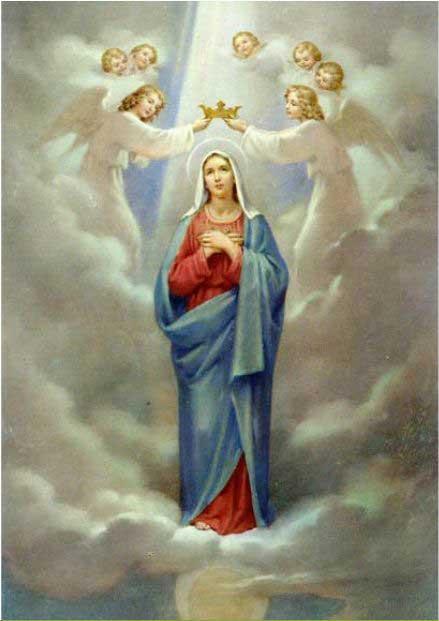
There is a wealth of prayer that is contained in a simple Marian devotion called the Holy Rosary. It is a prayer loved by countless saints including St. John Paul II, St. Padre Pio, and St. John XXIII. It is a prayer encouraged by our Lady herself at Lourdes and Fatima.

Some people find the rosary boring and meaningless. To them, it is just some repetitious prayer babbling the Hail Mary’s. Indeed, it can be noise, a clatter of tin cans, as St. Josemaria would call it, if we pray without reflection, when our minds and hearts are far away. Pope Paul VI (whose beatification is on next Sunday) pointed out: “Without contemplation, the rosary is a body without a soul, and its recitation runs the risk of becoming a mechanical repetition of formulas…”

What do we contemplate on? In the Rosary, we meditate on the life of Jesus from his infancy (the joyful mysteries), through his public life (the luminous mysteries), to his passion and death (the sorrowful mysteries), and resurrection (the glorious mysteries). That is why the Rosary can be said to be a “compendium of the Gospel.” It has all the depth of the Gospel message in its entirety. Although it is clearly Marian in character, it is at heart a Christocentric prayer.

12

We can learn a lot about Jesus from Mary; as the Rosary is actually a meditation with Mary on Jesus. Among all creatures, no one knows Jesus better than his Mother. As we contemplate on the scenes of the rosary, we learn from her to “read” Christ, to discover his secrets, and to understand his message.

The Rosary, aside from being a meditation centered on Jesus, is also a prayer addressed to the Father, to the Blessed Virgin, and to the Holy Trinity. This is the real secret that makes this prayer so powerful and effective. St. Padre Pio called the Rosary beads a weapon of extraordinary power against Satan. Father Gabriel Amorth, chief exorcist of the Vatican, explained that his colleague heard the devil saying during an exorcism: “Every Hail Mary is like a blow on my head. If Christians knew how powerful the Rosary was, it would be my end.”

Let us grab those beads and start praying the rosary daily. The best time is when we have fifteen minutes or so to finish the entire prayer. But if it is not possible, we can do it while travelling in a car, bus or plane, while in the hospital bed, while waiting in line at the supermarket, or for a dentist appointment or business meeting, If we have no time, we can start with just one decade (which consists of an Our Father, 10 Hail Mary’s and a Glory Be) or two each day. Gradually, we can increase the number of decades until we complete a set of five mysteries.

October, the month of the Rosary, provides us an excellent opportunity to rediscover this priceless treasure and to grow in this Marian devotion.

(Reference: Apostolic Letter “Rosarium Virginis Mariae” by St. John Paul II; Encyclical “Octobri mense” by Pope Leo XIII; “Question Time” by Fr. John Flader; “You can become a Saint!” by Mary Ann Budnik; “Echo of Mary, Queen of Peace” by Father Gabriel Amorth)

Categories
Cathechism of the Catholic Church

CATECHISM OF THE CATHOLIC CHURCH

10

What can we learn from the way in which Mary prayed?
To learn from Mary how to pray means to join in her prayer:
“Let it be to me according to your word.” (Lk 1:38) Prayer is
ultimately self-giving in response to God’s love. If we say Yes
as Mary did, God has the opportunity to lead his life in our life.

11

What are the words of the “Hail Mary”?
Hail, Mary,
full of grace,
the Lord is with you.
Blessed are you among women,
and blessed is the fruit of your womb, Jesus.
Holy Mary, Mother of God, pray for us sinners, now
and at the hour of our death. Amen.

In Latin:
Ave Maria,
gratia plena.
Dominus tecum.
Benedicta tu in mulieribus,
et benedictus fructus ventris tui,
Jesus. Sancta Maria, Mater Dei,
ora pro nobis peccatoribus, nunc
et in hora mortis nostrae. Amen.

Categories
Random Thoughts by Peachy Maramba

R A N D O M T H O U G H T S Voices from yesterday and today . . . by Peachy Maramba

9

ST. LUKE – FIRST CHRISTIAN HISTORIAN
First Century
October 18

Part I.
As in the case of most disciples of Jesus, everything we know about them is uncertain beyond what little we find recorded in the New Testament. Even their personal history is somewhat vague and obscure and left to tradition to fill in the gaps. Many times we can just conjecture, make deductions and list possibilities. So it is with our story of Luke.

A Portrait of Luke

However based on the letters of Paul and certain facts in the New Testament books of Luke and Acts attributed to Luke himself we can draw a picture of one of the earliest converts to the faith and of this first Christian historian and early leader of the Christian church.

His Personal History

His personal history is somewhat obscure except for the fact that he was unmarried and childless.

Some sources say that he is possibly the son of a freed man of some Roman family.

A Greek or Syrian?

His nameLoukas, a short form for the Latin Lucius or Lucanas, give away his Greek origin. He was also a native speaker of the Greek language as evidenced by his writings.

However some early sources such as the church historian Eusebius put him as coming from Antioch, in present day Turkey where he originally belonged to the Christian community there around the beginning of the Christian era. Others say he just lived there and first met Paul there.

A Gentile

Because Colossians 4:11 excludes him by implication from the “men of the circumcision,” this makes him a Gentile (of the non-Jewish faith). Even Paul who converted him himself does not include him in the list of his Jewish helpers thus making many scholars reach the conclusion that Luke was a Gentile making him one of the first non-Jewish followers of Jesus and the only non-Jewish among the four evangelists.

An Early Convert

While nothing is known of the time or circumstances of his conversion to Christianity many scholars agree that he must have been one of the earliest converts to the Christian faith because his connection with the early Antiochene church is well detailed in the Book of Acts of the Apostles in the Bible. He was NOT an apostle NOR had he ever met Jesus!

Paul’s Disciple, Companion and Personal Secretary

But it is as close friend and companion/fellow-worker of Paul that we have the clearest picture of Luke because he is mentioned three times by Paul in his letters. Luke had doubtless been already for some time a good friend and disciple of Paul who persuaded him to go with him on his evangelical voyages around the Mediterranean. Thus he joined Paul during many of his journeys starting from his second missionary trip traveling with the Apostle from Troas in Asia Minor to Philippe, Philippe to Miletus, Miletus to Caesaria and finally from Caesaria to Rome.

But even before Luke accompanied Paul on his second and third missionary journeys he was one of the fellow workers with the apostle (“Mark, Aristarchus, Demas and Luke who share my labours”). In the New Testament we find Luke mentioned as being part of the entourage of Paul. (Philemon 24, Colossians 4:14. II Timothy 4.11) He was his constant companion that never seems to have left his side unless ordered to do so for some service to the churches that Paul established.

As a member of Paul’s traveling entourage he aided him in his missionary activities across the Roman world perhaps even sharing both of Paul’s imprisonment. (Acts 27: 1-28: 29) In Rome under Julius Caesar Luke remained with him. From his Roman cell Paul wrote and referred to Luke as his “fellow worker” (Philem 24) and faithful companion to the end.

During the final hours before Paul’s death in Rome about 64 A.D. Paul mentions Luke (2 Timothy 4:11) that “Luke is alone with me” in a farewell letter he wrote in a Roman cell prior to his martyrdom. In each of the New Testament passages that Luke is mentioned, he is with Paul at the time of writing.

It is unknown how long Luke traveled with Paul except for the fact that Luke was with Paul during half of his ministry.

Throughout his travels with Paul, Luke took and kept careful notes of all the oral preaching and catechizing of the great missionary. So that his Gospel is rightfully said to have been “illumined by St. Paul.”In fact both St. Jerome and St. John Chrysostom called it “St. Paul’s Gospel.”
Paul’s Beloved Physician

Luke was a physician, a Greek doctor. In fact St. Paul called him his “beloved physician” (Col 4:14) who attended to him when he was physically ill and so he had the care of “Paul’s much-tried health.” He was beloved because he was a constant and devoted companion as well as can be seen by the writing of Paul as he lay dying, “…only Luke is with me.”

This explains the fact that most of Luke’s stories about Jesus are those that concern illness and the power of Jesus as a healer. It is no wonder that Luke is the patron saint of physicians.

A Learned Writer

That Luke was the author of both the Third Gospel that bears his name and the Book of Acts of the Apostles is generally (though not universally) accepted.

Both of his books were dedicated to Theopilus who was possibly a high Roman official who was a wealthy patron. But since there is little doubt that the book was intended for the use of the Church as a whole, especially for Gentile readers and since the name Theopilus means “lover of God” Luke was more likely dedicating his book to any Christian reader.

He is recognized as being the most literary of New Testament writers with distinctive qualities of mind and style. He is said to belong to cultivated Hellenistic circles where he learned to write easily and fluently good idiomatic Greek.

It is clear that Luke was well-educated with considerable literary power and a native speaker of the Greek language as evidenced by his clear, polished, elegant Greek and orderly writing. He was also most likely well versed in the Greek Old Testament, which he studied intensely. Because Luke was a “perceptive, sensitive writer with a knack for telling a story and depicting a scene” his Gospel has been described as “the most beautiful book ever written.”

Luke began his work with a prologue stating that he would use only the best sources and organize them into an “orderly account.” Since Luke did notpersonally know Jesus since he did not number himself among those “who from the beginning were eyewitnesses and ministers of the Word” Luke had to painstakingly obtain his information from those “eyewitnesses” of the facts and from written accounts.

Although it is now known how long Luke traveled with Paul it is evident that throughout his travels with Paul, Luke took and kept careful notes of all that he saw of Paul’s missionary work and all that he heard about Christ. It is clear that the so-called “we sections” of Acts are based on these personal journals of Luke.

As he was an actual eye-witness to the actions and miracles of Paul he devoted the major portion of his Acts of the Apostles relating them.

Aside from his own memoirs Luke used Mark and a now lost collection of the sayings of Jesus sometimes referred to as “Q”, other traditions about Jesus and personal interviews.

While there is no hard evidence to support it, it is very likely that Luke did visit Mary in Jerusalem while seeking information about Jesus. Because of this he is the only evangelist who spoke and wrote the most about the Virgin and the only one to give a graphic full account about the Annunciation and the Visitation.

His story of the birth of Jesus and his early life is told from the perspective of Mary the mother. His sympathetic portrayal of Jesus caring about the women assisting him in his ministry and for black sheep could only have come from Mary herself.

7

Luke as Historian and Theologian

It is said that sometime in the 80’s Luke decided to write his ambitious two-volume work. Being primarily a historian or recorder writing for the information of the Greeks he wanted to give a historical and theological account of the life of Jesus and how the Christian church originated. Since his two-volume work (Luke-Acts) accounts for more than a fourth of the New Testament, Luke is clearly entitled to the distinction of being the first Christian historian and the only Gentile Christian author among the four-evangelist writers of the New Testament Gospels. The Gospel according to St. Luke is one of the three Synoptic Gospels (Matthew, Mark and Luke). Generally judged to be the most literary and poetic of the four gospels Luke was regarded an ‘artist in words.’

Luke the Historian

Luke’s Gospel was written possibly around the year 85 in an ordered narrative primarily as a history or record that the Gentile Greek Christians who were his targeted market might know all about the early Christian Church. So he is “one of the major voices speaking to non-Jews about Jesus’ teachings” and his two books today are considered the earliest history of the Christian church. This makes Luke the first Christian historian.

He wrote the Acts of the Apostles as an appendix to his gospel to present false relations by leaving an authentic account of the wonderful works of God in planting His Church and of some of the miracles by which He confirmed it. Thus it is said that Luke relates six miracles and eighteen parables not mentioned in the other gospels. It is a “mixture of history and prophecy describing the spread of Christianity – how it broke with Judaism and extended beyond Jerusalem to Rome in the West.”

Luke the Theologian

The writing of Luke was not only that of a historian but also that of a theologian. Since it was written in Greek for Gentile Christian communities “it is one of the major voices speaking tonon-Jews about Jesus’ teachings.”

Because he also wrote about the teachings of Christ Luke was not only a historian buta theologian. His writing emphasizing gentle and humane aspects of the faith was directed at Gentile Christians who had been pagans redirecting his readers toward Christ rather than the heroes of Greek culture and telling them their place in God’s overall plan.

Acts of the Apostles

In the Acts of the Apostles the history of the growth and spread of the early Church is treated by Luke as a “truly mystical view of the working of the Spirit.” Thus he sees the early Christian community growing bolder, expanding and spreading the Word of God because they were inflamed with courage and love by the Holy Spirit whose influence began on that fateful and memorable Pentecost Sunday morning.

But from the thirteenth chapter Luke confines himself to the actions and miracles of St. Paul, which he witnessed himself.

Gospel of Luke

But his two books are not merely a compilation from varied earlier sources. More than any other of the Gospels, the Gospel of Luke shows clearly his humane approach and the universal scope of the teaching of Jesus. This gospel has also often been called the Gospel of the Poor or the Gospel of Mercy and the outcast because it specially stresses the relations Jesus had with them. Thus Luke is the only evangelist who incorporated in his Gospel the moving parables of the Good Samaritan and the parable of the Prodigal Son that Jesus told to exemplify goodness and kindness. He also wrote stories about other people who were rejected, despised and outcast from society whom Jesus treated with compassion. Luke even portrays Jesus caring for the black sheep of society. These, too, were not mentioned in the other gospels.
His account of the Nativity emphasizes the humbleness of Jesus’ birth and its significance in fulfilling the hopes of the poor. (“Blessed are you poor, for yours is the kingdom of God.”)

It has been said that “Luke’s Gospel is particularly valuable for the stress it lays on Christian purity, poverty and joyousness and for the graphic descriptions of the Annunciation, the visitation, the birth and early life of Jesus.”

Luke the Evanglist

Despite his being a historian and theologian St. Luke was first and foremost an evangelist, that is a person who taught the Christian faith to people who hadn’t heard about it before. Unlike the other evangelists Luke’s story does not end with the resurrection of Jesus but goes on to the Pentecost and “the ongoing story of Christ’s presence in the life of the church” and in the whole world. This is part of Luke’s legacy to us.

Includes Women in his Writings

Luke was a unique writer of the Third Gospel who more than any other New Testament writer included in his work the women who were important in the life of Jesus. In so doing he depicted Jesus as one caring for the status and salvation of women. This was an unusual happening at that timeas the status of women in those days was usually low.

It is thanks to this sympathetic writer that we get a clearer picture of the women in Jesus life such as the Virgin Mary, Elizabeth, mother of John the Baptist, Mary Magdalene, and even the widow whose son Jesus restored to life.

He evidently knew the Virgin Mary and was highly respectful of her. The words that he puts in her mouth during the Anunciation were so memorable that they became known as “Mary’s Prayer” and were incorporated as part of our liturgy.

Patron Saint of Artists and Physicians

According to one early legend of the 6th century, Luke was also a skillful artist even attributing a famous 12th century icon of our Lady in the Pauline Chapel in the Basilica of St. Mary Major in Rome to being one of his paintings. Thus it was said that he was the first to paint an icon of Mary. While the painting has since been proven to have been painted at a later date many painters still choose to have him as their inspiration and heavenly patron.

Because of this and other pictures of the Virgin Mary ascribed to him (displayed in the church of St. Augustine in Rome), Luke is the patron saint of fine arts of painters and glass artists. He is also the patron saint of physicians and surgeons and for some reason of butchers, lace makers, notaries and brewers.

His Ending

Nothing more is known for certain about Luke after Paul’s martyrdom and he completed his great two-volume work. After Paul died in 64 A.D. tradition tells us that Luke preached the Faith in Egypt and Greece. It is believed too that Luke became a great leader in the church of his home region. It was sometimes in the 80’s that he decided to write his two-volume work. He died at the age of 84 (others say at 74) in either Bithynia or Boetia, Greece. Whether he was martyred by crucifixion or not is also not certain. His relics are honored in Constantinople (now Istanbul, Turkey) in the Church of the Apostles. A few persist in the stories of his martyrdom, which seems most doubtful.

Symbol and Feast Day

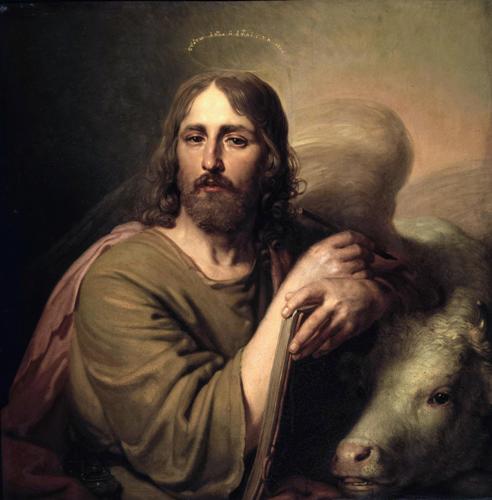
Saint Luke is represented by an ox often winged, a symbol of sacrifice and priesthood because his gospel begins with the ox, the animal of sacrifice of Zechariah (father of John the Baptist) to God to celebrate the birth of his son. It is a fitting symbol because the bull or ox is recognized in many religious traditions as an animal of great power and mystery.

His feast day is celebrated on October 18.

8

SOURCES of REFERENCE
ST. LUKE
October 18

Butler’s Lives of the Saints – Vol. IV pp 142.144
The Illustrated World Encyclopedia of Saints – p. 72
Pocket Dictionary of Saints – p 323
The Watkins Dictionary of Saints – pp. 143 – 146
A Calendar of Saints – 205
All Saints – pp 453 – 454
A Year With the Saints – October 18
Butler’s Saint for the Day – pp 492 – 493
Illustrated Lives of the Saints – Vol. I pp 474 -475
My First Book of Saints – pp 249
Saint Companions – pp 394 -395
Saint of the Day – pp 289 – 290
Saints – A Visual Guide – pp 74 – 75
Voices of the Saints – pp 34 – 35
Ordinary People, Extraordinary Lives Group 6 Card I
The Everything Saints Book – pp 25 – 26
The Lion Treasury of Saints – p 216; p 53
Servants of God – pp 56 – 57
The Way of the Saints – pp 282 – 283
Book of Saints – Part 8 – pp 22 – 23
Who’s Who in the Bible – pp 272 – 273

Categories
Fr. EJ Reflections

SUNDAY GOSPEL REFLECTION for the 28th Sunday in Ordinary Time By Fr. Efren Jimenez, OFM

The image used by Jesus in today’s Parable is close to the Filipino heart – a wedding party! Any great occasion in fact can be a reason for a party, from Baptisms, to anniversaries, there is a party. Even a wake for the dead is a party, though in a more solemn mode.

In the Scripture, and liturgy, the symbolism of a party celebration connotes deeper meaning, expressing what God has to offer to the human race – Thus, the Isaiah reading describes in rich imagery what is commonly referred to as the eschatological or end – time meal.

In his description of this meal Isaiah is trying to bring home to the people the exquisite joy and love of that final day when they would be united with the Lord forever. A common life and common love are symbolized. “This is the Lord for whom we looked; Let us rejoice and be glad.”

The banquet of which Jesus speaks in the Gospel is the same, an eschatological meal. But here we are told more about the participants. They will not be simply those you might expect on a royal wedding list. They will be all who want to come, those who sincerely search for the Lord. Our daily Eucharist is a holy meal where we feast on the Body and Blood of Christ. It is a sacred meal of fellowship, forgiveness and love.

MORE LESSON

The parable is heavily allegorical (symbolic story). As re-interpreted by Matthew in terms of Salvation history, the lesson is this: Just as distinguished guests, who refused to attend a royal banquet, were replaced by people found at random, one of whom was afterwards excluded for lack of appropriate attire, so also the Jews, having refused the Gospel, will be replaced in the banquet of the Kingdom of God by the gentiles, some of whom will be excluded for lack of good deeds, symbolized by the wedding garment. (Nil Guillemette, Parables of Today)

It is interesting why in the parable, the invitation is turned down, not just once, but several times. Is this also a warning for us? Israel, God’s chosen one, was unable to see the great love that God is offering for his people. How many times, indeed, did we refuse to acknowledge God’s invitation to a love-relationship. His generosity, forgiveness and love take on divine proportions. But God too, in his goodness, reacts to injustice with genuine indignation. God by his very nature becomes angry especially at open scorn and irresponsibility. In today’s world, for example, this is shown in any form of greed in extracting natural resources form mother earth to the extent that our planet is destroyed, leaving no resources for the next generation. (“Generational justice”) “The Planet is being exhausted in the excessive exploitation of natural resources. Not only is the functioning of the human community out of alignment with the functioning of the Planet, but also the human community has become a predator draining the life of its host.” (Thomas Berry)

Perhaps we restrict the meaning in ways Jesus did not intend if we think of the banquet that God offers as only beyond death and outside history. Jesus, as we know from his many reference to the bounty of nature, and interdependence of creatures (web of life), saw all creation as the joyful hospitality of God, inviting everyone to feast of the beauty of God’s hospitality, enabling us to live in an eco-friendly hospitable world!

And the way we respond to ultimate happiness, the consummation God offers, the “Heavenly Feast” is expressed in terms of the lives we live here and how. Thus the whole world and all its resources and opportunities is a divine hospitality, as a feast, a party, even a wedding feast of love of God!

We must act on this challenge to be responsible (Response–able) to honor God in all the glory of a created world.

Ironically, when it rains, it pours; if it floods, how can we have a party? Effect of Climate change?

About Fr. EJ and his reflections.

Categories
Special Events

Blessing of Animals from americancatholic.org by Kevin E. Mackin, O.F.M.

Fr. Efren(EJ) Jimenez, OFM blesses a dog during St. Francis of Assisi’s feast day last Oct. 4. The blessing of pets is an annual tradition of the parish.

A procession of animals, everything from dogs and cats to hamsters and even horses, is led to churches for a special ceremony called the Blessing of Pets.

This custom is conducted in remembrance of St. Francis of Assisi’s love for all creatures.

Francis, whose feast day is October 4th, loved the larks flying about his hilltop town. He and his early brothers, staying in a small hovel, allowed themselves to be displaced by a donkey.

Francis wrote a Canticle of the Creatures, an ode to God’s living things. “All praise to you, Oh Lord, for all these brother and sister creatures.” And there was testimony in the cause for St. Clare of Assisi’s canonization that referred to her little cat!

For single householders, a pet can be a true companion. Many people arrive home from work to find a furry friend overjoyed at their return. Many a senior has a lap filled with a purring fellow creature.

The bond between person and pet is like no other relationship, because the communication between fellow creatures is at its most basic. Eye-to-eye, a man and his dog, or a woman and her cat, are two creatures of love.

No wonder people enjoy the opportunity to take their animal companions to church for a special blessing. Church is the place where the bond of creation is celebrated.

A Franciscan friar welcomes each animal with a special prayer. The Blessing of Pets usually goes like this:
“Blessed are you, Lord God, maker of all living creatures. You called forth fish in the sea, birds in the air and animals on the land. You inspired St. Francis to call all of them his brothers and sisters. We askyou to bless this pet. By the power of your love, enable it to live according to your plan. May we always praise you for all yourbeauty in creation. Blessed are you, Lord our God, in all your creatures! Amen.”

As the prayer is offered, the pet is gently sprinkled with holy water.

Usually the Blessing of Pets is held outdoors. Some people criticize the amount and cost of care given to pets. People aremore important, they say. Care for poor people instead of poodles. And certainly our needy fellow humans should not be neglected.

However, I believe every creature is important. The love we give to a pet, and receive from a pet, can draw us more deeply into the larger circle of life, into the wonder of our common relationship to our Creator.

Categories
Special Events

St. Francis of Assisi Celebrated By Edmund Lim

This slideshow requires JavaScript.

In celebration of the Feast of St. Francis of Assisi, the SSAP community organized Triduum masses from Oct. 1-3, blessing of pets on Oct. 4 and the praying of the Franciscan Crown Rosary at the main church.

The Franciscan Crown (or Seraphic Rosary) dates back to the year 1422. A young novice in the Franciscan Order who previously was accustomed to expressing his devotion to the Blessed Virgin by adorning her statue with a wreath of fresh flowers was prevented from continuing this practice in the novitiate. This caused him so much distress that he considered leaving the Order.

The Blessed Virgin Mary then appeared to him instructing him to recite a Rosary of seven decades in honor of her seven joys allowing him to weave a “crown” more pleasing to her than flowers on her statue. From that time on the practice of the “crown of the seven joys” became a custom in the Order. The Crown recalls the seven joys of Mary and how she responded to the grace of God in her life. This beautiful prayer signifies the unity of our parish by praying together.

The parish community then joined in a salu-salo dinner at the parish center where ministry members contributed their culinary specialties while being serenaded by the SSAP Antioch Youth Group. It was a lively dinner where everyone broke bread and celebrated together in a family atmosphere.

Special thanks to Dee Jalandoni-Chan, chairperson of the Lectors and Commentators Ministry; Zari Poe, co-chairperson of the Altar Environment Ministry & core groups leader of CWL and Tina Teehankee, PPC secretary & chairperson of OFS.

Categories
Antioch

Youth Concert for a Good Cause by Karl Gaverza

This slideshow requires JavaScript.

The Youth concert is when the youth communities of San Antonio: Luke, Antioch and SYA all join together in a musical celebration. Two concerts were held this year, one was during the Parish fiesta last June and another on the feast day of St. Francis on October 4. The youth concert is usually done to foster friendship among the different youth groups but it is also used to garner donations for a charity.

For the October concert, as it was the feast day of the patron saint of pets the youth chose PAWS (Philippine Animal Welfare Society) as their benefactor. The youth concert is not only a showcase of the musical talents of the youth but it is also done for a good cause.

The Philippine Animal Welfare Society ( PAWS ) is a volunteer-based non-government organization whose goal is to prevent animal cruelty through education, animal sheltering and advocacy. We lovingly ask you to join us in aiding the fight against animal cruelty, and support the rehabilitation and care for the animals that need us the most.

For donations you may deposit to:

Bank of the Philippine Islands
Swift no. BOPIPHMM
BPI USD Account # 3944-0021-61
BPI PHP Account # 3943-0086-11

Philippine National Bank
Swift no. PNBM PHMM
PHP Account # 37-826-380001-2

Banco de Oro Unibank (BDO)
PHP Account No. 6250058159

Donors are suggested to fax to PAWS (475-1688) or email supportpaws@paws.org.ph a copy of their validated deposit slip, unless they wish to remain anonymous.

Categories
Lectors and Commentators

The Grace to Express By Letty Jacinto-Lopez

This slideshow requires JavaScript.

On the feast of St. Francis, Father Jesus Galindo and Dee Chan, Head of the LecCom Ministry, presented and welcomed the newly commissioned Lectors and Commentators of SSAP: Jonathan Cruz, Janice Ledesma, Alexandra Li, Therese Necio, Niña Pañares, Carmen Rode, Raquel Soon and Marie Tycangco, together with 40 of the Ministry’s seasoned lectors who renewed their commitment to serve.

It would be nice to listen to how they found the zeal (and the courage) to stand before the faithful and read the word of God. The jitters hasn’t left me but it certainly helped to:

• Read (in advance) and be familiar with the Readings of the Day. However, it is no foolproof guarantee. Rev. Father Genaro Diwa, Head of the Liturgical Commission, related how one lector reached for the microphone and declared, “A reading from the Letter of St. Paul to the Philippines!”

• Come to church thirty minutes before the start of the mass. I kneel in prayer to Mama Mary, to my guardian angel and to my favorite saint to guide and hold my hand. One time, even after I marked the page, the fan blew the page away. I searched frantically but could not locate it (Tip: memorize the page number) and panicking now, I turned to Father John Muscat who got rattled and could not find the page, too. That must have been the looongest minute before we eventually sighed with relief. Whew.

• Let the assembly settle down in their seats before reading. Do not rush or scurry. Adjust the microphone so that it helps project your voice through the vast expanse of the Santuario.

• Invite Offerrors from all age group. Once, Melon Recto Silverio gave me a neat suggestion, “Invite that pretty lady in a wheelchair.” I thought, “Why not?” When I approached her, she hesitated but her daughter encouraged her, “Mom, it’s easy. I will push you while you hold the gifts.” Mother and daughter beamed graciously at having participated in the holy celebration.

• Wear comfortable footwear. A lector walked elegantly on her stiletto heels but her heels got caught on the platform and ka-plop! Chirping birds and stars gathered around her like a little rainbow.

• Remember, we stand, not to impress but to express God’s word. No ego, but just your voice that reads clearly and slowly the word of God.

Somehow, sometime, may our proclamation move the community to find inspiration, comfort and renewed faith in hearing God’s word. He continues to be a loving, kind and forgiving presence in our lives.

To God be the glory. Amen.

About Letty and her articles.

Categories
Articles

What is tithing? By William J. Byron, S.J.

Tithing is a word that simply means one-tenth. Historically, it has been associated with financial support of the Church and Church-related charities. The tithe looks back to the ancient practice of offering to God a small portion of the harvest or the sacrifice of a young animal to express gratitude on the part of those who enjoy the fruits of the harvest and animal life around them. The sacrifice was also an acknowledgment of the people’s dependence on the Creator for what was needed to sustain life.

You don’t hear much these days about what used to be taught as the “precepts of the Church.” These precepts are disciplinary; they do not contain doctrinal pronouncements. They emerged from time to time in the early history of the Church as a means of guiding the faithful to live good Catholic lives — e.g., hearing Mass on Sundays and holy days, contributing financially to the support of the Church, receiving the Eucharist, confessing one’s sins. These precepts have varied in number from country to country and century to century in the life of the Church.

Strictly interpreted, the precept of tithing would mean pledging one-tenth of one’s income to the support of the Church. Few Catholics do this today, nor are any obliged to meet the 10 percent standard. There is, of course, a moral obligation to help the poor and provide support at an appropriate level to the Church and Church-related charities. And this obligation does not end at age 65.

To respond to your point about multiple earners in a family, the obligation falls on each. Although 10 percent would be an ideal, it is not a law. It would be wonderful if Catholic families — in the spirit of the tithe — would budget an agreed-upon percentage of family income to be distributed annually to good causes.

It is encouraging to see that young Catholics these days are notably generous in their commitment to community service. As they grow older, their Church just might resurrect and reconstruct the tithe — 10 percent — and break it down to 5 percent of income and five hours a week of community service. This adds up to an apples-and-oranges total of 10.

If, as the old saying reminds us, “It is in giving that we receive,” a revival of the tithe would produce a nice return on that investment to all who give with the certain knowledge that the Lord will never be outdone in generosity.

CATHECISM OF THE CATHOLIC CHURCH
http://www.vatican.va/

PART THREE
LIFE IN CHRIST
SECTION TWO
THE TEN COMMANDMENTS
CHAPTER TWO
“YOU SHALL LOVE YOUR NEIGHBOR AS YOURSELF”
VI. LOVE FOR THE POOR

2443 God blesses those who come to the aid of the poor and rebukes those who turn away from them: “Give to him who begs from you, do not refuse him who would borrow from you”; “you received without pay, give without pay.”232 It is by what they have done for the poor that Jesus Christ will recognize his chosen ones.233 When “the poor have the good news preached to them,” it is the sign of Christ’s presence.234

2444 “The Church’s love for the poor . . . is a part of her constant tradition.” This love is inspired by the Gospel of the Beatitudes, of the poverty of Jesus, and of his concern for the poor.235 Love for the poor is even one of the motives for the duty of working so as to “be able to give to those in need.”236 It extends not only to material poverty but also to the many forms of cultural and religious poverty.237

2445 Love for the poor is incompatible with immoderate love of riches or their selfish use:

Come now, you rich, weep and howl for the miseries that are coming upon you. Your riches have rotted and your garments are moth-eaten. Your gold and silver have rusted, and their rust will be evidence against you and will eat your flesh like fire. You have laid up treasure for the last days. Behold, the wages of the laborers who mowed your fields, which you kept back by fraud, cry out; and the cries of the harvesters have reached the ears of the Lord of hosts. You have lived on the earth in luxury and in pleasure; you have fattened your hearts in a day of slaughter. You have condemned, you have killed the righteous man; he does not resist you.238

2446 St. John Chrysostom vigorously recalls this: “Not to enable the poor to share in our goods is to steal from them and deprive them of life. The goods we possess are not ours, but theirs.”239 “The demands of justice must be satisfied first of all; that which is already due in justice is not to be offered as a gift of charity”:240
When we attend to the needs of those in want, we give them what is theirs, not ours. More than performing works of mercy, we are paying a debt of justice.241

2447 The works of mercy are charitable actions by which we come to the aid of our neighbor in his spiritual and bodily necessities.242 Instructing, advising, consoling, comforting are spiritual works of mercy, as are forgiving and bearing wrongs patiently. The corporal works of mercy consist especially in feeding the hungry, sheltering the homeless, clothing the naked, visiting the sick and imprisoned, and burying the dead.243 Among all these, giving alms to the poor is one of the chief witnesses to fraternal charity: it is also a work of justice pleasing to God:244

He who has two coats, let him share with him who has none and he who has food must do likewise.245 But give for alms those things which are within; and behold, everything is clean for you.246 If a brother or sister is ill-clad and in lack of daily food, and one of you says to them, “Go in peace, be warmed and filled,” without giving them the things needed for the body, what does it profit?247

2448 “In its various forms – material deprivation, unjust oppression, physical and psychological illness and death – human misery is the obvious sign of the inherited condition of frailty and need for salvation in which man finds himself as a consequence of original sin. This misery elicited the compassion of Christ the Savior, who willingly took it upon himself and identified himself with the least of his brethren. Hence, those who are oppressed by poverty are the object of a preferential love on the part of the Church which, since her origin and in spite of the failings of many of her members, has not ceased to work for their relief, defense, and liberation through numerous works of charity which remain indispensable always and everywhere.”248

2449 Beginning with the Old Testament, all kinds of juridical measures (the jubilee year of forgiveness of debts, prohibition of loans at interest and the keeping of collateral, the obligation to tithe, the daily payment of the day-laborer, the right to glean vines and fields) answer the exhortation of Deuteronomy: “For the poor will never cease out of the land; therefore I command you, ‘You shall open wide your hand to your brother, to the needy and to the poor in the land.'”249 Jesus makes these words his own: “The poor you always have with you, but you do not always have me.”250 In so doing he does not soften the vehemence of former oracles against “buying the poor for silver and the needy for a pair of sandals . . .,” but invites us to recognize his own presence in the poor who are his brethren:251

When her mother reproached her for caring for the poor and the sick at home, St. Rose of Lima said to her: “When we serve the poor and the sick, we serve Jesus. We must not fail to help our neighbors, because in them we serve Jesus.252

Catholic Digest Magazine

Categories
Reflections

“GOD’S GIFTS TO US AND OUR GIFTS TO GOD” 27thSunday in Ordinary Time, Year A (Is51:1-7; Phil 4:6-9; Mt 21:33-43) Fr.Robert B. Manansala, OFM

Roy B. Zuck shares a story about a beggar who asked for alms from a rich lady. She gave him a coin saying, “This is more than God has ever given me.” The beggar said, “O Madame, everything you have has been given by the Lord.” “True,” said the lady, “but God has not given it to me, it remained His all the time. What I have is only a loan from God. I am only a steward of God.”

In his book Mere Christianity, C. S. Lewis refers to the same idea of stewardship in terms of God’s gift of life and everything in it. He says: “Every faculty you have, your power of thinking or of moving your limbs from moment to moment, is given you by God. If you devoted every moment of your whole life exclusively to His service, you could not give Him anything that was not in a sense His own already.”

Indeed, God has entrusted us with so much: our lives, our families, our friends, our talents, the years of our lives, our resources and our wealth. The big questions are: How have we beenreceiving what God has given us? How have we been using and dealing with these God-given gifts? For every gift, there is a corresponding responsibility.

Stewardship is the main theme of the parable of the vineyard today. It is the story of a landowner who planted the vineyard, constructed a protection around it and put up a winepress for the time of harvest. He then leased the vineyard to his tenants, entrusting everything to them, and left for another country.

Having given the tenants everything they needed to produce a good harvest, the landowner expected his just share of a fruitful yield. But the tenants had not been good and faithful stewards. Aside from failing to give the landowner his just share, the tenants harmed and killed his servants first and then killed his son when they were sent to collect the landowner’s share. The tenants thought that with the servants and the son gone, they could seize the vineyard as their own.

In its original context, the parable of the vineyard is a story about the entire salvation history. God inaugurated His Kingdom on earth and first sent the prophets to call the Israelites to be faithful to their covenant with God. But the people resisted, rejected and killed the prophets. Finally, the Father sent his only Son Jesus invested with full divine identity and authority. But the leaders of the people also rejected him and put him to death.

The parable recounts the passage from the Book of Psalms about the rejected stone becoming the cornerstone (cf. Ps118:22-23). In the same way, just as the vineyard in the parable is taken away from the tenants and given to those who would be better stewards, the Kingdom of God will also be taken from those who have rejected the prophets and the Sonof God. Instead, the Kingdom will be given to those who will produce fruits by living according to the Kingdom values and the teachings and examples of Jesus and the prophets.

Indeed, in life what has been given can be taken away if we are not deserving and if we do not produce the expected fruits. This is a theme that reverberates in a lot of parables that have something to do with stewardship of God’s gifts, foremost of which is God’sreign in our lives and in the world.

In the Bible, when we talk of stewardship, we also talk of responsibility, fruitfulness and accountability. We must take intentional responsibility for everything that God has given us. What is given gratuitously must truly and gratefully be received.

But it is not enough to be grateful for what the Lord has given us; we must also be responsible and fruitful. Eleanor Torrey Powell, the great American film actress and tap dancer, expressed this beautifully when she said, “What we are is God’s gift to us, what we become is our gift to God.”

“Fruitfullness” here must not only be seen in terms of becoming more and better personally. Fruitfulness is also relational, interpersonal, social and meta-personal. It will be too selfish to only think of and work for our personal development and growth in different aspects of life without contributing to the development and betterment of others and of the world.

What we have achieved in life remains selfish and limited and will not be complete until it contributes to the betterment of others and their lives. What God has given us are not just for ourselves; they are also intended to be used and harnessed for the good of others and of the world. Randy Alcorn says, “Christians are God’s delivery people through whom he does his giving to a needy world. We are conduits of God’s grace to others.”

We take note also that the Bible uses the term fruitfulness instead of productivity. Fruitfulness is a spiritual reality and it has something to do with the work of the Holy Spirit in our lives and in the world. St. Paul, in his Letter to the Galatians, speak of love, joy, peace, patience, kindness, generosity, faithfulness, gentleness and self-control as fruits of the Holy Spirit (Gal 5:22-23). These fruits are to be concretized in the lives and deeds of Christians who are Spirit-filled. From the Christian perspective, one may be productive in terms of economic and other world achievements, but he or she may not necessarily be fruitful. As Christians, we are asked to be fruitful more than to be productive.This is the message of the saints of God.

The parable also makes it clear that we will have to make an accounting for everything that God has given us. Our God is a jealous God. While what He gives us are free, He asks for an accounting in the end. He has not given us gifts just to be wasted in the end.

The different parables on stewardship, including today’s parable, make it clear that it will not work if we only give back what God has given us. We have to give back double, triple or, in Biblical terms, a hundredfold out of the fruitful responsibility that we have exercised for ourselves, for our God-given gifts and for others. At the moment of personal accounting at the time of our death and in the final accounting tocome at the end of time, we hope to hear the Lord tell us: “Well done, my good and faithful servants. Since you were faithful in small matters, I will giveyour great responsibilities. Come, share your Master’s joy” (Mt 25:23).

But we do not have to wait for the personal accounting at the hour of our death and for the general accounting at the time of Parousia, from time to time, as we know it, life asks us to account for what the Lord has given us. One can lose his or her work if he or she does not do well out of neglect, incompetence and laziness. A school may reject us to re-enroll if we do not meet its academic and behavioral requirements. We can lose the love of others, including family members, if we do not heed the advice given on the ABS-CBN TV show Be Careful with my Heart. If we are not careful with the hearts of others, we can hurt them and lose their love for us. We can lose our Christian faith if we do not nourish it. The list is limitless and we know that the message of the Gospel parable is so true on a daily basis.

Neglect and irresponsibility are only two of the reasons for losing what we have already been gifted with. The parable also shows another dark reason: violence to others. The landowner’s servants and son were beaten and killed by the tenants. To harm, to destroy and to do violence to what God has given us are even worse ways of losing what we have been gifted with.

Sometimes, we hear someone tell another whose life or family has deteriorated in many aspects: “What have you done to your life?” “What have you done to your family?” Indeed, in life we do not only neglect persons and things; we can also do a lot of harm to them.

A number of years ago, the Catholic Bishops’ Conference of the Philippines issued a pastoral letter on the ecological problems in the country. The pastoral letter is entitled: “What is Happening to our Land?” This is not purely an ecological question; it is a deeply spiritual question. It is a question of stewardship, responsibility and accountability before God our Creator and before our present and future generations.

Someone said that God is actually limitless in His patience and kindness to us. He is always giving us new opportunities and new beginnings to be truly responsible, fruitful and accountable. This is so true. But the problem is that, as human beings, we are limited and are not infinite. Our time is limited. Our human and earthly existence is bound by space and time. We are historically conditioned and situated. We are only given a number of years.

During the Martial Law years, the student activists had a challenging motto for social and political involvement. “Kung Hindi Ngayon, Kailan Pa?” “If Not Now, When?” I think this is not only a political motto. It can also be used as a spiritual and evangelical motto. “Kung Hindi Ngayon, Kailan Pa? “If not Now, When?” If we do not truly decide now to live for God and His ways, when will we decide to do this? If not now, it may be too late.

St. Francis of Assisi said, “Let us begin again for until now we have done very little.”

Randy Alcorn also said, “What you do with your resources in this life is your autobiography.” I dare say,“What you do with God’s gifts to you is your spiritual autobiography.” It isthe story of how you have gratefully, responsibly, fruitfully and accountably lived the one and only gift of life that God has given you.

About Fr. Robert and his reflections.

Design a site like this with WordPress.com
Get started