Categories
JPIC

A ONCE A YEAR AFFAIR

10460460_813597521991626_387115500364808629_n

On the 1st Saturday of December, December 6, 2014, the SSAP-JPIC Scholarship Program will have its Annual Christmas Party / Graduation and Homecoming – Reunion exclusively for JPIC Scholars, past and present, in the Parish Center.

This is an event which scholars look forward to with much excitement! They don their best garments and shoes, socialize with the other scholars in an informal setting, allow their creativity and talents in song and dance numbers to shine through in the spirit of friendly competition, throw inhibitions to the winds by joining fun games to win prizes galore.

Through this once a year affair, the SSAP-JPIC Program Committee members would want them to have an unforgettable experience of their youth. Yes, they can be carefree and frivolous too.

We need your help! We will have a simple Christmas fare, but the trimmings that go with the party shall come from you. We appeal to our parishioners and churchgoers to please send us your gifts c/o Mrs. Jackie Macasias, JPIC Socio Pastoral Worker in the Parish Office.

If you have a yearly Christmas sharing list for the less fortunate, why not include our JPIC scholars in your list and do your own personal shopping?

Here are some gift suggestions:
1. Your “White Elephant” such as unused clothes, shoes, t-shirts, belts, towels, toiletries, accessories, bags, etc.
2. For our refrigeration/aircon/appliance repair vocational students, how about your extra carpentry/electrical repair tool kits?
3. For our Culinary Arts students, check your kitchen cabinet storage for unused pots and pans, baking paraphernalia, cooking/baking utensils.
4. Corporate give-aways such as umbrellas, school supplies, alarm clocks, etc.
5. Books

We do not ask much but much is expected from those who have more in life. Years from now, our scholars will be in different places of employment, even overseas. Wherever they will be, they will remember the warmth they felt at the Christmas Party tendered in their honor, where they felt your love and care. We can only wish them a great future, and through your prayers, rewarding employment opportunities made possible by the scholarship you have so kindly extended.
Please send your gifts soonest!

SSAP JPIC Scho. Prog. Comm. / Jean Chavez

Categories
OFM

Vocation Awareness Month

The Order of Friars Minor (OFM), together with the Our Lady of the Angels Seminary (OLAS) and all the Franciscan community, devotes the whole month of October as Franciscan Vocation Month.

This month – long celebration will be devoted to prayers for Franciscan religious life. Hence, we ask for your prayers that we may continue to grow all in faith and service to the Lord. Also, we take this opportunity to campaign for our vocation and encourage young men to join us in serving the Lord and spread His good news. We are appealing to you to help us achieve our goals to strengthen and produce more Franciscan servants.

Together with Fr. Cesar Malasa, OFM, the Franciscan Vocation Animator – are the OFM student friars and college seminarians , who were called and came to OLAS to prepare for a life of total service to the Lord and his people. We believe that with OLAS education and formation, we can develop fully and explicitly our priestly or religious vocation for the salvation of mankind. We are to be missionaries to the world, especially in East Asia, to live our lives according to the gospel, in joyful and prayerful brotherhood, living out the virtues of poverty, simplicity and chastity among the people. Following St. Francis, we heed to God’s call saying, “Come, Francis and build my Church which you can see is falling to ruin.”

We all have answered the call and more are still being called. This is manifested by our 205 applicants for school year 2013-2014; 102 of whom are recommended to enter the seminary. Unfortunately, of these 102 applicants, only 29 enrolled. More than half of them did not pursue because of financial constraints. We are saddened by this reality and we tried to find ways on how to help our brothers in Christ to be given the opportunity to respond to God’s call.

It is in this regard, that we seek for your assistance. We believe that with your generosity and kindness, you could help us send them to seminary education and formation by sharing your financial blessings for our congregation.

You can also adopt or sponsor a seminarian – we have more than seventy (70) college seminarians at the Our Lady of the Angels Seminary. It costs around P50,000 per semester to house, nourish, and educate each seminarian.

Thank you and hoping that we continuously walk in faith with the Lord and become instruments of His peace. God bless you all!

Fr. Cesar C. Malasa, OFM Vocation Animator
Province of San Pedro Bautista-Philippines

Please contact the SSAP parish office to send in your donations.

Categories
Random Thoughts by Peachy Maramba

RANDOM THOUGHTS Voices from yesterday and today . . . By Peachy Maramba

1

ST. PAUL of the CROSS:
Founder of the Passionist Congregation
1694-1775

October 19

Early Life
Paolo Francesco Danei now known as St. Paul of the Cross was the eldest of 16 children of Luke Danei and Ann Marie Massari both exemplary Christians. He was born on 3 January 1694 in the town of Ovada, Italy (then the Republic of Genoa). His family was noble but impoverished who had become merchants in Lombardy, Italy.

Not much is written about his early life except that from earliest years he showed signs of a great love for prayer especially before the Blessed Sacrament and for contemplation. So his childhood was spent in piety and great innocence.

It is to his mother that he owes his special devotion to the Sacred Passion of our Lord as she would always show him as a little boy the crucifix whenever he cried tears of pain or annoyance. Then she would tell him simply about how our Lord suffered.

It is to his father, on the other hand, that he was inspired by the stories of the lives of saints which he would often read aloud to his large family cautioning them against fighting and gambling.

Even at an early age he already exhibited a capacity for spiritual leadership when he organized a religious society among the youth of the neighborhood. While an adolescent, he was determined to devote himself to the service of God.

When he was fifteen after hearing a sermon on the Passion of Jesus, he adopted a lifestyle of prayer, rigorous austerity and great mortification at his home at Castellazzo, Lombardy.

Joins the Army
At first in 1714 he thought he would be serving God by joining the Venetian army to fight against the Turks. But after only a year he realized that the army was not his vocation. Moreover he was affected profoundly by the experience. When he was discharged a year later he refused a good inheritance and promising marriage to a wealthy girl. Instead he decided to follow his inner desire for a spiritual vocation so he became a recluse and went back to his earlier life of prayer and penance.

Dedicates his Life to God
In 1720 at the age of 26 he finally dedicated his life to God and was clothed in the habit of a hermit by the bishop of Alexandria Bishop Gastinara.

The following day he began a 40-day retreat in a room off the sacristy in the church of St. Charles at Castellazzo in Lombardy.

His Visions Begin
That year he had several extraordinarily vivid visions of the Blessed Mother in a black habit with the name of Jesus in white character surmounted by a cross in white on the chest. On the third occasion she told him to found a new religious Order or congregation devoted to preaching and mourning continually for the Passion and death of Christ, her Son. So Paul became determined to share with believers his profound awareness of the immense suffering Jesus endured as he hung on the cross.

In an ecstasy he beheld the black habit which he and his companions were to wear and which the Passionists still wear to this day. He received several other mystical visions instructing him on how to found the religious order.

Starts Founding the Order
After consulting with his Bishop-director of Alessandria who decided that the visions were authentic he decided to act on God’s wishes that he establish a congregation in honor of the Passion of Jesus Christ.

On November 22 of that same year the Bishop gave him the habit that had been shown to him in a vision. From then on Paul busied himself preparing the Rule of Life for his congregation the “Discalced Clerks of the Cross and the Passion” better known as the Passionist Congregation. He claimed he was divinely inspired to write the Rule during his 40 days retreat. It was also at this time that Paul first felt compelled for the conversion of England. His aim was to combine monastic virtue with active missionary work. Paul chose as their badge a heart with three nails in memory of the sufferings of Jesus.

Once the Rule was drawn up in 1721 Paul and his brother John the Baptist (who became his closest confidant and inseparable companion) set off for Rome seeking papal approval of their Rule.

At first try he failed so badly he was not even received inside the Vatican.

On their return home Paul was enthralled by the beauty of Monte Argentario that he decided to live there as hermits with his brother. In 1725 Pope Benedict XIII granted them permission to accept novices. So, seven years later in 1727 after receiving priestly ordination the two brothers founded the Passionist Congregation or the Barefooted Clerks of the Holy Cross and Passion starting community life in a small hermitage on Mount Argentario near Orbetello. Others soon joined.

Reluctantly against his will Paul was elected superior general, a position he held for the rest of his life.

Goals and Nature of the Order
To bring souls to Christ through a devout contemplation of His Passion was the main goal of the Order while living monastic lives. Thus it combined the austere Carthusian Life with the active Jesuit apostolate. So prayer, penance, poverty, solitude and devotion to Christ Crucified issuing forth from intensive apostolic work for God’s glory became the hallmark of the Order. It became a society pledged to austerity, self-denial and the contemplative life. They became popularly known as Passionists because of a special vow they take to spread devotion to Christ in His sufferings. In fact Paul would fervently preach about the sufferings of Christ with arms outstretched, cross in hand. When he would scourge himself pitilessly for the people’s sins everyone wept and confessed their sins.

Papal Approval
It was not till twenty years later from the time they first sought papal approval that they finally got it when Benedict XIV first simply approved their modified severe rule in 1741 and then later solemnly approved it in 1746.

From then on the new official Congregation of the Barefooted Clerks of the Most Holy Cross and Passion (or Passionists for short) began to spread throughout Italy in great demand for their missions which they were famous for.

The first monastery was built near Orbetello. Later he had to establish a larger community at the church of Saints John (his brother) and Paul in Rome. This splendid church became the headquarters of his congregation.

Work of the Passionists
The work of the Passionists was mainly preaching to the people in parishes. This is why Paul preached all over the Papal States to tremendous crowds. For fifty years Paul, the untiring missionary of Italy, brought back to the faith even the most hardened sinners and criminals. This was because one of his particular concerns was for the conversion of sinners. When he scourged himself in public for their sins he raised the crowds to fever pitch. It is no wonder that people fought to get near him- one of the most celebrated preachers of his time- and get a piece of his tunic as a relic.

In spite of all this Paul ironically believed that he was a useless servant and great sinner. Yet as if to prove him wrong “God blessed him with a number of supernatural gifts – prophecy, miracles of healing, appearances to people in visions in distant places, etc.

One of the things he prayed for throughout 50 years was the return of England to the Faith. So it is believed that it was thanks to the Passionists and their prayers that Cardinal Newman among many many others entered the church.

Death and Canonization
After spending the last years of his life in solitude his saintly death caused by a lifetime (81 years) of penance came at Rome on 18 October 1775. At his death he had established 12 monasteries in Italy and since then his congregation has spread throughout the world.

He was even able to found toward the end of his life the Institute of the Passionate Nuns, a Sister Order of the Passionists at Corneto (Tarquinia),Illinois in 1770.

Final approbation of his Order finally came from Pope Clement XIV in 1769.

Considered the greatest mystic of the 18th century Paul of the Cross was canonized on 29 June 1867 by Pope Pius IX. Not only was he a “tireless preacher of the word of the Cross, outstanding superior of the congregation, eminent model of penance and contemplation, an enlightened director of Souls, but also an indefatigable missionary of Italy.

2

SOURCES of REFERENCE
ST. PAUL of the CROSS
October 19, 20 (April 28)

Butler’s Lives of the Saints – Vol. II – pp 178 – 180
The Illustrated World Encyclopedia of Saints – p 209
Pocket Dictionary of Saints – pp 393 – 394
Butler’s Saint for the Day – pp 495 – 497
Illustrated Lives of the Saints – Vol. I – pp 478 – 479
My First Book of Saints – pp 252 – 253
Saints Companions – pp 396 – 397
Voices of the Saints – pp 604 – 605
Ordinary People, Extraordinary Lives Grou 6 Card 77
Book of Saints – Part 5 – pp 26 – 27

Categories
OFM

Honoring the 2014 Jubilarians

This slideshow requires JavaScript.

The Feast of the Stigmatization of St. Francis last September 17 accompanied the celebration of Jubilarians’ Day 2014.

The Order of Friars Minor of the Franciscan province of San Pedro Bautista paid tribute to the friars who celebrated milestones in their lives. Rev. Fr. Lino Gregorio Redoblado, OFM or Fr. Greg as everyone in the parish fondly calls him presided over the celebration of the Holy Eucharist at Santuario de San Antonio church. Dinner was then served at the Convento garden.

The Jubilarians of 2014 are:

Diamond Jubilarian
Fr. Bertram Tiemeyer, OFM
75 years as Religious

Ruby Jubilarians
Fr. Oscar Ante, OFM
Fr. ArcadioGuiriba, OFM
Fr. PoncianoMacabalo, OFM
Fr. Pedro Montallana, OFM
40 years as Religious

Fr. Rodrigo San Jose, OFM
Fr. Andres Ranoa, Jr., OFM
40 years as Priests

Silver Jubilarians
Fr. Alan Castillo, OFM
Fr. Reynaldo Legayada, OFM
Fr. Christopher Tibong, OFM
Bro. Alejo Villanueva, OFM
25 years as Religious

Fr. Renato Dameg.OFM
Fr. Alberto Marfil, OFM
Fr. MelitoPinili, OFM
25 years as Priests

The friars serve the people of God and the church following the footsteps of St. Francis of Assisi. They merit your kindness and charity for the good works that they do. Please be generous and donate to the Provincial Health Fund. You may send your donations through the Santuario de San Antonio parish office.

The Parish Bulletin acknowledges Ms. Cristina Manabat, contributor to The Provincial Communicator, the OFM Franciscan Magazine, on which this article is based.

Categories
Special Events

October at Our Lady of Lourdes Grotto

This slideshow requires JavaScript.


The Silver Society held its regular monthly celebration Oct. 11 at the Grotto of Our Lady of Lourdes. The Holy mass was presided by Fr. Baltazar ‘Tasang’ Obico, OFM. A sumptuous merienda spread was provided for everyone by the Society’s October celebrants Fredy Consunji, Lita Ascalon and Marrot Moreno.

The Silver Society celebrates the Holy mass at the Grotto of Our Lady of Lourdes every 11th day of the month. The grotto is situated behind the Adoration Room or the Porziuncula chapel beside the Convento building.

Categories
Pope Francis

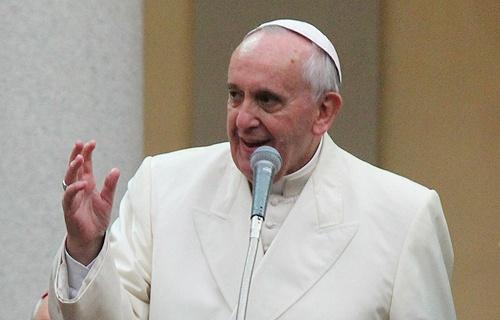
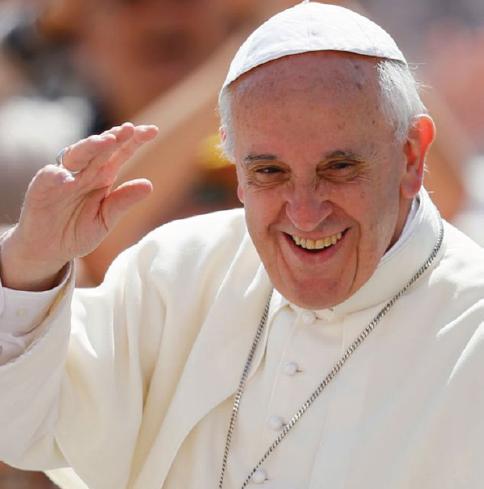
Vanity is like an onion, Pope Francis says.

PopeFrancis

In a colorful homily, Pope Francis highlighted the sin of vanity, saying that Christians must reject it by peeling away one layer at a time.

He cited the Desert Fathers, the saints of early Christian Egypt, who saw that “vanity is a temptation against which we must battle our whole life, because it always comes back to take the truth away from us.”

Drawing from their comparison, Pope Francis explained that vanity is “like an onion,” with layers that must be removed.

“You take it, and begin to peel it – the onion – and you peel away vanity today, a little bit tomorrow, and your whole life you’re peeling away vanity in order to overcome it.”

“And at the end you are pleased: I removed the vanity, I peeled the onion, but the odor remains with you on your hand,” he remarked in his homily during morning Mass at his Casa Santa Martha residence at the Vatican.

“Let us ask the Lord for the grace to not be vain, to be true, with the truth of reality and of the Gospel.”

Warning against the sin of vanity, Pope Francis compared vain Christians to soap bubbles that will soon burst or peacocks who “strut about.”

“How many Christians live for appearances? Their life seems like a soap bubble. The soap bubble is beautiful, with all its colors! But it lasts only a second, and then what?” he said.

“Even when we look at some funeral monuments, we feel its vanity, because the truth is returning to the bare earth, as the Servant of God Paul VI said. The bare earth awaits us, this is our final truth.”

“In the meantime, do I boast or do I do something? Do I do good? Do I seek God? Do I pray?” the Pope asked, urging Christians to seek these “substantial things.”

Those who do not seek substantial things “will pass like all things.”

Vanity is “a liar, a fantasist” that “deceives itself” and deceives the vain, he added. The vain man begins by pretending to be something, and ends by believing in his pretension.

“Vanity sows wicked anxiety, takes away peace,” Pope Francis said. Vanity is like someone who puts on too much makeup and fears the rain will come and wash it away.

The Pope said vain Christians sometimes say, “I am a Christian, I am related to that priest, to that sister, to that bishop; my family is a Christian family.”

However, he rejected this attitude, stressing that Jesus is the only foundation for the Christian life, and that only truth yields peace.

“What about your life with the Lord?” he asked. “How do you pray? Your life in the works of mercy, how’s that going? Do you visit the sick?” he asked.

“Jesus tells us we must build our house – that is, our Christian life – on the rock, on the truth,” he said, noting that Jesus warned that the vain “build their house on sand, and that house falls, that Christian life falls, slips, because it is not able to resist temptations.”

Vatican City, CNA/EWTN News

Categories
Pope Francis

Pope Francis: Satan seduces by disguising evil as good.

17

On the feast of the archangels, Pope Francis spoke of the ongoing battle between the devil and mankind, encouraging attendees to pray to the angels, who have been charged to defend us.

“He presents things as if they were good, but his intention is destruction. And the angels defend us,” the Roman Pontiff told those gathered for his Mass in the Vatican’s Saint Martha residence chapel.

The Bishop of Rome began by pointing to the day’s readings taken from Daniel 7 in which the prophet has a vision of God the Father on a throne of fire giving Christ dominion over the world, and Revelation 12, which recounts the battle in which Satan, as a large dragon, is cast out of heaven by St. Michael.

Noting how these are strong images portraying “the great dragon, the ancient serpent” who “seduces all of inhabited earth,” the Pope also drew attention to Christ’s words to Nathanael in the day’s Gospel from John when he tells him “You will see heaven opened and the angels of God ascending and descending upon the Son of man.”

All of these readings, he said, speak of “the struggle between God and the devil” which “takes place after Satan tries to destroy the woman who is about to give birth to a son.”

“Satan always tries to destroy man: the man that Daniel saw there, in glory, and whom Jesus told Nathaniel would come in glory,” the Roman Pontiff observed, explaining that “from the beginning the Bible speaks to us of this: Satan’s (use of) seduction to destroy.”

Envy could be the devil’s motive, he said, pointing to how Psalm 8 tells us, ‘You have made man superior to the angels.’ And that angel of great intelligence could not bear this humiliation; that a lower creature was made superior to him; and he tries to destroy it.”

Pope Francis then noted how “So many projects, except for one’s own sins, but many, many projects for mankind’s dehumanization, are his work, simply because he hates mankind.”

He continued by explaining that although the Bible tells us that the devil is astute and cunning in his attacks, we have the angels to defend us.

“They defend mankind and defend the God-man, the superior man, Jesus Christ who is the perfection of humanity, the most perfect.”

“This is why the Church honors the angels, because they are the ones who will be in the glory of God – they are in the glory of God – because they defend the great hidden mystery of God – namely, that the Word was made flesh.”

It is therefore the responsibility of the People of God “to safeguard man, the man Jesus,” the Pope went on, because “he is the man who gives life to all men.”

However this is not easy because Satan has invented “humanistic explanations that go against man, against humanity and against God” in order to destroy us.

“This struggle is a daily reality in Christian life, in our hearts, in our lives, in our families, in our people, in our churches,” the Pope went on, adding that “if we do not struggle, we will be defeated.”

“But the Lord gave this task primarily to the angels: to do battle and win,” he said, drawing attention to the final song of Revelation which reads “now have salvation and power come, and the kingdom of our God and the power of his Anointed. For the accuser of our brothers is cast out, who accuses them before our God day and night.”

Pope Francis concluded his homily by encouraging those present to pray to the Archangels Michael, Gabriel and Raphael, and to recite the prayer to Saint Michael often.

We should do this “so he may continue to do battle and defend the greatest mystery of mankind: that the Word was made Man, died and rose again. This is our treasure. That he may battle on to safeguard it.”

by Elise Harris
Vatican City, CNA/EWTN News

Categories
Pope Francis

Don’t overcomplicate the Christian life, Pope Francis Warns.

Pope

Pope Francis resumed daily Mass after his papal visit to Albania, telling those present that living the Christian life is simple: listen to God’s word and put it into practice.

“These are the two conditions in order to follow Jesus, hear the word of God and put it into practice. This is the Christian life, nothing more,” the Pope said.

“Simple, easy. Maybe we’ve made it a little difficult with explanations that no one understands, but the Christian life is this: listen to the word of God and practice it.”

A recurring theme in Pope Francis’ remarks was the condemnation of all violence done in the name of religion as well as the repeated acknowledgment of the brutal persecution of religious groups carried out late last century under Albania’s now-collapsed atheistic regime.

The Pope urged Christians to read God’s word faithfully and to truly listen with our hearts to what he has to say.

“Every time we do this – we open the Gospel and read a passage and ask ourselves: ‘Does God speak to me, say something to me?’ And if he says something, how would you respond?”

“This is to listen to the word of God, listen with your ears and hear with your heart.” God speaks to each of us. The Gospel was written for each of us,” he emphasized.

Although putting God’s word into practice “is not easy,” Christ is “merciful and forgives all,” even those who hear his word and turn against him. “Think of Judas. ‘Friend’ he says, in that moment” in the Gospel where he betrays Christ.

“The Lord,” Pope Francis reflected, is “always sowing his word, just asking an open heart to listen and willingness to put it into practice.”

“For this reason, the prayer today, which is that of the Psalm: ‘Lead me Lord on the path of your commands,’ that is the path of your Word, and that I may learn with your guide to put it into practice.”

Vatican City CNA/EWTN News

Categories
Articles

The Franciscan Crown Rosary

15
The Franciscan Crown Rosary is a Rosary consisting of seven decades with each decade describing a particular joy from the life of the Blessed Virgin Mary. The Seven Joys are:

1) The Annunciation
2) The Visitation
3) The Birth of Our Lord Jesus Christ
4) The Adoration of the Magi
5) The Finding of the Child Jesus in the Temple
6) The Appearance of Christ to Mary after the Resurrection
7) The Assumption and Coronation of Mary as Queen of Heaven

How to Pray the Crown Rosary
The Franciscan Crown Rosary begins quite simply by stating the first Mystery and then praying one Our Father and ten Hail Mary’s while meditating upon it. This same procedure is then followed for the other six Mysteries. Even though it is common practice nowadays to add the Glory Be at the end of each decade, and even the Fatima Prayer, these are not required. It is customary to finish by adding two Hail Mary’s in honor of the 72 years that Our Lady is said to have lived on earth, and one Our Father and Hail Mary for the intentions of the Pope.

Story of the Franciscan Crown
The story of the Rosary of the Seven Joys of the Blessed Virgin dates back to the early 15th century. A pious young man named James had been accustomed to adorning a beautiful statue of Mary with a crown of flowers, which he had picked and woven himself. He later entered the Franciscan Order, but either because of a lack of time or permission, he was no longer able to continue this devotion. Distraught because of this, he decided to abandon the religious life and return to the world.

Our Lady then appeared to him and convinced him not to leave the order. She told him that he should not be downcast because he was no longer permitted to adorn her statue, for she would teach him a way to give her honor which was much more pleasing and meritorious. Instead of a crown of flowers, which quickly wither, he was to weave a crown of prayers, and these prayers could be offered at any moment. She then taught him the Rosary of the Seven Joys, adding that these prayers would not only form a more acceptable crown, but they would also yield innumerable graces for himself and others.

This simple but beautiful devotion of praying the Crown of the Seven Joys of the Blessed Virgin soon spread over the entire Franciscan Order and was officially established in 1422.

16

Franciscan Scripture Reading
Franciscan reading exhibits qualities of Franciscan spirituality; actions, spontaneity, love, praise, beauty, and delight in creation. This form of reading involves the mental process of entering personally into the text.

Read chapter 53 of Isaiah. The message in the chapter prompts a reflection of the sacrificial death of Jesus on the cross. The Franciscan method invites you to take actions that would prompt obedience and compassion for humankind. You would also gain an appreciation for loving your fellow man. In connecting with the sacrifice of Cavalry, imagine as best you can the experience of dying on the cross. Using a cross with the crucified Savior, hold it in your hands, gazing at the details of the Lord’s crucified body. Imagine his pain and suffering.

You might look through today’s newspaper and identify places in the world where people are suffering and make a conscious effort to relieve that suffering. You may choose to write a poem expressing your feelings or paint a picture. Such a scene has been captured countless times on canvas.

The Franciscan method of action, love, spontaneity, love, praise, and delight in creation while reading scripture, is a personal connection with God causing the reader to saturate the entire experience with prayer, asking God to make you an instrument of peace in the lives of those who are suffering.

Categories
Articles

How To Pray The Franciscan Crown Rosary

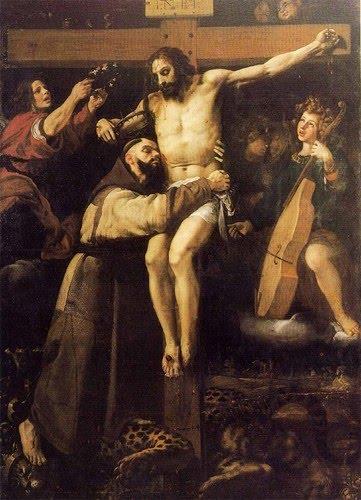
14St. Francis In Ecstasy, circa 1595 by Michelangelo Merisi da Caravaggio

The Franciscan rosary, also known as the Seven Joys of the Blessed Virgin Mary is composed of seven decades consisting of one Our Father and ten Hail Marys each. At the end two Hail Marys are added, and is concluded with the Our Father and Hail Mary. The last Our Father and Hail Mary are said for the intention of the Pope in order to gain the indulgence. The 72 Hail Marys commemorate the seventy-two years the Blessed Virgin Mary is supposed to have lived on earth.

The seven decades need not be recited at once, but the single decades may be recited provided that the whole rosary is said on the same day. It is not necessary to meditate on the mysteries of this rosary; it suffices to say the single decades in honor of the respective mystery.

The following are the mysteries of the Franciscan Crown:

1. The Immaculate Virgin Mary joyfully conceived Jesus by the Holy Ghost.
2. The immaculate Virgin Mary joyfully carried Jesus when she visited Elizabeth.
3. The Immaculate Virgin Mary joyfully brought Jesus into the world.
4. The Immaculate Virgin Mary exhibited Jesus to the adoration of the Magi.
5. The Immaculate Virgin Mary joyfully found Jesus in the Temple.
6. The Immaculate Virgin Mary joyfully beheld Jesus after His resurrection.
7. The Immaculate Virgin Mary was joyfully received by Jesus into heaven, and crowned Queen of heaven and earth.

The use of this rosary was begun in the order of St. Francis in 1422. It is said that a certain novice, before joining the Order, was accustomed to place a crown on a statue of the Blessed Virgin. When he was not allowed to continue this practice, he resolved to leave the Order. Mary appeared to him and dissuaded him, telling him that he could offer a much more pleasing crown by reciting a rosary of seven decades in honor of Her Seven Joys. This is the most highly indulgenced of all the types of rosaries.

Source: My Treasury of Chaplets; Patricia S. Quintiliani

Design a site like this with WordPress.com
Get started