Categories
Random Thoughts by Peachy Maramba

R A N D O M T H O U G H T S Voices from yesterday and today . . . by Peachy Maramba

23

ST. ANTHONY ZACCARIA:
Founder of the Clerks Regular of St. Paul

1502 – 1539
July 5

Thanks to His Mother
It is to his mother AntoniettaPescaroli who was widowed at the very early age of 18 that our saint of the day – Anthony Zaccaria-owes his spiritual growth. It was she who not only instilled in her only child compassion and mercy for the poor but also the virtue of practical Christian charity by sending him personally to distribute all her alms.

Compensating for the loss of his father while still very young his mother assiduously saw to it that he received a solid training. Choosing to be a doctor he trained for and studied medicine at the University of Padua in Italy the country of his birth.

Becomes a Doctor
By the time he reached the age of twenty-two (some say 25) he returned home to Cremona where he, a full-fledged physician, set up his practice. For a couple of years he practiced his profession treating all sorts of sick people. In doing so he found that he was treating not only their bodies but their souls as well – ministering not only to the sick and afflicted but also to the dying and the bereaved.

Becomes a Priest
Not content in doing this and teaching catechism to the youth even as he practiced medicine devoted Anthony decided to study theology that he might learn more comfort and ways of God. By the year 1528 Anthony who was by then only 26 years of age received Holy Orders and was ordained a secular priest.

Soon he moved to Milan where he was encouraged to go as there were greater opportunities for serving his fellowman. At Milan putting himself completely at the service of everyone he joined the Confraternity of Eternal Wisdom as the purpose of the organization was to carry out various works of mercy.

Then thanks to the help of the Countess of Guastella-LuigiaTorelli, he helped co-found a community called the Angelicals – a female congregation dedicated to the rescue of fallen women and girls and those in danger of falling into sin.

Two years later he turned his attention to something else. With the help of two fellow zealous priests Anthony founded a congregation this time of priests dedicated to reviving spirituality by helping to regenerate and revive the love of Divine worship and a truly proper Christian way of life. How? By frequent preaching and the frequent faithful worthy administration of the Sacraments.

Congregation of Clerks Regular of St. Paul
This was the Congregation of Clerks Regular of St. Paul (so named by Pope Clement VII) approved by Pope Clement VI in 1533 with Anthony as its first provost general.

Together the members ministered unceasingly night and day to the people of Milan and Cremona working to overcome the deplorable conditions of the people who had been stricken by frequent wars fought on their soil resulting in famine and plagues.

Apostle of Milan
Inspired by a zeal like that of St. Paul Anthony crammed each day with an amazing record of works of charity and mercy among the sick and the poor. For his success in achieving his goal he was aptly named the “Apostle of Milan”.

Crucifix in hand Anthony was a familiar and often seen figure going through the city’s streets at all times of the day or night preaching on Our Lord’s Passion and death. Stressing on the need for repentance and for performing penance of one’s sins, Anthony made up for the neglect of the clergy by preaching whenever and wherever he could.

Because the headquarters of the group was the St. Barnabas Church which Anthony had bought for his society they were popularly known as Barnabites.

In 1536 Anthony resigned as provost general so that he might help to spread the community. The Angelicals of St. Paul which he had earlier founded was a congregation of nuns who greatly helped him to raise moral standards and strict observance in several communities of nuns.

His Death and Canonization
Worn out by his excessive and tireless labors Anthony died at the very early age of 37 on July 15, 1539.

He was canonized by Pope Leo XIII in 1897.

Lesson from St. Anthony
Anthony left us this valuable lesson when he used to say: “That which God commands seems difficult and a burden, but all God’s commands are made easy by love. The way is rough; you draw back; you have no desire to follow it. Yet do so and you will attain glory.”

SOURCES of REFERENCE
ST. ANTHONY ZACCARIA

July 5

Butler’s Lives of the Saints – Vol. III pp 19 – 20
Pocket Dictionary of Saints – p 514
A Calendar of Saints – p 128
A Year With the Saints – July 5
Butler’s Saint for the day – pp 311 – 312
Illustrated Lives of the Saints – Vol. I – pp 290 – 291
My First Book of Saints – pp 143 – 144
Saint Companions – pp 245 – 246
Saint of the Day – pp 158 – 159
Voices of the Saints – pp 466 – 467

Categories
Fiesta

Philippine Diary How St. Anthony Came to Sampaloc (Manila) by Friar Jack Wintz O.F.M.

St. Anthony is alive and well in the Philippines! With the feast of Anthony of Padua approaching on June 13, it’s a good time to recall my February visits to two Franciscan churches in metro Manila. Both churches honor St. Anthony as their patron saint, and both are popular shrines. As we shall see, St. Anthony, who holds the Christ child in his arms, draws many people to Christ.
16
The St. Anthony Shrine in Sampaloc is featured first, not only because it was built before the second one (Santuario de San Antonio in Forbes Park), but also because the historical roots of the Sampaloc Shrine stretch back to a very old and venerable statue of St. Anthony that once stood inla Iglesia de San Francisco(the Church of St. Francis). This huge church, built of stone in 1739, is directly linked with the very first church built (in 1578) of bamboo and nipa by Spanish Franciscan friars shortly after they arrived in the Philippines. This large stone edifice, like its humble predecessor, stood in Intramuros, the old walled city of Manila. The large church, named after St. Francis, attracted many Catholics because of its very popular St. Anthony devotions and because of Anthony’s highly revered statue there. This massive stone structure, like many others in Intramuros, was totally destroyed by bombings at the end of World War II.
17
St. Anthony’s transfer to Sampaloc
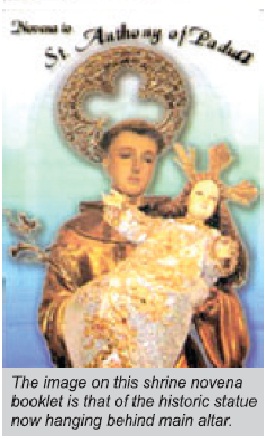
In the eyes of some, it seemed miraculous that the statue of St. Anthony survived the bombings of 1945 and was found intact amidst the crumbled ruins of the church. The statue was taken for safe keeping to the Franciscan church in Santa Ana (featured in last month’s E-spirations), but was ultimately transferred to St. Anthony Shrine in Sampaloc. According to Father Cielo Almazon, O.F.M., present rector of the shrine, the old, venerable statue of St. Anthony thus came to be mounted on the wall behind the main altar of the Sampaloc shrine.
25
On February 12, Father Cielo graciously took me on a tour of the shrine and spoke of the amazing number of people that St. Anthony draws into that church each week. St. Anthony devotions are held each Tuesday. Father Cielo estimates that some 5,000 people (collectively) attend the 10 Masses on ordinary Tuesdays. The first Mass begins at 5:45 a.m. and the 10th at 7:30 p.m. During the solemn novena held on the 13 Tuesdays preceding the feast of Anthony, Father Cielo estimates that the number of people attending rises to 8,000 each of those Tuesdays, with as many as 200 people standing outside during these Masses. The Prayers to St. Anthony are said after the gospel/homily of the Mass. According to Father Cielo, “the popularity of St. Anthony helps draw the faithful to the celebration of the Eucharist, which is the center of Catholic prayer and worship.”

Father Cielo points out that the thousands who come to the shrine represent a wide range of people—poor and rich. “There are beggars and street vendors, as well as retired professionals, students and teachers. The shrine is surrounded by various schools and colleges,” he adds, “with a good number of people traveling to the shrine from remote places far beyond the metropolitan area.”
18
More about Father Cielo
Father Cielo is a 55-year-old native of Northern Luzon. He holds a licentiate in sacred scripture from the Pontifical Biblical Institute in Rome and has taught scripture for 23 years at Our Lady of the Angels Franciscan Seminary in Quezon City and at the Inter-Congregational Theological School in New Manila. Father Cielo told me that he would like to see “St. Anthony Shrine become a place for expanded evangelization projects—in light of St. Anthony’s own charism and success as a great evangelizer.”

Father Cielo says that he sees St. Anthony “as a powerful intercessor on behalf of both the rich and the poor. The rich come here and give thanks to St. Anthony because he made their business prosperous and their families happy. The poor pray to St. Anthony invoking his assistance to pass board exams and help cure their sicknesses, and to have children. Most of all, Anthony helps us become better followers of Christ. As a prayer in the shrine’s novena booklet expresses it: ‘O Holy St. Anthony… pray that we may fulfill the will of God and live the way Jesus shows us in the gospels.”

A brief history of the Franciscan presence in Sampaloc
The first Franciscan Church in Sampaloc was Our Lady of Loreto, dedicated to Our Lady under that title in 1616. The pastor was Father Augustin de Tordecillas, one of the first 15 Franciscan friars to arrive in Manila from Spain. During the next 300 years, the church of Our Lady of Loreto experienced many challenges: destruction by fire (1639) and by earthquake (1880), though it was rebuilt in both instances—only to be abandoned because of the Philippine revolution (1896-98) and legal disputes that followed. Our Franciscan presence in Sampaloc survived at times only through the presence of Third Order Franciscans and their well-known VOT (Third Order) Church, located nearby. Today the Third Order of St. Francis is known as the Secular Franciscan Order (SFO).
19
Near the end of World War II (1945), the Franciscan friary and the VOT Church in Sampaloc, as well as many other buildings in Manila, were totally destroyed by bombings of the U.S. armed forces (to eliminate the hideouts of the Japanese occupiers). As noted earlier, the destruction included the old Church of St. Francis in Intramuros, as well as many others within those same old walls.

Not long afterwards, Father Mariano Montero, O.F.M., a Spanish friar once stationed at St. Francis Church in Intramuros, came up with the idea of transferring St. Anthony devotions (so popular in Intramuros) to Sampaloc, where the rebuilding of Sampaloc’s destroyed church was about to begin. Father Mariano decided to have the church’s name changed to the Shrine of St. Anthony. Finally, in 1947, the rebuilding of the church was completed and it was rededicated to St. Anthony of Padua.

Copyright © Franciscan Media. Taken from Friar Jack E-spirations on http://www.AmericanCatholic.org and used with permission. All rights reserved.

Design a site like this with WordPress.com
Get started