Categories
Articles Lent

PASSOVER MEAL by Tina Teehankee

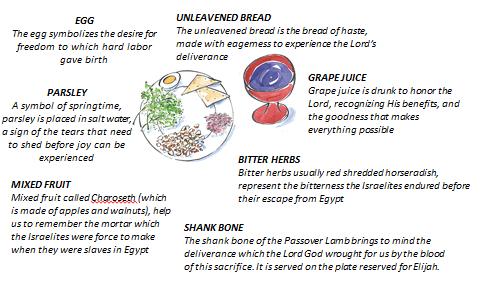
 Passover Seder MealThe Passover Seder Meal is a Christian ritual that allows us to return to the sources of our past that is the very ground of our being.  The celebration remembers the Passover night when God rescued the Children of Israel from slavery in Egypt.  Why is it important for us to observe the Passover Seder Meal?  Moses said, “You shall observe this rite as a perpetual ordinance for you and your children.  When you come to the land that the Lord will give you, as he has promised, you shall keep this observance.  And when your children ask you, “What do you mean by this observance?’ you shall say, ‘It is the Passover sacrifice to the Lord, for he passed over the houses of the Israelites in Egypt, when he struck down the Egyptians but spared our houses.”  And the people bowed down and worshiped. – Exodus 12:24-27

We invite families and friends to attend the Passover Seder Meal. The Passover Seder Meal costs P500.00 per head.  We can choose beef, chicken, or fish for our main dish complete with the Seder Meal symbols on each table.  We invite all Ministry Heads, Members, Parishioners and friends to attend.  Reserve a table and bring the entire family! Register now at the Parish Office c/o Ms. Bernadette Andulte or your Ministry Head.


Categories
Special Events

PASSOVER SEDER MEAL By Cristina Teehankee

12It is the Lenten season once again and that time of the year where Parishioners offer sacrifices and thank our Almighty God, break bread and celebrate one of the oldest Hebrew Liturgical festival . . . the Passover Seder Meal. Fr. Reu Jose Galoy, OFM, Parish Priest in coordination with the Liturgical Committee headed by Edmund Lim, PPC Vice President and assisted by Crissy Castillo, invite families and friends to the celebration of the Passover Seder Meal on Tuesday, March 31, 2015, after the 6:00 PM Mass at the Parish Center Social Hall. The family of Rafael (Ai-Ai) Galvez, Head of the Extra-Ordinary Ministry of Holy Communion is this year’s lead family.
untitled
The celebration remembers the Passover night when God rescued the children of Israel from slavery in Egypt. Moses explains in Exodus 12:24-27 the significance of observing this perpetual Jewish ordinance as our way of showing our gratitude to our God Almighty for having passed over the houses of the Israelites in Egypt when he struck down the Egyptians but sparing the Jewish houses.

Thus, the Seder Meal is the re-enactment of the exodus of the Jews from Egypt affirming God’s redemptive liberation of Israel from slavery and spiritual misery. The purpose of the Seder Meal and the directed conversation at table is to draw relationships between the Passover and important New Testament truths. It is vital that we recognize that Jesus was a faithful Jew who observed Judaic laws. It was within Judaism that Christianity was born and essential elements of Christian faith founded.

The Passover Seder Meal costs P500.00 per head. We can choose lamb, beef, chicken, or fish for our main dish. We invite all Ministry Heads, Members, Parishioners and friends to attend as part of our Parish Lenten activity. Do not miss this important celebration to understand better the roots of our faith. Reserve a table and bring the entire family! Register now at the Parish Office or your Ministry Head.

Categories
Articles

Passover Seder Meal

The SSAP community celebrated the Seder Meal on April 10, 2014 as a celebration of the exodus from Egypt and God’s redemptive liberation of Israel from slavery and spiritual misery. This Meal, while generally a Jewish tradition, has played an integral role in Franciscan Lenten celebration. Representatives from the different parish ministries were present to join in fellowship and to reenact the Passover meal.

In welcoming participants, the Seder Meal continues with the lighting of the candles. Using the prayer book for the ritual, the leader starts the meal with the blessing of the wine followed by the washing of hands. Then karpas (green vegetable) is dipped in salt water to remind participants of the misery caused by slavery in Egypt. At that point, the middle piece of three matzas (unleavened bread) on the table is broken and hidden by the leader for children to find later.

The leader then tells the Passover story beginning with the bread of affliction. It is a reminder of the Jewish people’s pain in slavery and is also symbolic of the suffering in the world today. Here the leader asks the children to open the door as a gesture of hospitality. The youngest person attending the Seder asks four questions. The first one being “Why is this night different from all other nights?” After the explanations, a second cup of wine — the cup of memory — is poured followed by another washing of hands and a prayer. Then the dinner is served.

Following dinner, young participants search for the hidden matza and songs or hymns are performed while the festivities continue. There is a prayer after the meal followed by the third cup — the cup of redemption. It is at this time the cup of Eljiah is filled and placed in the middle of the table. A recitation of the psalms and the conclusion of the Passover Seder are observed with the fourth cup — the cup of hope — along with the final benediction.

The festivities concluded with parishioners joyously dancing hand in hand forming a ring of unity amongst the community.

This slideshow requires JavaScript.

Design a site like this with WordPress.com
Get started