Categories
Fiesta

Philippine Diary How St. Anthony Came to Sampaloc (Manila) by Friar Jack Wintz O.F.M.

St. Anthony is alive and well in the Philippines! With the feast of Anthony of Padua approaching on June 13, it’s a good time to recall my February visits to two Franciscan churches in metro Manila. Both churches honor St. Anthony as their patron saint, and both are popular shrines. As we shall see, St. Anthony, who holds the Christ child in his arms, draws many people to Christ.
16
The St. Anthony Shrine in Sampaloc is featured first, not only because it was built before the second one (Santuario de San Antonio in Forbes Park), but also because the historical roots of the Sampaloc Shrine stretch back to a very old and venerable statue of St. Anthony that once stood inla Iglesia de San Francisco(the Church of St. Francis). This huge church, built of stone in 1739, is directly linked with the very first church built (in 1578) of bamboo and nipa by Spanish Franciscan friars shortly after they arrived in the Philippines. This large stone edifice, like its humble predecessor, stood in Intramuros, the old walled city of Manila. The large church, named after St. Francis, attracted many Catholics because of its very popular St. Anthony devotions and because of Anthony’s highly revered statue there. This massive stone structure, like many others in Intramuros, was totally destroyed by bombings at the end of World War II.
17
St. Anthony’s transfer to Sampaloc
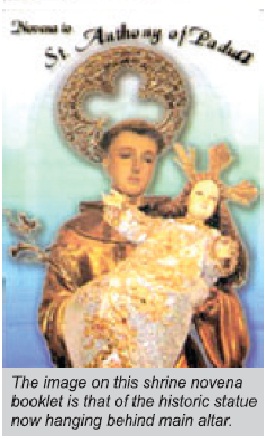
In the eyes of some, it seemed miraculous that the statue of St. Anthony survived the bombings of 1945 and was found intact amidst the crumbled ruins of the church. The statue was taken for safe keeping to the Franciscan church in Santa Ana (featured in last month’s E-spirations), but was ultimately transferred to St. Anthony Shrine in Sampaloc. According to Father Cielo Almazon, O.F.M., present rector of the shrine, the old, venerable statue of St. Anthony thus came to be mounted on the wall behind the main altar of the Sampaloc shrine.
25
On February 12, Father Cielo graciously took me on a tour of the shrine and spoke of the amazing number of people that St. Anthony draws into that church each week. St. Anthony devotions are held each Tuesday. Father Cielo estimates that some 5,000 people (collectively) attend the 10 Masses on ordinary Tuesdays. The first Mass begins at 5:45 a.m. and the 10th at 7:30 p.m. During the solemn novena held on the 13 Tuesdays preceding the feast of Anthony, Father Cielo estimates that the number of people attending rises to 8,000 each of those Tuesdays, with as many as 200 people standing outside during these Masses. The Prayers to St. Anthony are said after the gospel/homily of the Mass. According to Father Cielo, “the popularity of St. Anthony helps draw the faithful to the celebration of the Eucharist, which is the center of Catholic prayer and worship.”

Father Cielo points out that the thousands who come to the shrine represent a wide range of people—poor and rich. “There are beggars and street vendors, as well as retired professionals, students and teachers. The shrine is surrounded by various schools and colleges,” he adds, “with a good number of people traveling to the shrine from remote places far beyond the metropolitan area.”
18
More about Father Cielo
Father Cielo is a 55-year-old native of Northern Luzon. He holds a licentiate in sacred scripture from the Pontifical Biblical Institute in Rome and has taught scripture for 23 years at Our Lady of the Angels Franciscan Seminary in Quezon City and at the Inter-Congregational Theological School in New Manila. Father Cielo told me that he would like to see “St. Anthony Shrine become a place for expanded evangelization projects—in light of St. Anthony’s own charism and success as a great evangelizer.”

Father Cielo says that he sees St. Anthony “as a powerful intercessor on behalf of both the rich and the poor. The rich come here and give thanks to St. Anthony because he made their business prosperous and their families happy. The poor pray to St. Anthony invoking his assistance to pass board exams and help cure their sicknesses, and to have children. Most of all, Anthony helps us become better followers of Christ. As a prayer in the shrine’s novena booklet expresses it: ‘O Holy St. Anthony… pray that we may fulfill the will of God and live the way Jesus shows us in the gospels.”

A brief history of the Franciscan presence in Sampaloc
The first Franciscan Church in Sampaloc was Our Lady of Loreto, dedicated to Our Lady under that title in 1616. The pastor was Father Augustin de Tordecillas, one of the first 15 Franciscan friars to arrive in Manila from Spain. During the next 300 years, the church of Our Lady of Loreto experienced many challenges: destruction by fire (1639) and by earthquake (1880), though it was rebuilt in both instances—only to be abandoned because of the Philippine revolution (1896-98) and legal disputes that followed. Our Franciscan presence in Sampaloc survived at times only through the presence of Third Order Franciscans and their well-known VOT (Third Order) Church, located nearby. Today the Third Order of St. Francis is known as the Secular Franciscan Order (SFO).
19
Near the end of World War II (1945), the Franciscan friary and the VOT Church in Sampaloc, as well as many other buildings in Manila, were totally destroyed by bombings of the U.S. armed forces (to eliminate the hideouts of the Japanese occupiers). As noted earlier, the destruction included the old Church of St. Francis in Intramuros, as well as many others within those same old walls.

Not long afterwards, Father Mariano Montero, O.F.M., a Spanish friar once stationed at St. Francis Church in Intramuros, came up with the idea of transferring St. Anthony devotions (so popular in Intramuros) to Sampaloc, where the rebuilding of Sampaloc’s destroyed church was about to begin. Father Mariano decided to have the church’s name changed to the Shrine of St. Anthony. Finally, in 1947, the rebuilding of the church was completed and it was rededicated to St. Anthony of Padua.

Copyright © Franciscan Media. Taken from Friar Jack E-spirations on http://www.AmericanCatholic.org and used with permission. All rights reserved.

Categories
Pastoral Team Special Events

Thanksgiving Dinner & Celebration of the Holy Eucharist by Newly Ordained Franciscan Priests, by Cristina Teehankee

This slideshow requires JavaScript.


On behalf of Fr. Reu Jose Galoy, OFM Parish Priest and his Pastoral Team and the Parish Pastor al Council, headed by Jayme Blanco, President and Edmund Lim, Vice President, we congratulate the Order of Friars Minor, Franciscan Province of San Pedro Bautista, Philippines for their three newly ordained Priests: Rev. Fr. Emerson F. Bumagat, OFM from Camiguin Island, Calayan, Cagayan, Rev. Fr. Fernando B. Radin, Jr. OFM from Camotes Island, Cebu City and Rev. Fr. Angelo M. Dizon, OFM from Sampaloc, Manila.

Santuario de San Antonio Parish was fortunate to be one of the Parishes visited by the newly ordained priests for their Thanksgiving Mass, held Monday, May 4, 2015. A Thanksgiving Dinner celebration immediately followed at the Convent Garden attended by Parishioners who have journeyed with them through the years in Spirit . . . in prayer . . . and assistance. Although the Parishioners did not get to know much about the newly ordained priests, their smiles, kind words, prayer and diligent work, sparkled as sons of light.

Categories
Fr. Robert Manansala

“Echoes of God’s Love” Book Launching

This slideshow requires JavaScript.

November 30, 2014, Saturday, marked a milestone in the life of SSAP guest friar priest, Fr. Robert Manansala, OFM. He launched his first book, Echoes of God’s Love (Homilies for Liturgical Cycle B) at the packed St. Bonaventure Room. The room was filled with parishioners, Franciscans, seminarians, family and friends, who came to show their love and support for Fr. Robert.

Echoes of God’s Love is a compilation of homilies for the Sundays and major Solemnities and Feastdays for the Liturgical Year Cycle B, which started with the first Sunday of Advent.

Echoes of God’s Love is meant for spiritual reading to accompany us in our spiritual journey towards God. It speaks to the heart about the amazing love of God. Further, it challenges us to respond to His love by the way we live and love.

Despite Fr. Robert’s hectic schedule, he was able to complete the book and launch it in time for Advent. Fr. Robert heart-warmingly thanked the people who have supported him to see this dream of his turn into reality.

The official launch of the book were led by parishioners Mrs. Petrona Lim and Nanette Jalandoni. Assisting them were Ambassadors Howard Dee and Francisco del Rosario.

All proceeds of the book sale and donations have been pledged for the Library Upgrade and Renovation project of the Our Lady of Angels Seminary-College.

Interested parties may contact Bernadette Andulte at the parish office or visit the parish bookstore.

This article was written with contributions from Jaja Ledesma and Fr. Robert Manansala, OFM.

About Fr. Robert and his reflections.

Categories
Articles

Eternal Life, Christian Style

Wis 3:1-9; Ps 23:1-6; Rom 6:3-9; Jn 6:37-40
“If, then, we have died with Christ, we believe that we shall also live with him” (Rom 6:8)

This year the Commemoration of All the Faithful Departed (traditionally known as All Souls Day) interrupts the cycle of Sundays in Ordinary Time. The choice of Scripture readings is quite extensive and even confusing, as a glance at the Lectionary Nos. 668 and 1011-15 will show. I have chosen texts that are among those most often selected in liturgies for this day.

Our secular culture has a hard time confronting the reality of death. Many of us try not to think about death, use euphem-isms in talking about it and seek every natural and unnatural means to avoid it or put it off. For some, physical death is the absolute end of life. Therefore we should either “eat, drink and be merry” (hedonism) or use all our resources and efforts to make this world into a better place, because it is the only world we have (exclusive humanism). In certain late Old Testament books and in the New Testament, however, a different perspective on life and death emerges. While recognizing the natural character of physical death, these texts hold out hope for an eternal life with God and the avoidance of what can be called “ultimate death.”

Today’s Old Testament reading from the book of Wisdom (sometimes called the Wisdom of Solomon) is often used as the Old Testament reading at Catholic funerals. It comes from a Jewish book written in Greek in Alexandria in the first century B.C. The author was trying to bring together the best insights of the biblical and Greek philosophical traditions. While recognizing the reality of physical death, he offers the hope that wise and righteous persons may nevertheless enjoy eternal happiness with God and the blessed faithful. Even though skeptics (there were many in the writer’s time) regarded physical death as the absolute end of life, this biblical writer insists that the wise and righteous may and should hope for immortality, so they can regard the sufferings of the present and even their physical death as moments along the way to their future fullness of eternal life with God.

While the New Testament writers shared this belief in life after physical death, they based it not on the ancient Hebrew concept of Sheol as the abode of the dead (as the early Old Testament writers did), nor on the Greek philosophical idea of the immortality of the soul nor on the Jewish (especially Pharisaic) concept of the general resurrection of the dead. Rather, they based their hope for eternal life first and foremost on the resurrection of Jesus Christ as “the firstborn from the dead” (Col 1:18).

In today’s selection from John 6, Jesus proclaims that it is his Father’s will that “everyone who sees the Son and believes in him may have eternal life, and I shall raise him on the last day.” This statement implies that for those who believe in Jesus, eternal life has already begun. It does not begin at the moment of physical death. Instead, it begins in the act of faith in Jesus as the revealer and revelation of God. He becomes the point of “crisis” or decision for all. And Jesus promises that on the last day, at the general resurrection, those who believe in him will be raised, vindicated and richly rewarded. Thus John combines present and future eschatology. The pivot in all this is the resurrection of Jesus as the preview and guarantee of our future resurrection. In him and through him we have already begun to experience eternal life, and we can expect it to be even better.

In today’s selection from Romans 6 (the earliest theological reflection on Christian baptism), Paul focuses on the link be-tween Christ’s death and resurrection and our baptism. Through baptism we have entered into both the death of Je-sus and the eternal life of the risen Christ. Baptism involves dying with Christ in order to live with Christ. The water of baptism at once symbolizes death (by drowning) and life (without water life is impossible for humans). Baptism in-volves receiving the Holy Spirit, which is the power of God to live a virtuous and fruitful life in the present and to enjoy eternal life in the age to come.

What John and Paul hoped for was eternal life with Christ. The hope for eternal life is a desire planted deep in the hu-man psyche. Yet we need some good reason on which to base our hope. John, Paul and other early Christians were convinced that they had found a good reason in the life, death and resurrection of Jesus. If resurrection and eternal life can happen in the case of Jesus, they can happen in our case too, provided that we remain “in Christ,” that is, we share in the power of his life, death and resurrection, which we have experienced in faith and baptism.

Prayer:
• Do you believe in life after death? Why?
• What does faith in the risen Christ have to do with hope for eternal life?
• Do you ever reflect on the significance of baptism in your life? What might it have to do with enjoying eternal life in the present?
Daniel J. Harrington, S.J., is professor of New Testament at Boston College School of Theology and Ministry in Chestnut Hill, Mass.

© 2008 – America Magazine

Categories
Articles Pastoral Team Reflections

“Money Fills Your Pocket But Empties Your Heart”, Fr. Jesus Galindo, OFM

As long as we are ruled by greed and selfishness, we only think of ourselves and our welfare. But as soon as Jesus takes hold of our life, we begin to think about the needs of others.

Luke’s gospel can very well be called the “Gospel of the Underdog.” Jesus consistently shows his love and preference for the outcasts and the little ones: In the gospel, three Sundays ago, it was the Samaritan leper, an outcast, who was praised by Jesus – not the nine Jewish lepers. Two Sundays ago, it was a little old widow who won over the corrupt judge and got her demand. Last Sunday, it was the tax collector who was justified in the temple, not the self-righteous Pharisee. Today, it is Zacchaeus, another tax collector, who welcomed Jesus in his house, not the self-righteous critics.

Zacchaeus (his name means “just” or “clean”) is described by St. Luke as “a chief tax collector, a wealthy man, but short in stature.” He wanted very badly to see Jesus; and he did not stop at anything to have his wish come true, to the point of forgetting his social standing and making a fool of himself by climbing on a tree like a little monkey. Why did he want so badly to see Jesus? Was it plain curiosity? Was it remorse? Was it dissatisfaction with his wealth and with his way of life? Author J. Oswald Sanders, is his book entitled Facing Loneliness, says: “The millionaire is usually a lonely man, and the comedian is often more unhappy than his audience.” Money can fill your pockets but it empties your heart.

Zacchaeus’ act of childish abandon amply paid off. He got a lot more than what he was looking for or had expected. He not only got a glimpse of Jesus from his advantage point; he had the immense privilege of bringing Jesus right into his house. It looks like Jesus was just as eager to meet him as he was to meet Jesus. We can always find the Lord, if we really want to. He is always eager to meet us; in fact, he often takes the initiative. But then, we have to come out of ourselves, like Zacchaeus. Jesus will never find us if we remain enclosed in the bunker of our selfish, sinful ways.

Zacchaeus found salvation when he let go, not only of his social status but also of the wealth that enslaved him. He was a wealthy man but he was not happy; he was not really free. Money and power, especially if they are ill-gotten, enslave us. Ours may look like a golden cage, but it is a cage nonetheless. We must let go of it in order to be free.

Once Zacchaeus welcomed Jesus into his house and into his life, his heart was filled with grace and boundless generosity: “Behold, half of my possessions, Lord, I shall give to the poor.” As long as we are ruled by greed and selfishness, we only think of ourselves and our welfare. But as soon as Jesus takes hold of our life, we begin to think about the needs of others.

Zacchaeus’ story tells us that we cannot reconcile ourselves with God without reconciling with our fellowmen. We cannot seek forgiveness from God in the sacrament of reconciliation and then go on committing injustice and abuse against our workers and household help. It tells us further that restitution and reparation are necessary ingredients of true repentance: “If I have extorted anything from anyone I shall repay it four times over.”

Lastly, Zacchaeus’ story shows that, just as our wrongdoings often hurt the people around us (e.g., irresponsible parents bring shame and embarrassment to their children), so also our conversion brings about blessing and grace to the entire family: “Salvation has come to this house.” Not just to Zacchaeus but to his entire household as well.

May our encounter with Jesus in the Eucharist transform our life and that of the people around us, as it did transform the life of Zacchaeus and of his household!

as published on November 3, 2013, Parish Bulletin
About Fr. Jesus and his reflections

Categories
Articles Pastoral Team Reflections

“Persistence in Prayer” by Fr. Baltazar Obico, OFM

The efficacy of our prayer does not come from its form. What matters is the faith that accompanies the forms of prayer; the filial trust and confidence that we are children of God who is a Father.

In this age of charismatic renewal in the Church, a new prayer form has emerged. It is spontaneous, scriptural, accompanied by bodily gestures, raising and waving and clapping of hands. Some are hip-swaying, feet-thumping in joyful singing. Compare it to the traditional forms of prayer. It is ready made, usually read if not memorized already. It has minimal bodily gestures and movements. It is also repetitive that can lead to mindlessness. When this charismatic form of prayer was first introduced, not quite a few were turned off as they found that this movement, like dancing, borders on the disrespectful as we are used to minimal movement and herefore expect the church to be a place of quiet. On the other hand, some charismatics would frown and do away with the traditional form of prayer. Which is a more efficacious form of prayer, singing praises and thanking or the intercessory prayer of pleas and pleading?

Readings

This Sunday’s liturgical reading converges on the theme of prayer, and persistence on it and equates it with faith. Moses, sitting on the mountain with hands uplifted, while people fight in the plains below, has become a symbol of the necessity of prayer and its efficacy. (Ex. 17: 8 – 13). It illustrates that combatants as heralds of the apostolate, need, in order to emerge victorious, the prayer of the “contemplatives” who wear themselves out by praying without rest on the mountain. In the Gospel today, Luke made a surprising start by opening the Gospel account with the meaning of the parable which is the need for prayer and not to lose heart. Understood in this way, the parable of the unjust judge or the persistent widow teaches the necessity of prayer without ceasing even when the Lord seems slow to coming and deaf to our pleas. If an unjust judge finally gives the widow her due, how much more will not God, who is a Father, give justice to his elect. The lesson is that God gives justice promptly out after a long delay. Christians then in prayer must allow for the delay which God demands. They will pray “without intermission.” No longer is Christian prayer an appeal for immediate intervention. It accepts the patience of God.

Word

For a strong faith we need a strong prayer life. Our readings suggest there are things that may weigh heavily on our prayer life. We sometimes become tired and weary like Moses. Some call that spiritual burnout. It needs great effort and discipline to pray regularly. When Moses became tired, others came to support him. Do we appreciate the fact that we are supported by others? Not only do we pray for others, but others are praying for us at this moment. It is crucial not to overlook that. We are not spiritual castaways trying to survive on our own. We belong to the church, a community of faith, to support, give and transfer strength to one another. Know that someone, somebody, if not the whole community is praying for and with you.

The efficacy of our prayer does not come from its form. Whether it is a praising and singing hymn or pleading for God’s intercession. There is room for both, or any form of prayer. What matters is the faith that accompanies the forms of prayer; the filial trust and confidence that we are children of God who is a Father. If an unjust judge would relent, how much more would God, being a Father, deny us what we need. The work of intercession, praying for others is a powerful work of faith. Through it, we can touch the lives of others, the lives of our leaders, friends and people many miles part. Sometimes our form of prayer seems to be in a rut, and we need a spiritual jump-start; that is the time to turn to the Sacred Scripture. Paul today reminds us all that Sacred Scripture is inspired and useful for teaching and training. Let the word of God enliven our prayer, opening up new avenues to the Lord. There is room for both spiritual and traditional forms of prayer.

Finally, sometimes we simply become frustrated. We pray but the word doesn’t seem to change; at least not as quickly as we would want. We can became discouraged and lose our confidence in God. Our prayer does not consist in expecting God to accomplish what we ourselves fail to accomplish; give us peace; stop corruption. God is not a stop-gap. Prayer is basically a protest because war triumphs over peace, injustice over justice, evil over good. It is an entry into communion with the God of patience. In such communion the cries of protest are gradually translated into action. The perseverance asks of us is not only in praying to God, but in cooperating with Him to establish the justice we long for.

as published on October 20, 2013 Parish Bulletin
About Fr. Tasang and his other reflections

Categories
Articles Pastoral Team Reflections

“We have done no more than our duty”, Fr. Efren Jimenez, OFM

The person of faith becomes so much part of the world of God that even God is one of the family, a person whom one can address in perfect familiarity, even to the point of complaining. In faith, this is the expected, the ordinary, and the “natural.”

One of the fascinating characteristics of the scriptures is the constancy with which they come up with provocative statements. The reader, on reflection, has to ask hard questions. Is this really what God is saying? Howcan He allow the inspired author to make that statement? How can I possibly make this a part of my own life?

We have especially good examples of provocative statements in our first and third readings for this Sunday. The second reading contains a more sober observation that can serve as a summary response to the other two.

The prophet Habakkuk lived at a precarious time in Judah’s history. The mighty Assyrian empire had collapsed before the Babylonians in 609 B.C. and a new enemy had arisen to threaten God’s desperate people (the “Chaldea” of 1:6 refers to Babylon). The prophet was writing at a time when this threat loomed large. The first part of the reading reflects his anguish.

What is most provocative in these verses is the manner in which the prophet challenges God. “How long, O Lord? I cry for help but you do not listen!” Our traditional notion of piety would hardly recommend this kind of prayer. But there it is in the sacred scriptures, an accusation against God!

We do find examples of this kind of human questioning of divine wisdom in other books of the Bible. The most notable, of course, is the Book of Job, where the human protagonist challenges God to appear in a court of law with him. As far as we know, Habakkuk was the first to utter words of this kind to the God of Israel.

The saying about the power of faith is clearly provocative. While Jesus does not expect us to go around commanding sycamore trees to drown themselves in the ocean, one has to admit that it is a striking illustration.

Even more provocative but in a subtler way, is the parable about the servants. They are expected to go about their ordinary tasks in an unostentatious way. They are not to expect a handsome reward every time they pour their master a cup of coffee. Jesus’ disciples are to serve him in the same way: “We have done no more than our duty.”

This is provocative because, in a sense, serving Jesus is quite extraordinary. The total dedication to him, the acceptance of the cross, the serving of others in his name – these have always caught the attention of the world. How can they be said to be no more than duty?

The answer is faith. When one makes that total surrender to the Lord, the all else follows “naturally”. The extraordinary becomes ordinary. The unexpected becomes the completely expected. Saying “of course” to the difficult is the mark of the Christian disciple, the person of faith. Thus the joining of the saying of faith’s power to the parable of the servant-disciples is no accident.

The same explanation applies to the first reading. The person of faith becomes so much part of the world of God that even God is one of the family, a person whom one can address in perfect familiarity, even to the point of complaining. In faith, this is the expected, the ordinary, and the “natural.”

The Pauline author of the second reading had this kind of faith in mind when he tells Timothy to “stir into flame the gift of God…” We are to recognize our rich heritage whereby we can address God as our Father in a familiar way and can serve Jesus as easily and as readily as children of light.

as published on October 6, 2013 Parish Bulletin
About Fr. EJ and his Reflections

Categories
Articles Pastoral Team Reflections

“Make Friends with Dishonest Wealth” by Fr. Jesus Galindo

Make friends with those who, when one day you find yourself in trouble, that is, before God’s throne of justice, will defend and welcome you. These friends, we know, are the poor.

This Sunday’s Gospel presents us with a parable that in some respects has important contemporary relevance: the parable of the dishonest steward. The central character of the parable is the farm manager of a landowner, a well-known figure in our countryside when the sharecropping system was still in existence. Like all good parables, this one is like a miniature play, full of movement and scene changes. The actors in the first scene are the steward and the master and the scene ends with the master firing the steward: “You can no longer be my steward.” The steward does not even try to defend himself. He knows that he is guilty of what the master has discovered.

The second scene is a soliloquy of the steward, who is now alone. He has not yet accepted defeat. He immediately thinks about what he can do to get himself out of this situation and save his future.

The third scene — steward and tenant farmers — reveals to us the plan that the steward has devised. He asks the tenants, “How much do you owe?” “One hundred measures of wheat,” is one reply. “Here is your promissory note,” he says, “take it and write down eighty.” A classic case of corruption and falsehood that makes us think of similar situations in our own society, often on a much larger scale.

The conclusion may seem disconcerting: “The master praised the dishonest steward for acting prudently.” It is the master, not Jesus, who praises the steward’s shrewdness. We need to recall the particular nature of teaching in parables. The moral doctrine that is aimed at is not in the parable taken as a whole, in every detail, but only in that aspect of the parable that the narrator wishes to pick out. And the idea that Jesus intended to bring out with this parable is clear. The master praises the steward for his resourcefulness and for nothing else. It is not said that the master changed his mind about his decision to fire the man.

Indeed, given the initial conduct of the master and the quickness with which he discovers the new scam we can easily imagine the outcome, which the parable does not report. After having praised the steward for his astuteness, the master orders him to immediately restore the fruit of his dishonest transactions or pay it off in prison if he lacks the means.

It is cleverness that Jesus also praises, outside the parable. In fact, he adds: “The children of this world are more clever in dealing with their own generation than are the children of light.” That man, when he was faced with an emergency situation in which his whole future was at stake, showed a capacity for radical decision making and great resourcefulness. He acted quickly and intelligently — even if dishonestly — to save himself. This, Jesus observes to his disciples, is what you too must do, to save yourselves, not for a worldly future but for an eternal future.

Jesus is telling us Christians to be as quick and intelligent and resourceful in doing good as the “children of this world” (the corrupt) are in doing wrong. We are all God’s “stewards,” so we have to act wisely like the man in the parable.

The Gospel itself makes different practical applications of this teaching of Christ. The one that it insists the most on is the one regarding the use of wealth and money: “I tell you, make friends with dishonest wealth, so that when it fails, you will be welcomed into eternal dwellings.” In other words, do as that steward did; make friends with those who, when one day you find yourself in trouble, that is, before God’s throne of justice, will defend and welcome you. These friends, we know, are the poor.

We know this from what Christ says about his being the recipient of what we do for them. The poor, St. Augustine said, are, so to speak, our couriers and porters: They allow us to begin transferring our belongings now to the house that is being built for us in the hereafter. (R. Cantalamessa, ofm cap).

as published on September 22, 2013, Parish Bulletin

More about Fr. Jesus and his Reflections

Categories
Articles Pastoral Team

from Bro. Philip

Transfiguration Friary
25231 Code Road, Southfield, MI. 48033
248-356-8788

Dear Friends of SSA Parish;

Thank you, thank you to each of you.

I have been here at my new assignment now for over a month in Southfield, Michigan. It is really different because the parish has fewer families. The parish priest has only three Masses on Sunday and one Mass each day. I help out in our out-reach program of giving bags of food twice a week to those without work. That can be between 70-120 families on those days. We also have a Secular Franciscan Fraternity. However it has only a few members.

Our new parish priest, Fr. Bill Farris arrived last week and his assistant will be arriving later this month. Then we will have a community. What I miss is being with my brother priests and doing what I could, as a lay-brother, in prayer and service so they can be a service to all of you. I remember the different ministries in SSAP: helping at the Masses with the men of the Sacred Heart, the poor that come to the parish, the CCD program with the younger children, the young adults, SFO and CWL.

Truly I thank God for being a part of your parish family. I thank God for allowing me also to serve in a small way our Hansenites in Tala. Thank you who helped me be a part of that apostolate. They taught me that prayer must come from the heart.

I wish I could have been able to personally have said thank you to
more of you.

When I look back at the 11 years I realize what grace I received through all of you. For this I continue my prayers for the brothers and priests and all of you in the parish of Santuario de San Antonio.

Categories
Articles Pastoral Team

“The New Commandment”, Fifth Sunday of Easter, by Fr. Reu

Jesus said to his disciples, “I give you a new commandment: love one another; just as I have loved you, so also must you love one another” (In 13:34). The measuring stick of Christian love then is not our “selves” but Jesus.

I once heard in a send-off gathering: “the pain of hello is goodbye”. Separation is always painful, especially in established relationships, because presence is irreplaceable. Absence is often considered as a situation of disequilibrium, disharmony, lack, insecurity and vulnerability, and sometimes of negativity. And although human beings can adapt with absence with the passage of time, yet deep within the human heart is a longing for fulfillment, for reunion, for restoration, for a return. One of the ways the human heart copes with absence is to remember – or keep alive in one’s memory the words and actions of the beloved.

Our Gospel this Sunday talks about the farewell instruction of Jesus to his disciples through a new commandment. Jesus comes like a parent who issues reminders before leaving home — “be good and behave well”. In the Filipino tradition, we think of the “paalala” (reminder), or at the death bed, the so-called huling habilin (final instruction). For most part, the instruction consists of caring for one another especially the weaker members and to maintain harmony with one another. How these “last words” could influence our lives would depend on how much we value the person saying them.

Jesus said to his disciples, “I give you a new commandment: love one another; just as I have loved you, so also must you love one another” (Jn 13:34). But is there really something new in this “new commandment”? In the Hebrew Scriptures we read: “Love your neighbor as yourself” (Lev 19:18). Jesus, on the other hand, said, “love as I have loved you.” The measuring stick of Christian love then is not our “selves” but Jesus. And the cross is the symbol of this love – undeserved, sacrificial, unconditional, and redemptive. This love knows no boundaries – it goes out to the poor, the sick, outcast, wicked, corrupt and sinful. It is a love that embraces sin and suffering and transforms them from within, as only gratuitous loving can. It is a love that empties out in self-giving.

The Christian approach to loving is an invitation of Jesus to consider life and love as self-effacing, community-oriented, and God-centered. It empowers us to love because we have been loved first by Jesus. Finally, by loving we come to know more who we are and how God works through us. This is Jesus’ farewell instruction because this “new commandment”, which is a “new kind of love”, will manifest his presence among us. We then become his witnesses to the world.

As published on April 28, 2013, SSAP Parish Bulletin