Categories
Articles Pastoral Team Reflections

February 16, 2014 Sunday Reflection by Fr. Efren Jimenez, OFM

“Before men are life and death, good and evil, whichever he chooses shall be given him. Immense is the wisdom of the Lord; he is mighty in power, and all-seeing.”
–(Book of Sirach, 15:15-20)

St. Augustine said that the freedom of choice is man’s ticket to heaven, and not otherwise due to his / her tendency to sin.

These are amazing words! Profound and endearing words to us who take the path of objective moral values in life to God. There is nothing arbitrary about God’s Law and therefore it is not a transient set of values. It reflects the wisdom of creation itself. The passage from the Wisdom of Sirach argues that within the great Wisdom of God’s creation, human persons have freedom of choice in shaping their lives, and their society. St. Augustine said that the freedom of choice is man’s ticket to heaven, and not otherwise due to his / her tendency to sin. God is never responsible for human sin, and destruction, nor does it constitute a license to sin and destroy. Life and sin are before us. God sees all, and He guides us. But we are responsible for our actions. This passage is stark in its insistence on human responsibility for the consequences of one’s actions and decisions.

It is easy to assume, on the one hand, to conclude that St. Paul’s mind in understanding of God’s Law from the Book of Wisdom are simply the same. He also writes of God’s wisdom, hidden in a secret purpose, which will complete our understanding of our own life story to fulfilment. We live in a confusing world, at times chaotic and dysfunctional, but time will come and all will come to truth.

The Gospel speaks of the completion of the law; the secret purpose of redemption in Christ clearly does not mean that the law is abrogated in favour of license. God’s law is from the beginning and it will last to the end because it is not arbitrary but the very wisdom of creation. In Jesus, the law touches reality to guide and fulfil the good purpose of every human being, and when the law touches the substance of human life, Jesus interprets the traditional prescriptions far more demandingly than most of us would have expected. He does not reduce the law, but bring it to its fullness and completion.

Thus, the beginning of violence and destruction is not murder but includes the many ways of putting one another down, of hurting, excluding or despising another, of holding grudges and unwillingness to discuss problems. Likewise, personal insecurity and breakdown of families come about not only through sensational adulteries, but through each person’s commitment and enduring fidelity in personal relationships. The lustful eye that sees another as less than a person, as an instrument for pleasure, profit, is at odds with the reality of God’s Kingdom. And also with breaking oaths, or forms of many lies, deceits and evasion that make oaths necessary in human society.

Jesus is teaching here the meaning of a transforming new attitude. He is asking us to go beyond the law, to observe the spirit of love and justice, and responsibility arising from a sense of what is right.

About Fr. EJ and his reflections

Categories
Articles Pastoral Team Reflections

“Being Salt and Light: We are sent into the World”, Mt 5:13:16, by Fr. Baltazar Obico, OFM

The Lord is the source of strength, power and inspiration, transcending anything, which we can see and understand.

Do you still remember the communion veil? The tall wall of most convents? Women’s veil everytime they go to church? These are expressions of how the church saw herself prior to Vatican II. In 1870, Vatican I defined the church as a self-sufficient, supernatural society; she saw herself as an institution that does not need the world, and as someone opposed to the world. During Vatican I, the church was besieged by the hostile world such as the forces of rationalism, the French monarchy, and therefore she retreated into her own cocoon, effectively withdrawing herself from the world. The resulting spirituality is called “Fuga Mundi” or flight from the world; the more one is withdrawn from the world, the more one fulfills her vocation as a believer.

Gospel

In Vatican II, the church has turned around 180 degrees; instead of withdrawal, one is called to involvement in the world. The world is not a place of hostility but one of engagement. The Vatican II document of the church for her self-understanding is called “Lumen Gentium” or Light of the Nations. It is the image predicated to the disciples by Jesus to stress the missionary character of our vocation; that the church is essentially missionary in character. The emphasis is on the word “essentially” to mean, to lose its missionary character is to lose its reason for being. It is like salt that loses its flavor and has to be trampled underfoot, or a light hidden in a bushel basket.

The gospel presents two powerful images for the Christian community – salt and light. Though small and common, both images are forcefully developed. Salt is one of the most precious elements of the earth. It is a sign of purity, it is a preservative and gives flavors to others. Light is destined to be seen by all.

Both images show that the essence of their being is their relationship with others. Secondly, both salt and light have to lose themselves in order to fulfill their function in the world. Both echo the self-effacing character of their life.

Word

The liturgy exhorts us to enflesh our missionary calling, to honor our interrelatedness with all reality. The danger of today’s consumerist and materialistic generation is the pursuit of passing pleasure and a covetous heart. When our life becomes caught in our interests and concerns, there is no longer room for others. God’s voice in our hearts is silenced and the joy and wish of doing good for others, especially the poor, is drowned in the feverish search for one’s fulfillment.

St. Francis in his peace prayer captures the paradox of what happens to salt and light if it becomes faithful to its nature. “It is in giving that we receive.” Life’s joy is experienced when it is given away. Conversely, it is weakened when not shared. When the church summons us to mission, she is leading us to authentic fulfillment. For as Pope Francis says…”here we discover a profound law of reality: that life is attained and matures in the measure that it is offered in order to give life to others. This is what mission means.” Salt and light fulfill themselves by giving themselves away.

Lastly, while mission demands sacrifice, generosity and steadfastness on the part of the missionary, it would be foolhardy to see it as a heroic, individual undertaking; for first and foremost it is the Lord’s mission, not ours. The Lord is the source of strength, power and inspiration, transcending anything, which we can see and understand. In every missionary endeavor, the glory belongs to God who has honored us by calling us to cooperate. The danger is to arrogate the honor and glorify ourselves.

About Fr. Tasang and his relections.

Categories
Articles Reflections

“Feast of the Presentation of the Lord” by Fr. Reu Galoy, OFM

the gospel tells us that we can only recognize the Messiah in our midst with the eyes of faith and with a soul wrapped in prayer.

All commentaries on this Sunday’s gospel say that Joseph and Mary’s presentation of the child Jesus in the temple is in obedience to the law – first, the purification of Mary after giving birth and second, the consecration and presentation of Jesus as the firstborn son. We see in this ritual being performed by Joseph and Mary the offering of their son – a gift from God back to God. Every child belongs to God.

In different cultures, there are rituals of presenting children to the community or to the society and these are considered milestones in the child’s life. But few would speak about a child being presented and consecrated to God. When the firstborn son of Prince William and Kate was first presented to the public, it made news all over the world, there was even a live telecast. We could only imagine how many photos were taken of this royal family. When we present a young daughter to “society” in a ritual called “debut,” we organize the best party and invite significant people.

Jesus is presented and consecrated in the temple with two young pigeons, the offering of the poor. No cameras, no klieg lights, no events coordinator, no music, no influential people, no applause. It did not make news all over the world, neither in the temple. The story of Christmas is consistent up to this point – a story of humility, fragility and solidarity with humankind.

BUT two persons noticed – two prayerful persons did notice that there in the temple was being offered the future messiah. Of the many people who might be there in the temple that day, Simeon and Anna noticed this obscure, ordinary family doing an ordinary ritual according to the law. It is said that Simeon and Anna never left the temple and prayed day and night. This detail in the gospel tells us that we can only recognize the Messiah in our midst with the eyes of faith and with a soul wrapped in prayer.

The Messiah is presented. In turn, God receives and claims the beloved Son. God, through Simeon and Anna, comes close, making once again the presentation ritual a manifestation and an encounter of the human and the divine. In the liturgical season, Christmas ends today. Yet we know that Christmas – the divine-human encounter — goes on to this day.

Today, let us welcome our Savior, the fragile baby offered in the temple, the light of the world. May we share his light to everyone we meet and may we recognize him in the many ways he comes to us every day.

About Fr. Reu and his other reflections.

Categories
Articles Pastoral Team Reflections

“Repent, the Kingdom of Heaven is at Hand.” by Fr. Jesus Galindo, OFM

…to establish the kingdom of God, a kingdom of justice, peace, truth and love… for this task to succeed, …(Jesus needed to find) …only a humble and docile heart.

Historical note: Zebulun and Naphtali, mentioned in today’s first reading from the prophet Isaiah and in the gospel, are two of the twelve tribes of Israel named after the twelve sons of Jacob. When the Israelites conquered Palestine after their Exodus from Egypt, they divided up the land among the twelve tribes (save for the tribe of Levi). The tribes of Zebulun and Naphtali settled in the Northernmost part of the country, later called Galilee (Cf. Book of Joshua,19:10-16, 32-39). Zebulun and Naphtali were the first provinces of Israel to be overrun by Tiglath-pileser III of Assyria in 733 BC, who turned them into an Assyrian province–hence the moniker “Galilee of the Gentiles.”

* * *

“Repent, the kingdom of heaven is at hand.” These are the very first words uttered by Jesus at the beginning of his public ministry. These were also the very first words of John the Baptist when he began his public ministry in the desert (Mt 3:1). What is the relationship between repentance and the kingdom of heaven? First of all, what is the kingdom of heaven? Where is it to be found? Most of us have the idea that the kingdom of heaven is, where else, but up there in heaven. We get there after death. (Mark and Luke use the expression ‘kingdom of God”). Jesus, however, tells us that “… the kingdom of heaven is at hand” (Mt 4:17). “The kingdom of God is among you” (Lk 17:21). It exists right here and now.

God’s kingdom is not territorial. God does not rule over towns and cities. God reigns over the hearts of men and women who accept his rule and obey his will. God’s kingdom is found in our hearts, if indeed God is in control of our lives.

And it is precisely here that repentance comes in. Repentance means conversion. It consists not so much in beating our chest as in removing from our hearts any obstacle, which may stand in the way between us and God; anything that may pull us apart from God and from our fellowmen. Paul asks the Corinthians to shun divisions and factionalism (2nd reading). With us, it might be pride, vanity, anger, hatred or envy; it might be money, alcohol, drugs, sex … whatever. God cannot set His throne in our hearts if they are already filled with something else. Hence Jesus’ call for repentance.

Jesus’ primary concern throughout his public ministry was to establish the kingdom of God, dismantling in the process the kingdom of Satan, namely, hunger, illness, suffering and injustice. This he did, as the gospel tells us, by preaching and by curing every disease. The cures that Jesus performed were meant not only to restore people’s health but also to restore their faith in God.

In the task of building up God’s kingdom Jesus did not want to go it alone. He chose 12 disciples to carry out that task — even after he was gone. We heard in today’s gospel how he called his first disciples, two pairs of brothers: Peter and Andrew, James and John. We might think that Jesus made the wrong choice. Instead of going to the temple or to the synagogue of Jerusalem to look for learned and competent people (priests, scribes, Pharisees), he went to the seashore to look for rude and unlearned fishermen.

Indeed it is often difficult to understand Jesus’ way of doing things. He always seems to oppose or challenge our ways of thinking: “The first will be the last and the last will be the first.” “He who exalts himself will be humbled…” “He who saves his life, will lose it…” But we can be sure that he knew well what he was doing, and in no way can we improve on it. He did not come to set up a business enterprise, a chain of banks or restaurants, but to establish the kingdom of God, a kingdom of justice, peace, truth and love. And for this task to succeed, no managerial skills or degrees are needed; only a humble and docile heart. That is exactly what he found in the rude fishermen, and not in the learned scribes and Pharisees.

Hopefully, he will find it in each one of us too!

About Fr. Jesus and more of his reflections

Categories
Reflections

Can God do anything? Is he almighty?

“For God nothing is impossible” (see Luke 1:37).
He is almighty. Anyone who calls on God in need believes that he is all-powerful. God created the world out of nothing. He is the Lord of history. He guides all things and can do everything. How he uses his omnipotence is of course a mystery. Not infrequently people ask, Where was God then? Through the prophet Isaiah he tells us, “My thoughts are not your thoughts, neither are your ways my ways” (Is 55:8). Often God’s omnipotence is displayed in a situation where men no longer expect anything from it. The powerlessness of Good Friday was the prerequisite for the Resurrection.

Does science make the Creator superfluous?
No. The sentence “God created the world” is not an outmoded scientific statement. We are dealing here with a theological statement, therefore a statement about the divine meaning (theos = God, logos = meaning) and origin of things.

The creation account is not a scientific model for explaining the beginning of the world. “God created the world” is a theological statement that is concerned with the relation of the world to God. God willed the world; he sustains it and will perfect it. Being created is a lasting quality in things and a fundamental truth about them.

Can someone accept the theory of evolution and still believe in the Creator?
Yes. Although it is a different kind of knowledge, faith is open to the findings and hypotheses of the sciences.

Theology has no scientific competence, and natural science has no theological competence. Natural science cannot dogmatically rule out the possibility that there are purposeful processes in creation; conversely, faith cannot define specifically how these processes take place in the course of nature’s development. A Christian can accept the theory of evolution as a helpful explanatory model, provided he does not fall into the heresy of evolutionism, which views man as the random product of biological processes. Evolution presupposes the existence of something that can develop. The theory says nothing about where this “something” came from. Furthermore, questions about the being, essence, dignity, mission, meaning, and wherefore of the world and man cannot be answered in biological terms. Just as “evolutionism” oversteps a boundary on the one side, so does creationism on the other. Creationists naively take biblical data literally (for example, to calculate the earth’s age, they cite the six days of work in Genesis 1).

Contributed by Fr. Jesus Galindo OFM
From: Catechism in a Year
Cathechism of the Catholic Church

Categories
Articles Pastoral Team Reflections

“Some Challenges Of The Feast Of The Sto. Nino” by Fr. Robert Manansala, OFM

The Feast of the Sto. Nino celebrates our nation’s great devotion to the child Jesus that has been maintained since 1521 with the gifting of the new Christian queen Juana with the image of the Sto. Nino by Magellan. The devotion has acquired different cultural trappings and practices, foremost of which are the Sinulog festivities that can be called as indigenously native.

The following are some of the challenges that the Feast of the Sto. Nino poses to us as Christians.

First, the Feast of the Sto. Nino reminds us of Jesus humbly identifying Himself with us in our humanity. The Son of God became flesh and dwelt among us. He was born a helpless and vulnerable child. He grew up in age, strength, knowledge, wisdom, and virtues and in the love and the grace of the Lord. He experienced what we experience in terms of human growth processes. He became close to us, near to us, becoming like us in all things except sin.

We have seen images of the Sto. Nino wearing a “Barong Tagalog,” in a basketball uniform, in a “kamiseta,” or in shorts. These devotional and indigenous images all boil down to the reality of God being one with us in all things except sin. Many people can identify with the Sto. Nino because He has first identified Himself with us.

Second, the feast challenges us to be childlike and to reclaim the inner child within us in the face of growths, sophistications and experiences of pains as adults. The child possesses so many endearing qualities that we must keep even when we are already adults. Child-like qualities such as trust, forgiveness, simplicity, gentleness and transparency, among others, must continue even in the lives of adult people.

The gospel reading from St. Matthew on this Feast of the Sto. Nino (Year A) deals with the issue of true greatness in the Kingdom of God. The discourse is occasioned by the disciples’ question about who is the greatest in God’s Kingdom. In the context of the Jewish society in that time, there was a good deal of preoccupation with position, status and placement in the coming Kingdom.

Jesus’ answer to the question of the disciples is composed of powerful actions and words. He calls a child and sets him in the midst of the disciples and admonishes them to become like little children. In ancient society, a child was a “nobody,” someone unimportant and without legal rights or standing and who was completely dependent on his parents. For a child, everything was a gift.

Anybody, therefore, who wants to be great in the Kingdom of God must be like a little child, a “nobody”. He/she must be someone who sees and receives everything as a gift from God. No one has a rightful claim on God’s Kingdom. The only precondition for entry into the Kingdom is the childlike and humble attitude of recognizing and receiving the Kingdom as a gift.

In presenting a child as a symbol of the Kingdom, Jesus makes him/her a model of innocence, humility and dependence on God. All forms of lobbying and status climbing are dismissed as anti-Kingdom values and practices.

Finally, we cannot have a devotion to the Sto. Nino and at the same time neglect our children. We refer here not only to our own biological, adoptive or surrogate children, but also to all the children in our midst. The Feast of the Sto. Nino must also impel us to take care of and protect all children, especially the most vulnerable among them. In the gospel passage, Jesus shows that people of the Kingdom manifest God’s special care and concern for the little ones.

According to the He Cares Foundation: Streetchildren Caring Center, there are more than 1.5 million street children in the Philippines – about 70,000 of them in Metro Manila alone. The Feast of the Sto. Nino reminds us that the inherent Filipino love for children must be translated into concrete deeds and programs that address the sufferings and problems of vulnerable children, including the street children. We cannot accumulate images of the Sto. Nino, some of which are even very expensive, while neglecting the poor and abused children. Genuine devotions must always lead to good deeds in the name of God and for the sake of others, especially the little ones.

About Fr. Robert and more of his reflections

Categories
Articles Pastoral Team Reflections

“Feast of the Lord’s Baptism” by Fr. Baltazar Obico, OFM

Francesco Albani's 17th century painting

NEW LIFE WITH CHRIST
Incorporation into the Church and Sharing in the Trinitarian Life

In baptism, we are made “beloved children” of the Father.

The word padrino or ninong comes from the church-religious vocabulary to mean godparents, someone who will assist the parents of the child in order that the baptized child grows to be mature Christians. In other words, they serve as 2nd parents to their godchild that the latter should grow into Christian discipleship.

The word padrino has deteriorated into what is known as the padrino system in our culture that is contributive to our inefficient and corrupt bureaucracy. It has eroded the merit system; what is important is who your well-placed padrino is, who can facilitate favors on your behalf either through employment or government contracts.

The deterioration can be traced to the reduction of baptism becoming merely social events. Chief concern is given to the numerous ninongs and ninangs and to the lavish feasts for these invited guests. Less interest is shown in the explicit religious dimension of the sacrament itself. The obvious result is nominal Catholicism sometimes labelled as K.B.L. (Kasal, Binyag at Libing) as those are the only occasions where the baptized go to the Church.

Today, we celebrate the Lord’s Baptism. In Matthew’s account, John is reluctant to baptize Jesus due to his awe of Jesus; to the fact that he perceives in Jesus the “more powerful one.” While the Pharisees and Sadducees apparently lack remorse and a sense of sinfulness, Jesus appears to John to have no need for baptism. Jesus responds, “It is proper… to fulfill all righteousness.” The adjective “all” means that it is not simply a special requirement for the Son of Man, but one that joins Him with fellow Christians in carrying out all that God requires. It is Jesus’ solidarity with the messianic community that he allowed himself to be baptized. Secondly, the baptism of Jesus means the public recognition of His divine Sonship; the Spirit descends like a dove and a voice reveals who Jesus is, “This is my beloved Son, with whom I am well pleased.” And lastly but not part of the Gospel proclamation, immediately after baptism, Jesus begins His public ministry.

In baptism, we are made “beloved children” of the Father. Traditionally we have associated Baptism with the cleansing of original sin. We experience a painful moral weakness in trying to do what our conscience tells us but also an inclination to evil which is traditionally called “concupiscence.” As a consequence we find ourselves in a society structured by sinful structures, injustice and moral observations. The struggle against sin must go on, but with our baptisms we are marked with Christ, indwelt by the Spirit and supported by the Christian community. Therefore baptism focuses on our having new life in Christ, not our washing away of original sin.

In baptism, we are with others as members of Christ’s body, the Church. This means our personal relation with Christ is never a private affair but always a loving relation that originates, develops and grows in union with fellow members of Christ’s body. Our baptismal life is never a solitary, isolated thing but a communal sharing with others.

Lastly baptism enables us to share in its three-fold ministry of Jesus; as Prophet, Priest and King. In baptism we are not only recipients of the privilege of being the children of the Father but we are also tasked to proclaim His message and establish His Kingdom through our words, deeds and courageous initiative. This ministry entails that we have to bring to the political arena our commitment to establish God’s Kingdom of justice and peace.

About Fr. Tasang and his reflections

Categories
Articles Pastoral Team Reflections

“I was in prison and you visited me…” Matthew 25:37

This Sunday is the end of National Correctional Consciousness (NACOCO) Week a national celebration held in correctional institutions across the country. For one week, the inmates through their supporters hold activities among themselves and for their families and friends.

In our parish the Prison Ministry would like to take this opportunity to share with you the activities that it does for the inmates of Makati City Jail. The most basic need of an inmate is justice, through the prison ministry; indigent inmates are assisted with legal counsel from lawyers in the SYA community as well as through volunteers who coordinate their cases with the Public Attorney’s Office (PAO).

The majority of the inmates are poor and cannot afford bail, legal fees and money for their most basic needs. Many of the inmates have very few visitors and therefore rely on the prison system for all their needs for food, clothing and toiletries. This is the second concern that the Prison Ministry addresses. In every activity that we do, we try our best to give some food, soap, toothpaste, detergent and other small things that go along way. Even used soap from hotels is well received by the inmates. We also coordinate with the City for medical missions and emergency hospitalization for serious cases.

The third concern that the Prison Ministry addresses is the need for livelihood, skills, recreation and development. In this regard, there are several projects that the Ministry does together with the SYA community such as sports (chess, boxing, futsal, dodgeball and others), cooking contests, film showing, Adult Learning tutorials, livelihood programs (eco bags and other sewn items, handicrafts), and much more.

The final concern is that of the spirit. SYA volunteers teach catechism classes to the inmates every Monday evening, there are weekly masses on Saturday afternoons that our volunteers regularly participate in, we help with special religious celebrations such as feast days, lent, Easter, Christmas and even Santacruzans. The Prison Ministry helped build a 200 person capacity chapel inside the prison grounds that is considered one of the most beautiful chapels in any correctional institution in the Philippines.

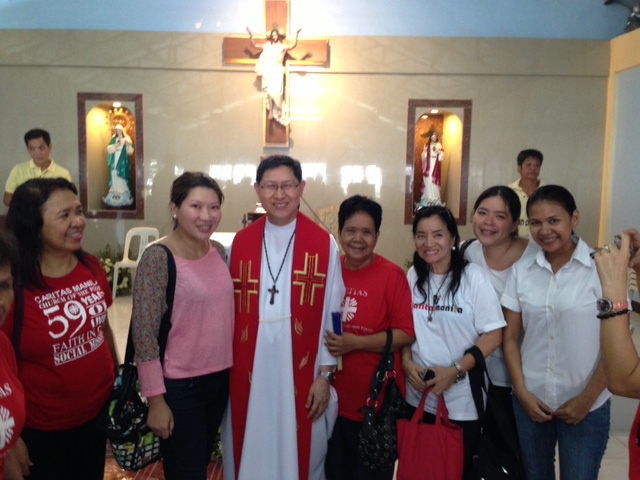
prison min photoLast September 14, Archbishop Luis Tagle celebrated mass at the chapel and the Prison Ministry was the only group that was allowed to stay inside the chapel with the inmates. In his homily he mentions how the Church is close to prisoners because Christ was a prisoner. He also mentioned that prisoners are no longer calledinmates but as temporary residents of the institution. The mass was so beautiful because one could feel the prayers of all the residents all around the small chapel. Prayers of justice and assistance, prayers of love for their families outside the walls, and prayers of thanksgiving for giving the residents a second chance.

This week’s NACOCO will have activities such as dance and singing contest, a Bible trivia contest, a basketball and volleyball tournament, medical mission, and a Family Fun Day. All of these projects of the Prison Ministry would not be possible without the generous contributions of all parishioners through mass collections and donations during the annual Francisfest. Outside the church today is a small photo display of some activities of the Prison Ministry.

For more information on the Prison Ministry Outreach Program>>>>>

Categories
Articles Pastoral Team Reflections

“Manifestation of God (in our Beloved Pope and in Us)” (Mt. 2:1-12), by Fr. Joel Sulse, OFM

Jesus is now the evident manifestation of the Father who wants to share His unconditional love and faithfulness with all of us.

This first Sunday of the year is designated by our Church as the Solemnity of the Epiphany of the Lord. This means the manifestation of our God to us. How did this revelation come about?

The letter of Paul to the Ephesians (3:2-3a, 5-6) tells us that God’s revelation come to us as a grace which can only be understood through faith, and in our belongingness to the body of Christ Himself. This means that all are called to a universal salvation, Jews and the Gentiles alike. This has been offered by God for all of us since we are all important in Him, and He wants us to be dignified all the more by experiencing his salvific grace.

The first reading from the prophet Isaiah 60:1-6 affirms in our memory about the coming of the Light. This Light will transform the world and will draw back the whole humanity to Yahweh, our source of life. It will help all peoples restore their identity back to God through their faith in Yahweh. Following this, we are all challenged to be the light to our world as well.

How can the salvific grace enrich us? How can we become a clear light for others? How can God be manifested in us?

Matthew brings us back to the memory of the great event that happened in Bethlehem years ago. This event opened the doors of our faith beyond the Jewish backyard. This was actually the purpose of the manifestation of God. This is part of His mission. He wanted us to realize that He is for all. He wanted us to know that He did not come for a limited community only. He wants us to experience the universality of His love. This love is manifested in our faithfulness to his will. And this results in unity, peace and respect for one another and for all.

How can the Wise Men become our guide in deepening our faith? What basically are the attitudes of these men? They are from Persia – experts in astrology with the capacity to interpret dreams. Why are they persistent in seeing the child? In other words, there is that sense of openness and sincerity in them. Why are they interested? It is because they are convinced that there is something in this baby. There is therefore that evident manifestation in their hearts coming from that enthusiasm and commitment burning deep inside them. We were told that the Star in the East guided them to Bethlehem through King Herod. Why is this so? Again, there must be a reminder for Herod.

One can notice that the divine will guided the search of the wise men for a purpose. The divine hand is present every inch of the way, orchestrating the event as it unfolds. And finally, seeing the child in a lowly, smelly manger, they brought in their gifts fit for royalty. Why do they have to accord Him with the gifts of frankincense, gold and myrrh? The gifts tell of who the child is and was, and his destiny.

We were told that King Herod was so disturbed. He was deeply trouble especially when the Magi did not send him any word and went the other way. His unease created a vacuum of fear and jealousy that resulted in his plotting to kill the children who are a threat to his kingdom. The imperial kingly attitude of “power hunger” blossomed in his greedy heart. His dubious intent overpowered him, thus, the killing of the infants and children. But the Magi and the the non-Jews paid homage and worshipped Jesus. They paved the way in Matthew’s special narrative: “make disciples of all nations.” They lived their faith, and followed its demands beyond reproach.

The whole story of the visit of the wise sages revolves on Jesus, an affirmation of His being the true King of Israel. And that salvation of Israel and the world comes through Him. The end of the story is a shift of us being invited like the Jewish disciples to go out to the world and bring the good news of salvation. Jesus is now the evident manifestation of the Father who wants to share His unconditional love and faithfulness with all of us.

The Magi are reminding us that we too can bring the same gifts to Jesus. They are telling us that we have that capacity as well to find “the Christ” if we have the diligence and the sincerity to look for Him. The light has been provided to us already. We just have to follow the light and faithfully manifest Him as well in our day to day living.

As we celebrate the feast of the Epiphany, let us pray to God that His gifts to us be manifested by the way we live, like our beloved Pope. Let us continue to manifest ourselves as FAITHFUL GIFTS for our family, for our community, for our country, for the Church, and for His Kingdom. Happy Feast Day of the Epiphany!

About Fr. Joel and his reflections

Categories
Articles Pastoral Team Reflections

“A BLESSED New Year (2014) to all!” by Fr. Efren Jimenez, OFM

Isang makakalikasan at makatarungang Bagong Taon sa lahat! Mabuhay ang pamilyang Filipino!
When people treasure life than despise it, when people affirm and speak values to one another, when people know they are brothers and sisters, and they keep looking for reasons to have faith in God, then family life becomes a solid place for love, security and transforming agent in our world today.

The liturgy of this feast is a troublesome mixture of so many things all at once. It continues the story of Jesus from the infancy narratives as the Gospel of Matthew relates it. It also offers general words of wisdom about human existence as shaped by family life. At the same time it presents exhortations about Christian community life as distinctively redeemed and redemptive.

The lesson from the Book of Wisdom literature offers reflectionsupon patterns of human life. Each generation shapes the conditions in which life will be lived in the future. This happens in the family circle and also in larger society.

There is a note of responsibility here, in our decision and actions, not only for the making of our lives and personalities, but in large measures also for the making of the lives and personalities of others.

When we turn to the Second Reading we seem to move to the more
particular – to some extent beyond the advise in Wisdom Literature – in the emphasis on forbearance, compassion, patience, humility, bearing with one another and forgiving one another and on top of these, put on love, that is, the bond of perfection.

One must be heroic in the exercise of virtue like humility in situations which are often unjust. Our family, when strengthened by virtue of discernment and pursuing the will of God, can mirror the quality of the Holy Family as described in the Gospel.

The feast of the Holy Family is a celebration of our human bonds with Jesus of Nazareth, and therefore of our redeeming bond of grace with all the human family in the world, but particularly the poor, the distressed, the despised, the abandoned children in the streets.

When people treasure life than despise it, when people affirm and speak values to one another, when people know they are brothers and sisters, and they keep looking for reasons to have faith in God, then family life becomes a solid place for love, security and transforming agent in our world today.

PAX ET BONUM!

About Fr. EJ and his reflections

Design a site like this with WordPress.com
Get started