Categories
Articles

La Luna y Sol: YSA Charity Ball a Huge Success by Sandi Suplido

This slideshow requires JavaScript.

Last February 21, the Youth of San Antonio (YSA) celebrated a night of love and generosity in their annual charity ball, with the theme “La Luna y Sol.” Just imagine, stepping into a hall decorated with little white lights, filled with a hundred beautiful ladies and handsome gentlemen who came in their classiest outfits to have fun and raise funds as a community!

YSA raised thirty thousand pesos through the success of the Charity Ball. As part of their efforts to grow closer as a community and to spread God’s love, they worked on this fundraiser to provide financial support to the JPIC Scholarship Program. During the Charity Ball, former scholar Ferdinand Basashared his journey while in the program and how he found hope for his and his family’s future.

Indeed, it was an evening of light and wonder. The parish hall was beautifully decorated to look like a starry night, thanks to the crafty skills of Pat Zulueta, Tara Singson, and Mykie Concepcion

Everyone sang and danced to amazing performances by a mix of some local artists (Kysha’s Crew, The Cohens, Bea Lorenzo and Edgar Tordesillas), as well as by our very own Lukers and Antiochers (Kevin Kramer, Jamie Garcia, Emilio Tordesillas, and Michael Rosenthal).

Although it was like being in a room full of stars, the YSA voted for a few individuals who outshined the rest in the festivities. In case you missed it, here are the night’s brightest:
Prom King: Kevin Kramer
Prom Queen: MykieConcpecion
Best Dressed Male: Church Campos
Best Dressed Female: MikeeAtayde
Best Promposal: SantiOngsiako and IssaBarte
Cutest Couple: Arianna Norton and RaditoBanzon

This event was made possible by the Antioch community (headed by Aljohn Robles, Bea Limpo, and CamilaCarunungan) and the Luke 18 community (Bianca Macasaet and Diego Ramirez).

After this evening of generosity, may we all be like God’s stars in the sky—
His instruments of love and light to the world.

Categories
Articles

WELCOME TO THE FAMILY, The ABC’s of Catholic Doctrine by Lianne Tiu

Not long ago, people were proud that they had five, seven, or ten children. A large family was a blessing, a source of envy; while a small family was looked upon as a tragedy and sometimes as a sign of selfishness. Catholic thinking has always been that parents are privileged to cooperate with God to bring new life into the world and that children are blessings from Him. The beauty of the family has always been praised and given attention; but there has never been exhortation for people to have as many children as they could possibly have. In fact, Pope Francis recently commented that good Catholics do not have to breed like rabbits. The number of children is to be based on the ability of a couple to bring them into the world, rear them accordingly to Christian principles, and educate them properly.

3AI AI AND ROSE GALVEZ WITH THEIR 5 CHILDREN

“Do you think you have all the children GOD intends for you to have?” This is a question couples should ask themselves as they include Father God in their family planning decisions. They have to keep in mind that He has brought them together for the purpose of having children. A couple, who decides to avoid a new birth for the time being, should have grave reasons for choosing so. They may be medical eugenic, social, and economic. (To be discussed in the next issue) The desire to have another car or to have a trip abroad should not necessarily be an issue to the question, “Can we afford another child right now?”

LITO AND APPLE PIE MABANTA WITH THEIR 8 KIDS

Couples should seek good advice (perhaps from a priest who is faithful to the Church’s doctrine) and discern through prayers before deciding to postpone or avoid pregnancy. The use of the Natural Family Planning method to regulate birth is approved by the Church. It monitors a woman’s cycle to avoid intercourse when she is ovulating. Any act of contraception, be it by pills, condoms, withdrawal, ligation, or vasectomy is illicit and is always wrong. If it is done with full knowledge and full consent, it is a mortal sin.

Ernie and Marichu Khan with their 10 children

ERNIE AND MARICHU KHAN WITH THEIR 10 CHILDREN

In this age of anti-child mentality, it is a big boost to learn that Pope Francis praised large families in his weekly audience at St. Peter’s square. He said, “Healthy families are essential to the life of society. It provides us with consolation and hope to see so many large families who welcome children as a gift from God…These families know that each child is a blessing.” For many of us who have a mind-set of having no more than two children, it is about time that we turn the tables on welcoming more children into our families.

(Reference: Pope Paul VI encyclical “Humanae Vitae”; Faith Seeking Understanding “Marriage and the Family” by Fr. Charles Belmonte; “A Marriage Manual for Catholics” by Dr. William Lynch; “Pope Francis has rebooted the debate on family and sexual mores” by John Allen Jr. January 20, 2015; “Pope clarifies ‘good Catholics breeding like rabbits’ comment” RT news January 21, 2015)

Categories
Articles Pope Francis

The Grace of Tears By Javier Luis Gomez

3
Everyone has their own story about how Pope Francis has moved them this weekend. For me this was when I heard what Pope Francis said to Iris Palomar, one of the street children at UST. In tears she asked the pope, “Why is God allowing bad things to happen, even if it is not the fault of children? Why are there so few people helping us?” Iris and many street children suffer from drugs, sexual abuse, hunger, prostitution, theft – numerous and daily injustices.

Pope Francis had no words to say, and the only answer he could give was a compassionate embrace for a child who had suffered so much. Then he told everyone gathered that “Only when we too can cry about the things you said can we come close to answering that question: why do children suffer so much?” Today’s world doesn’t know how to cry.

“If you don’t learn to cry”, the Pope said, “you cannot be a good Christian… Be courageous: don’t be afraid to cry.”

Tears will not remove world hunger. Tears will not protect children from abuse. But tears will let us suffer with them. To feel what they feel – in a mysterious but also real way.

On his flight back, Pope Francis recalled an ancient prayer begging the Lord for the grace of tears. And so we can pray with Pope Francis, “Lord, you who have made it so that Moses with his cane could make water flow from a stone, make it so that from the rock that is my heart, the water of tears may flow.”

Photos by Rocky Chan, Crissy Castillo, Shelli Manuel-Tomacruz,
Fr. Antonio Spadaro, SJ.

Categories
Articles

So What Happens Now?, The ABC’s of Catholic Doctrine by Lianne Tiu

popeWhen Pope Francis boarded the plane back for Rome, we were filled with mixed emotions: great joy and gratitude for having the chance to see him, at the same time, sadness that he was leaving our country.

At the moment, we are emotionally high and spiritually recharged. Yet soon, the “Pope fever” will gradually die down. So what happens next? Cardinal Tagle said, “The event (of the Pope’s visit) is so deep – so deep.

There is so much to reflect on, so much to pray over, so much to learn. And it is only in meditation, in prayer, in silence, that we can really get to the depths of the profound meaning of this event.” We can reflect on the Pope’s contagious smile, his gestures of humility, kindness and sincerity, and his messages on sanctity of family, caring for the poor, suffering, respecting women, corruption, among others We can reflect on the emotional plea “why God allows children to suffer” of a young girl, the six million people that trooped to Luneta despite the rain, the private plane carrying government officials that skidded off the Tacloban runway, and the father’s acceptance of the death of his daughter from a scaffolding collapse.

We need to make time and find a quiet place to pray each day. As Pope Francis said we need to “rest” in the Lord so that we can hear His voice and understand what He asks of us, especially from the pontiff’s visit. Once we have heard His voice, we must get up and act. This way, we bring God’s love to others through our love and good works. We become witnesses and missionaries of the joy of the Gospel, in Asia and the whole world.

The “Pope fever” will live on when we rest in prayer and use the three languages of the mind, heart and hands in harmony. Pope Francis has brought us “awesome sunshine to last us many lifetimes.”

Reference: Press Conference at Villamor Airbase (January 19, 2015); Pope Francis’ messages at Mall of Asia and UST and (January 16 & 18, 2015); Pope’s homily at Luneta (January 18, 2015); Speech of Archbishop Soc Villegas after the Luneta Mass (January 18, 2015 )

Categories
Articles

“Thank you from the Altar Ministry!” by Bing Bing Quiros

This slideshow requires JavaScript.


The Altar Ministry would like to thank Architect Conrad Onglao for his time and effort in preparing the advent wreath, main altar decorations and for the beautiful Belen Christmas season 2014. Together with Conrad, our heartfelt gratitude goes to Ms. Zsazsa Padilla and their staff for all the help they extended to us. Also to Mr. Onet Limchoc for the Belen shed. Thank you too to the Dasmarinas Village Association Office for lending us the star! Our Altar Ministry family is growing! Till next year!

Categories
Articles

“The Feast of the Presentation of the Blessed Virgin Mary” submitted by J’net B. Zulueta

9
Mary’s presentation was celebrated in Jerusalem in the sixth century. A church was built there in honor of this mystery. The Eastern Church was more interested in the feast, but it does appear in the West in the 11th century. Although the feast at times disappeared from the calendar, in the 16th century it became a feast of the universal Church.

As with Mary’s birth, we read of Mary’s presentation in the temple only in apocryphal literature. In what is recognized as an unhistorical account, the Protoevangelium of James tells us that Anna and Joachim offered Mary to God in the Temple when she was three years old. This was to carry out a promise made to God when Anna was still childless.

Mary’s presentation has an important theological purpose; It continues the impact of the feasts of the Immaculate Conception (December 8) and of the birth of Mary (September 8). It emphasizes that the holiness conferred on Mary from the beginning of her life on earth continued through her early childhood and beyond.

Prayer to the Blessed Virgin Mary

Most holy Virgin Immaculate, my Mother Mary, to thee who art the Mother of my Lord, the queen of the universe, the advocate, the hope, the refuge of sinners, I who am the most miserable of all sinners, have recourse this day.

I venerate thee, great queen, and I thank thee for the many graces thou has bestowed upon me even unto this day; in particular for having delivered me from the hell which I have so often deserved by my sins. I love thee, most dear Lady; and for the love I bear thee, I promise to serve thee willingly forever and to do what I can to make thee loved by others also.

I place in thee all my hopes for salvation; accept me as thy servant and shelter me under thy mantle, thou who art the Mother of mercy. And since thou art so powerful with God, deliver me from all temptations, or at least obtain for me the strength to overcome them until death. From thee I implore a true love for Jesus Christ.

Through thee I hope to die a holy death. My dear Mother, by the love thou bearest to Almighty God, I pray thee to assist me always, but most of all at the last moment of my life. Forsake me not then, until thou shalt see me safe in heaven, there to bless thee and sing of thy mercies through all eternity. Such is my hope.

Amen.

by Saint AlphonsusLiguori

Categories
Articles

Eternal Life, Christian Style

Wis 3:1-9; Ps 23:1-6; Rom 6:3-9; Jn 6:37-40
“If, then, we have died with Christ, we believe that we shall also live with him” (Rom 6:8)

This year the Commemoration of All the Faithful Departed (traditionally known as All Souls Day) interrupts the cycle of Sundays in Ordinary Time. The choice of Scripture readings is quite extensive and even confusing, as a glance at the Lectionary Nos. 668 and 1011-15 will show. I have chosen texts that are among those most often selected in liturgies for this day.

Our secular culture has a hard time confronting the reality of death. Many of us try not to think about death, use euphem-isms in talking about it and seek every natural and unnatural means to avoid it or put it off. For some, physical death is the absolute end of life. Therefore we should either “eat, drink and be merry” (hedonism) or use all our resources and efforts to make this world into a better place, because it is the only world we have (exclusive humanism). In certain late Old Testament books and in the New Testament, however, a different perspective on life and death emerges. While recognizing the natural character of physical death, these texts hold out hope for an eternal life with God and the avoidance of what can be called “ultimate death.”

Today’s Old Testament reading from the book of Wisdom (sometimes called the Wisdom of Solomon) is often used as the Old Testament reading at Catholic funerals. It comes from a Jewish book written in Greek in Alexandria in the first century B.C. The author was trying to bring together the best insights of the biblical and Greek philosophical traditions. While recognizing the reality of physical death, he offers the hope that wise and righteous persons may nevertheless enjoy eternal happiness with God and the blessed faithful. Even though skeptics (there were many in the writer’s time) regarded physical death as the absolute end of life, this biblical writer insists that the wise and righteous may and should hope for immortality, so they can regard the sufferings of the present and even their physical death as moments along the way to their future fullness of eternal life with God.

While the New Testament writers shared this belief in life after physical death, they based it not on the ancient Hebrew concept of Sheol as the abode of the dead (as the early Old Testament writers did), nor on the Greek philosophical idea of the immortality of the soul nor on the Jewish (especially Pharisaic) concept of the general resurrection of the dead. Rather, they based their hope for eternal life first and foremost on the resurrection of Jesus Christ as “the firstborn from the dead” (Col 1:18).

In today’s selection from John 6, Jesus proclaims that it is his Father’s will that “everyone who sees the Son and believes in him may have eternal life, and I shall raise him on the last day.” This statement implies that for those who believe in Jesus, eternal life has already begun. It does not begin at the moment of physical death. Instead, it begins in the act of faith in Jesus as the revealer and revelation of God. He becomes the point of “crisis” or decision for all. And Jesus promises that on the last day, at the general resurrection, those who believe in him will be raised, vindicated and richly rewarded. Thus John combines present and future eschatology. The pivot in all this is the resurrection of Jesus as the preview and guarantee of our future resurrection. In him and through him we have already begun to experience eternal life, and we can expect it to be even better.

In today’s selection from Romans 6 (the earliest theological reflection on Christian baptism), Paul focuses on the link be-tween Christ’s death and resurrection and our baptism. Through baptism we have entered into both the death of Je-sus and the eternal life of the risen Christ. Baptism involves dying with Christ in order to live with Christ. The water of baptism at once symbolizes death (by drowning) and life (without water life is impossible for humans). Baptism in-volves receiving the Holy Spirit, which is the power of God to live a virtuous and fruitful life in the present and to enjoy eternal life in the age to come.

What John and Paul hoped for was eternal life with Christ. The hope for eternal life is a desire planted deep in the hu-man psyche. Yet we need some good reason on which to base our hope. John, Paul and other early Christians were convinced that they had found a good reason in the life, death and resurrection of Jesus. If resurrection and eternal life can happen in the case of Jesus, they can happen in our case too, provided that we remain “in Christ,” that is, we share in the power of his life, death and resurrection, which we have experienced in faith and baptism.

Prayer:
• Do you believe in life after death? Why?
• What does faith in the risen Christ have to do with hope for eternal life?
• Do you ever reflect on the significance of baptism in your life? What might it have to do with enjoying eternal life in the present?
Daniel J. Harrington, S.J., is professor of New Testament at Boston College School of Theology and Ministry in Chestnut Hill, Mass.

© 2008 – America Magazine
Categories
Articles

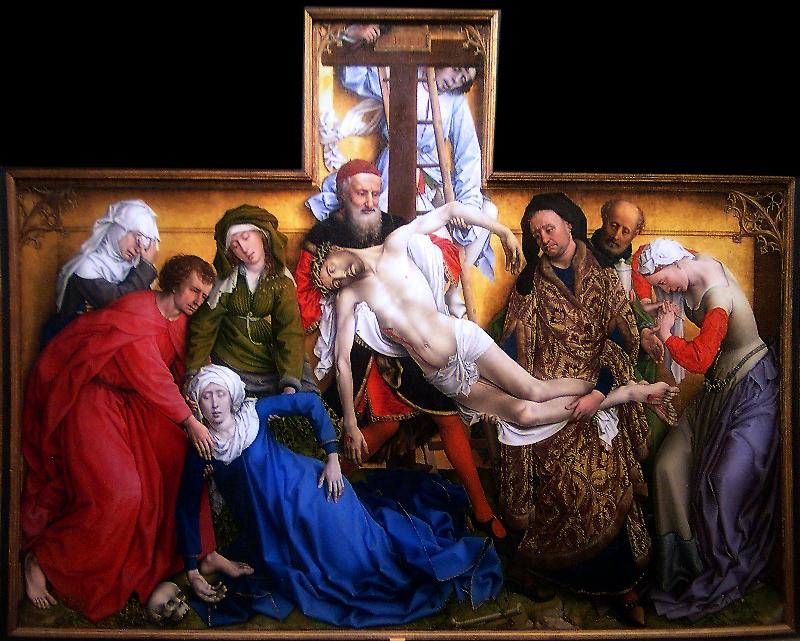
Mater Dolorosa – Sorrowing Mother

4
5

Mater Dolorosa – Sorrowing Mother
Roger van der Weyden – c. 1435 (oil on oak panel)
Museo del Prado, Madrid

Stabat Mater Dolorosa
Sequence Hymn

Bruised, derided, cursed, defiled,
she beheld her tender child
all with scourges rent.

For the sins of His own nation,
saw Him hang in desolation,
till His spirit forth He sent.

O sweet Mother fount of love!
touch my spirit from above,
make my heart with thine accord.

Make me feel as thou hast felt;
make my soul to glow and melt
with the love of Christ, my Lord.

Holy Mother! Pierce me through,
in my heart each wound renew
of my savior crucified.

At the cross her station keeping
stood the mournful Mother weeping,
close to Jesus to last.

At the cross her station keeping
stood the mournful Mother weeping
close to Jesus to the last

Through her heart, His sorrow sharing,
all His bitter anguish bearing
Now at length the sword had passed.

Oh, how sad sore distressed
was that Mother highly blessed,
of the sole-begotten One!

Christ above in torment hangs,
she beneath beholds the pangs
of her dying, glorious Son.

Is there one who would not weep,
whelmed in miseries so deep,
Christ’s dear Mother to behold?

Can the human heart refrain
from partaking in her pain,
in that Mother’s pain untold?

Contributed by J’net B. Zulueta,
president of the Catholic Women’s League (CWL).

Categories
Articles

The Franciscan Crown Rosary

15
The Franciscan Crown Rosary is a Rosary consisting of seven decades with each decade describing a particular joy from the life of the Blessed Virgin Mary. The Seven Joys are:

1) The Annunciation
2) The Visitation
3) The Birth of Our Lord Jesus Christ
4) The Adoration of the Magi
5) The Finding of the Child Jesus in the Temple
6) The Appearance of Christ to Mary after the Resurrection
7) The Assumption and Coronation of Mary as Queen of Heaven

How to Pray the Crown Rosary
The Franciscan Crown Rosary begins quite simply by stating the first Mystery and then praying one Our Father and ten Hail Mary’s while meditating upon it. This same procedure is then followed for the other six Mysteries. Even though it is common practice nowadays to add the Glory Be at the end of each decade, and even the Fatima Prayer, these are not required. It is customary to finish by adding two Hail Mary’s in honor of the 72 years that Our Lady is said to have lived on earth, and one Our Father and Hail Mary for the intentions of the Pope.

Story of the Franciscan Crown
The story of the Rosary of the Seven Joys of the Blessed Virgin dates back to the early 15th century. A pious young man named James had been accustomed to adorning a beautiful statue of Mary with a crown of flowers, which he had picked and woven himself. He later entered the Franciscan Order, but either because of a lack of time or permission, he was no longer able to continue this devotion. Distraught because of this, he decided to abandon the religious life and return to the world.

Our Lady then appeared to him and convinced him not to leave the order. She told him that he should not be downcast because he was no longer permitted to adorn her statue, for she would teach him a way to give her honor which was much more pleasing and meritorious. Instead of a crown of flowers, which quickly wither, he was to weave a crown of prayers, and these prayers could be offered at any moment. She then taught him the Rosary of the Seven Joys, adding that these prayers would not only form a more acceptable crown, but they would also yield innumerable graces for himself and others.

This simple but beautiful devotion of praying the Crown of the Seven Joys of the Blessed Virgin soon spread over the entire Franciscan Order and was officially established in 1422.

16

Franciscan Scripture Reading
Franciscan reading exhibits qualities of Franciscan spirituality; actions, spontaneity, love, praise, beauty, and delight in creation. This form of reading involves the mental process of entering personally into the text.

Read chapter 53 of Isaiah. The message in the chapter prompts a reflection of the sacrificial death of Jesus on the cross. The Franciscan method invites you to take actions that would prompt obedience and compassion for humankind. You would also gain an appreciation for loving your fellow man. In connecting with the sacrifice of Cavalry, imagine as best you can the experience of dying on the cross. Using a cross with the crucified Savior, hold it in your hands, gazing at the details of the Lord’s crucified body. Imagine his pain and suffering.

You might look through today’s newspaper and identify places in the world where people are suffering and make a conscious effort to relieve that suffering. You may choose to write a poem expressing your feelings or paint a picture. Such a scene has been captured countless times on canvas.

The Franciscan method of action, love, spontaneity, love, praise, and delight in creation while reading scripture, is a personal connection with God causing the reader to saturate the entire experience with prayer, asking God to make you an instrument of peace in the lives of those who are suffering.

Categories
Articles

How To Pray The Franciscan Crown Rosary

14St. Francis In Ecstasy, circa 1595 by Michelangelo Merisi da Caravaggio

The Franciscan rosary, also known as the Seven Joys of the Blessed Virgin Mary is composed of seven decades consisting of one Our Father and ten Hail Marys each. At the end two Hail Marys are added, and is concluded with the Our Father and Hail Mary. The last Our Father and Hail Mary are said for the intention of the Pope in order to gain the indulgence. The 72 Hail Marys commemorate the seventy-two years the Blessed Virgin Mary is supposed to have lived on earth.

The seven decades need not be recited at once, but the single decades may be recited provided that the whole rosary is said on the same day. It is not necessary to meditate on the mysteries of this rosary; it suffices to say the single decades in honor of the respective mystery.

The following are the mysteries of the Franciscan Crown:

1. The Immaculate Virgin Mary joyfully conceived Jesus by the Holy Ghost.
2. The immaculate Virgin Mary joyfully carried Jesus when she visited Elizabeth.
3. The Immaculate Virgin Mary joyfully brought Jesus into the world.
4. The Immaculate Virgin Mary exhibited Jesus to the adoration of the Magi.
5. The Immaculate Virgin Mary joyfully found Jesus in the Temple.
6. The Immaculate Virgin Mary joyfully beheld Jesus after His resurrection.
7. The Immaculate Virgin Mary was joyfully received by Jesus into heaven, and crowned Queen of heaven and earth.

The use of this rosary was begun in the order of St. Francis in 1422. It is said that a certain novice, before joining the Order, was accustomed to place a crown on a statue of the Blessed Virgin. When he was not allowed to continue this practice, he resolved to leave the Order. Mary appeared to him and dissuaded him, telling him that he could offer a much more pleasing crown by reciting a rosary of seven decades in honor of Her Seven Joys. This is the most highly indulgenced of all the types of rosaries.

Source: My Treasury of Chaplets; Patricia S. Quintiliani

Design a site like this with WordPress.com
Get started