Categories
Altar Server

To Serve Or Not To Serve By : Jonathan Huang

This slideshow requires JavaScript.

I sometimes get asked by people why I became an altar server at my parish or why do I serve at mass? Some would even tease me that I could be doing something else that was fun instead of serving. And to be honest, I never really used to give it much thought. I guess you can say I just found myself serving at mass 4 years ago. How did this happen? Because my older brother was already an altar server at SSAP. So right after my first communion, I found myself serving with him and my dad, who’s a Eucharistic Minister as well.

It was only when the Altar Server Ministry of SSAP was formally formed with my dad as its Ministry Head that I started reflecting on my reasons for serving at mass. For one, I invited my best friend to join the ministry. And it felt really good to be doing something with my best friend that was meaningful. During the orientation, my brother quoted Pope Benedict XVI when he spoke to the new members : “When you’re close to the altar, you’re close to God”. That’s when I started thinking that by serving, I was also getting closer to God and showing my love for him. I realized all of a sudden the true meaning of what we get told during religion class : that God truly loved us so much that He had given us His only son, Jesus, who in turn, gave up his life so that all of us will be saved. And serving at mass is therefore my way of saying “Thank you” to God.

Our ministry is slowly starting to grow with more young girls and boys signing up to serve at mass. It’s actually fun being able to teach them and eventually seeing them serve on their own. My brother once told me that one day they’ll also be teaching other kids to serve and in fact, some have already brought in their siblings and showing them how to serve. I’m really happy to be a part of this and I’m hoping God is happy, too.

So now, if someone were to ask me whether “to serve or not to serve”, my answer would definitely be a loud YES to serve!

For those interested to be an Altar Server, pls. email ssapaltarserver@gmail.com.

Categories
Random Thoughts by Peachy Maramba

RANDOM THOUGHTS Voices from yesterday and today. . . by: Peachy Maramba

2

St. JOSAPHAT KUNSEVICH of POLOTSK
The Martyr of Ecumenism-First Eastern Saint

1580-1623
Nov. 12

The first priest of the Eastern Church to be canonized by the Western Church was St. Josaphat because he was martyred for his great efforts to reunite the Orthodox Church with Rome.

Early Years
Josaphat was born John Kunsevich at Vladimir, Ukraine in 1580. While working for a merchant at Vilna in what is now Poland he was offered not only a partnership in the business but also one of his master’s daughters in marriage.

But John turned down the offer because he had already made up his mind to become a monk together with his good friend Joseph Rutsky. In 1604 they entered the Monastery of the Holy Trinity at Vilna where they were ordained priests of the Byzantine rite in 1609. It was then that John took the name Josaphat.

From the beginning both Josaphat and his friend Joseph were intent on reforming the Ruthenian church which now covers the area of the present day Belorussia and Ukraine.

Rise in Church
Soon they had worked their way up in the Church with Joseph becoming the abbot of Holy Trinity and Josaphat sent to Poland to found new houses. Upon his return in 1614, he was named abbot of the monastery while Joseph made metropolitan of Kiev.

In 1617 Josaphat was appointed bishop of Vitebsk, Russia. Eight months later when the Archbishop of Polotsk died, he took over the sec. Unfortunately, he found the diocese in a terrible state: laymen controlling church lands, lax discipline among the orders of monks, general decadence with churches in a rundown state and the secular clergy marrying several times. (According to the Eastern Canon Laws a married man may be ordained a priest but cannot marry again if his wife dies).

Josaphat called synods to put into effect his reforms which by 1620 became effective. So successful was he in his efforts that he enraged several sectors such as the monks at the famous Caves monastery near Kiev.

Overriding Goal
However besides working tirelessly intent on reforming the abuses they saw in the Church, Josaphat and Joseph had one overriding goal: to unite the Ukrainian Church with Rome. This was a very hot and controversial topic at that time.

There was widespread opposition to Rome because both the church leaders and lay people were worried that the pope and the cardinals would arbitrarily interfere in their lives. Besides they were Westerners and thus were unfamiliar with their Eastern Europeans religious customs, spiritual traditions and folk beliefs based on centuries of ancient native cultures. So simply and basically this was their one prime argument against union: “Roman Catholicism was not the traditional Christianity of the various indigenous peoples living in that area between Europe and Asia.”

So they insisted and declared vehemently that Roman Catholicism was NOT for the Ruthenian people.

A group of dissident bishops of the Orthodox church then began to sow seeds of dissension claiming that Josaphat was not only “turning Latin” but was in actuality a Latin priest and a “robber of souls.”

Soon riots broke out as people chose sides.

No Catholic Support
Unfortunately, Josaphat was not given the support he should have received from the Latin bishops of Poland because while he advocated unification with Rome he insisted on maintaining Byzantine rites and customs. So the Catholic Chancellor of Lithuania, Leo Sapieha, fearing that the discord and dissension that Josaphat created might make the area politically unstable allowing the neighboring Cossacks to invade, falsely accused Josaphat of fomenting trouble and of using violence and closing down non-Catholic churches. Naturally this stirred up further dissent.

3

In the meantime the followers of the bishop of Polosk, Meletius Smotrisky, who had been elected by the group of dissident bishops hatched a plot against Josaphat to drive him from the area.

The Plot Against Josaphat
A priest named Elias was sent to harass Josaphat several times. After many warnings he was finally arrested and locked up by one of Josaphat’s deacons on November 12, 1623. However, he was set free shortly after an angry mob assembled, stormed the grounds and broke in demanding his release. They then seized Josaphat shouting, “Kill the papist!”

After hitting Josaphat on the head with a halberd and shooting him with a bullet they dragged him from his home and threw him into the Divina River at Vitebsk, Russia.

Canonized
He was canonized in 1867, the first Eastern saint to be formally canonized for furthering religious unity especially among Christian Churches.

SOURCES of REFERENCE
ST. JOSAPHAT KUNSEVICH of POLOTSK
November 12

Butler’s Lives of the Saints – vol. IV pp 337 – 340
The Illustrated World Encyclopedia of Saints – p. 250
The Book of Saints – p. 281
Pocket Dictionary of Saints – pp. 285 – 286
A Calendar of Saints – p. 220
A Year with the Saints – Nov. 12
Butler’s Saint for the Day – pp. 532 – 533
Illustrated Lives of the Saints – Vol. I pp. 511 – 512
My First Book of Saints – pp 269 – 270
Saint Companion – pp 424 – 425
Saint of the Day – pp. 309 – 310
Voices of the Saints – p. 534
The Way of the Saints – pp. 257 – 259

1

Prayer of St. Josephat
From the Catholic Encyclopedia

Lord, fill your Church with the Spirit that gave Saint Josaphat courage to lay down his life for his people. By his prayers may your Spirit make us strong and willing to offer our lives for our brothers and sisters. We ask this through our Lord Jesus Christ, your Son, who lives and reigns with you and the Holy Spirit, One God, forever and ever.

Categories
Fr. Robert Manansala Reflections

LOVING THE DEAD BEYOND THEIR EARTHLY LIFE, by Fr. Robert B. Manansala, OFM

The Commemoration of all the Faithful Departed (All Souls’ Day),
Cycle B
Wis 3:1-9; Ps 23:1-3a, 3b-4, 5, 6;Rom 5:5-11 or Rom 6:3-9; Jn 6:37-40

The Commemoration of all the Faithful Departed echoes a very important message: no human life is perfect, not even Christian life. And the Good News on this Commemoration of the Dead is that God in Jesus loves us, even as we are not perfect, and that the love of God does not abandon the souls of our departed brothers and sisters in the faith, even as they did not measure up to the ideals of Christian perfection. In the Gospel of John, Jesus says, “Do not let your hearts be troubled. You have faith in God; have faith also in Me. In my Father’s house there are many dwelling places. If there were none, would I have told you that I am going to prepare a place for you? And if I go and prepare a place for you, I will come back again and take you to myself, so that where I am you also may be” (Jn 14:1-3). The redemptive and loving action of God in Jesus extends beyond death.

The Commemoration of the Dead is very much connected to two articles of faith in our Christian tradition: the Communion of Saints, and the Doctrine of Purgatory. The Catechism of the Catholic Church explains the belief in the Communion of Saints in the following words: “We believe in the communion of all the faithful of Christ, those who are pilgrims on earth, the dead who are being purified, and the blessed in heaven, all together forming one Church; and we believe that in this communion, the merciful love of God and His saints is always [attentive] to our prayers’” (CCC 962).

On All Saints’ Day we honor all the saints, the blessed, the venerable and the holy who are with God in heaven. There they intercede for us, assisting us by their prayers. On All Souls’ Day we remember all the faithful departed – those who have died, and are being prepared for their entrance into eternal glory by being purified in purgatory.

Again, we read in the Catechism: “All who die in God’s grace and friendship, but still imperfectly purified, are indeed assured of their eternal salvation; but after death they undergo purification, so as to achieve the holiness necessary to enter the joy of heaven…” (CCC 1030). The same Catechism describes purgatory as the “final purification of the elect, which is entirely different from the punishment of the damned” (CCC 1031).

Some modern theologians suggest that purgatory may be an “instant” or progressive purification immediately after death varying in intensity from soul to soul, depending on the state of each individual.

The teaching on purgatory as the final purification is based on the practice of prayer for the dead. The Book of Maccabees describes how Judas, the military commander, discovered those of his men who had died in a particular battle had been wearing forbidden pagan amulets. His men at once “prayed that the sinful deed might be fully blotted out” (2 Mc. 12: 42). Judas then “took up a collection from all his soldiers, amounting to two thousand silver drachmas, which he sent to Jerusalem to provide for the expiatory sacrifice” (2 Mc. 12: 43). The narrator continues, ”If he were not expecting the fallen to rise again, it would have been superfluous and foolish to pray for the dead. But if he did this with a view to the splendid reward that awaits those who had gone to rest in godliness, it was a holy and pious thought. Thus he made atonement for the dead that they might be absolved from their sin” (2 Mc 12: 44-46).

The above verses clearly illustrate the existence of purgatory that, at the time of the Reformation, Protestants had to cut the Books of the Maccabees out of their Bibles in order to avoid accepting the doctrine. Not only can we show that prayer for the souls of the departed was practiced by the Jews at the time of the Maccabees, but also we can show it has been retained by Orthodox Jews today. They recite a prayer known as the Mourner’s Kaddish for eleven months after the death of a loved one, so that the loved one may be purified.

As Christians, we believe in the so-called Four Last Things: death, judgment, heaven and hell. Purgatory is not mentioned as one of the “last things,” because, strictly speaking, purgatory is a part of heaven. Purgatory is the “remedial class” for heaven-bound souls. Souls who go to purgatory are those who have been judged worthy of heaven, but not straight away. They still need some purification or purgation before they are ready for heaven because, according to Revelation 21:27, “nothing unclean shall enter it.” A very good illustration for this is the set-up in many churches in the west. Before we get to the main church, we have to go through the vestibule first. We are already in the church but not yet in the main church.

In James Boswell’s famous biography of Samuel Johnson, a great eighteenth century British author, a passage deals with purgatory and Masses for the dead. Boswell writes that the idea of purgatory made eminent sense to Johnson. His reasoning is that the vast majority of people who die should not be judged so bad as to deserve hell or so good as to deserve heaven. So, he concluded, there must be a kind of state where some sort of cleansing takes place before one finally enters heaven.

When asked about Masses for those in purgatory, Johnson replied that praying for them is as proper as praying for our brothers and sisters who are alive. Praying for the dead, like praying for the living, is a manifestation of love. St. Augustine noted: “If we had no care for the dead, we would not be in the habit of praying for them.” For us, believers, praying for a loved one is a way of bridging any distance, even death. In prayer we stand in God’s presence in the company of the people we love, even as these persons have gone before us.

The Catechism of the Catholic Church recommends prayer for the dead in conjunction with the offering of the Eucharistic Sacrifice (CCC1032). Pope Leo XIII, in his 1902 encyclical Mirae caritatis, states: “The grace of mutual love among the living, strengthened and increased by the Sacrament of the Eucharist, flows, especially by virtue of the Sacrifice [of the Mass], to all who belong to the communion of saints.”

The Catechism also encourages “almsgiving, indulgences, and works of penance undertaken on behalf of the dead.” All these prayerful acts are to be conducted as matters of faith, and not as something magical. The greatest act is to offer Mass for the dead, because in this One Sacrifice, the merits of our Lord Jesus are applied to the dead. Hence, this reconciling offering of the Lord is the greatest and most perfect prayer we can offer our dead in their state of purification. Let us not forget to pray for our dearly departed, have Masses offered for them, visit their graves, and make daily sacrifices for them.

Our prayers and other sacrifices for the dead are capable not only of helping them, but also of making their intercession for us effective. The Church chooses the entire month of November for increased prayers on behalf oft he souls in purgatory. Our ideas about purgatory are usually frightening. This should not be the case. Fr. Leonard Foley, a Franciscan theologian, gives us a very good insight on purgatory in terms of God’s purifying act of love. He writes, “We must not make purgatory into a flaming concentration camp on the brink of hell – or even a hell for a short time.’ It is blasphemous to think of it as a place where a petty God exacts final punishment… Saint Catherine of Genoa, a mystic of the fifteenth century, wrote that the ‘fire’ of purgatory is God’s love ‘burning’ the soul so that, at last, the soul is wholly aflame. It is the pain of wanting to be made totally worthy of One who is seen as infinitely lovable, the pain of desire for union that is now absolutely assured, but not yet fully tasted.”

Purgatory may be a form of “blazing enlightenment” which penetrates and perfects our very being. God can anticipate and apply the merits of our present and future prayers for the dead in favor of the souls we pray for at the time of their purification. Purgatory is thus “the fringe of heaven, a state where heaven’s eternal light has a refining effect on the “holy souls” (not ‘poor souls’), who are held in the arms of Divine Mercy.”

Let us end with something to keep us reflecting. The Church has a rite declaring someone is in heaven. This is officially the meaning of the process of canonization. This is also in essence what we celebrate on All Saints’ Day. Also, the Church has a special day dedicated to those who are heaven-bound– all souls in purgatory, those in transit to heaven. November 2nd, All Souls’ Day, is especially dedicated to this. A good thing about our November 2 commemoration of the dead, like our November 1st commemoration of all the saints, is that we pray not only for our dead relatives and friends, but also for all the dead. We remember even those who have no one to pray for them.

Let us take note though that we do not have any rite or ceremony declaring someone is in hell. The Church can never and should never do this– not even for the most despicable person in the world. We leave it to the merciful prerogative of God. Thus, our prayers should be for all the dead – including those who may have lived despicable lives here on earth.

About Fr. Robert and his other reflections…

Categories
Special Events

CORO DE SAN ANTONIO HONORS ITS DEAD by Amelita Guevara

7
On Sunday Nov. 2, on the feast of All Souls Day, the CORO DE SAN ANTONIO would like to honor all its members and their relatives who have died since its inception in 1962.

The CORO has been blessed with members who had, literally, life-long commitments. To prove this, some members have passed on to the next life and received their Creator’s reward “with their boots on”(while still active members of the Coro).

1973 – Our first big emotional loss was (1) Cesing Lopez, who suddenly died a few days before Christmas, and he was the lead tenor at the time. All we could sing then for his funeral were Christmas carols. His wife, Tining Lopez, continued to serve the Coro for many more years after Cesing’s death.

1980(2) Diding Panlilio, the power behind the first organized yearly Christmas choir. It was made up of a small group, She was the one that recruited me to conduct the choir in 1962, when she found out I was going to move into the community. After 18 years of service to the Coro, she passed away in July, a month short of when the Coro, through the instigation of Fr. Hugh, became a weekly choir.

1993(3) Lita Malixi kept coming until she was too weak to make it to Church. This kindly soul is remembered very deeply by all those who knew her.

1997 – We lost two of our most valuable members:
(4) Enteng Antiporda, our lead baritone, who religiously came all the way from Binan,
Laguna, on March 30 the morning after our Easter Vigil service. He literally accompanied the Resurrected Lord to heaven.

(5) Medong Favis, fondly dubbed as the Coro’s “First Lady.” She suffered through a long period of dialysis and the CORO used to greet her in song every Nov. 22, her birthday, until she passed away, on Sept. 25.

1998 (6) Primo Santos, singlehandedly had built first choir risers in the choir loft. He was already in a wheel chair and still came to choir.

1999 – three more members painfully left us:

(7) Charito Gidaya, who invited us to the inauguration of the Church of the Twin Hearts in Quezon City. She still sang with us at the Fiesta of San Antonio and the special Memorial Mass for Mrs. Eva Macapagal with hardly a premonition that she would pass away so soon after that. She died on Aug. 1.

(8) Ditas Lichauco – Nov. 23. No one could ever guess that this frail looking wheel-chaired lovely lady could sing with such beauty of sound. She could sustain hours of rehearsals week after week. She was involved in many other activities of the Parish, having started the Sunrise Service of St. Francis in October.

(9) Aster Favis, the CORO’s President for life, from the inception of the Coro, until he sank into a coma within the year of the death of his beloved wife, Medong. He died on Dec. 30.

2002 (10) Mario Calasanz, most faithful and reliable tenor, who learned to read notes by just looking at the movement of the musical lines without knowing their names.

2005 (11) Titang del Rosario, sang in the soprano section until she moved to the States to join her daughter, Grace. Died of cancer.

March of 2004 was saddest year for the Coro We lost four members in the same year.

(12) Celing Batungbakal who was faithfully coming to choir in spite of her regular dialysis for a long time. She is responsible for recruiting many members who are still in the Coro today.

(13) Greg Alcaraz, the oldest among the bass section, faithful as he was faithful and loving to his wife, Maggie, alto, who has retired from the Coro due to illness.

(14) Purita Trajano – lovable lady, more concerned in bringing us various things to eat, than being a lawyer.

(15) Arie Samson, who had taken care of all the schedules of the Coro and reminded us of all coming events, including birthdays of each member. She listed down all the activities of the Coro every year, even while undergoing chemo and radiation.

2006 (16) Lourdes Wong fought bravely her illness for several years, coming to choir as long as her health permitted. She would house most of our members who lived far when we need to serve until late at night or early at dawn. She died in September. Her daughter, Judy and son-in-law Eddie are still members of the Coro.

Jan. 30, 2008
(17) Manny Gregorio
, who was our first Vocal Coach and soloist, a most valuable asset, way back in the 60’s passed away, after a long bout of diabetes. His wife Lourdes, a pianist and the nations leading harpist, still comes, when needed, to accompany the Coro.

2008 (18) Luz Santos, beloved wife of Primo Santos, who built our first choir risers.

2009 (19) Nori Ongsiako, very talented alto who played her accordion for many events.

July 27, 2010 (20) Arturo Navera, our Prime Tenor soloist for many years, died after a devastating experience during typhoon Ondoy.

Oct. 27 2013 (21) Ginny Abello, one of our most dedicated and reliable sopranos. She still sang at choir the night before she died suddenly. She used to go with her husband (died 2011) to Lourdes, France, faithfully to serve for 22 years.

Jan. 4, 2014 (22) Jana Mora, alto.

Jan. 10, 2014 (23) Fely Guevara, soprano.

The Coro sang at the funerals of all its members and their direct relatives.

1. 2007 – Jess Jalandoni, husband of the oldest member of the Coro, Angelita, age 90, who still comes to sing with the Coro to this day.
2. 2007 – Edgardo Guevara, husband of Coro member Fely and father for several Coro members: Edgardo, Jr. & Letty G. Allado.
3. 2013– Cards Guevara, Husband of Amelita Guevara, conductress of the Coro de San Antonio.

We ask you for prayers for the CORO as we continue in our service to the Lord, to our Parish and to the community. May new members be enticed to join us. All one needs is love for the Lord through song and the commitment to come for weekly rehearsals every Sunday afternoon.

This Nov. 2, 2014, Sunday 6:00 p.m. mass is being offered for our departed Members as well as for all the departed members of our Parish.

Categories
Fr. Jesus Galindo

THE COMMUNION OF SAINTS By Fr. Jesus Galindo, OFM

3

In the ninth article of the Apostles’ Creed, we profess: “[I believe in] the communion of saints.” This communion of saints does not refer to the reception of the holy Eucharist but rather to the spiritual union that exists among all the members of the Church, both living and dead. In the Creed, we are all called “saints,” even though we may not yet have attained holiness.

The members of the Church, united by a common faith in Jesus Christ, belong to three groups or states: First, the Church Triumphant, composed of the men and women of all times whose souls have already attained the glory of heaven. Second, the Church Suffering, composed of “all who die in God’s grace and friendship, but still imperfectly purified, and who must undergo purification after death so as to achieve the holiness necessary to enter the joy of heaven. The Church gives the name Purgatory to this final purification” (Catechism of the Catholic Church, n. 1030-1031). Third, the Church Militant, that is, all of us who are still alive and struggling to do God’s will and to live as disciples of Christ.

There exists among the three groups spiritual communion-a bond of faith, unity and love. The saints in heaven inspire and protect us, and intercede for us; and we in turn offer prayers and suffrages in behalf of the souls in Purgatory.

On November 1 and 2, we celebrate this article of our faith, the Communion of Saints. On November 1, we recall the Church Triumphant. It is the Solemnity of All the Saints—with emphasis on “All,” meaning, we recall not only the men and women whose holiness has been officially proclaimed through canonization—a relatively small number, but also the thousands and myriads who enjoy the glory of heaven and whose holiness is known to God alone. Some call this the feast of the Unknown Saint, in reference to the Tomb of the Unknown Soldier.

November 1 is indeed a glorious and joyous celebration. It is a day to thank God for giving ordinary men and women like us a share in his holiness. It is a day to remember that all of us are called to holiness. The saints were not born saints; they became saints by being obedient to God’s will—many of them to the point of death. They experienced the same obstacles, trials and temptations we experience.
That is why they can be our role models. Besides, being God’s friends, they can also intercede for us before the only Mediator, Jesus Christ.

In the Philippines, the joy of the feast of All the Saints is all but overshadowed, first by the Halloween festival, with its emphasis on the ghostly and scary costumes and the trick-or-treat games; and then by the now well-established custom of going to the cemeteries to honor the dead on this day—one day ahead of time.

November 2 is the day to recall the Church Suffering–the Commemoration of All the Faithful Departed, also called All Souls’ Day. As mentioned above, the Catholic Church teaches that the souls of those who die without making up for sins committed, though confessed and forgiven (think of a person who could not reconcile, or could not repay stolen money, or could not restore a destroyed reputation), must undergo purification after death in Purgatory.

Non-Catholics deny the existence of Purgatory saying that no such word is mentioned in the Bible. True, the word purgatory is not mentioned in the Bible; but the rationale and the concept of purgatory are. In Revelation 21:27, we read, “Nothing unclean shall enter [into heaven].” In 2 Maccabees12:43-46 we read that “…The valiant Judas took up a collection among his soldiers and sent it to Jerusalem to be offered as a sacrifice for sin… so that the dead might be pardoned for their sin.” In Luke 12:58 we are enjoined to settle with our accuser on the way to court, “lest he drag you to the judge and the judge deliver you to the jailer, and the jailer throw you in prison. I tell you, you will not get out until you have paid the very last penny.”

On November 1 and 2, as we honor and recall the Church Triumphant and the Church Suffering, we renew our faith and our hope in the resurrection of the dead and in the life to come. For us, life is changed, not ended.

About Fr. Jesus and his other reflections..

Categories
Reflections

“Commemoration of the faithful departed: (john 14: 1-6) Life as a Pilgrimage”, A Sunday Gospel Reflection By Fr. Baltazar Obico, OFM

INTRODUCTION:Because of its proximity with the feast of All Saints, today’s feast of All Souls has not been given its due importance; specially because as early as Nov.1, people already troop to the cemeteries November first we celebrate the feast of All Saints; our communion with holy people and holy things; with the teaching of the apostles, fellowship in the Spirit and communion in the sacraments. Today, November two, we commemorate our faithful departed as one family of God. We remember and pray for all our loved ones who have gone ahead of us. Culturally we are attuned to communion with all our faithful departed as we cherish the memory of the dead with great piety, offering prayers for them.

GOSPEL:The gospel today belongs to the so-called farewell discourse of Jesus. Jesus knows the pain and anxiety that his departure will bring to his disciples. He knows the lacuna their separation will bring to them. It is as if the disciples’ world would cave in; their world is going to collapse. At such time there was only one thing to do…. to trust in God and trust in Jesus. There comes a time when we have to believe where we cannot prove, and accept where we cannot understand; that life has a meaning, a purpose in the midst of the certitude of death. Jesus assures them that his death is not so much a departure; it is an arrival; not only a going away but a going back; not only an ending but a fulfillment. The image created by Jesus is life as a pilgrimage, a journey that has its origin in God and will also culminate in him.

WORD: If life is a pilgrimage, we are reminded of a very basic fundamental truth. All of life comes from God. Life proceeds from Him. This is a truth, which we have aggressively set aside or conveniently taken for granted. If life comes from God, it has its own laws and dynamics independent of what we wish or what we want. Life is God-governed and God-constituted. We were not consulted whether we like to be born and what other specifics we should have. (Tall, dark and never mind.) It is amazing to watch a child grow; the ordered unfolding of his physical and mental powers and attributes. How the hair grows, teeth appear, knees becoming strong that begins to walk. These are things which we not only don’t have to make it happen nor can we prevent it to happen. It is life’s God- giveness!

If life is a pilgrimage then, death is coming home to the Father. Jesus used the imagery of “my father’s house.” What awaits us through death is union with the father. Today we celebrate the sacred memory of the faithful departed. Yes, they have departed from us and in this world, but they have returned to the Father’s house. Our faith calls us not only to lament our loss but to celebrate their gain. Home is synonymous to peace, security and rest. The English word “ END” sums up aptly the double signification of the reality of death in our lives; first, it means, it’s over and done; it is finished. On the other hand, the end refers also to purpose. (What is the end of your life?) It means death not as ending but as fulfillment. This world says death is an ending, a decay, corruption. From the perspective of faith death is coming home.
If life is a pilgrimage, it is not a continuum of birth and death, but of beginning and ending, and in between, an ongoing journey and lastly a coming home. We are all pilgrims in this world on our way to the Father with Jesus as the Way.

As pilgrims in this world, we traverse A series of dying; times of letting go, renunciation of wealth and power and in the end even of space. We move from the wide arena of active involvement in the world and society to the limited space of occupation of home and garden, then of the room until finally restricted to the narrow confines of a bed. Each of these small steps of dying can help us break through the deeper meaning of life, which we have myopically seen in its material dimension of health and wealth. These little deaths strengthen the inner person in us. In each we can open spaces in our being to receive God and the new life that awaits us. Death therefore need not take us by surprise. The whole of life is filled with opportunities to rehearse the final passage. Letting go of youth, health, plans, friends when this is asked of us can all become a preparation for the last great renunciation we have to make.

Brothers and Sisters, take time to recall how God has held us through these little deaths of life and any fear should be allayed. We know that He will sustain us just as surely in the last moments of our demise.

About Fr. Tasang and his other reflections..

Categories
Pope Francis

Pope urges activists to struggle against ‘structural causes’ of poverty.

17

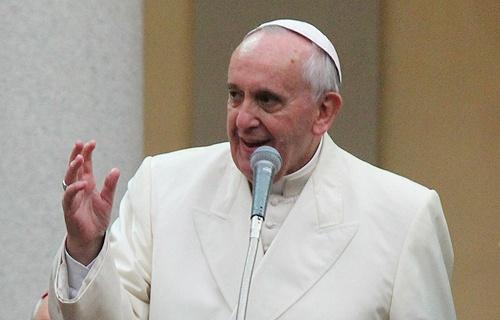
Pope Francis urged an international gathering of grassroots social activists to struggle against the “structural causes” of poverty and inequality, with a “revolutionary” program drawn from the Gospels.

“The poor no longer wait, they seek to be protagonists, they organize, study, work, demand and, above all, practice that special solidarity that exists among those who suffer, among the poor,” the pope said to a Vatican-sponsored World Meeting of Popular Movements.

The pope said solidarity entails struggling “against the structural causes of poverty, inequality, the lack of work, land and shelter, the denial of social and labor rights,” and confronting what he called the “empire of money.”

Most of what the pope said recalled his earlier statements on social justice, especially his November 2013 apostolic exhortation, Evangelii Gaudium (“The Joy of the Gospel”), but he delivered the remarks with a strong note of personal encouragement to the activists, telling them: “Today I want to join my voice to yours and accompany you in your struggle.”

Pope Francis said Catholic social teaching defines “land, shelter and work” as “sacred rights,” yet “if I speak of this some people conclude that the pope is a communist.”

Deploring the displacement of his “brother peasants” from their “native soil,” the pope warned that traditional rural life is at “risk of extinction.” He also said “financial speculation” on food prices, was to blame for the starvation of millions around the world.

“I’ve said and I repeat: a home for every family,” Pope Francis said. “Family and shelter go hand in hand.”

Scorning terms such as “homeless people” as euphemisms, the pope said that, in general, “behind a euphemism lays a crime.”

The pope called for urban planning based on the “authentic and respectful integration” of different communities, and criticized real estate developers who demolish the “poor settlements” typical of cities in underdeveloped countries.

Every neighborhood should have “adequate infrastructure,” include sewers, streets and recreational facilities, he said.

Pope Francis reiterated his earlier criticisms of rising youth unemployment, in Europe and elsewhere, as reflective of a “throwaway culture” that treats people as leftovers. Other examples, he said, include society’s neglect of the aged, low fertility rates, malnourished children and abortion.

Noting that he was addressing representatives of non-unionized workers such as trash pickers, street peddlers and artisans, the pope said “every worker, whether or not part of a formal system of salaried work, has the right to a decent wage, social security and a pension plan.”

The pope said social justice also requires peace and environmental protection, both of which the global economic system inevitably threatens.

“There are economic systems that must make war in order to survive,” he said. “An economic system centered on the god of money also needs to plunder nature in order to maintain the frenetic pace of consumption inherent in it.”

Pope Francis said that he was writing an encyclical on ecology, and promised the activists that the document would reflect their concerns.
The pope acknowledged that the activists sought to replace the current economic and political system with one based on “human dignity,” but warned them to avoid destructive extremism in the process.

“It must be done with courage, but also with intelligence; with tenacity, but without fanaticism; with passion, but without violence,” he said, and recommended that social movements take their “guide of action,” from the Gospels, specifically the beatitudes and the 25th chapter of Matthew, in which Jesus says: “Whatever you did for one of these least brothers of mine, you did for me.”
At the end of his speech, which lasted more than half an hour, the pope gave the more than 150 activists rosaries he said had been made by “artisans, trash pickers and workers from the popular economic of Latin America.”

In the audience was Bolivian President Evo Morales, an outspoken and controversial critic of globalization, who the Vatican noted was attending not as a head of state but as the leader of a grassroots social movement. Morales was scheduled to meet informally with Pope Francis later the same day.

Francis X. Rocca
Catholic News Service
Oct. 28, 2014
Vatican City

Categories
Fr. EJ Reflections

Reflections on the Feast of All Souls By Fr. Efren ‘EJ’ Jimenez, OFM

• No doubt, the observance of the feast of all souls here in the Philippines is most unique – flowers, candles, food and drinks, and even music are part of the celebration. One cannot separate the bonding of the living and the dead, and among the living. Prayers and incensation are made and on top of these are the celebrations of the Eucharist. As if one can hear the very words of Jesus in one solemn tone: “do this in my memory!”

• The theological underpinning of the feast is the acknowledgment of human frailty. Since few people achieve perfection in this life but, rather, go to the grave still scarred with traces of sinfulness, some come face-to-face with God. The Council of Trent affirmed this purgatory state and insisted that the prayers of the living can speed the process of purification.

• Superstition still clung to the observance. Medieval popular belief held that the souls in purgatory could appear on this day in the form of witches, toads or will-ó-the-wisps. Graveside food offerings supposedly eased the dead’s rest.

• Observances of more religious nature have survived. These include public processions or private visits to cemeteries and decorating graves with flowers and lights, recitation of the Holy Rosary and celebration of the Holy mass.

• Whether or not one should pray for the dead is one of the great arguments which divide Christians. Appalled by the abuse of indulgences in the Church of his day, Luther rejected the concept of purgatory. Yet prayer for a loved one is, for the believer, a way of erasing any distance, even death. In prayer we stand in God’s presence in the company of someone we love, even if that person has gone before us into death.

• The deeper religious truth – these are those things we confront in death – loss, change, and transformation. The common denominator in these three realities is the fact that one must give up something. It is possible for both loss and change to lead for transformation to occur unless something is lost and something is changed. Life is a continual process of losing. But in Jesus there is time for change towards transformation, a time comes for throwing stones away, for letting the water go so that it might be made into wine. For giving away five barley loaves so that a multitude may be fed, for the wheat to be crushed and become the Bread of Eternal Life.

About Fr. EJ and his other reflections.

Categories
Reflections

“All Souls” Day

Readings:Is 25:6-9; Rom 5:5-11 (or Rom 5.17-21); Luke 7:11-17
The Lord of the Living
Or, the triumph of life over death
(the resurrection of the son of the widow)

1. This gospel passage – the resurrection of the dead son of a widow – would be better understood and appre-ciated if taken together with preceding story – the heal-ing of the servant of the Roman centurion. Both stories constitute an instructive response to the question posed by John the Baptist in Lk 7:19: “Are the One who is to come, or are to wait for another?” (Are you the Messiah?). These stories reveal to us who Jesus is, and therefore, also his mission.

2. The healing of the centurion’s servant informs us of the universal scope of the mission of Jesus – he offers sal-vation not only to the Jews but to the Gentiles, meaning to all humankind. The true miracle in the story is the faith of the centurion. He understood and accepted that Jesus comes from God, offering healing and salvation to the world, symbolized by the cure of the pagan servant. The fullness of our humanity begins with good works and ends with openness to the saving mystery of God’s love, as it happened to the Roman centurion.

3. On the other hand, the resurrection of the son of the widow reveals Jesus Christ as the Lord of the living. He brings to us the ultimate triumph of life over death.

4. Let us try to deepen our reflection. We believe as Church, as the gathering of believers that the miracles of Jesus, considered in their totality, reflect and antic-ipate the truth of God’s reign, notwithstanding the fact that no one can guarantee the historical basis of each and every miracle. And among those miracles, or signs that best express the identity of Jesus is the resurrec-tion of the widow’s son.

5. Let us look at some of significant elements. The first is that there is a revelation from God. The people cried out: “A great prophet has risen among us. God has visited his people” (7:16). Here we are told something tremendously important: Jesus is the ultimate prophet and he transcends the primitive meaning of the word prophecy. Jesus is not simply one who transmit the word of God, he is the Word of God; Jesus does not only announce the Kingdom of God, he fulfills it by his resurrection and of those who believe in him. Secondly, the young man’s resurrection unveilsthe true meaning of earthly life, namely the beginning of eternal life in God’s kingdom. Heaven begins on earth. And thirdly, the resurrection of the widow’s son gives testimony that Jesus is the Messiah who will guarantee life’s triumph over death.

6. It is life guaranteed by the resurrection of Jesus Christ, the Redeemer, that we celebrated yesterday with all the saints in heaven and that we celebrate today with all the faithful departed, as the community that he has gathered in faith. We remember, we believe.

[2013]

Categories
Reflections

Commemoration of All the Faithful Departed

Where Do We Go When We Die?
The souls of the just are in the hand of God (Wis 3:1)
Readings:Different readings can be chosen from the Lectionary

Where do we go when we die? This is not a frivolous question. It has puzzled people of all cultures from the beginning of time, and it continues to puzzle many today. This question in no way suggests a lack of faith. Rather it underscores some of the mystery surrounding death.

In the past, this feast focused on our role in the deliverance of the “poor souls in Purgatory.” They were the “church suffering,” waiting for what we, the “church militant,” would do to alleviate their suffering so that they might join the saints in heaven, the “church triumphant.” We said prayers and made visits to churches in order to gain indulgences that might shorten their stay in that nebulous place of temporal punishment. Without denying our need to be purified of the traces of sinfulness, the readings for today suggest a very different focus.

The passage from the Book of Wisdom is quite consoling. That is why many people choose it as a reading for funerals. It states that the righteous dead are secure in the protection of God. Only the foolish think that “their going forth from us [is] utter destruction.” We grieve over their death; their passing is our loss. But is it their loss? They have hope that is “full of immortality.” In other words, their hope cannot be extinguished by death.

The psalm is also comforting. God, the gentle shepherd, leads the psalmist through the dark valley. There is no fear here, only trust and courage.

Paul too speaks of hope, a hope grounded in God’s love. He insists that we have every reason to hope, for if Jesus died for us when we were still sinners, how much more can we expect from God now that we have been made righteous through the shedding of Jesus’ blood?
The point of the Gospel story is really not the resurrection of Lazarus, which could prompt us to hope that we or our loved ones might be restored to life, but the claim that Jesus himself is the resurrection and the life. After all, Lazarus had to die again, but what Jesus promised was a life that is not subject to death: “…who lives and believes in me will never die.” There is that troubling word again: believe. Do we believe that Jesus can do this? Do we believe that Jesus will do this? Do we believe that our beloved dead are indeed secure in the hand of God?

Dianne Bergant, CSA
Last Updated: Tuesday, 02 November 2010
© America: The National Catholic Weekly, 2003.

Design a site like this with WordPress.com
Get started