Categories
liturgical committee

Installation of the Relic of St. Anthony of Padua By Edmund Lim Worship coordinator (2011-2015)

Relic 1
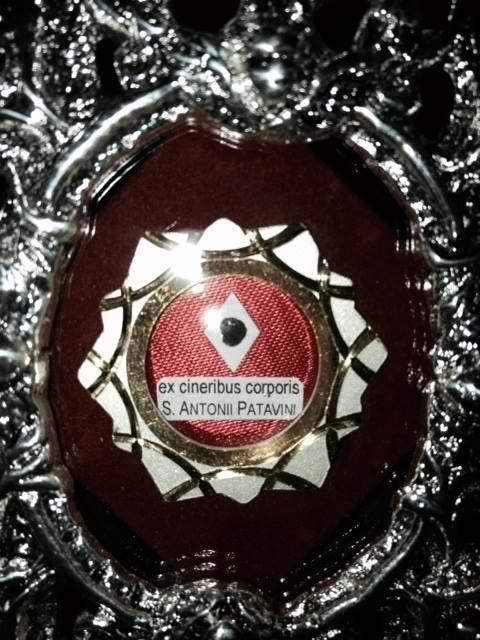
On June 13th, 2015, our parish will receive a first class relic of our beloved patron Saint Anthony of Padua and Lisbon in the Fiesta Mass of our Church. It was precisely a year ago, when I jokingly told my aunt if it is at all possible for our parish Santuario De San Antonio to have a relic of St Anthony similar to what I saw in his birth place in Lisbon and his resting place in the Basilica Padua. Little did I know that my aunt began asking her friends in Rome and through the good graces of our saint, we got not one but two relics sent to us for our veneration.

What is a Relic?
A relic is something connected with a saint or blessed, including a part of their body (e.g. hair or a piece of bone), their clothing, or an object that the person used or touched.

Relics are classified as 1st Class – a part of the person’s body, for example: blood, hair, or bones; 2nd Class ‑ an article touched by the person or touched directly to part of his or her body; and 3rd Class ‑ something touched indirectly to the person, that is, to a 1st or 2nd Class relic, to the tomb, etc.

It is not the kind of relic or how big it is that is important, but rather the faith and prayer that the relic occasions. By the communion of saints, it is that person who is close to us, blessing and praying for us
Relic 2
Why Do We Venerate Relics?
The veneration of relics is an ancient custom dating from the reverence shown at the graves of the martyrs even in the time of the apostles. Miracles have been worked by God in association with relics – “…not that some magical power existed in them, but just as God’s work was done through the lives of [holy people], so did His work continue after their deaths. Likewise, just as [others] were drawn closer to God through the lives of [holy people], so did they (even if through their remains) inspire others to draw closer even after their deaths. This perspective provides the Church’s understanding of relics.” (Fr. W. Saunders, “Keeping Relics in Perspective”, © 2003 Arlington Catholic Herald)

“In all, relics remind us of the holiness of a saint and his cooperation in God’s work; at the same time, relics inspire us to ask for the prayers of that saint and to beg the grace of God to live the same kind a faith-filled life.” (Saunders)

What Do We Express When We Venerate Relics?
“To venerate the relics of the saints is a profession of belief in several doctrines of the Catholic faith: (1) the belief in everlasting life for those who have obediently witnessed to Christ and His Holy Gospel here on earth; (2) the truth of the resurrection of the body for all persons on the last day; (3) the doctrine of the splendor of the human body and the respect which all should show toward the bodies of both the living and the deceased; (4) the belief in the special intercessory power which the saints enjoy in heaven because of their intimate relationship with Christ the King; and (5) the truth of our closeness to the saints because of our connection in the communion of saints — we as members of the Church militant or pilgrim Church, they as members of the Church triumphant.” (Fr. W. Saunders, “Church Teaching on Relics”, © 2003 Arlington Catholic Herald)
Relic 3
I have served as the Worship Coordinator for our parish for almost 4 years…. I am truly grateful to have been given the opportunity to be a servant in our parish. I am extremely happy too that one of the last liturgical events we are organizing is the instillation of the relic of our patron Saint Anthony of Padua in our church… I wish to express special thanks to My aunt Miss Amparo Lim, National President of the CWL, Fr. Jess Dajac in Rome and our parish priest, Fr. Reu for making the installation of the relic of our patron saint possible.

Looking forward, we hope that the arrival of St Anthony will deepen our devotion to our patron saint and pray that we can become a shrine to our most beloved saint and live up to our theme, “We care because we pray.”

Categories
Hospital Ministry

Hospital Ministry Thanksgiving Mass and Lunch By Sabrina Soriano-Sy

This slideshow requires JavaScript.

It was more than 20 years ago when Steve Lopez (may he rest in peace) founded the PGH Adopt-A-Child-Foundation. Over the years, it has transformed until its current form as the Hospital Ministry supporting the Philippine General Hospital, Rizal Medical Center, and Our Lady of Porciuncula Hospital.

The members and volunteers visit the hospital pediatric wards weekly, giving out medicine to referred patients. Aside from these regular visits, they have a variety of activities throughout the year – such as the healing mass, Stations of the Cross, Flores de Mayo, art contests, field trips, Christmas gift giving, and more – supporting the wards and the school.

The Hospital Ministry would not be possible without the kind hearts and generosity of the donors / parishioners who share their blessings of time, talent, and treasure to the ministry. In line with this, the Hospital Ministry held a Thanksgiving Mass and Lunch last May 16 (Saturday). This was their way of showing appreciation to the people who continue to make the ministry and their work possible.

The mass was led by Fr. Reu Jose C. Galoy followed by a simple lunch. 2 patients (Camille Vizcarra and Brix Durante) and their families came to give testimony as to how the ministry helped them with their medical conditions. Representatives from PGH and RMC also came to thank the ministry and the donors for the support and good work they have done throughout all these years, helping countless patients along the way.

Thank you once again to our donors and volunteers. We cannot express our gratitude enough for the support that you continue to give to the Hospital Ministry. Especial thanks also to the following donors / volunteers who attended the thanksgiving mass and lunch: Mrs. Doris See, Mrs. Nena Jalandoni, Mrs. Nenette Jalandoni, Mrs. Estela Lopez, Mrs. Grace Padilla, PPC President Jaime Blanco and his wife Karen, PPC VP Edmund Lim, Paul and Caron Macasaet, Mark Lim, Rachel Ybanez, Marty Santos, Raymond and Claudette Katigbak.

“For it is in giving that we receive.” – St. Francis of Assissi

*** Photo credits to Rachel Ybanez

Categories
CCD

CCD-TOPS Feeding Outreach By Marga Gregorio

This slideshow requires JavaScript.


For two Saturday mornings, April 18 and 25, the level 6-8 students of the CCD program engaged in another outreach activity. The beneficiary was the community of the TAHANAN OUTREACH PROJECTS AND SERVICES (TOPS), located in Sta. Ana Manila area where the children travelled to. TOPS is a pioneer organization dedicated in assisting street children, runaways, endangered and disadvantaged youth, with the main goal of preventing juvenile delinquency. The organization provides direct health, social work, educational, economic and crisis intervention services.

The CCD Outreach event last April jumpstarted the sponsorship of a weekly feeding program for 100 disadvantaged children between the ages of 5-10, for a duration of 6 consecutive months.

Fifty (50) CCD students were assigned on each Saturday of the designated outreach days. They were divided into four (4) groups: Food Preparation, Servers, Decor and Entertainment.

The décor group put up banners and tarpaulins, cleaned and set-up the venue, with all the energy and creativity they had. With great enthusiasm and a cheerful spirit, the food preparation group mixed the milk formulas, prepared ham and cheese sandwiches, hotdogs on sticks. They also helped in the preparation and cooking of pancit and spaghetti, by chopping the ingredients, sautéing, boiling the pasta, mixing, and packing them in Styrofoam containers. After the food preparation, servers eagerly served their wards or “alagas,” the food they themselves prepared, with joy in their hearts and a twinkle in their eyes. The entertainment group made sure to elicit from the children laughter and glee, with games and a simple program. We were heralded by the angelic voices of the childrens’ songs. The children of TOPS were also given ”loot bags” by the end of the activity to complete their fun-filled day. The CCD Committee led by Lia Te, Marivic Borromeo and Katty Qua supervised the event with the help of CCD teachers Aphro Abarquez (who served as host), Rachelle Wenger, Gabby Trinidad, Noel Amaya, Patrick Castaneda, Rolly Macabuag, Mimi David, Marga Gregorio, and our secretary, Leah Azarcon.

In this activity the CCD children somehow reflected Jesus’ attitude of servanthood as he manifested when he washed the feet of his disciples…for ”it is in giving that we receive,” as the prayer of St. Francis aptly states.

The CCD Outreach Programs throughout the year are mainly funded by our Light-A-Parol project, which is held every December. The main thrust of CCD for these outreach activities is to fulfill the “Faith In Action” aspect of its curriculum — to put into action Christian values and virtues taught to them in CCD. In this particular outreach, the children manifested virtues like humility, industriousness, cheerfulness, kindness, generosity and charity.

Categories
CCD

CCD-BINHI Outreach Activity By Marga Gregorio

This slideshow requires JavaScript.

Saturday, March 21, from 9:00am to 12:00 noon,  CCD engaged in its second outreach activity for this school year 2014-2015. It was held in the Convento gardens of Santuario de San Antonio. The beneficiaries were the “BINHI” children, between the ages of 4 – 6, from the convent of the Rosalie Rendu Development Center, Daughters of Charity of Saint Vincent de Paul.

Formed in 2008, the Binhi English Literacy Foundation, Inc. provides English learning support  to less privileged Filipino children in marginalized areas through an English literacy program. 

The CCD children from Reception, Levels 1 and 2, ages 4-7 years old, were each assigned partners from the Binhi group.  Together, they participated in the game stations that included treasure hunt, shoot that ball, hat making, musical chairs among others. There were popcorn and ice cream booths, and a yummy merienda from Jollibee.  The Binhi kids performed an entertaining alphabet song number, showing their language and reading progress.   It was a fun-filled interaction with lots of games and entertainment, including the very popular Jollibee mascot.  Prizes and surprises abounded that brightened every child’s smile.  The Binhi children also brought home educational gift packs from CCD as well as books and educational items donated by the CCD parents and children.

Aphro Abarquez, one of our CCD teachers was our gracious host who made sure everyone was happily entertained. We also had big help from our teacher volunteers Rolly Macabuag, Mimi David, Noel Amaya, Dottie Pasia, Mary Ann Villanueva, Marga Gregorio and Crissy Castillo and some older CCD kids Martina Qua, Paco Borromeo, Derek De Wit and Stella Grealy. Although the weather threatened rain showers, it turned out to be a very pleasant, bright, shiny day.

 The CCD Outreach Programs throughout the year are mainly funded by the Light-a-Parol project, which is held every December.  The main thrust of CCD for these outreach activities is to fulfill the “Faith In Action” aspect of its curriculum — to put into action Christian values and virtues taught to them in CCD.

Categories
Cathechism of the Catholic Church

CATECHISM OF THE CATHOLIC CHURCH

How many sacraments are there, and what are their names?
The Church has seven sacraments: Baptism, Confirmation, Eucharist, Penance, Anointing of the Sick, Holy Orders, and Matrimony.

Why do we need sacraments in the first place?
We need sacraments in order to outgrow our petty human life and to become like Jesus through Jesus: children of God in freedom and glory.

In Baptism the fallen children of men become cherished children of God; through Confirmation the weak become strong, committed Christians; through Penance the guilty are reconciled; through the Eucharist the hungry become bread for others; through Matrimony and Holy Orders individualists become servants of love; through the Anointing of the Sick the despairing become people of confidence. The sacrament in all the sacraments is Christ himself. In him we men, lost in selfishness, grow and mature into the true life that has no end.

Why is faith in Jesus Christ not enough? Why does God give us the sacraments, too?
We can and should come to God with all our senses, not just with the intellect. That is why God gives himself to us in earthly signs especially in bread and wine, the Body and Blood of Christ.

People saw Jesus, heard him, could touch him and thereby experience salvation and healing in body and soul. The sensible signs of the sacraments show this same signature of God, who desires to address the whole man, not just his head.

Is there some inner logic that unites the sacraments with each other?
All sacraments are an encounter with Christ, who is him self the original sacrament.

There are sacraments of initiation, which introduce the recipient into the faith: Baptism, Confirmation, and Eucharist. There are sacraments of healing: Reconciliation and the Anointing of the Sick. And there are sacraments of communion and mission: Matrimony and Holy Orders.

Baptism joins us with Christ. Confirmation gives us his Spirit. The Eucharist unites us with him. Confession reconciles us with Christ. Through the Anointing of the Sick, Christ heals, strengthens, and consoles. In the sacrament of Matrimony, Christ promises his love in our love and his fidelity in our fidelity. Through the sacrament of Holy Orders, priests have the privilege of forgiving sins and celebrating the Holy Sacrifice of the Mass.

Why do the sacraments belong to the Church? Why cannot anyone use them however he wants?
Sacraments are Christ’s gift to his Church. It is her duty to administer them and to protect them from misuse.

Jesus entrusted his words and signs to specific men, namely, the apostles, who were to hand them on; he did not hand them over to an anonymous crowd. Today we would say: He did not post his inheritance on the Internet for free access but rather registered it under a domain name. Sacraments exist for the Church and through the Church. They are for her, because the Body of Christ, which is the Church, is established, nourished, and perfected through the sacraments. They exist through her, because the sacraments are the power of Christ’s Body, for example in confession, where Christ forgives our sins through the priest.

Which sacraments can be received only once in a lifetime?
Baptism, Confirmation, and Holy Orders. These sacraments imprint an indelible mark on the soul of the Christian. Baptism and Confirmation make him once and for all a child of God and Christlike. Holy Orders similarly leaves an imprint on a Christian man.

Just as someone always is and remains a child of his parents (and not just “sometimes” or “a little bit”), so also through Baptism and Confirmation one becomes forever a child of God, Christlike, and a member of his Church. Similarly, Holy Orders is not a “job” that a man does until retirement; rather, it is an irrevocable charism (gift of grace). Because God is faithful, the effect of these sacraments is maintained forever for the Christian – as receptivity to God’s call, as a vocation, and as protection. Consequently these sacraments cannot be repeated.

Why is faith a prerequisite for the sacraments?
Sacraments are not magic. A sacrament can be effective only if one understands and accepts it in faith. Sacraments not only presuppose faith, they also strengthen it and give expression to it.

Jesus commissioned the apostles first to make people disciples through their preaching, in other words, to awaken their faith and only then to baptize them. There are two things, therefore, that we receive from the Church: faith and the sacraments. Even today someone becomes a Christian, not through a mere ritual or by being listed in a register, but rather through acceptance of the true faith. We receive the true faith from the Church. She vouches for it. Because the Church’s faith is expressed in the liturgy, no sacramental ritual can be changed or manipulated at the discretion of an individual minister or a congregation.

If a sacrament is administered by someone who is unworthy, does it fail to have its effect?
No. The sacraments are effective on the basis of the sacramental action that is carried out (ex opereoperato), in other words, independently of the moral conduct or spiritual outlook of the minister. It is enough for him to intend to do what the Church does. By all means, ministers of the sacraments ought to live an exemplary life. But the sacraments take effect, not because of the holiness of their ministers, but rather because Christ himself is at work in them. In any case, he respects our freedom when we receive the sacraments. That is why they have a positive effect only if we rely on Christ.

What is Baptism?
Baptism is the way out of the kingdom of death into life, the gateway to the Church, and the beginning of a lasting communion with God.

Baptism is the foundational sacrament and the prerequisite for all other sacraments. It unites us with Jesus Christ, incorporates us into his redemptive death on the Cross, thereby freeing us from the power of Original Sin and all personal sins, and causes us to rise with him to a life without end. Since Baptism is a covenant with God, the individual must say Yes to it. In the baptism of children, the parents confess the Faith on behalf of the children.

How is Baptism administered?
The classical form of administering Baptism is the threefold immersion of the candidate in the water. Usually, however, water is poured three times over the head of the candidate, while the minister of the sacrament speaks the words, “N., I baptize you in the name of the Father, and of the Son, and of the Holy Spirit.”

Water symbolizes cleansing and new life, which was already expressed in the baptism of repentance performed by John the Baptist. The Baptism that is administered with water “in the name of the Father, and of the Son, and of the Holy Spirit” is more than a sign of conversion and repentance; it is new life in Christ. That is why the ceremony also includes the signs of anointing, the white garment, and the baptismal candle.

Who can be baptized, and what is required of a candidate?
Any person who is not yet baptized can be baptized. The only prerequisite for Baptism is faith, which must be professed publicly at the Baptism. A person who turns to Christianity is not just changing a worldview. He travels a path of learning (the catechumenate), in which he becomes a new man through personal conversion, but especially through the gift of Baptism. He is now a living member of the Body of Christ.

Why does the Church adhere to the practice of infant Baptism?
From antiquity the Church has practiced infant Baptism. There is one reason for this: before we decide on God, God has decided on us. Baptism is therefore a grace, an undeserved gift of God, who accepts us unconditionally. Believing parents who want what is best for their child want Baptism also, in which the child is freed from the influence of original sin and the power of death.

Infant Baptism presupposes that Christian parents will raise the baptized child in the faith. It is an injustice to deprive the child of Baptism out of a mistaken liberality. One cannot deprive a child of love so that he can later decide on love for himself; so too it would be an injustice if believing parents were to deprive their child of God’s grace in Baptism. Just as every person is born with the ability to speak yet must learn a language, so too every person is born with the capacity to believe but must become acquainted with the faith. At any rate, Baptism can never be imposed on anyone.
If someone has received Baptism as a little child, he must “ratify” it later in life – this means he must say Yes to it, so that it becomes fruitful.

Who can administer Baptism?
Normally a bishop, a priest, or a deacon administers the sacrament of Baptism. In an emergency, any Christian, indeed anyone, can baptize by pouring water over the head of the recipient and pronouncing the baptismal formula, “I baptize you in the name of the Father and of the Son and of the Holy Spirit.”

Baptism is so important that even a non-Christian can administer it. In doing so, however, he must have the intention of doing what the Church does when she baptizes.

Is Baptism in fact the only way to salvation?
For all those who have received the Gospel and have heard that Christ is “the way, and the truth, and the life,” (Jn 14:6) Baptism is the only way to God and salvation. At the same time, however, it is true that Christ died for all mankind. Therefore all men who have had no opportunity to learn about Christ and the faith but seek God sincerely and live according to their conscience also find salvation (the so-called Baptism of desire).

God has made salvation dependent on the sacraments. Therefore the Church must tirelessly offer them to mankind. To give up her missionary work would be a betrayal of God’s commission. God himself, however, is not dependent on his sacraments. In places where the Church does not exist or has had no success – whether by her own fault or for other reasons – God himself paves for the people other ways to salvation in Christ.

What is Confirmation?
Confirmation is the sacrament that completes Baptism; in it the gift of the Holy Spirit is bestowed upon us. Anyone who freely decides to live a life as God’s child and asks for God’s Spirit under the signs of the imposition of hands and anointing with chrism receives the strength to witness to God’s love and might in word and deed. He is now a full-fledged, responsible member of the Catholic Church.

When a coach sends a soccer player onto the playing field, he puts his hand on his shoulder and gives him final instructions. We can understand Confirmation in a similar way. A hand is placed upon us. We step out onto the field of life. Through the Holy Spirit we know what we have to do and we have been given the power to do it. He has motivated us. His mission resounds in our ears. We sense his help. We will not betray his trust or disappoint him; we will win the game for him. We just have to want to do it and listen to him.

What does Sacred Scripture say about the sacrament of Confirmation?
In the Old Testament, the People of God expected the outpouring of the Holy Spirit upon the Messiah. Jesus lived his life in a special Spirit of love and of perfect unity with his Father in heaven. This Spirit of Jesus was the “Holy Spirit” for whom the people of Israel longed; this was the same Spirit whom Jesus promised to his disciples, the same Spirit who descended upon the disciples fifty days after Easter, on the feast of Pentecost. And it is again this same Holy Spirit of Jesus who descends upon everyone who receives the sacrament of Confirmation.

In the Acts of the Apostles, which were written a few decades after the death of Jesus, we see Peter and John traveling about to confirm new Christians by imposing hands on those who previously “had only been baptized in the name of the Lord Jesus,” so that their hearts might be filled with the Holy Spirit.


What happens in Confirmation?

In Confirmation the soul of a baptized Christian is imprinted with a permanent seal that can be received only once and marks this individual forever as a Christian. The gift of the Holy Spirit is the strength from above in which this individual puts the grace of his Baptism into practice through his life and acts as a “witness” for Christ.

To be confirmed means to make a “covenant” with God. The confirmand says, “Yes, I believe in you, my God; give me your Holy Spirit, so that I might belong entirely to you and never be separated from you and may witness to you throughout my whole life, body and soul, in my words and deeds, on good days and bad.” And God says, “Yes, I believe in you, too, my child and I will give you my Spirit, my very self. I will belong entirely to you. I will never separate myself from you, in this life or eternally in the next. I will be in your body and your soul, in your words and deeds. Even if you forget me, I will still be there on good days and bad.”

Who can be confirmed, and what is required of a candidate for Confirmation?
Any Catholic Christian who has received the sacrament of Baptism and is in the “state of grace” can be admitted to Confirmation.

To be “in the state of grace” means not to have committed any serious sin (mortal sin). By a serious sin a person separates himself from God and can be reconciled with God only by making a good confession. A (young) Christian who is preparing for Confirmation finds himself in one of the most important phases of his life. He will do everything possible to grasp the faith with his heart and his understanding; he will pray alone and with others for the Holy Spirit; he will reconcile himself in every way with himself, with the people around him, and with God. Confession is part of this, since it brings one closer to God even if one has not committed a mortal sin.

Who may confirm?
The Sacrament of Confirmation is normally administered by the bishop. For weighty reasons when necessary, the bishop can also delegate a priest to do it. In danger of death, any priest can administer Confirmation.
Categories
Random Thoughts by Peachy Maramba

R A N D O M T H O U G H T S Voices from yesterday and today . . . by Peachy Maramba

Untitled

ST. BONIFACE: Apostle of Germany
673 – 754
June 5

Monk in England
One of the great figures in the annals of Christian mission Boniface spent the first half of his life as a monk in England. Born in 673 of a good family at Crediton, Devonshire in Southeast England he was baptized Wynfrith (Winfrid), a name which meant “Joy and Peace.”

When he was only five years old he decided to offer his life to the Lord after hearing the conversation of some monks who visited his home.

So at the age of seven he started on the road to being a monk by being educated by the Benedictines at the monastery school at Exeter then to the Nursling abbey in Winchester (famed for learning) under the abbot Winberht. Upon completion of his course he so distinguished himself as a brilliant scholar that the Abbot appointed him to teach.

A very popular teacher many scholars came to the school attracted by his teaching skill. His lecture notes were even copied by his students and circulated to other schools. For them he wrote a famous Latin Grammar textbook, which was the first to be used in English schools. He was eventually named director of the monastic school.

After he was ordained in 715 at the age of 30 Boniface, a noted preacher, began delivering inspiring homilies that were all based on the Bible which was his delight throughout his life.

Missionary Career
Boniface was already a well-known scholar and teacher in the Benedictine order when he decided at the age of forty that what he wanted above all else was to be a missionary, his true vocation as revealed to him by God. So seized with a missionary fervor Boniface, in 1716 following the example of other Saxon kinsmen monks set out as missionary after his abbot reluctantly gave his consent. An Anglo-Saxon by birth his long standing wish was to convey the gospel to Friesland, (now Northern Netherlands) where his co-Saxon people remained un-persuaded by the spreading Christian religion. However his first evangelical mission to Friesland failed probably because of the hostility of Radbod, king of the Frisians, who said he had no wish “to go to heaven with a handful of beggars.” Reluctantly he was forced to return to Nursling. Delighted to have him back, his fellow monks elected him abbot from 716 to 718 after Winbert died. However Boniface, still felt he was called by God to evangelize in a foreign land.

Mission to Evangelize Germany
Convinced that a papal commission was essential to his success as a missionary Boniface made the first of his three visits to Rome. First Boniface presented in 718 his proposed mission to Pope Gregory II who not only changed his name from Wynfrith to Boniface (meaning “doing good”) but also gave him a wide missionary commission. He was told to go forth “to those people who are still in the bonds of infidelity . . . . to teach them the service of the kingdom of God by persuasion of the truth in the name of Christ, the Lord our God.”

Pope Gregory II sent him in 719 to evangelize the heathens in Germany as the vast majority of the people still worshipped pagan gods.

In Germany he was able to engage in missionary work so successfully for three years under his countryman Willibrord, the first bishop of Utrecht.

Consecrated a Regional Bishop
Then in 722 he successfully converted and baptized great numbers in Hesse and Thuringia. When he sent word about his extraordinary results to the pope he was summoned back to Rome where he was consecrated a regional bishop for all of Germany. Not only was he able to eliminate paganism in much of the country but he founded churches and Benedictine monasteries and successfully asked English monasteries to send many monks and nuns to act as teachers to help him establish churches.

Demolishes the Oak of Thor
Because Boniface particularly was opposed to idolatry he deplored the worship of trees which was a common feature of the folk religion of Germany.

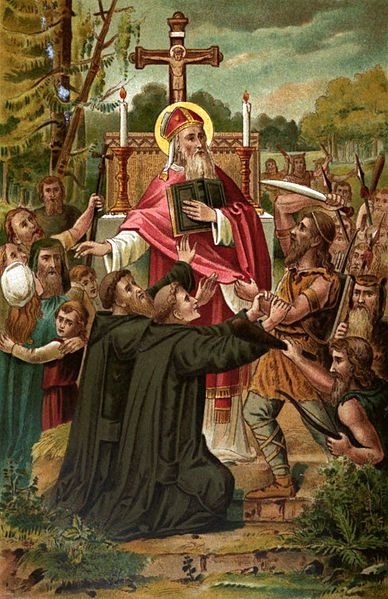
In a famous incident, so the legend goes, to undermine the pagan superstition Boniface in front of an awestruck crowd axed down the sacred oak of Donar called The Oak of Thor which stood at the Summit of Mount Gudenberg. It was an object of pagan worship as sacred to the god Thor. The crowd of onlookers were aghast expecting the heavenly punishment of their gods to rain down in lightning bolts on Boniface for his sacrilege.

When nothing happened, the people interpreted it to mean that Boniface had the more powerful god and so a wave of conversions ensued. Boniface used the wood of the famous tree to build a Christian chapel on that very spot. He named the church Saint Peter’s.

From then on the work of evangelization went on steadily and even more new churches and converts were established throughout the country. He was thus popularly known as the “St. Paul of Germany” because through him Germany became a Christian country.

Founded the Abbey of Fulda
In 735 Boniface and his disciple St. Sturmi founded Fulda, the chief monastery they co-founded, which later became the German Monte Cassino – a great monastic and learning center for northern Europe. Today Fulda is still the annual meeting place for the German Bishops.

Revitalizes the Church in France
In the meantime the Church in France was in great need of revitalization. Under Charles Martel, the Frankish King, the Church was so neglected that many ecclesiastical abuses prevailed and were rampant throughout the country.

Thankfully when he died in 741 his sons were convinced to call a synod to deal with these abuses. Boniface who presided over 4 of such assemblies was able to instill fresh vigor into the Church of Gaul (France).

In just five years he was able to regenerate the Frankish church: to reform and revitalize the Church in France to her former greatness.

So when in 747 Boniface was summoned by Pope Zachary to come once more to Rome he made him not only archbishop of Mainz and designated him Primate of Germany but named him apostolic delegate for Germany and Gaul.

His Martyrdom
Since to his dismay the Germans were “lapsing” Boniface already nearing eighty, resigned his see and once more hit the road to return to his first love – missionary work – to reconvert his Saxon kinsmen in Friesland who had turn pagans.

It was here while quietly reading in his tent at Dokkum while waiting to confirm new converts that a band of hostile pagans came and attacked Boniface and his 53 companions – killing them all.

In the famous monastery of Fulda lies not only his remains but the blood-stained book that Boniface raised over his head to protect himself from the brutal sword cuts that martyred him on June 5, 754.

Boniface’s organizing genius even more than his missionary zeal has left a lasting mark upon the German and French churches throughout all the middle ages.

Archbishop Cuthbert of Canterbury wrote of Boniface, his contemporary: “We in England lovingly count him as one of the best and greatest teachers of the true faith.”

He is rightfully called the patron and Apostle of Germany because to him belongs the credit of “systematically evangelizing and civilizing the great regions of central Germany . . .” so that through him Germany became a Christian country. It’s no wonder he is popularly known as “St. Paul of Germany.”

His other great achievement was the regeneration of the Frankish Church.

His feast day (June 5) was extended to the universal church by Pope Pius IX in 1874.

SOURCES of REFERENCE
ST. BONIFACE
June 5

Butler’s Lives of the Saints – Vol. II pp 477 – 481
The Illustrated World Encyclopedia – pp 129
Pocket Dictionary of Saints – pp 82 – 83
The Watkins Dictionary of Saints – pp 38 – 39
A Calendar of Saints – p. 107
All Saints – pp 246 – 247
Saints for Everyday – pp 190 – 192
A Year With the Saints – June 5
Butler’s Saint for the Day – pp 261 – 263
Illustrated Lives of the Saints – Vol. I pp 239 – 240
My First Book of Saints – pp 118 – 120
Saint Companions – pp 203 – 205
Saints for Our Time – pp 119 – 121
Saint of the Day – pp 130 – 131
Lives of the Saints Part I – pp 169 – 175
Children’s Book of Saints – pp 115 – 118
Saints – A Visual Guide – pp 190 – 191
Voices of the Saints – pp 298 – 299
Ordinary People, Extraordinary Lives – Group 6 Card 14
The Everything Saints Book – pp 76 – 77
The Lion Treasury of Saints – p 211, 124 – 125
Best – Loved Saints – pp 61 – 64
The Way of the Saints – pp 82 – 83
Book of Saints – Part 4 pp 18 – 19

Categories
Fr. Baltazar Obico Reflections

SUNDAY GOSPEL REFLECTION By Fr. Baltazar Obico, OFM

FEAST OF CORPUS CHRISTI: Corpus Christi celebrates the gifts we received, identifies who we are, and renews our commitment to which we are called.

Background: Today’s feast is in a sense an unexpected feast for several reasons. It duplicates Holy Thursday; we are repeating the Last Supper celebration without the sadness of Good Friday. Secondly, because every Eucharistic celebration is a feast of the Body and Blood of Jesus. Unexpected, because of the origin of its feast. An Augustinian nun, Juliana of Liege reported a vision. She had seen a full moon in splendor, save for the dark area on one side. As she understood it, the moon was the Church, the area that was dark because the Church has no feast of Blessed Sacrament. Fifty five years later, Corpus Christi became a universal feast of the Church.

GOSPEL: Today we have Mark’s account of the Last Supper. The 1st two readings (Ex. 24:3-8; Heb. 9:11-15), together with the gospel speak of sacrifice, blood and covenant. What we call Last Supper, Jesus (and the rest of the Jews) called it the Passover meal. This meal meant a great deal to Jesus and that he himself carefully organized its celebration to the last detail. While the beginning is full of vivid touches, the rest of the narrative is extremely simple. The gestures made by Jesus are those of any head of the household at a paschal meal. But the words pronounced by Jesus when accomplishing these familiar gestures are extra ordinary.

…”This is my body…this is my blood…the evocation of his death, close at hand is obvious. Still more, his blood is the blood of the covenant, which will be shed for many.” Jesus did not merely make a prophetic gesture in order to announce that he was about to die. He proclaimed that he was giving his life to seal the covenant so that all might drink at the source of this life.

WORD:

1. Corpus Christi means first of all the physical body of Christ. It is this body that suffered torture, bloodied by whipping. It is the same body that took all the cruelty thrown at him, the same body that was nailed and hung on the cross. Jesus took all of them not in stoic indifference neither by vengeful spirit but by dignified silence. His body took all of these without eliciting sympathy and exhibiting anger; there is serenity and strength that can only spring from a heart in communion with God; his words are only forgiveness. When Jesus took upon his physical body all the injuries inflicted on him and breathed his last on the cross, he acted out and fulfilled the words he said on the Last Supper when he said “This is my body which will be given up for you.” Therefore when we receive the Body of Christ, we want to conform ourselves to the depth of Christ’s love. We should be able to bear the suffering for the sake of others. We too are willing to give up our bodies for others. When Jesus asks us to “to do this in memory of me” he was referring to that kind of love for others.

2. Corpus Christi also means the Eucharistic body of Christ in the Eucharistic species. In the Eucharist we have Jesus himself, body and blood, soul and divinity. When we receive Holy Communion, we have a closer contact with Jesus than was possible to anybody during his earthly life. In the Eucharist the actual distance between ourselves and Christ vanishes. The God-man out of sheer love gives the lowly bread and wine his flesh to eat and his blood or drink. We can only respond with awe and wonder because something marvelous and enrapturing has broken into our common place world. As we grow older, most of us have lost our sense of wonder. We get blasé, we become worldly-wise and sophisticated. We have grown up. Heschel saw it as modern man’s trap, believing that everything can be explained, that all of reality is simply an affair which has only to be organized in order to be mastered. All enigma can be solved and all wonder is nothing but effect of novelty upon ignorance. The enemy of wonder is to take things for granted. We need to recover this sense of wonder. We have nothing to rely on except the words of Jesus, when he said “this is my body.” He did not say this is the symbol of his body. His words are trustworthy. When we come to mass to receive the Eucharist we are making a number of statements. We are acknowledging Jesus as the Bread of life, the one who alone can satisfy our hunger. In that sense we cannot take it lightly. Our familiarity with the mass and the frequency with which we celebrate it can dull our senses to the full significance of what we are doing.

3. Corpus Christi means above all the mystical body of Christ, the community of believers. The Eucharist is essential a meal. It intends to bring together not only us with God but with one another. When we receive the body of Christ in communion, we are also accepting the presence of Christ in one another. We can’t share fruitfully in the first if we are unmindful of the second. When we as family have a meal at home together, we are drawn closer by that sharing more than anything else. When we provide hospitality to friends by way of meal – or they for us – we have the opportunity for closeness with them that nothing else has. The Last Supper had a powerfully unifying effect on the disciples. In the Last Supper together, they became conscious in a new way that they belonged not only to the Lord but also to each other. In the Eucharist, God is providing us the same opportunity, with the addition that the closeness, intimacy and union are provided for by God in abundance. The more we eat together, the more we become his mystical body. Those words, Corpus Christi, express who we are in this parish. In this year of faith, we commit ourselves again to being Corpus Christi, one body of Christ.

Brothers and sisters, we are what we receive, Corpus Christi.

About Fr. Tasang and his reflections….

Categories
JPIC

A NATURE – FIELD DAY by JPIC Scholarship Committee/Marietta Cuyegkeng/MVR

JPIC

Recently our JPIC scholars and JPIC Scholarship Committee members trooped to the Mini-Forest Park, Miriam College for the annual JPIC Scholars’ Graduation Picnic.

Conceptualized by Sr. Marisa Lichauco along with the JPIC Scholarship Committee, the moving force behind this green oasis, the much anticipated event is a JPIC scholars’ culminating activity that seeks to enhance everyone’s appreciation of nature and its beauty – the Integrity of Creation.

Sr. Marisa toured the youth around the various gardens – the Friendship Garden, Centennial Garden, Science Garden, Freedom Garden, Peace Garden, Prayer Garden and Shade Garden. These gardens emphasize the peace, calm and serenity that nature brings, pointing out the usefulness of the various trees and plants for daily lives. After the tour, trivia questions on the gardens followed.

To complete the event, the Ateneo Placement Office Mrs. Carla S. Siojo, Mr. Ronnie Rodriguez and other members, introduced to JPIC Scholarship Program by Mr. Renan Prado, English Tutorial Teacher of our JPIC Scholarship, conducted an informative workshop on how to make an effective resume and comport oneself during job interviews.

A delicious adobo rice lunch “binalot” style with green mangoes, tomato and red egg siding was served, after which games were played and prizes given. It was not only a fun-filled day. The picnic was an educational and uplifting experience as well.

These activities are designed to give our scholars meaningful experiences to enable them to become well rounded and responsible citizens better equipped to face life’s challenges.

Categories
Fr. Sergio Santos Reflections

Solemnity of the Most Holy Trinity, SUNDAY GOSPEL REFLECTION By Fr. Serge Santos, OFM

Our brother and friend, Jesus Christ, obeyed totally his father and our father in his life acknowledging his mission as Son of God, undergoing his passion, crucifixion, and death on the cross in Calvary.  Our Lord Jesus Christ is faithful to God the Father in the Holy Spirit from the beginning of his life as Son of God, teaching in the synagogues of Nazareth and Capernaum.

Jesus Christ’s saving mission benefits the disciples, including us, because he promised for those who believe him and are baptized that none will be lost of those given to him by God the Father. Our pursuit of this so-called Salvation depends upon our intimate and loving relationship with our God.

As finite human beings, we have choices and priorities in life.  Because of the freedom of choice, we practice what we believe is right and good.  At times, usually we do not care about something that we do not understand; therefore it is hard to believe and practice.

The Holy Trinity (Blessed Trinity) is a doctrine of the church.  This doctrine teaches that there are three persons in one God.  The one God (Yahweh or Lord) in the Old Testament is the God that the Israelites (Jews) believe in and no other.  However, we the New Testament people are blessed with stories in Jesus’ life which help us understand the mystery.  For example, during the baptism of Jesus Christ by his cousin John the Baptist, we recall, “Jesus too was baptized.  Then while he was praying, the heavens opened.  The Holy Spirit came down upon him in the bodily form of a dove and a voice from heaven was heard, “You are my Son, this day I have begotten you.”  (Luke 3:21-23)

It is known that the relationship of the Most Holy Trinity is personal and intimate.  Christ invites the disciples including us to be friends – no longer servants – with him.  Praise the Lord, we could have Jesus Christ as best friend.  We stay united with Jesus Christ by obeying his commandments in loving God and neighbor (everyone is our neighbor).

Jesus Christ is very personal and intimate with us.  He revealed his secrets in the Holy Scriptures (secrets of his Father) to us as we always have God with us (Emmanuel – Incarnation).  We are all spiritually blessed.  What more can we ask for from God? Paul in the second reading today reminds us: (Rom 8:15-17)  “The Spirit himself bears witness with our spirit that we are children of God, and if children, then heirs with Christ, if only we suffer with him so that we may also be glorified with him.”  As we share with Jesus Christ in the cup of passion (suffering and death), we also share in the cup of glory (Resurrection and Ascension). Jesus Christ is present with us in the celebration of the Holy Eucharist (Holy Mass).  That is why the priest who represents Jesus Christ in the Holy Mass intones the doxology of the Blessed Trinity.

We must come to appreciate the value of praying to the Father through the Son in the Holy Spirit.  After all, when Jesus taught us to pray he said, “When you pray, say “Our Father…”  It has been observed that Christianity is not much looking at Jesus as it is looking in the same direction with him.,. that is, to the Father.  And so the Trinity is indeed a very important mystery for us, not just something to believe and then we forget.  This great truth should shape our attitude toward the three persons in God and influence our prayer.  Indeed the mystery of the Trinity is a very personal matter.

Because we have joined a pilgrimage towards a loving, compassionate and merciful God, we could always be grateful and thankful to God the Father and the Son Jesus Christ and the Holy Spirit for an intimate and friendly relationship with them (hopefully and peacefully).

About Fr. Serge and his other reflections…

Categories
Pastoral Team

IMPORTANT NOTICE FROM THE PASTORAL TEAM

Novenas for Our Mother of Perpetual Help and the Sacred Heart of Jesus

For decades now, we have been praying the novena to Our Mother of Perpetual Help after the 7:30AM mass and before the 6:00 PM mass on Wednesdays, with a short exposition of the Blessed Sacrament at the end. Before Vatican Council II, it was rather common to have novenas with exposition of the Blessed Sacrament. Novenas, in those days, were held mostly in the afternoon. No masses were then held in the afternoon and evening. Hence, the exposition of the Blessed Sacrament served as a kind of substitute for the masses.

After the liturgical reform of Vatican Council II, however, masses are held daily in the morning, afternoon and evening. Hence, there is hardly any need for having the exposition of the Blessed Sacrament, in as much as the holy mass is celebrated right after the novena. We noticed that the novena booklet (Perpetual Help Novena)
page 19, says, ”Benediction or Holy Mass,” not “Benediction and Holy Mass.” In churches or chapels where no masses are held on weekdays, the exposition of the Blessed Sacrament is right.

In view of this, the pastoral team has decided that, if the mass is to follow the novena prayers in honor of the Mother of Perpetual Help, no exposition of the Blessed Sacrament will be held.

As for the First Friday devotion of the Sacred Heart of Jesus we need to keep in mind the norms laid don by the church regarding holy hours. In the Second Instruction “Tres Abhinc Annos” 4 May 1967, on the implementation of the Constitution on the Sacred Liturgy, it says: It is necessary that when the exposition of the Blessed Sacrament is solemn and prolonged, it should be begun at the end of the Mass in which the host to be exposed has been consecrated.

Thank you.
Pastoral Team

Design a site like this with WordPress.com
Get started