Categories
Press Release

PRESS RELEASE

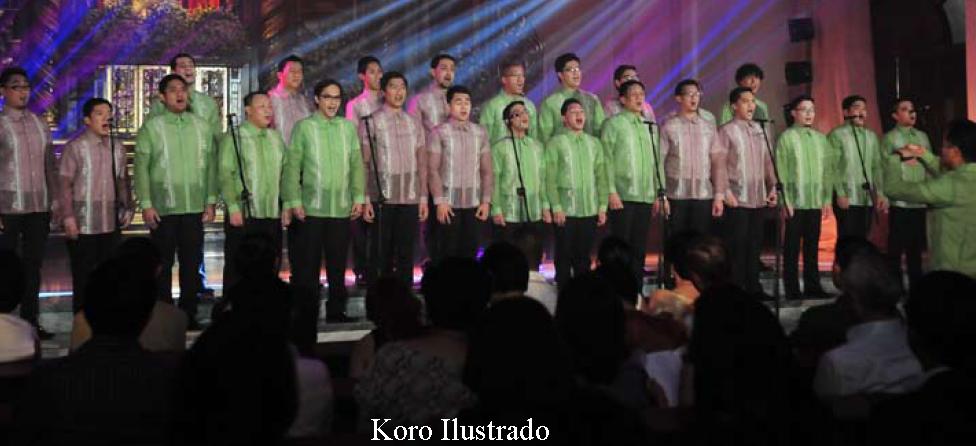
Koro As a resident choir of Santuario de San Antonio, Koro Ilustrado and the soul-uplifting music they make us experience has inspired a lot of our parishioners. Now witness one of the country’s leading all-male choirs soar higher in a benefit concert that promises to give you a different kind of high.

Koro Ilustrado invites you to watch “Higher”, a benefit concert for our little brothers from the Bahay Ampunan ni Hesus, Maria at Jose in Bulacan, and KI’s international tour fund in 2015. The event will happen at the Santuario de San Antonio church on August 2, 2014 (Saturday), 8pm.

Koro Ilustrado placed second in the Vocal Ensemble Category of the first Andrea O. Veneracion International Choral Festival in 2013. In the same year, it also launched its debut album titled “Sa Iyong Pag-ibig” under the Jesuit Communications label.

The 27th Awit Awards also nominated the group in the Best Performance by A New Group Recording Artist category for “Waka-Waka”, one of the songs in the debut album. The album will be sold during the concert.

The choir serves at the 4:30 p.m. mass every second and fourth Saturdays of the month at the parish.

In place of tickets, donations will be collected at the door. For pledges of donations for and inquiries about this benefit concert, please contact (0999) 869 2224 or approach a Koro Ilustrado member after the mass.

Categories
Pastoral Team

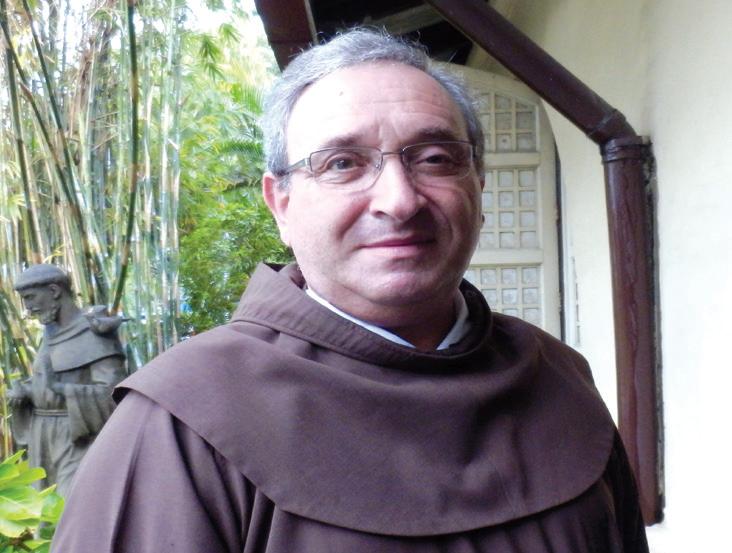
WELCOME FR. SERGE AND FR. TONY!

Following custom in this parish, the time has come for priests to rotate their assignments. Let’s all welcome Fr. Serge Santos, OFM who will be with us regularly for 2 years, and Fr. Tony Eguiguren, OFM who will be serving the parish until August 30, 2014.
8

FR. SERGIO “SERGE” SANTOS, OFM

Friar Serge hails from Caloocan City. His parents were originally from Bulacan.

He has been a professed friar for 34 years. He obtained his Master of Divinity degree at the Franciscan School of Theology, GTU, in Berkeley, California.

He obtained his Bachelor in Commercial Science degree, major in Business Administration and Management and minor in Accounting, Banking and Finance at San Beda College, Manila.

His secular life was filled with a wealth of experiences: as an employee of Araneta University for one year;administrative and clerical employee of Marsman and Co., Inc. for ten years; trust accounting specialist and trust tax technician of Wells Fargo Bank, San Francisco, California for 10 years.

Serge immigrated to the U.S.A. as professional immigrant in 1968. He was inspired by the Holy Spirit while working in the bank and joined the Franciscans of the St. Barbara Province in California. Serge lived, worked and ministered for 36 years in California before transferring to the Franciscans of San Pedro Bautista Province, Philippines.

As a Franciscan he served in various capacities as parochial vicar, pastor, chaplain, bursar, director/formator, pastoral counselor, and spiritual director.

He is a new member of the community of the pastoral team although he has been assigned here some eight years ago. Being elderly, his main ministry will be counselling and confessions. He will be available for counselling on MWF 9am-11am and by appointment.
9

FR. ANTONIO “TONY” EGUIGUREN, OFM

Fr. Antonio Eguiguren, OFM is not new to the Parish community having stayed here for a year and half four years ago. Fr. Tony is a member of the Belgian Province, although he is originally from Spain. He is a visiting professor at the Institute of Consecrated Life, and is part of our community until August 2014. He feels at home in our parish, especially with the Spanish –speaking parishioners.

Categories
CWL Fr. Joel Sulse

CWL Will Always Remember You, Fr. Joel! by C. Quesada

10
Last April 5th the Catholic Women’s League gave Fr. Joel Sulse a despedida luncheon. He will soon leave for Rome for further studies.

We find it hard to say good bye to someone like Fr. Joel because we have grown very fond of him. He always has a smile for those he meets. You will never see him angry. He is approachable and makes time for you

Our CWL scholars simply love him. They love his teachings because somehow Fr. Joel touches their lives. One scholar shared how abandoned he felt when his father left the family. Fr. Joel told him that he knows how he feels because the father of his nephews also left the family and he took the role of the father.

The scholars honored Fr. Joel with songs, dances, poems and cards, Truly Fr. Joel will always be remembered.7

Diane C. Pangilinan, a college scholar of Catholic Women’s League Santuario de San Antonio Parish, drew the image of Fr. Joel Sulse in behalf of all the CWL Scholars, as a tribute for Father Joel as he leaves the parish.

Diane says, “We believe that it is not enough to show how much Father Joel has shared himself among us. We are all very blessed to experience his love and compassion as our spiritual father.”

Well done, Diane!

Categories
Articles

PARISH ART RESTORATION PROJECT

As we celebrate the fiesta of our patron saint, St. Anthony of Padua, on June 13, we shall also launch the Amorsolo Restoration Project. Before the construction of Santuario de San Antonio in 1953, the Franciscans commissioned Fernando Amorsolo (1892-1972), national artist, to paint copies of two murals attributed to Giotto di Bondone in the Basilica of St. Francis in Assisi, Italy: “Stigmatization of St. Francis” and “Sermon to the Birds.”

These murals are greatly in need of restoration. Appraisals were done by Sylvia Amorsolo Lazo, recognized expert on Amorsolo paintings. The Lopez Museum has been selected to do the work. After due diligence and consultations with experts, the Parish Pastoral Team and the Pastoral Council concurred in deciding that now is the time to do the restoration.

Please support the FERNANDO AMORSOLO’S PAINTINGS OF ST. FRANCIS RESTORATION PROJECT of our parish by buying raffle tickets worth Php1,000 each and get a chance to win the grand prize of Plane tickets for two (2) to Rome, Italy. Second prize – One (1) Sculptured Ostrich Egg by Artist Danny Rayos Del Sol, and Third Prize – Two (2) Plane tickets to Hong Kong.

You may also avail of the Fiesta Dinner Dinner Ticket for Php1,000 on June 13, Friday, 7PM. There will be minor raffle prizes to be given away for dinner participants.

All donations should be addressed to the following: SSAP Restricted for the Amorsolo Restoration Project and may be brought directly to the Parish Office.

Please click on these posters for more details or visit our parish office.Restoration Project

Categories
Articles Prison Ministry

“SANTA CRUZAN IN MAKATI CITY JAIL” by Alli Raval

Last May 30, 2014, we had the Santa Cruzan in Makati City Jail. 40 Residents joined the procession dressed in beautiful gowns and barongs donated by our parishioners. They all looked so different . . . not wearing their usual yellow shirts with BJMP stamped on them. They have smiles on their faces, looking proud of what they were wearing and the roles they were portraying for the procession.

Nowadays, others think of the Santa Cruzan as a fashion event. . . but this year, in MCJ, the participants gave a description of the Saints they were portraying. It gave a deeper meaning of what the Santa Cruzan is all about. Atty. Jolly Gomez gave the residents the history of Santa Cruzan in one of the Monday Catechism classes.

We started the event with a mass, celebrated by their Chaplain Fr. Bouban. In the sermon, he talked about embracing and carrying our own cross, as Jesus Christ did. Words cannot express the crosses being carried by the residents of MCJ. Some have been there for more than 10 years and their cases have not been heard. Others are proven innocent after 2 years of being in jail. They are away from their families, they are forgotten and abandoned. They are confined within the 4 walls of Makati City Jail, uncertain of what tomorrow brings.

We, we who are outside those walls, have our own crosses too. . . yet we are reminded and called by Jesus Christ to follow His example and help carry the crosses of others who have lost their freedom , who have lost hope, who are alone. . . those hardest to love . . . those who are imprisoned.

“For I was hungry and you gave me no food, I was thirsty and you gave me no drink, was a stranger and you did not welcome me, naked and you did not clothe me, sick and in prison and you did not visit me.’

-Matthew 25:42-43

Categories
Articles Cathechism of the Catholic Church

Catechism of the Catholic Church

Who can be baptized, and what is required of a candidate?
Any person who is not yet baptized can be baptized. The only prerequisite for Baptism is faith, which must be professed publicly at the Baptism.

A person who turns to Christianity is not just changing a world view. He travels a path of learning (the catechumenate), in which he becomes a new man through personal conversion, but especially through the gift of Baptism. He is now a living member of the Body of Christ.

Why does the Church adhere to the practice of infant Baptism?
From antiquity the Church has practiced infant Baptism. There is one reason for this: before we decide on God, God has decided on us. Baptism is therefore a grace, an undeserved gift of God, who accepts us unconditionally. Believing parents who want what is best for their child want Baptism also, in which the child is freed from the influence of original sin and the power of death.

Infant Baptism presupposes that Christian parents will raise the baptized child in the faith. It is an injustice to deprive the child of Baptism out of a mistaken liberality.

One cannot deprive a child of love so that he can later decide on love for himself; so too it would be an injustice if believing parents were to deprive their child of God’s grace in Baptism. Just as every person is born with the ability to speak yet must learn a language, so too every person is born with the capacity to believe but must become acquainted with the faith. At any rate, Baptism can never be imposed on anyone. If someone has received Baptism as a little child, he must “ratify” it later in life – this means he must say Yes to it, so that it becomes fruitful.

Categories
Articles The ABC’s of Catholic Doctrine

The ABC’s of Catholic Doctrine: Is the novena a superstitious prayer? by Lianne Tiu

Novena, which comes from the Latin word “novem” meaning nine, is a nine-day public or private prayer for some special intention or occasion. Its purpose may be to adore God directly (such as the novena to the Sacred Heart of Jesus) or to venerate Mary, St. Anthony, or other saints. Why nine? It followed the time when Mary and Jesus’ first disciples spent nine days together in prayer between our Lord’s Ascension and Pentecost Sunday.

The novena is a legitimate form of devotion, which a Catholic may wish to observe. It is a sign of faith and trust in God’s love for us as we present our petitions, praise and thanksgiving before God. Some novenas are highly indulgenced by the Church.

A problem arises when the comments contained in the printed cards or papers meant to spread the novena prayers lead to attitudes bordering on the superstitious. For example: “Say this prayer to St. So-and-So for nine mornings for anything you desire. It has never been known to fail.” “This novena prayer is so effective; but one has to be sure that he really wants what he asks for (no changing of mind) before making the novena.” It becomes superstitious when we think that we can somehow automatically control our future through the use of “guaranteed” novena prayers or by carrying out certain acts, independently of God.

When we say the novena prayer of Our Lady of Perpetual Help, for example, we ask for the assistance of Mary (our Mother who is always ready to intercede with her Son on our behalf) so that God will grant us our request. We believe in His providence and goodness; we believe that He hears our prayers. Should our petitions not be granted, it is because He foresees that they will not lead to our ultimate good.

(Reference: “Towards Certainty” by Fr. M. Guzman)

Categories
Articles Random Thoughts by Peachy Maramba

RANDOM THOUGHTS: Voices from yesterday and today…by Peachy Maramba

ST. NORBERT: FOUNDER of CANONS REGULAR of PREMONTRE
1080 – 1134
June 6

Norbert was born in Xanten in the duchy of Cleves, Germany in 1080 to a wealthy family of distinguished origins. His father, Heribert was Count of Gennep and related to the emperor as his mother Hedwig of Guise was from the house of Lorraine. Related thus to the German imperial house he led a pleasure – seeking and worldly life as an almoner at the court of Emperor Henry V.

To obtain financial benefit and to ensure his success at court he accepted minor religious orders as Canon in the church of St. Victor at Xanten and even as subdeacon. Thus Norbert though never a bad person exploited the church for his own profit as he was content to devote the early part of his life to the world and its pleasures.

One day at age 33 as he was riding across the countryside his horse was startled when a bolt of lightning in a violent thunderstorm almost hit them. Thrown to the ground where he lay unconscious for nearly an hour Norbert awoke to the fateful words of the Lord to St. Paul on his way to Damascus. Timidly Norbert asked, “Lord, what wilt thou have me do?” An inner voice replied, “Turn from evil and do good; seek after peace and pursue it.”

So this is what Norbert did as his accident had been the occasion of his conversion. He became a sincere penitent reforming his life by adopting a rigorous life of prayer, fasting and meditation. A retreat he made in the monastery of St. Sigebert completed his conversion. He then studied for the priesthood, which he had steadfastly avoided in the past. He was ordained at Cologne in 1155. As a changed man, Norbert tried to reform his brother canons at the Chapter of Xanten but they resented this, persecuted and ridiculed him. He was denounced as a hypocrite at the Council of Fritzlar in 1188 for his extreme ascetism and unauthorized preaching without a license.

In disgust he re-assigned his canonry, gave all his possessions to the poor to prove the sincerity of his intentions and wandered barefoot and penniless to St. Giles in France. On a visit of penance to Pope Gelasius II he traveled barefoot in the snow and made a public confession to him. In return the Pope gave him permission to preach the gospel wherever he wanted. So Norbert became an itinerant preacher in northern France. He was even credited with performing some miracles. Soon he became known as the most famous missionary of his time.He was also called the “Apostle of Eucharist” because of his zealous preaching and vigorous stand against heresy, which denied that Christ was in the Eucharist.

In 1112, after being given a grant of land at Premontre, Laon from the Bishop there, Norbert founded his order The Premonstratensian Canons. This monastic order was also called “White Canons” after their white vestments. Norbert also founded was a second Order for women and the Confraternity of the White Scapular. The white Canons quickly spread all over Western Europe especially in Hungary. Pope Honorious II officially approved their constitutions in 1125.

Then in 1126 Emperor Lothair chose Norbert as archbishop of Magdebourg, Germany in recognition of his services as a reconciler. Though now a bishop, Norbert still lived the austere life, which he had set up for his order. Unfortunately soon after consecration he fell ill and after four months of sickness died at the age of fifty-three on June 6, 1134.

He was canonized in 1582 by Pope Gregory XIII. His shrine at Magdebourg became famous for many miracles. He was proclaimed Patron and Protector of Bohemia (Czechoslovakia) because 600 Protestants of Magdebourg became reconciled to the church when his body was transferred to Prague in 1627.

His relics are now resting in the abbey of Strahov in Bohemia.
SOURCES of REFERENCE: Butler’s Lives of the Saints – Vol. II – pp 484-487; Saints for Our Time – pp 121-123; Saints of the Day – pp 131 – 132; Voices of the Saints – pp 342-343; and others.

Categories
Articles

“Communication at the Service of an Authentic Culture of Encounter,” MESSAGE OF POPE FRANCIS 
FOR THE 48TH WORLD COMMUNICATIONS DAY

Dear Brothers and Sisters,

Today we are living in a world which is growing ever “smaller” and where, as a result, it would seem to be easier for all of us to be neighbors. Developments in travel and communications technology are bringing us closer together and making us more connected, even as globalization makes us increasingly interdependent. Nonetheless, divisions, which are sometimes quite deep, continue to exist within our human family. On the global level we see a scandalous gap between the opulence of the wealthy and the utter destitution of the poor. Often we need only walk the streets of a city to see the contrast between people living on the street and the brilliant lights of the store windows. We have become so accustomed to these things that they no longer unsettle us. Our world suffers from many forms of exclusion, marginalization and poverty, to say nothing of conflicts born of a combination of economic, political, ideological, and, sadly, even religious motives.

In a world like this, media can help us to feel closer to one another, creating a sense of the unity of the human family which can in turn inspire solidarity and serious efforts to ensure a more dignified life for all. Good communication helps us to grow closer, to know one another better, and ultimately, to grow in unity. The walls which divide us can be broken down only if we are prepared to listenand learn from one another. We need to resolve our differences through forms of dialogue which help us grow in understanding and mutual respect. A culture of encounter demands that we be ready not only to give, but also to receive. Media can help us greatly in this, especially nowadays, when the networks of human communication have made unprecedented advances. The internet, in particular, offers immense possibilities for encounter and solidarity. This is something truly good, a gift from God.

This is not to say that certain problems do not exist. The speed with which information is communicated exceeds our capacity for reflection and judgment, and this does not make for more balanced and proper forms of self-expression. The variety of opinions being aired can be seen as helpful, but it also enables people to barricade themselves behind sources of information which only confirm their own wishes and ideas, or political and economic interests. The world of communications can help us either to expand our knowledge or to lose our bearings. The desire for digital connectivity can have the effect of isolating us from our neighbors, from those closest to us. We should not overlook the fact that those who for whatever reason lack access to social media run the risk of being left behind.

While these drawbacks are real, they do not justify rejecting social media; rather, they remind us that communication is ultimately a human rather than technological achievement. What is it, then, that helps us, in the digital environment, to grow in humanity and mutual understanding? We need, for example, to recover a certain sense of deliberateness and calm. This calls for time and the ability to be silent and to listen. We need also to be patient if we want to understand those who are different from us. People only express themselves fully when they are not merely tolerated, but know that they are truly accepted. If we are genuinely attentive in listening to others, we will learn to look at the world with different eyes and come to appreciate the richness of human experience as manifested in different cultures and traditions. We will also learn to appreciate more fully the important values inspired by Christianity, such as the vision of the human person, the nature of marriage and the family, the proper distinction between the religious and political spheres, the principles of solidarity and subsidiarity, and many others.

How, then, can communication be at the service of an authentic culture of encounter? What does it mean for us, as disciples of the Lord, to encounter others in the light of the Gospel? In spite of our own limitations and sinfulness, how do we draw truly close to one another? These questions are summed up in what a scribe – a communicator – once asked Jesus: “And who is my neighbor?” (Lk 10:29). This question can help us to see communication in terms of “neighborliness”. We might paraphrase the question in this way: How can we be “neighborly” in our use of the communications media and in the new environment created by digital technology? I find an answer in the parable of the Good Samaritan, which is also a parable about communication. Those who communicate, in effect, become neighbors. The Good Samaritan not only draws nearer to the man he finds half dead on the side of the road; he takes responsibility for him. Jesus shifts our understanding: it is not just about seeing the other as someone like myself, but of the ability to make myself like the other. Communication is really about realizing that we are all human beings, children of God. I like seeing this power of communication as “neighborliness”.

Whenever communication is primarily aimed at promoting consumption or manipulating others, we are dealing with a form of violent aggression like that suffered by the man in the parable, who was beaten by robbers and left abandoned on the road. The Levite and the priest do not regard him as a neighbor, but as a stranger to be kept at a distance. In those days, it was rules of ritual purity, which conditioned their response. Nowadays there is a danger that certain media so condition our responses that we fail to see our real neighbor.

It is not enough to be passersby on the digital highways, simply “connected”; connections need to grow into true encounters. We cannot live apart, closed in on ourselves. We need to love and to be loved. We need tenderness. Media strategies do not ensure beauty, goodness and truth in communication. The world of media also has to be concerned with humanity. it too is called to show tenderness. The digital world can be an environment rich in humanity; a network not of wires but of people. The impartiality of media is merely an appearance; only those who go out of themselves in their communication can become a true point of reference for others. Personal engagement is the basis of the trustworthiness of a communicator. Christian witness, thanks to the internet, can thereby reach the peripheries of human existence.

As I have frequently observed, if a choice has to be made between a bruised Church, which goes out to the streets and a Church suffering from self-absorption, I certainly prefer the first. Those “streets” are the world where people live and where they can be reached, both effectively and affectively. The digital highway is one of them, a street teeming with people who are often hurting, men and women looking for salvation or hope. By means of the internet, the Christian message can reach “to the ends of the earth” (Acts 1:8). Keeping the doors of our churches open also means keeping them open in the digital environment so that people, whatever their situation in life, can enter, and so that the Gospel can go out to reach everyone. We are called to show that the Church is the home of all. Are we capable of communicating the image of such a Church? Communication is a means of expressing the missionary vocation of the entire Church; today the social networks are one way to experience this call to discover the beauty of faith, the beauty of encountering Christ. In the area of communications too, we need a Church capable of bringing warmth and of stirring hearts.

Effective Christian witness is not about bombarding people with religious messages, but about our willingness to be available to others “by patiently and respectfully engaging their questions and their doubts as they advance in their search for the truth and the meaning of human existence” (BENEDICT XVI, Message for the 47th World Communications Day, 2013). We need but recall the story of the disciples on the way to Emmaus. We have to be able to dialogue with the men and women of today, to understand their expectations, doubts and hopes, and to bring them the Gospel, Jesus Christ himself, God incarnate, who died and rose to free us from sin and death. We are challenged to be people of depth, attentive to what is happening around us and spiritually alert. To dialogue means to believe that the “other” has something worthwhile to say, and to entertain his or her point of view and perspective. Engaging in dialogue does not mean renouncing our own ideas and traditions, but the claim that they alone are valid or absolute.

May the image of the Good Samaritan who tended to the wounds of the injured man by pouring oil and wine over them be our inspiration. Let our communication be a balm, which relieves pain and a fine wine which gladdens hearts. May the light we bring to others not be the result of cosmetics or special effects, but rather of our being loving and merciful “neighbors” to those wounded and left on the side of the road. Let us boldly become citizens of the digital world. The Church needs to be concerned for, and present in, the world of communication, in order to dialogue with people today and to help them encounter Christ. She needs to be a Church at the side of others, capable of accompanying everyone along the way. The revolution taking place in communications media and in information technologies represents a great and thrilling challenge; may we respond to that challenge with fresh energy and imagination as we seek to share with others the beauty of God.

From the Vatican, 24 January 2014, the Memorial of Saint Francis de Sales.

FRANCIS
Categories
Articles

PROJECT BRIEF FOR THE CONSERVATION OF THE AMORSOLOS

The conservation of the two Amorsolo murals will be undertaken by the Roberto M. Lopez Conservation Center of the Lopez Museum. The project is estimated to take place in three phases over the course of 18 months. The first phase entails project preparations where the contract will be finalized, teams assembled, requirements constructed, and special materials ordered and prepared. The second and third phases each entail the protection, de-installation, transportation, conservation and re-installation of the painting and frame, as each mural will be conserved one at a time. Throughout the process, the Lopez Conservation Center will document the project and provide progress reports to the Parish every 4 to 5 months by Ms. Margarita C. Villanueva, Executive Assistant, The Lopez Museum.

Please support the Restoration Project on the works of art by renowned National Filipino Artist Fernando Amorsolo’s Interpretation of the “Stigmatization of St. Francis” and “Sermon to the Birds” and get a chance to win plane tickets for two (2) to Rome, Italy. Raffle tickets at Php1,000 each available at the Parish office. Raffle draw on June 13, 2014. For more details: click on poster or call 843-8835.
Restoration Project

Design a site like this with WordPress.com
Get started