My previous Friar Jack’s E-spiration (May 28, 2008) told of the tragic 1945 bombing and destruction of the old Church of St. Francis in Intramuros, Manila’s old walled city. Because the old church had become a popular center of devotions to St. Anthony, the sudden absence of that church had an effect on other Franciscan sites in the Manila area. For example, the old Franciscan church in Sampoloc, also destroyed by the bombings, changed its name to St. Anthony Shrine upon being rebuilt (see the previous E-spiration: “Philippine Diary: How St. Anthony Came to Sampaloc”).
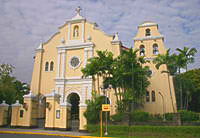 In this month’s E-spiration, we will look at a second popular shrine of St. Anthony located in the metro Manila area, known as Santuario de San Antonio. This shrine also came into existence because of the disappearance of the old St. Francis Church in Intramuros. The task of building this shrine to St. Anthony was entrusted to a Spanish Franciscan, named Father Jose Martinez, O.F.M. I personally remember encountering Father Jose during my first tour of duty in the Philippines (1969-1972) to teach English and literature at our Franciscan seminary in Quezon City. Father Jose told me that he remembered clearly how in 1945 he was standing in the bell tower of St. Francis Church in Intramuros watching the American bombing raids going on in the distance—obviously some days, weeks or hours before the church’s actual destruction.
After the Church of St. Francis in Intramuros was destroyed, the friars of the Manila-based Franciscan province decided to replace that church and build a new one somewhere outside Intramuros. And Father Jose Martinez was the friar commissioned to supervise the construction of the church. Father Jose’s intention from early on was to build a shrine to St. Anthony. The money for funding the construction of the church came from the sale of the lot where the old, revered church once stood in Intramuros.
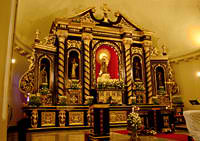 By the time the church was built and in operation, Father Jose was appointed pastor of the growing congregation. Ironically, what was built on lonely, swampy grassland would in time welcome an affluent congregation. Many members of the congregation would become top-ranking officials, businesspeople and politicians, living in beautiful homes with wide streets and tree-studded lawns. Thus, the area eventually known as Forbes Park became synonymous, in the minds of many, with wealth and prosperity.
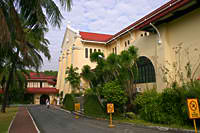 And yet, the popularity of St. Anthony, as well as the family-creating skills of friendly friars and staff, have encouraged thousands of people—rich and poor alike—to flow through the church’s doors and feel at home in the parish family. Week after week these people participate in the Masses and devotions and many other functions of this popular parish and shrine of St. Anthony. For more than 50 years, Franciscan friars and co-workers have striven, with God’s help, to minister to the needs of all who seek help, whether they are affluent or disadvantaged.
Visiting the Forbes Park shrine
When I visited Santuario de San Antonio last February, I had several opportunities to see the beautiful church and friary, as well as the various images of St. Anthony and other art work. I also witnessed the immense crowds participating in Sunday Mass. In addition, I had a chance to meet several of the friars who live or minister there and to sit down and chat a bit with Father Joel Sulse, O.F.M., head of the Franciscan community there.
 Father Joel explained that a nine-day solemn novena leads up to the feast of St. Anthony (June 13) each year. “This novena is very popular,” the 38-year-old friar told me. “The faithful come in large numbers. Between 700 and 800 people attend each of the four Masses and devotions each of the nine days.” This means that as many as 3,000 or so people might come for Mass on each day of the solemn novena. The 6 p.m. Mass is designated as the daily solemn novena Mass. “Of course, on the feast of St. Anthony itself, all the four Masses are well attended,” he said. In addition to the solemn novena before the feast, people can attend during the year the ordinary novenas for nine consecutive Tuesdays—and these are also quite popular, affirmed the friar.
There are other popular customs associated with the feast of St. Anthony, according to Father Sulse. For example, on the feast day, there might be an orchestra playing festive music after one (or some) of the Masses. Also, there is a colorful procession that goes around to a designated village in the vicinity of the shrine. The procession goes for about 2½ miles, and a statue of St. Anthony is pulled along on a carosa (or float). Tables are placed along the route with statues of St. Anthony on them. Another tradition at the shrine is the blessing of bread at all Masses during the feast day itself.
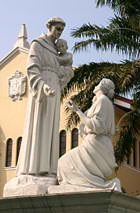 Another custom that many anticipate, most especially the workers in the villages, is the free breakfast served by members of the Secular Franciscan Order and the Catholic Women’s League. These meals, often a great blessing for the poor and disadvantaged, are served each day during the entire nine-day novena after the 6:15 a.m. Mass in front of the church. Normally, between 600 and 700 people are served each day. Among the workers enjoying these breakfasts are maids and gardeners employed by the well-to-do, security guards, construction laborers and workers in nearby shopping malls, as well as taxi and jeepney drivers.
More about Father Joel
Father Joel was born in Pandacan, Manila, but has lived a good part of his life on the Island of Samar in the Visayas. He was ordained in Santuario de San Antonio, where he was later given his present assignment. He also served earlier at the St. Anthony Shrine in Sampaloc, Manila, and at San Pedro Bautista Parish in San Francisco del Monte.
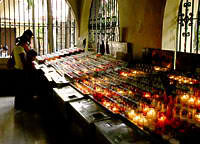 “St. Anthony is a very attractive saint,” said Father Joel, “because he is a miracle-worker. I believe St. Anthony became very popular because he touched and continues to touch people from all walks of life—rich and poor, young and old, scholar and simple person. And in contemporary times, many people come to pray to him because they feel lost.”
Copyright © Franciscan Media. Taken from Friar Jack E-spirations on http://www.AmericanCatholic.org and used with permission. All rights reserved.
 Santuario de San Antonio Parish