Categories
CCD

A DAY OF RECOLLECTION AND REFLECTION FOR CCD CONFIRMATION STUDENTS

7
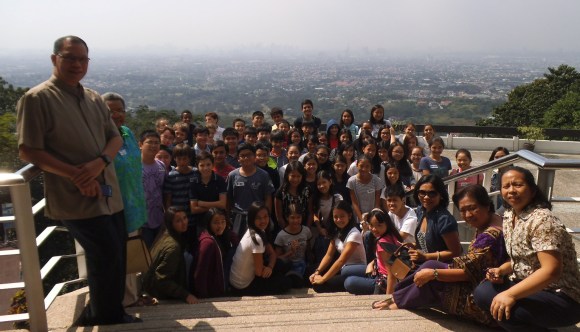
Confirmation students with Father Edwin Soliva, SDB, Facilitator, and teachers Rachelle Wenger, Mimi David, Yolanda Lomotan, Nancy Gonewai

The morning of Saturday, 23 January, dawned cool and sunny.  With happy anticipation, the CCD (Continuing Catholic Development) level 7 Confirmation students and their teachers gathered early at the Parish Centre – it was the day of their 2016 annual Recollection.  After a full briefing on the day’s program from the teachers, and a prayer for guidance and a safe journey, the group departed in two busloads from Santuario  de San Antonio Parish promptly at 8.00am  for the first part of their journey to Antipolo and the Eugenio Lopez Centre, the Recollection venue.

For the fifth year in a row, Father Edwin Soliva, SDB, was again the Facilitator and as in previous Recollections, his lecture, his advice, his counselling, his mentoring, his charisma – held the students spell-bound from the beginning to the end of the day’s activities.   The Recollection proper started at 9.00am and his opening remarks   were “Confirmation is allowing God to bring out the best in you and saying I CAN.”   And yet, he continued, of all the seven Sacraments, Confirmation is the most neglected, forgotten, and un-appreciated of all.  Therefore, as he told the students, he would teach them and show them how to receive, to respect and to sustain the coming of the Holy Spirit into their lives which would enable them to live their lives each day, to the fullest.

Father Edwin’s first talk was on the 3Ss  – stewardship  – the realization that we are mere caretakers and that all the blessings in life come from God;  simplicity –  the realization that there is a great God Who is in control and Who is the source of all our blessings; sharing – the realization that on receiving these many blessings, we not keep them to ourselves but share them with others just like Mary, when after the Annunciation, she travelled to visit and to serve her cousin, Elizabeth.

On Reflection, student, Gabe Bautista said “………… The last S is sharing and this means I should share what I have with others.  Sharing means to give but you don’t necessarily need to share objects, you can share knowledge and when you share knowledge, it means you teach something to others”.

Student Carina Samson, reflected on the final concept Father Edwin shared in his second talk on FEAR and LOVE.  Father Edwin demonstrated the difference between saying I can and I wish.   In her Reflection, Carina  said that Fear is a powerful force which can make man say “I wish I can but I can’t”   Love also is a powerful force that can make man say “If I want to make my dreams come true, I have to wake up and make them happen”.  “Father taught us how to sing the song I CAN by Donna Cruz –  ‘I’m so lucky I could smile, I didn’t know this for a while’ were the words which touched me the most because I used to complain about what I didn’t have in life instead of finding ways to enjoy the life I’m blessed with.”

The inspirational movie Father Edwin showed the students, FACING THE GIANTS, demonstrated what can happen if we allow the giants and failures to pull us down like what happened to the coach of the football team.  But his life turned around for the better when he surrendered his fear to God.  In his Reflection, Diego Lorenzana, concluded , “I like to think that fear and love are completely opposites.  Since it’s either being mediocre and being passionate.  ‘If we lose, we praise God, if we win we still praise God’ inspired the team’s determination never to give up.  Fear is always trying to fit in while love, is being yourself and showing passion to live the best life we can”.

As always, the day ended with the celebration of Holy Mass and thanksgiving for a truly wonderful and meaningful day.   The Chapel of the Eugenio Lopez Centre was standing room only and the presence of so many parents and siblings of the Confirmandi at Mass was indeed an affirmation to the teachers in particular, and to CCD in general, of the importance and the necessity of this annual Recollection, to fully prepare the students in the reception into their lives, of the Holy Spirit at Confirmation.  Part of the Offertory were  the students’ letters  to their parents in response to the parents’ Palanca to them.  Before the final blessing, the students read out loud to the congregation their individual “love dare” to make them realize that the Recollection was not an outing but instead, it was a great Timeout with their Coach (God), asking them to do something.

This Recollection has been special and unique in two ways : the students numbered the most with sixty-two who will be making their Confirmation in May; and the attendance rate was one hundred percent, breaking all CCD records – a sure testament to the teachers in prepping them well and mentoring to them, before the Recollection.

Categories
CCD

CCD Confirmation Rites

On the Saturday of May 23, 2015, from 8-10 am, the level 7 CCD (Continuing Catholic Development) students (aged 12 – 14) were blessed to receive the Sacrament of Confirmation, for the school year 2014-2015. The confirmandi were fifty-eight (58) in all, the largest number of recipients in CCD history. The presiding Bishop was His Excellency, the Most Reverend Francisco Mendoza de Leon D. D., Auxiliary Bishop of Antipolo, and the Concelebrant, our very own Parish priest – Fr. Reu Jose C. Galoy, OFM.

Beginning the school year last August 2014, the students were prepared for the reception of the Sacrament by basic catechetical instruction, immersing themselves more about Jesus’ life through Bible reading and film showing, learning prayers and doctrine through the aid of their textbook, “The Story of Jesus” in the Blessed Are We series, plus lessons on the Gifts of the Holy Spirit. To assist and enhance the students along this path of their religious learning, CCD also provided a supplementary program consisting of a one-day Recollection, attendance to which was mandatory; and an afternoon set aside specifically for talks and discussions on the Holy Spirit. A program of prayer and praying was also an integral part of the Confirmation syllabus; and with the encouragement of their teachers and the support of the CCD committee, the confirmandi translated into action their acquired knowledge and faith through their outreach activity in ”TOPS”(a facility dedicated to the prevention of juvenile delinquency).

The elegant and regal apparel of the students (with the girls clad in a uniform “off-white” beaded dresses, and the boys in their jusi barongs and black trousers) on the rite itself, made them both interiorly and physically prepared to receive the Holy Spirit in this Sacrament. The confirmandi renewed their Baptismal promises with the pledge of support by parents and godparents. The “Laying of the Hands” and the “Anointing with Chrism” by the presiding bishop, and his invocation of “Gifts of the Holy Spirit,” implored our Lord God to fill them with his Spirit and seal them with the sign of the cross of Christ so that they may obtain everlasting life.

The CCD ministry, through guidance of the Holy Spirit, the benign pastorship of our parish priest Fr. Reu and all the SSAP priests, the dutiful compliance of the students, parents and godparents, the unwavering, generous leadership of the CCD committee (Lia Te- CCD chairperson, Katty Qua and Marivic Ortigas-Borromeo), the cheerful support of Leah Azarcon- office assistant, the guidance of CCD teachers Nancy Gonewai, Rachelle Wenger, Mimi David, Yolanda Lomotan and Marga Gregorio, the staff of SSAP, worked together as a team to realize yet another milestone in this Confirmation rite.

The beautifully captured photography of Lino Tey, the angelic voices of the Lester Delgado choir, the fresh and dramatic floral arrangements by Tony Padilla in the venue of our very own Santuario de San Antonio parish Church, contributed to this most memorable occasion.

“By the Sacrament of Confirmation the faithful are more perfectly bound to the Church and are endowed with the special strength of the Holy Spirit. Hence they are, as true witnesses of Christ, more strictly obliged to spread the Faith by word and deed “(VATICAN II, Lumen Gentium, no. 11).

Categories
Cathechism of the Catholic Church

Catechism of the Catholic Church

But we have Baptism, which reconciles us with God; why
then do we need a special sacrament of Reconciliation?

Baptism does snatch us from the power of sin and death and
brings us into the new life of the children of God, but it does not
free us from human weakness and the inclination to sin. That is
why we need a place where we can be reconciled with God again
and again. That place is confession.

It does not seem like a modern thing to go to confession; it can
be difficult and may cost a great deal of effort at first. But it is one
of the greatest graces that we can receive again and again in our
life, it truly renews the soul, completely unburdens it, leaving it
without the debts of the past, accepted in love, and equipped
with new strength. God is merciful, and he desires nothing more
earnestly than for us, too, to lay claim to his mercy. Someone
who has gone to confession turns a clean, new page in the book
of his life.

Who instituted the sacrament of Penance?
Jesus himself instituted the sacrament of Penance when
he showed himself to his apostles on Easter day and
commanded them, “Receive the Holy Spirit. If you forgive
the sins of any, they are forgiven; if you retain the sins of any,
they are retained.” (Jn 20:22a-23)

Nowhere did Jesus express more beautifully what happens
in the sacrament of Penance than in the parable of the
Prodigal Son: We go astray, we are lost and can no longer cope.
Yet our Father waits for us with great, indeed, infinite longing;
he forgives us when we come back; he takes us in again,
forgives our sins. Jesus himself forgave the sins of many
individuals; it was more important to him than working miracles.
He regarded this as the great sign of the dawning of the
kingdom of God, in which all wounds are healed and all
tears are wiped away. Jesus forgave sins in the power of
the Holy Spirit, and he handed that power on to his apostles.
We fall into the arms of our heavenly Father when we go to
a priest and confess.

Who can forgive sins?
God alone can forgive sins. Jesus could say “Your sins
are forgiven” (Mk 2:5) only because he is the Son of God.
And priests can forgive sins in Jesus’ place only because
Jesus has given them that authority.

Many people say, “I can go directly to God; why do I need
a priest?” God, though, wants it otherwise. We rationalize
our sins away and like to sweep things under the rug. That is
why God wants us to tell our sins and to acknowledge them
in a personal encounter. Therefore, the following words from
the Gospel are true of priests: “If you forgive the sins of any,
they are forgiven; if you retain the sins of any, they are retained.”

What sins must be confessed?
Under normal circumstances, all serious sins that one remembers after
making a thorough examination of conscience and that have not yet been
confessed can be forgiven only in individual sacramental confession.
Of course there will be reluctance before making a confession. Overcoming it
is the first step toward interior healing. Often it helps to think that even the Pope
has to have the courage to confess his failings and weaknesses to another priest –
and thereby to God. Only in life-or-death emergencies (for instance, during an
airstrike in wartime or on other occasions when a group of people are in
danger of death) can a priest administer “general absolution” to a group
of people without the personal confession of sins beforehand. However,
afterwards, one must confess serious sins in a personal confession at the
first opportunity.

When is a Catholic obliged to confess his serious sins? How often should
one go to confession?

Upon reaching the age of reason, a Catholic is obliged to confess his serious sins.
The Church urgently advises the faithful to do this at least once a year. At any
rate one must go to confession before receiving Holy Communion if one has
committed a serious sin.

By “the age of reason”, the Church means the age at which one has arrived at the
use of reason and has learned to distinguish between good and bad.

Can I make a confession even if I have not committed any serious sins?
Confession is a great gift of healing that brings about closer union with the Lord,
even if, strictly speaking, you do not have to go to confession.
In Taizé, at Catholic conferences, at World Youth Day celebrations – everywhere,
you see young people being reconciled with God. Christians who take seriously
their decision to follow Jesus seek the joy that comes from a radical new beginning
with God. Even the saints went to confession regularly, if possible. They needed it
in order to grow in humility and charity, so as to allow themselves to be touched
by God’s healing light even in the inmost recesses of their souls.

Why are priests the only ones who can forgive sins?
No man can forgive sins unless he has a commission from God to do so and the
power given by him to ensure that the forgiveness he promises the penitent
really takes place. The bishop, in the first place, is appointed to do that and, then,
his helpers, the ordained priests.

Are there sins that are so serious that not even the average
priest can forgive them?

There are sins in which a man turns completely away from God and at the
same time, because of the seriousness of the deed, incurs excommunication.
When a sin results in “excommunication”, absolution can be granted only by
the bishop or a priest delegated by him, and, in a few cases, only by the Pope.
In danger of death, any priest can absolve from every sin and excommunication.
A Catholic who, for example, cooperates in an abortion automatically excludes
himself from sacramental communion; the Church simply acknowledges this fact.
The purpose of “excommunication” is to correct the sinner and to lead him
back to the right path.

May a priest later repeat something he has learned in confession?
No. Under no circumstances. The secrecy of the confessional is absolute.
Any priest who would tell another person something he had learned in the
confessional would be excommunicated. Even to the police, the priest cannot
say or suggest anything.

There is hardly anything that priests take more seriously than the seal of the
confessional. There are priests who have suffered torture for it and have gone
to their deaths. Therefore, you can speak candidly and unreservedly to a priest
and confide in him with great peace of mind, because his only job at that moment
is to be entirely “the ear of God.”

What are the positive effects of confession?
Confession reconciles the sinner with God and the Church.
The second after absolution is like a shower after playing sports, like the
fresh air after a summer storm, like waking up on a sunlit summer morning,
like the weightlessness of a diver … . Everything is contained in the word
“reconciliation” (from a Latin verb meaning “to bring back together, to restore”):
we are at peace with God again.

Categories
CCD

“Confirmation 2014” by Rachelle Wenger

confirmation 2014Another year has passed, another batch of students have patiently attended their CCD (Continuing Catholic Development) classes and finally have reaffirmed their Catholic vows and received the Holy Spirit through the Sacrament of Confirmation.

I still vividly recall how on the first day of the school year, I was nervous as to how to teach teenagers and make them enjoy, learn, and appreciate, at the same time, the teachings of our faith and to know God on a more personal level and understand what Jesus went through and hopefully be mature enough to understand what receiving the Holy Spirit means. How do I let these messages become adaptable to their teen years when they themselves have a lot of questions and conflicts with the many changes this age brings?

I guess, I myself had to open up to the Holy Spirit to allow the Spirit’s wisdom and grace to open my mind and heart to be able to touch these children’s lives in that one hour we have together every Sunday.

As our officiating bishop, Bishop Mylo Hubert Vergara, has shared during his homily, there are 3 things that the Confirmandi need to take with them: Pray to God daily, in whatever state or mood one is in, pray. Whether happy or sad, grateful or needy, pray. It is a beautiful habit for one to offer our daily lives conversing with our God, makes us feel closer to Him, makes Him become more real to us, makes Him work in our lives even more.

Next is to celebrate Jesus in the Eucharist, by receiving Christ, we strengthen our bond with Him and hopefully as we receive Jesus’s real body through the sacrament, we are more aware of our thoughts, words and actions.

Lastly, and I think was such a beautiful parting word was to imitate Christ. He is the ultimate role model and the best human being to walk the earth. As we are all created in the likeness of God and Christ is our brother, difficult as it may be, we have it all in ourselves to be like Christ, to imitate Him. To reflect on things we say and do and be consciously aware if this is pleasing to our Creator who at all times is watching over us and aspire to live a moral life are just some things we can do. Being kind to others even at challenging times is a real manifestation of how God loves us.

This year’s batch had 37 students all beautifully confirmed by Bishop Mylo Hubert Vergara and assisted by our new parish priest, Fr. Reu Galoy, OFM. Of course, a big thank you to the CCD Committee — Lia Te, Marivic Borromeo, Katty Qua and Nancy Gonewai, with the help of Leah Azarcon, for patiently working hard to make the whole school year a success. Special thanks also go to our Curriculum Head, Libet Virata, our commentator Karen Blanco, our Liturgical Coordinator Jojo Leveriza, our Speech and Comportment coach Juno Henares Chuidian, CCD teachers Mimi David, Uwa Tambunting, lay ministers and altar servers Jentry Arbis, Andrew Romualdez, Christie Nair and Paco Borromeo for their dedication and assistance, the Psalm 47 Men’s Choir for the beautiful music which made the event even more meaningful. Thank you also to Betta Kramer, CCD treasurer and Conifrmation Committee member together with Gina Roxas.

Thank you also to the parents who are our co-educators and role models in raising good Catholics. Most specially, thank you to my co-teachers in Confirmation, Nancy Gonewai and Yolanda Lomotan for lovingly, passionately and tirelessly teaching the students how it is to love God and live a truly virtuous Catholic life.

The year has ended, the students have graduated and confirmed, certificates were given, photos were taken, tears of joy were shed, these I will take with me as I journey again on the next path to meeting the next batch of Confirmandi. And just like in any beginning and ending, it is the journey with the new batch of students in leading them closer to our Creator that I most look forward to.

Categories
Cathechism of the Catholic Church

Catechism of the Catholic Church

(continued from the Parish Bulletin June 8, 2014 Issue)

What does Sacred Scripture say about the sacrament of Confirmation?
In the Old Testament, the People of God expected the outpouring of the Holy Spirit upon the Messiah. Jesus lived his life in a special Spirit of love and of perfect unity with his Father in heaven. This Spirit of Jesus was the “Holy Spirit” for whom the people of Israel longed; this was the same Spirit whom Jesus promised to his disciples, the same Spirit who descended upon the disciples fifty days after Easter, on the feast of Pentecost. And it is again this same Holy Spirit of Jesus who descends upon everyone who receives the sacrament of Confirmation.

In the Acts of the Apostles, which were written a few decades after the death of Jesus, we see Peter and John traveling about to confirm new Christians by imposing hands on those who previously “had only been baptized in the name of the Lord Jesus,” so that their hearts might be filled with the Holy Spirit.

What happens in Confirmation?
In Confirmation the soul of a baptized Christian is imprinted with a permanent seal that can be received only once and marks this individual forever as a Christian. The gift of the Holy Spirit is the strength from above in which this individual puts the grace of his Baptism into practice through his life and acts as a “witness” for Christ.

To be confirmed means to make a “covenant” with God. The confirmand says, “Yes, I believe in you, my God; give me your Holy Spirit, so that I might belong entirely to you and never be separated from you and may witness to you throughout my whole life, body and soul, in my words and deeds, on good days and bad.” And God says, “Yes, I believe in you, too, my child and I will give you my Spirit, my very self. I will belong entirely to you. I will never separate myself from you, in this life or eternally in the next. I will be in your body and your soul, in your words and deeds. Even if you forget me, I will still be thereon good days and bad.”

Who can be confirmed, and what is required of a candidate for Confirmation?
Any Catholic Christian who has received the sacrament of Baptism and is in the “state of grace” can be admitted to Confirmation.
To be “in the state of grace” means not to have committed any serious sin (mortal sin).
By a serious sin a person separates himself from God and can be reconciled with God only by making a good confession. A (young) Christian who is preparing for Confirmation finds himself in one of the most important phases of his life. He will do everything possible to grasp the faith with his heart and his understanding; he will pray alone and with others for the Holy Spirit; he will reconcile himself in every way with himself, with the people around him, and with God. Confession is part of this, since it
brings one closer to God even if one has not committed a mortal sin.

Who may confirm?
The Sacrament of Confirmation is normally administered by the bishop. For weighty reasons when necessary, the bishop can also delegate a priest to do it. In danger of death, any priest can administer Confirmation.

Design a site like this with WordPress.com
Get started