Categories
The ABC’s of Catholic Doctrine

“Pope Francis is coming to town!”, The ABC’s of Catholic Doctrine By Lianne Tiu

1

Four more days to go – as we continue to find ways and means on how we can get close to the Holy Father or be a part in the meetings and Masses that he will be celebrating during his visit to the Philippines.

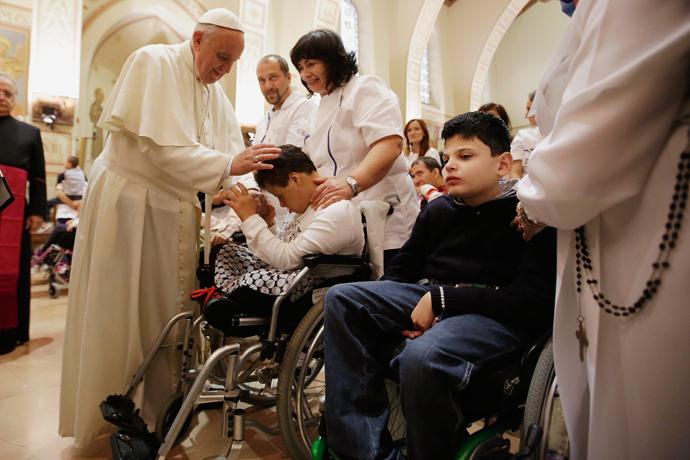
Pope Francis is the Vicar of Christ on earth, the bishop of Rome, the successor of St. Peter. He is the leader of the 1.2 billion Catholics. He has gained many fans around the world because of his personal holiness and simple living.

We are not, however, to treat the pontiff like some kind of celebrity or rock star. Rather, we are to look at the message he is trying to tell us. He is coming here primarily to comfort our people who have suffered from the typhoons and earthquake that have hit the Visayas. He is imitating Jesus, who after seeing the people, felt compassion for them for they were distressed like sheep without a shepherd. (Matt9:36) We, too, are challenged to imitate Jesus by resolving to make an act of mercy everyday. It may be to visit our lonely grandmother, to adjust the low salary of an employee, to attend a funeral, to lovingly correct a friend who is using contraceptives, or engaging in marital infidelity, or contemplating to undergo in vitro fertilization (IVF).
3

The papal visit is a good time to re-learn and live the corporal and spiritual works of mercy. It is also a good time to meet Jesus in the Tribunal of Mercy, which is the Sacrament of Penance. In Confession, He (in the person of the priest) waits for us with open arms to show his love, mercy, and compassion.

Yes, Pope Francis is coming to town. And he wants to lead us to Jesus Christ, who is Mercy and Compassion.
2
(Reference: papalvisit.ph “Pope Francis Papal Visit 2015 Mercy and Compassion”; “The Faith Explained” by Leo Trese; Vatican Radio)

7 Corporal Works of Mercy:
To feed the hungry
To give drink to the thirsty
To clothe the naked
To visit the imprisoned
To shelter the homeless
To visit the sick
To bury the dead

7 Spiritual Works of Mercy:
To admonish the sinner
To instruct the ignorant
To counsel the doubtful
To comfort the sorrowful
To bear wrongs patiently
To forgive all injuries
To pray for the living and the dead

Categories
The ABC’s of Catholic Doctrine

“So great a God, so tiny an infant!”, The ABC’s of Catholic Doctrine By Lianne Tiu

15

St. Francis of Assisi repeated these words with tears of joy as he knelt at the first Christmas crib. He was the first to introduce the Nativity scene in 1223, after obtaining permission from Pope Honorius III.

“So great a God, so tiny an infant!” God, who made heaven and earth, came into the world without any ostentatious display of live bands or gun salutes. He spent nine months in His mother’s womb, like all of us, following the natural course of events. He took the form of a tiny defenseless baby. No one knew about Him except Mary and Joseph; later on, the shepherds and the three wise men. There was no room for Him at the inn; so there He was, the Lord of all creation, born in a manger. Since the time of Adam and Eve, the whole world waited for the promised Savior. And this most-awaited event in our history took place in a quiet and unspectacular way.
8

God’s greatness is hidden in a manger, in swaddling clothes, in a stable. During this Christmas season, let us contemplate on Jesus’ birth and imitate Him. We resolve be humble and simple like Him. How often we desire to be the center of attention, to be loved and praised by everyone, and to always appear in good light. We are not content to do good and disappear. We must stop thinking about ourselves and feel the responsibility to help others. We ask Jesus, Mary and Joseph to help us to be simple before God and others. And we try to learn from the greatness of this Child who is God!
14
(Reference: “Celebrating with God” by Fr. M. Guzman, “In Conversation with God Vol 1” by Francis Fernandez, “Do You Want to be Great” by Fr. Charles Belmonte; “Christ is Passing By” by St. Josemaria Escriva)

Categories
The ABC’s of Catholic Doctrine

“Immaculate Misconception?”, The ABC’s of Catholic Doctrine By Lianne Tiu

7
There seems to be a widespread misunderstanding of the word “Immaculate Conception.” Most of us think it is the conception of Jesus by Mary, who is a virgin. Because of this, the “Immaculate Conception” is sometimes jokingly referred to as the “Immaculate Misconception”.

The conception of Jesus by Mary is called the Incarnation of Christ. To incarnate means to become flesh. The Son of God, became flesh; He became man. The conception of Mary by Anne, on the other hand, is called Immaculate Conception. Immaculate means without stain. Mary was free from original sin at the moment of her conception.
8
We celebrate the Incarnation of Christ (also called the Annunciation) on March 25, nine months before Christmas Day. We celebrate the Immaculate Conception on December 8, nine months before Mary’s birthday on Sept. 8.

The belief that our Lady was conceived without sin existed since the early Church; and Pope Pius IX formally proclaimed it as a dogma of faith in 1854.A dogma is a statement declaring to the world that God has revealed this truth which all men should believe. About 3 years after the declaration, Mary herself confirmed the infallible words of the Pope. She appeared to a young girl named Bernadette at Lourdes, France. When asked who she was, her answer was: I am the Immaculate Conception!
9
(Reference: “What Is the Immaculate Conception” by Scott Richert; Immaculate Conception and Virgin Birth (The Nazarene Way of Essenic Studies); IneffabilisDeus (Apostolic Constitution issued by Pope Pius IX on December 8, 1854; “God’s Kindness to Mankind” by Pope Pius XII).

Categories
The ABC’s of Catholic Doctrine

Can we choose to die at our own terms? The ABC’s of Catholic Doctrine By Lianne Tiu

5

Recently, we heard the sad and highly publicized story of 29 year-old Brittany Maynard, who was diagnosed with terminal brain cancer and decided to take her own life. Some suicide advocates are using her story to fuel emotions and to market the idea of “death with dignity” – that people should be able to have a choice to end their lives if they are suffering. They also want the government to legalize physician-assisted suicide. Maynard’s story is making us consider an issue, which we haven’t thought of before – that of accepting suicide and euthanasia.

Suicide is taking our own life. Euthanasia is assisting death to someone who is suffering. We have to be reminded that both are sins against the fifth Commandment, “Thou shalt not kill.” Nowadays, we hear people talking about their rights, their choices. “Who has the right to tell me that I deserve to suffer greatly for years?” “Why can’t I have the right to choose when, how and where to die?” God alone is Lord of life and death. (Deuteronomy 32:39; Job 12:10, 1Samuel 2:6) He created us. He alone has the right to decide when we should die. We are not the master of our own lives. If we are in pain, if we are unhappy with our lives, God wants us to endure our suffering patiently for a higher purpose, which we sometimes cannot understand. Euthanasia, on the other hand, is actually false mercy.

4

Our intention may be good; we want to alleviate or cease the suffering of the sick, elderly or the dying. But such action or omission, which causes death is evil. We do not have the right to dictate when and who should live or die. When a person in extreme pain expresses his desire to end his life, we must refuse (even if his sickness is incurable and is at the last stage of life). True compassion is to help him, to give him our love and patience, to pray for him, and to teach him about the redemptive and purifying value of suffering. We also ask the priest to administer the sacrament of anointing the sick (which can help eliminate his fear and anxiety and can help him accept suffering and death). Our help is not to hasten death or to assist him in killing himself.

(Reference: The Faith Explained Today by Joe Babendreier; “Brittany Maynard Ends her Life” by Sheila Liaugminas {Sheila Reports Nov. 3, 2014})

Categories
The ABC’s of Catholic Doctrine

“Inner Beauty Exceeds Any Fashion Statement” The ABC’s of Catholic Doctrine By Lianne Tiu

9

We are saddened to hear the demise of legendary fashion designer Oscar de la Renta, who spent half a century putting high society in haute couture. The world gives much significance to fashion.

Something else, however, is more important than fashion. And this is what supports the dress, of what is inside: the intimacy of the person. What is more valuable than the dress is the inner beauty – the compassion, truth, modesty, humility, …all the good qualities that are within us. It makes us radiate an aura of goodness, of holiness. And this is what makes us beautiful.

People underestimate their inner beauty maybe because of the strong influence of media and fashion designers who place so much importance on the exterior. Outer beauty may attract, but inner beauty captivates. As Audrey Hepburn states, “…true beauty in a woman is reflected in her soul…” When we live in the state of grace (when we are not in mortal sin and in good relationship with God), we actually possess an aura that far exceeds any fashion statement.

(Reference: Dressing with Dignity by Colleen Hammond; A Modesty Proposal by Rev. T.G. Morrow )

10

Categories
The ABC’s of Catholic Doctrine

“Pain and Joy in Purgatory”, The ABC’s of Catholic Doctrine By Lianne Tiu

1

Souls in purgatory experience two forms of punishment: the pain of loss and the pain of sense.

The pain of loss is a delay in the vision of God. As the souls in purgatory are interested in God and not in created goods anymore, their desire to possess God is extremely intense. But they cannot enjoy Him until they have totally expiated their faults and the punishment of their sins.

The pain of sense, on the other hand, is referred to in several documents of the Magisterium as fire. This fire’s way of operating is mysterious though. Also, St. Augustine wrote that purgatory’s pain of sense is more severe than anything man can suffer here on earth.

The purpose of the punishment in purgatory is to cleanse the soul so that it can reach the total purity required to enjoy the Beatific Vision.

untitled

It is hard to imagine that there is joy in purgatory. But it’s true – purgatory is not a sad “place.” It is rather the opposite, in spite of the pains. Although the souls suffer greatly, their joys and consolations are beyond description. This is because they know that they are sure to enter heaven; they are comforted and they enjoyed the spiritual help of the Blessed Virgin, the angels and the saints. Moreover, their pains can be reduced through our help, most importantly through the Holy Mass. We can also offer sacrifices and penances on their behalf, gain indulgences for them, pray for them, and give alms in their memory.

(Reference: “The Last Things” by Carlos Escartin in “Faith Seeking Understanding Vol. II”)

Categories
The ABC’s of Catholic Doctrine

“Rediscovering a Treasure” The ABC’s of Catholic Doctrine By Lianne Tiu

13

There is a wealth of prayer that is contained in a simple Marian devotion called the Holy Rosary. It is a prayer loved by countless saints including St. John Paul II, St. Padre Pio, and St. John XXIII. It is a prayer encouraged by our Lady herself at Lourdes and Fatima.

Some people find the rosary boring and meaningless. To them, it is just some repetitious prayer babbling the Hail Mary’s. Indeed, it can be noise, a clatter of tin cans, as St. Josemaria would call it, if we pray without reflection, when our minds and hearts are far away. Pope Paul VI (whose beatification is on next Sunday) pointed out: “Without contemplation, the rosary is a body without a soul, and its recitation runs the risk of becoming a mechanical repetition of formulas…”

What do we contemplate on? In the Rosary, we meditate on the life of Jesus from his infancy (the joyful mysteries), through his public life (the luminous mysteries), to his passion and death (the sorrowful mysteries), and resurrection (the glorious mysteries). That is why the Rosary can be said to be a “compendium of the Gospel.” It has all the depth of the Gospel message in its entirety. Although it is clearly Marian in character, it is at heart a Christocentric prayer.

12

We can learn a lot about Jesus from Mary; as the Rosary is actually a meditation with Mary on Jesus. Among all creatures, no one knows Jesus better than his Mother. As we contemplate on the scenes of the rosary, we learn from her to “read” Christ, to discover his secrets, and to understand his message.

The Rosary, aside from being a meditation centered on Jesus, is also a prayer addressed to the Father, to the Blessed Virgin, and to the Holy Trinity. This is the real secret that makes this prayer so powerful and effective. St. Padre Pio called the Rosary beads a weapon of extraordinary power against Satan. Father Gabriel Amorth, chief exorcist of the Vatican, explained that his colleague heard the devil saying during an exorcism: “Every Hail Mary is like a blow on my head. If Christians knew how powerful the Rosary was, it would be my end.”

Let us grab those beads and start praying the rosary daily. The best time is when we have fifteen minutes or so to finish the entire prayer. But if it is not possible, we can do it while travelling in a car, bus or plane, while in the hospital bed, while waiting in line at the supermarket, or for a dentist appointment or business meeting, If we have no time, we can start with just one decade (which consists of an Our Father, 10 Hail Mary’s and a Glory Be) or two each day. Gradually, we can increase the number of decades until we complete a set of five mysteries.

October, the month of the Rosary, provides us an excellent opportunity to rediscover this priceless treasure and to grow in this Marian devotion.

(Reference: Apostolic Letter “Rosarium Virginis Mariae” by St. John Paul II; Encyclical “Octobri mense” by Pope Leo XIII; “Question Time” by Fr. John Flader; “You can become a Saint!” by Mary Ann Budnik; “Echo of Mary, Queen of Peace” by Father Gabriel Amorth)

Categories
The ABC’s of Catholic Doctrine

“What is the Importance of a Beatification or a Canonization?,” The ABC’s of Catholic Doctrine by Lianne Tiu

3
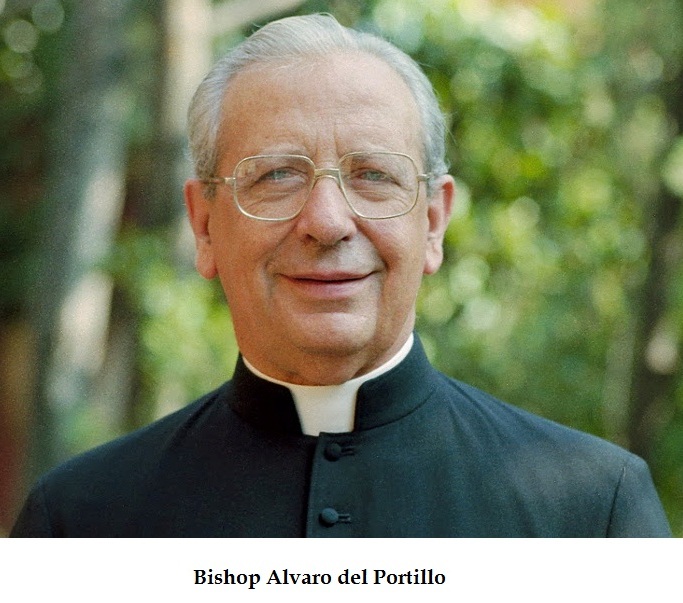
Last April 2014, we witnessed the canonization of two great popes: John Paul II and John XXIII. Today (on Sept. 27), Bishop Alvaro del Portillo, successor to Saint Josemaria and first Prelate of Opus Dei, is to be numbered among the blessed; the ceremony taking place in Madrid, Spain. These events make us ponder on the significance of the beatification and canonization.

Pope Francis, in referring to the saints, said, “God chooses certain people so that we might see more clearly the reality of sanctity, so that we might see that it is He who sanctifies . . . This is the first rule of sanctity: Christ must increase and we must decrease.” (Homily, 9 May 2014).
5

The examples of the saints inspire us to imitate them. The canonization and beatification reminds us that it is possible for us to be like them –SAINTS! We have the mistaken idea that saints are super heroes. Pope Emeritus Benedict XVI wrote: “It is not for me,’ we are led to think, ‘because I do not feel capable of attaining heroic virtue. It is too high a goal.’ Holiness then becomes a thing reserved for some “greats” whose images we see on the altars, and who are completely different from us ordinary sinners. But this is a mistaken notion of holiness…”

A saint is not superior to others; he can be very weak, with many mistakes in his life. What makes him different is that he keeps on struggling – getting up after each fall. He does not live extraordinary life. What makes him holy is the love and care that goes into the ordinary experiences of each day. It is his profound contact with God, becoming His friend. It is letting God work, the Only One who can give him the graces and the help to achieve heaven – to be eternally with the Blessed Trinity and to belong forever to the great family of God.

Today, let us resolve to begin our journey to become saints.

(Reference: “Sanctity: Everyone’s Vocation” an article by Bishop Javier Echevarria published in “Palabra;” “You can become a Saint!” by Mary Ann Budnik; “Letting God Work” an article by Cardinal Joseph Ratzinger, in L’Osservatore Romano, October 6, 2002.)

Categories
The ABC’s of Catholic Doctrine

“Late for Mass – A Sign of Lack of Love for God?”, The ABC’s of Catholic Doctrine by Lianne Tiu

7
Sunday after Sunday, many of us arrive late for Mass. Some of us justify: “It is our day of relaxation; and well, at least we still attend Mass.” An hour of the 168 hours a week is too precious to waste on a boring and repetitious Sunday obligation. And we ask: At what point can we get away and not be considered really late for Mass?

There is no official teaching of the Church on this issue. But before Vatican Council II, some moral theology manuals placed arrival before the Offertory as the dividing line on whether we fulfill the Sunday Mass* obligation. But if we consider the importance of the Liturgy of the Word and the unity of the Mass, the cut-off point should be at the beginning of the readings. Yet, it is difficult to give a precise cut-off moment as it gives a wrong message that some parts of the Mass are not that important.
5
Mass begins with the entrance procession and ends after the final dismissal. We should be there from beginning to end (and until the priest leaves, as a sign of respect for the priesthood). Each part of the Mass relates and complements the others in a single act of worship even though some parts are essential while the others are merely important. Ideally, it is good to arrive some time before the Mass begins in order to recollect our selves and to prepare for it in silent prayer.

During Sunday, to miss a small part of the Mass (for example, coming in at the readings or leaving at the last blessing) is a venial sin. To miss the principal parts of the Mass (Offertory, Consecration, or Communion**) is a mortal sin, if our failure to be present is deliberate. It is because it is almost equivalent to missing the entire Mass. Thus, if we are late for Sunday Mass, it is better to attend another Mass so that we are present for the entire Mass.

If we arrive late for Mass, we have to honestly ask ourselves, Why? If it is because of some justified reason or an unforeseen event, such as blocked traffic due to an accident, we have acted in good conscience and are not strictly obliged to attend another Mass (but may do so, if it is possible).
6
If we arrive late due to culpable negligence, and especially if we do so habitually, we have to examine ourselves, change our ways, and go to confession.

St. Josemaría wrote: “You say the Mass is long and, I add, because your love is short.” Let us seriously think about it.

*It also applies to Holyday of Obligation Mass and anticipated Mass.
**We are not obliged to receive Communion at Mass; more so if we have mortal sin in our souls.

8

(Reference: “My Catholic Faith” by Rev. Louis LaRavoire Morrow; “The Faith Explained” by Leo Trese; “Question Time 2” by Fr. John Flader; “Liturgy: Communion for Late Arrivals at Mass?” by Fr. Edward McNamara; “If Mass Is Boring” By Jesus Colina)

Categories
The ABC’s of Catholic Doctrine

The ABC’s of Catholic Doctrine: Do We have to Make “Beso-Beso” with Priests? by Lianne Tiu

4

“Beso-beso” which originated from the Spanish word for “kiss,” has become a common greeting in the Philippines. It is a cheek-to-cheek kiss between a man and a woman, a parent and a child, two women, or two men. For many upper class- Filipinos, it is a normal greeting among relatives and close friends, and there is no squeamishness about it. However, there are situations which we can ask ourselves if this social gesture extends to people we meet for the first time, to casual acquaintances, to business people, or to church leaders? There are instances when we notice older men taking advantage by making “beso-beso” with younger or pretty girls. Would not a smile or a handshake be a better alternative in these situations?

7a

With regards to clerics, we have to be aware that they have a vow of chastity. In fact, Canon 277 reminds them: “Clerics are to conduct themselves with due prudence in associating with persons whose company could endanger their obligation to observe continence or could cause scandal for the faithful.” Women and young girls should have a delicate reserve in their dealings with priests. Instead of making “beso-beso,” they may greet the priests with a smile or a handshake and a “Good morning/afternoon/evening, Father.” Men may give them a hug (if they are the hugging type). It is also good to be familiar with some forms of address to show respect to them. We greet the Pope as “Your Holiness,” “Most Holy Father,” or “Holy Father;” the Cardinal as “Your Eminence;” the Archbishop and Bishop as “Your Excellency;” a Monsignor as “Monsignor;” and the Priest as “Father.”

8

Avoiding “beso-beso” with the priests is our way of showing deep respect for them – these men who are entirely consecrated to Christ and to the Church.

Reference: “How to Address Church Officials” by Father William Saunders; “Priestly Celibacy in the Code of Canon Law;” “Training for Priestly Celibacy” by Pope Paul VI; Wikipedia

Design a site like this with WordPress.com
Get started