Categories
Random Thoughts by Peachy Maramba

RANDOM THOUGHTS Voices from yesterday and today . . . By Peachy Maramba

1

ST. PAUL of the CROSS:
Founder of the Passionist Congregation
1694-1775

October 19

Early Life
Paolo Francesco Danei now known as St. Paul of the Cross was the eldest of 16 children of Luke Danei and Ann Marie Massari both exemplary Christians. He was born on 3 January 1694 in the town of Ovada, Italy (then the Republic of Genoa). His family was noble but impoverished who had become merchants in Lombardy, Italy.

Not much is written about his early life except that from earliest years he showed signs of a great love for prayer especially before the Blessed Sacrament and for contemplation. So his childhood was spent in piety and great innocence.

It is to his mother that he owes his special devotion to the Sacred Passion of our Lord as she would always show him as a little boy the crucifix whenever he cried tears of pain or annoyance. Then she would tell him simply about how our Lord suffered.

It is to his father, on the other hand, that he was inspired by the stories of the lives of saints which he would often read aloud to his large family cautioning them against fighting and gambling.

Even at an early age he already exhibited a capacity for spiritual leadership when he organized a religious society among the youth of the neighborhood. While an adolescent, he was determined to devote himself to the service of God.

When he was fifteen after hearing a sermon on the Passion of Jesus, he adopted a lifestyle of prayer, rigorous austerity and great mortification at his home at Castellazzo, Lombardy.

Joins the Army
At first in 1714 he thought he would be serving God by joining the Venetian army to fight against the Turks. But after only a year he realized that the army was not his vocation. Moreover he was affected profoundly by the experience. When he was discharged a year later he refused a good inheritance and promising marriage to a wealthy girl. Instead he decided to follow his inner desire for a spiritual vocation so he became a recluse and went back to his earlier life of prayer and penance.

Dedicates his Life to God
In 1720 at the age of 26 he finally dedicated his life to God and was clothed in the habit of a hermit by the bishop of Alexandria Bishop Gastinara.

The following day he began a 40-day retreat in a room off the sacristy in the church of St. Charles at Castellazzo in Lombardy.

His Visions Begin
That year he had several extraordinarily vivid visions of the Blessed Mother in a black habit with the name of Jesus in white character surmounted by a cross in white on the chest. On the third occasion she told him to found a new religious Order or congregation devoted to preaching and mourning continually for the Passion and death of Christ, her Son. So Paul became determined to share with believers his profound awareness of the immense suffering Jesus endured as he hung on the cross.

In an ecstasy he beheld the black habit which he and his companions were to wear and which the Passionists still wear to this day. He received several other mystical visions instructing him on how to found the religious order.

Starts Founding the Order
After consulting with his Bishop-director of Alessandria who decided that the visions were authentic he decided to act on God’s wishes that he establish a congregation in honor of the Passion of Jesus Christ.

On November 22 of that same year the Bishop gave him the habit that had been shown to him in a vision. From then on Paul busied himself preparing the Rule of Life for his congregation the “Discalced Clerks of the Cross and the Passion” better known as the Passionist Congregation. He claimed he was divinely inspired to write the Rule during his 40 days retreat. It was also at this time that Paul first felt compelled for the conversion of England. His aim was to combine monastic virtue with active missionary work. Paul chose as their badge a heart with three nails in memory of the sufferings of Jesus.

Once the Rule was drawn up in 1721 Paul and his brother John the Baptist (who became his closest confidant and inseparable companion) set off for Rome seeking papal approval of their Rule.

At first try he failed so badly he was not even received inside the Vatican.

On their return home Paul was enthralled by the beauty of Monte Argentario that he decided to live there as hermits with his brother. In 1725 Pope Benedict XIII granted them permission to accept novices. So, seven years later in 1727 after receiving priestly ordination the two brothers founded the Passionist Congregation or the Barefooted Clerks of the Holy Cross and Passion starting community life in a small hermitage on Mount Argentario near Orbetello. Others soon joined.

Reluctantly against his will Paul was elected superior general, a position he held for the rest of his life.

Goals and Nature of the Order
To bring souls to Christ through a devout contemplation of His Passion was the main goal of the Order while living monastic lives. Thus it combined the austere Carthusian Life with the active Jesuit apostolate. So prayer, penance, poverty, solitude and devotion to Christ Crucified issuing forth from intensive apostolic work for God’s glory became the hallmark of the Order. It became a society pledged to austerity, self-denial and the contemplative life. They became popularly known as Passionists because of a special vow they take to spread devotion to Christ in His sufferings. In fact Paul would fervently preach about the sufferings of Christ with arms outstretched, cross in hand. When he would scourge himself pitilessly for the people’s sins everyone wept and confessed their sins.

Papal Approval
It was not till twenty years later from the time they first sought papal approval that they finally got it when Benedict XIV first simply approved their modified severe rule in 1741 and then later solemnly approved it in 1746.

From then on the new official Congregation of the Barefooted Clerks of the Most Holy Cross and Passion (or Passionists for short) began to spread throughout Italy in great demand for their missions which they were famous for.

The first monastery was built near Orbetello. Later he had to establish a larger community at the church of Saints John (his brother) and Paul in Rome. This splendid church became the headquarters of his congregation.

Work of the Passionists
The work of the Passionists was mainly preaching to the people in parishes. This is why Paul preached all over the Papal States to tremendous crowds. For fifty years Paul, the untiring missionary of Italy, brought back to the faith even the most hardened sinners and criminals. This was because one of his particular concerns was for the conversion of sinners. When he scourged himself in public for their sins he raised the crowds to fever pitch. It is no wonder that people fought to get near him- one of the most celebrated preachers of his time- and get a piece of his tunic as a relic.

In spite of all this Paul ironically believed that he was a useless servant and great sinner. Yet as if to prove him wrong “God blessed him with a number of supernatural gifts – prophecy, miracles of healing, appearances to people in visions in distant places, etc.

One of the things he prayed for throughout 50 years was the return of England to the Faith. So it is believed that it was thanks to the Passionists and their prayers that Cardinal Newman among many many others entered the church.

Death and Canonization
After spending the last years of his life in solitude his saintly death caused by a lifetime (81 years) of penance came at Rome on 18 October 1775. At his death he had established 12 monasteries in Italy and since then his congregation has spread throughout the world.

He was even able to found toward the end of his life the Institute of the Passionate Nuns, a Sister Order of the Passionists at Corneto (Tarquinia),Illinois in 1770.

Final approbation of his Order finally came from Pope Clement XIV in 1769.

Considered the greatest mystic of the 18th century Paul of the Cross was canonized on 29 June 1867 by Pope Pius IX. Not only was he a “tireless preacher of the word of the Cross, outstanding superior of the congregation, eminent model of penance and contemplation, an enlightened director of Souls, but also an indefatigable missionary of Italy.

2

SOURCES of REFERENCE
ST. PAUL of the CROSS
October 19, 20 (April 28)

Butler’s Lives of the Saints – Vol. II – pp 178 – 180
The Illustrated World Encyclopedia of Saints – p 209
Pocket Dictionary of Saints – pp 393 – 394
Butler’s Saint for the Day – pp 495 – 497
Illustrated Lives of the Saints – Vol. I – pp 478 – 479
My First Book of Saints – pp 252 – 253
Saints Companions – pp 396 – 397
Voices of the Saints – pp 604 – 605
Ordinary People, Extraordinary Lives Grou 6 Card 77
Book of Saints – Part 5 – pp 26 – 27
Categories
Random Thoughts by Peachy Maramba

R A N D O M T H O U G H T S Voices from yesterday and today . . . by Peachy Maramba

9

ST. LUKE – FIRST CHRISTIAN HISTORIAN
First Century
October 18

Part I.
As in the case of most disciples of Jesus, everything we know about them is uncertain beyond what little we find recorded in the New Testament. Even their personal history is somewhat vague and obscure and left to tradition to fill in the gaps. Many times we can just conjecture, make deductions and list possibilities. So it is with our story of Luke.

A Portrait of Luke

However based on the letters of Paul and certain facts in the New Testament books of Luke and Acts attributed to Luke himself we can draw a picture of one of the earliest converts to the faith and of this first Christian historian and early leader of the Christian church.

His Personal History

His personal history is somewhat obscure except for the fact that he was unmarried and childless.

Some sources say that he is possibly the son of a freed man of some Roman family.

A Greek or Syrian?

His nameLoukas, a short form for the Latin Lucius or Lucanas, give away his Greek origin. He was also a native speaker of the Greek language as evidenced by his writings.

However some early sources such as the church historian Eusebius put him as coming from Antioch, in present day Turkey where he originally belonged to the Christian community there around the beginning of the Christian era. Others say he just lived there and first met Paul there.

A Gentile

Because Colossians 4:11 excludes him by implication from the “men of the circumcision,” this makes him a Gentile (of the non-Jewish faith). Even Paul who converted him himself does not include him in the list of his Jewish helpers thus making many scholars reach the conclusion that Luke was a Gentile making him one of the first non-Jewish followers of Jesus and the only non-Jewish among the four evangelists.

An Early Convert

While nothing is known of the time or circumstances of his conversion to Christianity many scholars agree that he must have been one of the earliest converts to the Christian faith because his connection with the early Antiochene church is well detailed in the Book of Acts of the Apostles in the Bible. He was NOT an apostle NOR had he ever met Jesus!

Paul’s Disciple, Companion and Personal Secretary

But it is as close friend and companion/fellow-worker of Paul that we have the clearest picture of Luke because he is mentioned three times by Paul in his letters. Luke had doubtless been already for some time a good friend and disciple of Paul who persuaded him to go with him on his evangelical voyages around the Mediterranean. Thus he joined Paul during many of his journeys starting from his second missionary trip traveling with the Apostle from Troas in Asia Minor to Philippe, Philippe to Miletus, Miletus to Caesaria and finally from Caesaria to Rome.

But even before Luke accompanied Paul on his second and third missionary journeys he was one of the fellow workers with the apostle (“Mark, Aristarchus, Demas and Luke who share my labours”). In the New Testament we find Luke mentioned as being part of the entourage of Paul. (Philemon 24, Colossians 4:14. II Timothy 4.11) He was his constant companion that never seems to have left his side unless ordered to do so for some service to the churches that Paul established.

As a member of Paul’s traveling entourage he aided him in his missionary activities across the Roman world perhaps even sharing both of Paul’s imprisonment. (Acts 27: 1-28: 29) In Rome under Julius Caesar Luke remained with him. From his Roman cell Paul wrote and referred to Luke as his “fellow worker” (Philem 24) and faithful companion to the end.

During the final hours before Paul’s death in Rome about 64 A.D. Paul mentions Luke (2 Timothy 4:11) that “Luke is alone with me” in a farewell letter he wrote in a Roman cell prior to his martyrdom. In each of the New Testament passages that Luke is mentioned, he is with Paul at the time of writing.

It is unknown how long Luke traveled with Paul except for the fact that Luke was with Paul during half of his ministry.

Throughout his travels with Paul, Luke took and kept careful notes of all the oral preaching and catechizing of the great missionary. So that his Gospel is rightfully said to have been “illumined by St. Paul.”In fact both St. Jerome and St. John Chrysostom called it “St. Paul’s Gospel.”
Paul’s Beloved Physician

Luke was a physician, a Greek doctor. In fact St. Paul called him his “beloved physician” (Col 4:14) who attended to him when he was physically ill and so he had the care of “Paul’s much-tried health.” He was beloved because he was a constant and devoted companion as well as can be seen by the writing of Paul as he lay dying, “…only Luke is with me.”

This explains the fact that most of Luke’s stories about Jesus are those that concern illness and the power of Jesus as a healer. It is no wonder that Luke is the patron saint of physicians.

A Learned Writer

That Luke was the author of both the Third Gospel that bears his name and the Book of Acts of the Apostles is generally (though not universally) accepted.

Both of his books were dedicated to Theopilus who was possibly a high Roman official who was a wealthy patron. But since there is little doubt that the book was intended for the use of the Church as a whole, especially for Gentile readers and since the name Theopilus means “lover of God” Luke was more likely dedicating his book to any Christian reader.

He is recognized as being the most literary of New Testament writers with distinctive qualities of mind and style. He is said to belong to cultivated Hellenistic circles where he learned to write easily and fluently good idiomatic Greek.

It is clear that Luke was well-educated with considerable literary power and a native speaker of the Greek language as evidenced by his clear, polished, elegant Greek and orderly writing. He was also most likely well versed in the Greek Old Testament, which he studied intensely. Because Luke was a “perceptive, sensitive writer with a knack for telling a story and depicting a scene” his Gospel has been described as “the most beautiful book ever written.”

Luke began his work with a prologue stating that he would use only the best sources and organize them into an “orderly account.” Since Luke did notpersonally know Jesus since he did not number himself among those “who from the beginning were eyewitnesses and ministers of the Word” Luke had to painstakingly obtain his information from those “eyewitnesses” of the facts and from written accounts.

Although it is now known how long Luke traveled with Paul it is evident that throughout his travels with Paul, Luke took and kept careful notes of all that he saw of Paul’s missionary work and all that he heard about Christ. It is clear that the so-called “we sections” of Acts are based on these personal journals of Luke.

As he was an actual eye-witness to the actions and miracles of Paul he devoted the major portion of his Acts of the Apostles relating them.

Aside from his own memoirs Luke used Mark and a now lost collection of the sayings of Jesus sometimes referred to as “Q”, other traditions about Jesus and personal interviews.

While there is no hard evidence to support it, it is very likely that Luke did visit Mary in Jerusalem while seeking information about Jesus. Because of this he is the only evangelist who spoke and wrote the most about the Virgin and the only one to give a graphic full account about the Annunciation and the Visitation.

His story of the birth of Jesus and his early life is told from the perspective of Mary the mother. His sympathetic portrayal of Jesus caring about the women assisting him in his ministry and for black sheep could only have come from Mary herself.

7

Luke as Historian and Theologian

It is said that sometime in the 80’s Luke decided to write his ambitious two-volume work. Being primarily a historian or recorder writing for the information of the Greeks he wanted to give a historical and theological account of the life of Jesus and how the Christian church originated. Since his two-volume work (Luke-Acts) accounts for more than a fourth of the New Testament, Luke is clearly entitled to the distinction of being the first Christian historian and the only Gentile Christian author among the four-evangelist writers of the New Testament Gospels. The Gospel according to St. Luke is one of the three Synoptic Gospels (Matthew, Mark and Luke). Generally judged to be the most literary and poetic of the four gospels Luke was regarded an ‘artist in words.’

Luke the Historian

Luke’s Gospel was written possibly around the year 85 in an ordered narrative primarily as a history or record that the Gentile Greek Christians who were his targeted market might know all about the early Christian Church. So he is “one of the major voices speaking to non-Jews about Jesus’ teachings” and his two books today are considered the earliest history of the Christian church. This makes Luke the first Christian historian.

He wrote the Acts of the Apostles as an appendix to his gospel to present false relations by leaving an authentic account of the wonderful works of God in planting His Church and of some of the miracles by which He confirmed it. Thus it is said that Luke relates six miracles and eighteen parables not mentioned in the other gospels. It is a “mixture of history and prophecy describing the spread of Christianity – how it broke with Judaism and extended beyond Jerusalem to Rome in the West.”

Luke the Theologian

The writing of Luke was not only that of a historian but also that of a theologian. Since it was written in Greek for Gentile Christian communities “it is one of the major voices speaking tonon-Jews about Jesus’ teachings.”

Because he also wrote about the teachings of Christ Luke was not only a historian buta theologian. His writing emphasizing gentle and humane aspects of the faith was directed at Gentile Christians who had been pagans redirecting his readers toward Christ rather than the heroes of Greek culture and telling them their place in God’s overall plan.

Acts of the Apostles

In the Acts of the Apostles the history of the growth and spread of the early Church is treated by Luke as a “truly mystical view of the working of the Spirit.” Thus he sees the early Christian community growing bolder, expanding and spreading the Word of God because they were inflamed with courage and love by the Holy Spirit whose influence began on that fateful and memorable Pentecost Sunday morning.

But from the thirteenth chapter Luke confines himself to the actions and miracles of St. Paul, which he witnessed himself.

Gospel of Luke

But his two books are not merely a compilation from varied earlier sources. More than any other of the Gospels, the Gospel of Luke shows clearly his humane approach and the universal scope of the teaching of Jesus. This gospel has also often been called the Gospel of the Poor or the Gospel of Mercy and the outcast because it specially stresses the relations Jesus had with them. Thus Luke is the only evangelist who incorporated in his Gospel the moving parables of the Good Samaritan and the parable of the Prodigal Son that Jesus told to exemplify goodness and kindness. He also wrote stories about other people who were rejected, despised and outcast from society whom Jesus treated with compassion. Luke even portrays Jesus caring for the black sheep of society. These, too, were not mentioned in the other gospels.
His account of the Nativity emphasizes the humbleness of Jesus’ birth and its significance in fulfilling the hopes of the poor. (“Blessed are you poor, for yours is the kingdom of God.”)

It has been said that “Luke’s Gospel is particularly valuable for the stress it lays on Christian purity, poverty and joyousness and for the graphic descriptions of the Annunciation, the visitation, the birth and early life of Jesus.”

Luke the Evanglist

Despite his being a historian and theologian St. Luke was first and foremost an evangelist, that is a person who taught the Christian faith to people who hadn’t heard about it before. Unlike the other evangelists Luke’s story does not end with the resurrection of Jesus but goes on to the Pentecost and “the ongoing story of Christ’s presence in the life of the church” and in the whole world. This is part of Luke’s legacy to us.

Includes Women in his Writings

Luke was a unique writer of the Third Gospel who more than any other New Testament writer included in his work the women who were important in the life of Jesus. In so doing he depicted Jesus as one caring for the status and salvation of women. This was an unusual happening at that timeas the status of women in those days was usually low.

It is thanks to this sympathetic writer that we get a clearer picture of the women in Jesus life such as the Virgin Mary, Elizabeth, mother of John the Baptist, Mary Magdalene, and even the widow whose son Jesus restored to life.

He evidently knew the Virgin Mary and was highly respectful of her. The words that he puts in her mouth during the Anunciation were so memorable that they became known as “Mary’s Prayer” and were incorporated as part of our liturgy.

Patron Saint of Artists and Physicians

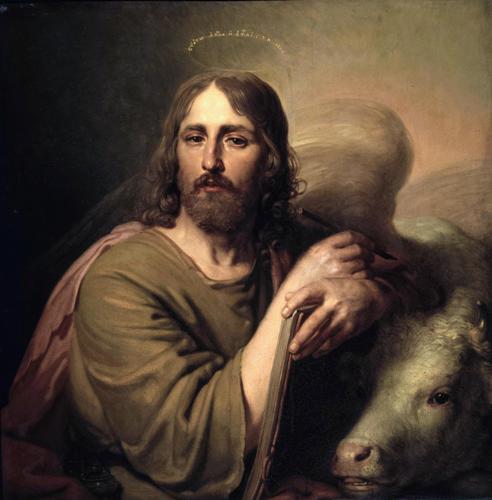
According to one early legend of the 6th century, Luke was also a skillful artist even attributing a famous 12th century icon of our Lady in the Pauline Chapel in the Basilica of St. Mary Major in Rome to being one of his paintings. Thus it was said that he was the first to paint an icon of Mary. While the painting has since been proven to have been painted at a later date many painters still choose to have him as their inspiration and heavenly patron.

Because of this and other pictures of the Virgin Mary ascribed to him (displayed in the church of St. Augustine in Rome), Luke is the patron saint of fine arts of painters and glass artists. He is also the patron saint of physicians and surgeons and for some reason of butchers, lace makers, notaries and brewers.

His Ending

Nothing more is known for certain about Luke after Paul’s martyrdom and he completed his great two-volume work. After Paul died in 64 A.D. tradition tells us that Luke preached the Faith in Egypt and Greece. It is believed too that Luke became a great leader in the church of his home region. It was sometimes in the 80’s that he decided to write his two-volume work. He died at the age of 84 (others say at 74) in either Bithynia or Boetia, Greece. Whether he was martyred by crucifixion or not is also not certain. His relics are honored in Constantinople (now Istanbul, Turkey) in the Church of the Apostles. A few persist in the stories of his martyrdom, which seems most doubtful.

Symbol and Feast Day

Saint Luke is represented by an ox often winged, a symbol of sacrifice and priesthood because his gospel begins with the ox, the animal of sacrifice of Zechariah (father of John the Baptist) to God to celebrate the birth of his son. It is a fitting symbol because the bull or ox is recognized in many religious traditions as an animal of great power and mystery.

His feast day is celebrated on October 18.

8

SOURCES of REFERENCE
ST. LUKE
October 18

Butler’s Lives of the Saints – Vol. IV pp 142.144
The Illustrated World Encyclopedia of Saints – p. 72
Pocket Dictionary of Saints – p 323
The Watkins Dictionary of Saints – pp. 143 – 146
A Calendar of Saints – 205
All Saints – pp 453 – 454
A Year With the Saints – October 18
Butler’s Saint for the Day – pp 492 – 493
Illustrated Lives of the Saints – Vol. I pp 474 -475
My First Book of Saints – pp 249
Saint Companions – pp 394 -395
Saint of the Day – pp 289 – 290
Saints – A Visual Guide – pp 74 – 75
Voices of the Saints – pp 34 – 35
Ordinary People, Extraordinary Lives Group 6 Card I
The Everything Saints Book – pp 25 – 26
The Lion Treasury of Saints – p 216; p 53
Servants of God – pp 56 – 57
The Way of the Saints – pp 282 – 283
Book of Saints – Part 8 – pp 22 – 23
Who’s Who in the Bible – pp 272 – 273

Categories
Random Thoughts by Peachy Maramba

R A N D O M T H O U G H T S Voices from yesterday and today . . . by Peachy Maramba

1

ST. FRANCIS of ASSISI: His Prayer
1181 – 1225
October 4

FIRST RECORDED WORDS of ST. FRANCIS

We have but a few pages of writing, which we can for certain be attributed to St. Francis, one of the most widely loved saints in the world and founder of the largest religious order.

It is interesting to note that his first words we have on record probably dates from 1205-6 when he was already twenty-three years old.

Fittingly his first words are prayers that he is said to have said over and over again.

Prayer of St. Francis
Most High, glorious God
Illumine the darkness of my heart,
Give me a right faith,
a certain hope and
a perfect charity
and grant me insight
and wisdom
so I can always observe your holy and true command.

Prayer

There is no activity that Francis liked better than prayer which became for him always his first concern. Thus Francis ordered his followers to pray regularly. He told them that when they spoke with God in prayer not only were their inner feelings purified but they could attain union with the one true and highest God and even actually hear Him.

Most High, Glorious God

Francis who remains a knight at heart begins his prayer in this chivalrous courteous address of praise. In fact it is said that his prayers almost always begins and ends in praise thus making his prayers one of adoration.

Because praise and adoration makes up the core of Francis’ prayer he is able in this way to unite prayer and love enabling him to put on the mind of Christ.

The words Most High recognizes the infinite distance between God and him and in typical Francis’ humility acknowledges his nothingness before the Most High God.

It is a true humility because Francis is neither looking down upon himself nor even demeaning himself for he knows he has been chosen by God to be simple and unlearned. Rather he is admitting that God is God and he, Francis, is not; so his prayer is for the Most High to take the initiative with him. In time this perspective will affect everything he will do and become.

This deep and earnest prayer of Francis is addressed to the “Most High”, a term that we find him using over and over again the rest of his life.

When he wrote the Rule for the Franciscan order he founded, he ended it saying:

“All powerful, most holy, most high and supreme God. . .
Let all of us. . . magnify and give thanks to the most
high and supreme eternal God. . .
glorious, exalted on high, sublime, most high. . .”
An excerpt from his famous “Canticle of the Sun,” the great poem of his life that he sings in ecstasy and gratitude when he was nearing death says:
“Most High, all-powerful Good Lord,
Yours are the praises, the glory, the honor
and all blessing.

Illumine the darkness of my heart

Francis loved to pray for the light which would shine through the darkness of his heart which would cleanse it and the rest would follow. Thus he was constantly asking God for enlightenment over the darkness and ignorance that causes him not see aright.

In a great moment of enlightenment Francis could put on the mind of Christ and finally see the world as God sees it: That poverty will ultimately bring him the greatest and sweetest joy and content.

Give me a right faith, a certain hope

When Francis dictated the memories of his youth to Brother Leo in the Porziuncula he said:
“And he the Lord gave me such faith in churches that I would simply pray and say: We adore thee O Lord Jesus Christ, here and in all the world. . . after that the Lord gave me and He gives me so much faith in priests . . . I am unwilling to see sin in them because in them I see the Son of God and they are my lords.”

a perfect charity

The priest translated the first passage that Francis had opened at random in the book of the Gospels: “If thou hast an eye to be perfect, go then and sell all that belongs to thee; give it to the poor and so the treasure that thou hast shall be in heaven, then come back and follow me.”

and grant me insight

The mind of Francis was preoccupied with the paradox that in detachment, poverty and penance were perfect joy to be found. True joy derives from seeking first the Kingdom of God.

God gave him also the insight to realize that it is not war that needs to be outlawed but the love of money, the greed of the human heart that is at the root of war.

and wisdom

Untrained, unlettered and with a minimum of knowledge of what a preacher normally should know, Francis prayed unceasingly and continually not trusting in his own strength or wisdom but relying wholly on God; so he was granted the wisdom to grasp that the love of neighbor can only be secured when the Gospel is lived sincerely, when the Word of God moves people to make decisions that radically changes their lives.

Thus Francis instructed all his followers:
“Make all of your time a holy leisure in which to inscribe wisdom in your heart.”

So I can always observe your holy and true command

All the things that Francis prays for in this prayer – light to the darkness of his heart; faith, hope, charity, insight and wisdom are – so he can observe God’s holy and true command.

Francis’ only desire was to be obedient to God’s will in everything. Thus placing God’s will above everything else is a gift of Francis to our world today. So is his simple but eloquent first words.

SOURCES of REFERENCE
ST. FRANCIS of ASSISI
October 4

Butlers Lives of the Saints – Vol. IV pp 22 – 32
The Illustrated World Encyclopedia of SAINTS – pp 148 – 149
Pocket Dictionary of Saints – pp 195 – 196
The Watkins Dictionary of Saints – pp 90 – 92
A Calendar of Saints – p 197
All Saints – pp 432 – 433
A Year With the Saints – October 4
Butler’s Saint for the Day – pp 469 – 412
Illustrated Lives of the Saints – Vol. I pp 448 – 451
My First Book of Saints – pp 232 – 234
Saint Companions – pp 371 – 374
Saints for Our Time – pp 371 – 374
Saints of the Day – pp 266 – 267
Children’s Book of Saints – pp 205 – 210
Saints – A Visual Guide – pp 214 – 215
Voices of the Saints – pp 360 – 361
Ordinary People Extraordinary Lives – Group 7 Card 2
The Everything Saints Book – pp 90 – 91
The Lion Treasury of Saints – pp 140 – 141
The Flying Friar – pp 74 – 77
Servants of God – pp 28 – 29
Best-Love Saints – pp 74 – 79
The Way of the Saints – pp 172 – 173
Book of Saints – Part 6 – pp 20 – 21
Novenas – pp 58 61
Saints Ancient and Modern – p 80 – 87
Francis of Assisi and Teresa Kolkata – pp 13 – 15; pp 22 – 25

Categories
Random Thoughts by Peachy Maramba

R A N D O M T H O U G H T S Voices from yesterday and today . . . by Peachy Maramba

2

ST. HILDEGARD: Medieval Abbess Mystic and Visionary
1098-1179
September 17

Medieval Abbess
One of the most remarkable and outstanding woman of history especially of her age (1098-1179) was known only as St. Hildegard of Bingen. Not only was she an abbess and founder of a Benedictine religious community but also the first of the great German mystics. She was also one of the most creative woman of her time being a poet, painter, visionary, preacher, a physician, pharmacist and a political moralist, a composer of music and writer of books on mystical theology, ecology and herbal medicine. What an amazing nun she truly was! What was even more amazing was that for over 800 years she remained unknown and in relative obscurity.

Such that nowhere could did I find a record of her last name nor the names of her parents who were described as being possibly noble.

Early Years
Of her early years as a child we know very little apart from the fact that in 1098 she was born the tenth child at Bockelheim (some say Bermersheim), in the province of Rhernhessenof Germany. Her father may have been a soldier. Because she was a sickly child afflicted with fragile health at the age of eight she was placed in the care of Count Meginhard’s devout sister, Jutta Von Spanheim to educate and consecrate her to God. Jutta was a reclusive nun who lived in a cottage attached to a nearby Benedictine abbey in Diessenberg, Germany. It is said that this was when Hildegard’s spiritual career began.

It was Jutta who raised and educated Hildegard until she was eighteen years old who when she put on the habit of a Benedictine nun at fifteen a monastic community of religious women had already gathered about Jutta. Up to this point Hildegard seemed an unexceptional nun leading an exteriorly uneventual life.

Abbess Foundress of a Benedictine Convent
When Jutta died in 1136 Hildegard at the age of thirty-eight succeeded her as prioress or director of the hermitage. Eleven years later (about 1147) after receiving a divine call she moved her community of eighteen nuns to Rupertsberg near present day Bingebruck on a hill above the Rhine near Bingen and there founded a convent now called Rupertsberg Convent on Benedictine principles and became the first abbess there. Eighteen years later in 1165 she founded another convent, a daughter-house at Eibingen.

Visionary and Mystic Extraordinaire
Hildegard, the first of the great German mystics, claimed that from infancy (three years old to be exact) God had already given her the gift of visions. She wrote, “These visions which I saw I beheld neither in sleep nor dreaming nor in madness nor with my bodily eyes or ears, nor in hidden places but I saw them in full view and according to God’s will, when I was wakeful and alert, with the eyes of the spirit and the inward ears.” Her soul through this gift of vision was able to behold the “shade of living light in which things, present and future were reflected . . . as well as the revealed word of God – both in Scripture and in the book of nature.” However because of this gift she would often say things that seemed strange to those that heard her.

Understandably Hildegard’s gift so worried her that fearing that people would think her crazy, a fraud or a sorceress only to Jutta did she confide the secret of her visions. But when at age 43 after she became prioress and her visions pressed upon her with greater urgency she decided to confide in and describe them to her spiritual adviser, a monk named Godfrey. It was also because the voice of God seemed to say to her: “I am the living and inaccessible light and I enlighten whomever I will. Write what you see and hear.”

Godfrey instructed Hildegard to write down some of the things God had made known to her since childhood such as “the charity of Christ and the continuance of the Kingdom of God, the holy angels, the Devil and hell.”

He then presented her text to his abbot Canon who in turn when he read them had them examined by a team of theologians. They declared them to be valid and certified their orthodoxy.

Since her visions were declared authentic and good for the church, the archbishop of Mainz then appointed monk Volmar as teacher, confidant and secretary to help Hildegard in preparing a manuscript record of her visions 1141-1150. Because of her powers as seeress and prophetess she is often called “the Sibyl of the Rhine.”

1

Visionary Writing
This best known and major work of Hildegard entitled Scivias (i.e., sciensvias Domini: The Way of Wisdom or Know the Ways of the Lord) was written between 1141 and 1151. It records her 26 visions, prophetic, apocalyptic and symbolic in form. In it she presents human beings as radiating from God’s love which were like “rays of His splendor proceeding from the sun itself.” When the pope, Bd. Eugenius III read it he wrote to Hildegard expressing wonder at the favors she received from God but warned her against pride. He authorized her to publish whatever the Holy Ghost told her to publish.This book took her ten years to complete.

Today it is said that there are many editions of her writings.

Mystic Artist

Besides being an abbess and foundress of a Benedictine religious community, an author, poet, theologian and prophet Hildegard was also an artist. Her text of Scivias was accompanied by her extraordinary mystical symbolic paintings that portrayed human beings and the cosmos as “living sparks” of God’s love.

Holy Preacher
Because Hildegard regarded her visions as a vocation to reform the world she went on several preaching tours through the Rhineland denouncing the vices of society in spite of all her work and continual sickness. Soon her reputation and authority as a holy preacher was widely recognized extending far beyond the borders of her native Germany.

With complete fearlessness and unerring justice she rebuked from the pulpit and through her writing not only lay-folk but especially popes, princes and bishops. Thus she wrote to the loathsome archbishop of Mainz . . . “Turn to the Lord, for your time is at hand.” It was.

Other Writings

With her gift of extremely vivid imagery Hildegard authored 50 allegorical homilies and even wrote a morality play. Besides her visionary writings she also maintained an ongoing voluminous correspondence with notable figures such as 4 popes and 2 emperors wherein she shared her spiritual insights, political morality and occasional criticism where she felt it was needed. Because her letters were full of prophecies and warnings they soon made her notorious and caused some people to denounce her as a fraud, a sorceress and even a demoniac. She also wrote a book on the lives of saints.

She also created a so-called unknown language a sort of Esperanto consisting of a made-up alphabet and about nine hundred words using a mixture of Latin and German.

Doctor and Pharmacist
This multi-talented nun even avidly studied the use of medicinal herbs and the physiology of the human body. She wrote two books on medicine and natural history. Many elements in her visions speak about our ecological age. Her study of the use of medicinal herbs seemed to anticipate our present principles of homeopathy.

Musician and Composer
“Music,” according to Hildegard, “is a bridge of holiness between this world and the World of All Beauty and Music.” In spite of her busy and full schedule Hildegard found the time to compose religious music (hymns, canticles and anthems) of haunting beauty and originality. “Music”, she wrote, “was a symbol of the harmony that Satan disturbed.”

She viewed music as a sacred realm leading to God so she wrote beautiful music that lifts our spirits and souls closer to heaven. Thus if you hear her music it will sound like angels singing about God’s powerful presence in all creation. Today many of her musical compositions have been recorded.

She also wrote one of the earliest musical plays. It is said that full of creative energy Hildegard was one of the earliest composers of music in Europe.

Interdict
In 1179, the year she died, she got into trouble with the ecclesiastical authorities when she allowed a young man who had been excommunicated to be buried in the cemetery adjoining her convent. When they insisted that he be disinterred she refused on the ground that before he died he reconciled with the church and even received the sacraments.

Because of her stand Hildegard was forbidden the celebration or reception of the Eucharist. It was a terrible sanction and Hildegard suffered greatly because of it.

The interdict was eventually lifted allowing her to die peacefully on September 17, 1179 only a few months after its lifting. She was 81 years old, crippled and exhausted from her grueling schedule.

Multiple miracles occurred during her lifetime and at her death.

Never Canonized
While Hildegard was an astonishing remarkable woman of God who accomplished so much it is almost unbelievable and ironic that although 3 attempts were made to canonize her she was never formally canonized. However she has long been venerated as a saint and her name is in the Roman martyrology. Pilgrims go to the parish church in Bingen to venerate her relics.

She was hailed in her lifetime both as a saint and as a fraud and sorceress. Yet for eight hundred years she remained in relative obscurity. It is thanks to contemporary interest in the role of women in history that we know about her today.

Her feast is kept on September 17 especially celebrated by the Benedictines and Anglicans.Her relics are venerated by pilgrims at the parish church at Bingen.

On the eight-hundredth anniversary of the death of this medieval Renaissance woman in 1979 Pope John Paul II described her as “an outstanding saint . . . a light to her people and her time who shines more brightly today.”

She was certainly not only “one of the great figures of the twelfth century but one of the most remarkable of women.”

4

SOURCES of REFERENCE
ST. HILDEGARD
September 17

Butler’s Lives of the Saints – Vol. 3 – pp 580 – 585
The Illustrated World Encyclopedia of Saints – p 144
Pocket Dictionary of Saints – pp 239 – 240
The Watkins Dictionary of Saints – p 114
A Calendar of Saints – p 180
All Saints – pp 405 – 407
Butler’s Saint for the Day – pp 419 – 421
Illustrated Lives of the Saints – Vol. 2 – pp 430 – 433
Children’s Book of Saints – pp 59 – 61
The Big Book of Women Saints – p 280
The Way of the Saints – pp 198 – 199
Voices of the Saints – p 350 – 351
The Everything Saints Book – pp 105 – 107
The Way of the Saints – pp 198 – 199
Book of Saints – Part 9 – pp 4 – 5

Categories
Random Thoughts by Peachy Maramba

R A N D O M T H O U G H T S Voices from yesterday and today. . . by Peachy Maramba

9

ST. PETER CLAVER:
atron of the Negroes in America

1581 – 1654
September 9

His Ambition
Peter was born in 1581 at Verdu, in Catalonia near Barcelona, Spain of impoverished farmers but descended from ancient and distinguished families. He had always nursed an ambition of one day becoming a missionary in the New World. So the first step he took into making his dream a reality he set out after only a few years of study at the University of Barcelona (where he later graduated about the year 1601 with distinction) to apply and was received into the novitiate of Tarragon hoping to be a Jesuit priest of the Society of Jesus. He was then sent to the college of Montesione at Palma in Majorca. His fateful meeting with Alphonsus Rodriguez the holy doorkeeper in the Jesuit college was to set the future direction of his life.

It was his humble lay brother who not only taught him about the saints but fired in him the idea of going to the New World to help save “millions of those perishing souls.”

Moved by the fervor of Alphonsus Peter offered himself in 1610 to his provincial for assignment to the West Indies. However it was to the South American city of Cartagena (now the republic of Columbia) then thriving principal slave market of the New World, where he was sent to complete his theological studies. It was there he was ordained in 1615 a Jesuit priest. He was to spend the next forty years of his life working there.

At that time Cartagena was a great and major port of entry for the African slave trade which had been established in the Americas for nearly a hundred years. Every year thousands of them sold by petty kings in Africa reaching to 10,000 would arrive at this major clearing-house to be sold to buyers from inland – there to work as slaves either in the mines or in the plantations (work considered “too onerous” for the native Indian). It was a very profitable business each slave being bought for about four crowns a head and sold for approximately 200 crowns!

His Apostolate
It was after Peter had worked under Father Alfonso de Sandoval whom he met at his ordination and who was a great Jesuit missionary who himself had spent forty years in the service of the slaves that Peter declared himself “the slave of the Negroes forever.” Thus he devoted his apostolate joining Father de Sandoval to help him to alleviate the plight of the poor slaves who were transported to the New World from West Africa under the harshest foul and inhuman conditions imaginable.

Not only were they packed into the dark sunless holds of the ships like sardines for the whole of the three-month journey but like cordwood were chained together in packs of six to lie in their own filth. Fed daily with a mash of water and maize – just barely enough to keep them alive – with no medicines or treatment when they were sick it’s a wonder that 2/3 of them managed to survive the journey.

It was to these wretched souls that survived that Peter probably the first white man to concern himself with these unfortunates dedicated 33 years of his life to. Following the simple formula of modeling himself after the compassionate Jesus, Peter reached out to the slaves. As soon as he heard the canon blast that heralded the arrival of a slave ship with a new batch of slaves, Peter would hurriedly make his way to the docks. After talking his way past the captain he would finally get to meet the “cargo” in the yards where the scarcely alive slaves were crammed and penned with hardly room to breathe after being disgorged from the long arduous trip from West Africa. There they were displayed and sold until they were shipped out to the estates or mines.

It was here where the now “half-crazed fear-struck” new arrivals would be “broken” – that is prepared for the mines and plantations where they would work the rest of their lives.

Deeds First
Moving swiftly among the half conscious and half-dead stinking Africans Peter would first immediately greet them in the “horribly fetid hold,” distribute food and drink and minister to the sick and wounded.

Words Later
It was only when they were clothed, fed, treated, encouraged and comfortable that through the help of black catechists, interpreters, pictures (to convey Christ’s life and His promise of redemption) and impromptu sign language as well as the universal language of friendly gestures and brotherly smiles would he try to communicate to them the message of the Gospel and some of the rudiments of Christianity. As he said to his assistant “We must speak to them with our hands first, before we try to speak to them with our lips.”

Then in the large town square he would baptize them presenting each one with a treasured medal of Jesus and Mary.

Powerful Advocate
It was when Peter tried to instill in the slaves a sense of their human dignity and preciousness in the eyes of God that he got into trouble with the business and civil authorities who suspected that Peter might be undermining their lucrative commerce through his ministry.

However Peter was tireless in his efforts to improve the lot of the slaves who kept coming month after month in spite of repeated papal censure. Not only did he work unceasingly for the abolition of the slave trade but he would plead with the owners to be more humane and Christian. He would journey from one village to another regularly visiting where the slaves lived in the plantations to make sure that the few laws protecting them were being enforced. He would even bed down with them in the slave quarters. Peter thus became a forceful advocate for his wards continuously seeking better treatment from the authorities and slave owners.

Great Evangelizer
Besides preaching powerful and hard hitting sermons to them in the church, marketplace and plazas he would spend as much as 15 hours a day hearing confession and instructing them in the faith. It is no wonder that he is said to have baptized as many as over three hundred thousand slaves in his 33 years career of being “a slave to the Negroes forever.” He would also solemnize their weddings and baptize their babies.

Peter also worked among prisoners who were condemned. It was said that during Peter’s lifetime no one was executed at Cartagena without his spiritual assistance.

Peter also worked among lepers ministering to them in the St. Lazarus Hospital.

Furthermore Peter became known as one blessed with such supernatural gifts as “prophecy, the power to perform miracles and the ability to read men’s minds.”

Each week Peter would visit the two hospitals of Cartegena. It is said that here he worked miraculous cures among the sick and dying.

Apostle of Cartagena
But Peter was not only apostle of the slaves but of the whole Cartagena. It is said that sometimes Peter would spend the whole day preaching to all who would stop to listen at the great square of the city or in the church or even at the market place.

As if working in repulsive circumstances were not enough mortification he would often pray alone in his cell with a crown of thorns on his head and a heavy cross weighing down his shoulders.

His Death
Unfortunately in 1650 Peter was struck by an outbreak of a plague that beset Cartagena. While he managed to survive he never fully recovered. In fact for the rest of his life he was weak and incapacitated and pain was his constant companion. Despite his illness he tried to continue his work although on a much reduced scale. The tragedy was that a trembling in his limbs made it impossible for him to celebrate Mass.

Poor Peter lived in extreme poverty and eventually succumbed and died in his cell four years later in 1654 virtually alone largely forgotten and neglected by all except for Dona Isabel de Urbina and her sister who came to nurse him. He finally got his wish to imitate the example of the Ass who never complains in any circumstances as he is only an ass. So also must God’s servant be. He died on September 8, the day we celebrate the birthday of Mary whom he dearly loved.

Rewards After Death
It is ironic that the rumor of his approaching end made everyone suddenly remember the extraordinary priest they considered a saint. Not only did they kiss his head before it was too late but they stripped his cell of anything that could be considered a relic. After Peter died the city and the church which had previously treated him with some reserve and even disdain now competed to honor his memory. They ordered a great and grand funeral and burial with much pomp for him at public expense and even the slaves arranged for a Mass to be said in his honor. He was never again forgotten and his fame spread throughout the world!

By ministering to victims of the African slave trade and by opening the people’s eyes to the evils and horrors of slavery and by starting charitable societies among the Spanish people to help the slaves Peter Claver achieved sainthood.

He was canonized in 1888 at the same time as his friend St. Alphonsus Rodriguez and named special patron saint of all Catholic Black missions – that is of all missionary activities to Negroes not only in Africa but in whatever part of the world by Pope Leo XIII in September 9, 1896. However he is also patron of Columbia and can be invoked also as patron by all who suffer from cruelty and scorn of the powerful. His feast is celebrated on this day and observed throughout the United States.

He is also the patron of Columbia and all of the Negroes in Africa.

10

SOURCES of REFERENCE
ST. PETER CLAVER
September 9

Butler’s Lives of the Saints – Vol. 3 – p 519 – 524
The Illustrated World Encyclopedia of Saints – p. 192
Pocket Dictionary of Saints – pp 121
A Calendar of Saints – p 176
All Saints – pp 391 – 392
A Year With the Saints – September 9
Butler’s Saint of the Day – pp 234 – 236
Illustrated Lives of the Saints – Vol. 1 – pp 404 – 405
My First Book of Saints – pp 205 – 206
Saint Companions – pp 336 – 337
Saints for Our Time – pp 191 – 193
Butler’s Saint for the Day – pp 427 – 429
Children’s Book of Saints – pp 119 – 122
Voices of the Saints – p 546 – 547
The Flying Friar – pp 63 – 65
The Way of the Saints – pp 371 – 372
Book of Saints Part 1 – pp 20 – 21

Categories
Random Thoughts by Peachy Maramba

R A N D O M T H O U G H T S Voices from yesterday and today . . . by Peachy Maramba

2
ST. ROSE of VITERBO:
Teenage Revolutionary Saint

1235-1252
September 4

It is interesting to note that the list of Franciscan saints includes quite a few who really did not accomplish anything quite extraordinary. So have hope because you too can be a saint even if you’re only what you consider ordinary and if you’re only in your teens.

St. Rose of Viterbo, Italy was such a saint and a revolutionary one at that.

Vision of the Virgin Mary

When only eight years old Rose, daughter of poor and pious parents, became very seriously ill. One night she had a vision of the Virgin Mary who told her to wear the clothes of a Franciscan but to remain at her parents’ home so that she could continue to be a good example to her neighbors by both word and deed. In the meantime she kept on thinking about how much the Lord suffered for us and how much thoughtless sinners were unappreciative and ungrateful for it.

Rose, who even as a child of seven years was already practicing penitential austerities and living as a recluse, when she recovered she did exactly as the vision bade her to do. First she donned the habit of a lay penitent and began a life of penance while living at home. She also prayed a lot and did all she could to aid the poor. She was as generous to them as she was strict with herself.

It was when she reached ten years of age that Rose joined the Third Order of St. Francis. Young as she was she would daily preach in the streets of Viterbo about sin, the sufferings of Jesus and public penance.

A Revolutionary

But it was not enough for Rose to be just an inspiring example of a saintly life. Political controversy also inspired her.

So when Emperor Frederick II of Germany, who was just excommunicated for the second time, decided to wage war against the pope and the papal states he sent his forces to occupy the town of Viterbo, Rose’s native city. Because Rose as a child had a vision of Our Lord telling her to fight without ceasing for God and the people to remain faithful to the Pope and Church she went out into the streets denouncing her fellow townspeople as cowards for putting up with the presence of Frederick’s troops. At this time Rose was only twelve years old.

The spirited young girl took the pope’s side against the emperor and exhorted her fellow citizens to remain faithful to him. But when she started preaching revolution accompanied by remarkable miracles this caused great tension and alarm not only for her own family but for the other villagers. They feared that she was a serious threat needlessly antagonizing the soldiers. So as the crowds gathered around the home of Rose – some out of just sheer curiosity – the situation increasingly grew tense.

This situation continued for several years until some people felt that she should be condemned to death for putting them at needless risk. Unsurprisingly to settle the matter the imperial prefect banished her family and her from the city to Soriano, the nearby town because he considered her a serious threat to his own authority. Rose however assured her parents that Christ would reward those who were persecuted for justice’s sake. So she continued her crusade for the Pope not only from Soriano but from all the neighboring cities and towns.

Then Rose having the gift of prophecy predicted that the emperor was dying and peace would soon be restored. He did die 10 days after just as she foretold.

Combats a Witch

When she was informed that a sorceress in the town of Vitorchiano had succeeded in perverting the minds of many of the townspeople Rose managed to bring about their conversion as well as that of the witch by a miracle which was well attested. Standing on a flaming pyre she preached unscathed for three hours! She then led the witch and followers back to the sacraments.

When the pope’s side won in Viterbo in 1251 and the papal supporters returned to power Rose was finally allowed to return to her beloved city. She returned in triumph.

Attempts to Found a Religious Community

But Rose’s life of controversy did not end here. When she petitioned to join the local convent of Poor Clares she was turned down because her father was not rich enough to give her a dowry. Besides that the abbess was reluctant to admit such a celebrity and revolutionary as she.

“Very well” said Rose ever humble. “You will not have me now, but perhaps you will be more wiling when I am dead – when I can be no danger to the humility of the convent. Then she will know that I only did what God told me.”

So Rose then tried at age 15 to found her own religious community. In time the kindly parish priest gave Rose and a few companions a house and a chapel. Unfortunately the property was near a convent of nuns who protested to the pope that they had exclusive rights to be the only order of nuns in the area.

Since they had the legal right Rose and her companions had to leave. Having failed in her attempt Rose returned to live with her parents where she continued her life of prayer and penance.

Her Death

She got gravely ill at the age of eighteen. When she was dying she gave the world a valuable lesson when she told her parents: “I die with joy for I desire to be united to my God. Live so as not to fear death. For those who live well in the world, death is not frightening, but sweet and precious.”

Like St. Francis she saw death as the gateway to a new life. She died on 6 March 1251 at the tender age of 18. She was buried at first in the parish graveyard at the Church of Santa Maria in Podio. Later she was transferred to the church of the Poor Clares, the convent of St. Mary of the Roses as she had once foretold. It was Pope Alexander IV who on 6 March 1252 ordered her body to be interred there in the convent that had rejected her because she appeared to him three times in dreams telling him that it was God’s will that he do so.

And even if the church was burnt down in 1357 her body was preserved. Every year 70 men carry her body in triumphal procession through the streets of Viterbo on the eve of her feast on September 4.

So while Rose did not influence kings and popes and never got to establish the religious order of her dreams she nevertheless was not afraid to stand up for her spiritual values and practices. It was because of this that she was canonized in 1457 by Pope Callistus III.

During the 750th anniversary of her birth in 1984 John Paul II visited Viterbo.

Let us all follow Rose’s advise: “Live so as not to fear death. For those who live well in the world, death is not frightening but sweet and precious.”

1

SOURCES of REFERENCE
ST. ROSE of VITERBO
September 4

Butler’s Lives of the Saint – Vol. III – pp 487 – 488
The Illustrated World Encyclopedia of Saints – p 247
Saint Companions – pp 329 – 330
The Big Book of Women Saints – p 265
The Way of the Saints – pp 396 – 397

Categories
Random Thoughts by Peachy Maramba

R A N D O M T H O U G H T S: Voices from yesterday and today . . . by Peachy Maramba

6

ST. LAWRENCE of ROME :
Patron of Cooks

d. 258:
August 10

A Likely Tale
If you believe that all saints are dry, sedate joyless types you should hear the tale about St. Lawrence. No one is really certain how much of this story about him is true but as the Italians say,“Se non e vero, e ben trovato” or “Even if it isn’t true it makes a fascinating story.” Famous Christian writers such as St. Ambrose, Damasus and St. Augustine thought so as they faithfully recounted the details of the martyrdom of one of the earliest martyrs of the church in Rome to show how early Christians viewed the prospect of dying for their faith.

Not only did the account of Lawrence’s martyrdom amuse people, more importantly it made such a deep and lasting impression on the early Church that many were converted to the faith on hearing the oral tradition about this saint.

According to Tradition
Lawrence, it is said, was born in Huesca, Spain around 230. He was the first of seven deacons (clerics ranking just below a priest) who served the Roman Church in the third century. Besides assisting the Pope when celebrating Holy Mass and giving Holy Communion to the people, Lawrence was tasked with being the almsgiver who had the grave responsibility of being in charge of Church property and distributing to the poor the offerings and alms given by the Christians.

He was a deacon of Pope Sixtus II with whom he was on intimate terms. When Sixtus was condemned to die at the Catacombs of St. Calixtus in 258 during the oppressive persecution of the Christians conducted by Emperor Valerian, Lawrence was overwhelmed with grief that he could not die along with him.

But as the Pope together with four other deacons were being led out to die, the Pope said, “Do not cry, my son. I am not leaving you. In three days you will follow me.”

Overjoyed and believing wholeheartedly his beloved pope’s prophecy, Lawrence immediately began to prepare for his own leave-taking. Following the order of the pope he first sold many of the treasures of the Church such as the chalices and even the sacred vessels. Then he assembled as many of the 1,000 unfortunates of Rome the church had been caring for. To them he distributed all the money he had amassed.

You can imagine the anger of the prefect of Rome when he heard of Lawrence’s unheard of charity and mass disposal of Church valuables as he felt that the Church’swealth should rightfully go to the government to maintain the Emperor’s forces.

Being a “worshipperof gold and silver” the prefect also thought of all the other treasures the Church must have in hiding. So he summoned Lawrence andtold him, “I am told that to adorn your ceremonies you Christians burn tapers in silver candlesticks and that your priests make offerings in bejeweled cups of gold. Bring these and your other treasures out of hiding. The emperor needs them.”

On being commanded to immediately reclaim and hand over the other treasures of the Church in his charge, Lawrence begged for three days time to be able to reassemble and inventory them.

By the third day he had gathered all the poor, crippled, orphaned, blind, ill, old, lepers, widows and dispossessed of Rome that the Church maintained. Instead of the gold and silver the prefect was expecting these he presented grandly to the prefect of Rome as the riches of the Church. “These seeming wretches are truly what our Church treasures most,” Lawrence insisted.

Martyrdom
Failing to see the humor in this and enraged beyond belief the prefect shouted at Lawrence, “I know that it is your mad wish to die a martyr and so you shall. But not in the way you imagine. You will not die quickly as I will make sure that your flesh will be destroyed bit by bit, inch by inch.”

Immediately ordering a huge gridironto bebrought forth he had hot coals placed under it. Then after having Lawrence stripped he had him bound to this red-hot griddle where his flesh would be roasted in slow motion. He wanted to be sure Lawrence would die a slow and painful death.

However after some considerable time Lawrence now bathed in light but apparently feeling no pain seemingly immune to the tortures of his persecutors smiled at the prefect and said, “I think I am now well done on this side, so you can turn me over.”

After complying with his macabre request and when he was near death. Lawrence again spoke and cheerfully said, “There. I believe that I am now thoroughly cooked. Let the feast begin.”

Wide-awake to the end, Lawrence bore the agony with unbelievable equanimity and even prayed for the conversion of Rome and the spread of the faith throughout the Roman world. And on that note he breathed his last.

It is said that several people including some senators and soldiers who witnessed the final moments of Lawrence were so moved by his heroic death that they immediately became Christians on the spot. It is said that it was they who gave Lawrence a decent burial on the Via Tiburtina. According to the poet Prudentius it was the death and example of Lawrence which signaled the end of paganism and led to the conversion of Rome. God had answered Lawrence’s prayer! His death which had inspired a great devotion in Rome spread quickly throughout the Church. In keeping with his name Lawrence won great “laurels” for the Church.

Veneration
Thus the beautiful basilica of San Lorenzo was built over his grave just outside the walls of Rome in a cemetery on the Via Tiburtina by Emperor Constantine. It became one of the centers to which the newly baptized were taken during Easter week.

Few martyrs have been as venerated as Lawrence with a cult growing up quickly around him probably because of his sense of humor in the midst of his fiery end. His rare courage which encourages others in times of persecution could only come from a firm faith in the promises of the Lord and made him one of the most famous Roman martyrs.

In the 4th century the name Lawrence was included in the Canon of the Roman Mass immediately after Saints Peter and Paul.

St. Lawrence is understandably the Patron of the Poor as his job as deacon was to distribute alms to them.

He is named Patron of Firefighters because of his fiery death. And with a hint of his own humor, Lawrence was appropriately named Patron of Cooks.

His feast day which falls on August 10 was first observed early in the 4th century.Falling shooting fiery stars which are periodic swarms of meteors often seen in Rome at that time of his feast are known as “the tears of St. Lawrence.”

He has even given his name to a river in Canada, a cathedral in Spain and to many churches the world over.

However while later historians revealed that our saint was actually beheaded, his death (or the likely tale of his death) did actually lead to the conversion of Rome. This is probably why while little is known about him the Church has given him extraordinary honor.

His burial place in St. Lawrence Outside the Wall (San Lorenzo fuori le Mura) has become not only one of the seven principal churches in Rome but a favorite pilgrimage site in Rome. It is said that in Rome alone there are 30 Roman Churches dedicated to him and countless churches worldwide.

SOURCES of REFERENCE
ST. LAWRENCE of ROME
August 10

Butler’s Lives of the Saints – Vol. III – pp 297 – 299
Pocket Dictionary of Saints – p 304
The Watkins Dictionary of Saints – p 141
A Calendar of Saints – p 152
A Year With the Saints – August 10
Butler’s Saint for the Day – pp 374 – 375
Illustrated Lives of the Saints – Vol. I pp 355-356
My First Book of Saints – pp 176-178
Saint Companions – pp 295-296
Saints for Our Time – pp 167-168
Saint of the Day – pp 200 – 201
Saints – A Visual Guide – pp 84-85
Voices of the Saints – pp 66 – 67
The Everything Saints Book – p 270
The Lion Treasury of Saints – p 215; p 64 – 65
The Flying Friar – pp 54-57
Best Loved Saints – pp 38-40
The Way of the Saints pp 274-275
Book of Saints – Part I – pp 16-17

Categories
Random Thoughts by Peachy Maramba

R A N D O M T H O U G H T S: Voices from yesterday and today . . .by Peachy Maramba

4

ST. IGNATIUS of LOYOLA:
Founder of the Society of Jesus

1491-1556
July 31

PART I

First Period – 1491-1521
A Knight and Soldier

Christened Iñigo Lopez de Loyola he was born in the ancestral castle of Loyola at Azpeitia in the Basque province of Guipuzcoa, Spain in 1491 the youngest of 13 (some say11) children of an ancient noble and wealthy family. His father Don Beltran was lord of Oñaz and Loyola.

As a youth he first served as a page in several courts where he was trained in the code of honor and chivalry. Taking his profession as a soldier very seriously at the age of 25 he entered the military service and determined to be an outstanding soldier of the Duke of Nagara. In the unsuccessful defense of Pamplona against the French he suffered a grievous injury when he was struck in the leg by a cannonball that broke his right shin and tore open his left calf. This marked the turning point in his life. At the young age of 30 his ambition of pursuing a military career and his dreams of glory came to an abrupt and crashing end.

This ends the first period of his life when he describes himself in his Autobiography as “a man given to the vanities of the world whose chief delight consisted in martial exercises with a great and vain desire to win renown” in spite of his short stature (under five feet two inches in height).

Second Period – 1521-1524
A Soldier of Christ

This second period could well be called the most decisive and critical stage of his life. Back home in the family castle his condition became so serious that he was given the last sacraments after he had undergone several excruciating painful operations on his leg that was badly set. Fortunately he recovered but it left him with a permanent limp followed by a prolonged and painful convalescence.

To combat sheer boredom he requested for something to read like the books of chivalrous romances he was fond of. Unfortunately he had to settle on the only two books available – a Carthusian Life of Christ and the other The Golden Legend, a collection of the biographies of saints.

He became so fascinated and impressed by the life of Christ that he decided to devote himself to Him thereby becoming a knight and soldier of the Cross instead of the Crown. Since the book of saints by an anonymous writer contained prologues to the biographies that conceived the Service of God as holy chivalry – this view of life profoundly moved and attracted him that he vowed to imitate their lives imagining what a great honor it must be to serve to the greater glory of God (this became his motto later in life). He asked himself: “These men were of the same frame as I why then should I not do what they have done?”

Spurred on by a vision he had of the Mother of God surrounded with light holding baby Jesus in her arms and full of zeal to start his holy life he decided that as soon as possible he would do penance for his sins by imitating the holy austerities practiced by the saints.

As soon as he sufficiently recovered he mounted a mule, and went to Our Lady of Montserrat, a Catalonian shrine of pilgrimage in the mountains above Barcelona in northeastern Spain. It was on the way here that he traded his rich robes for a beggar’s sackcloth, and then made an all-night vigil pledging himself as a knight in God’s service before the famous statue of the Virgin Mary.

After 3 days confessing his sins in the Benedictine abbey of Monserrat he hung near the statue his sword and dagger as symbols of his abandoned military ambitions. Thus did he instead become a soldier of Christ.

The following day he went to the nearby small town of Manresa where he lived ten months in a cave on the banks of the river in solitary reflection living as a hermit-beggar, scourging himself of sinful attachments, fasting and praying.

While on the banks of the Cardoner river while searching for God’s will God gave him knowledge of himself aided by several mystical visions such as the sight of a blinding light emanating from the Eucharist. He came to understand and know many spiritual things as things of the faith.

But after enjoying much peace of mind and heavenly consolation he was soon affected by the most terrible trial of fears and scruples. He found no comfort in prayer, fasting nor even from the sacraments. Overwhelmed with sadness he felt himself on the brink of despair.

It was at this time that he began to jot down notes of what was happening to him and what he was doing to cure his scrupulous conscience. As he wrote his notes for what was to become his famous book of Spiritual Exercises his soul once more began to overflow with spiritual joy and his tranquility of mind was eventually restored.

The Spiritual Exercises

He trained his mind to get mentally fit by praying seven hours a day. He kept notes of what he was doing describing it as his spiritual exercises. He later wrote down his religious experiences of his own conversion and this became the fundamentals of his famous manual The Spiritual Exercises. This how-to book, which was not published until 1548 is still used for spiritual retreats and for spiritual formation of his followers and has had a profound effect on the lives of Christians. In fact one author described it as “the book that shook the Catholic world.”

It remained one of the most famous and fruitful work of Ignatius.

Pilgrimage to the Holy Land

In February 1523 Ignatius started on his pilgrimage to the Holy Land by begging and walking all the way in spite of a permanent limp caused by his war injury. However his plans to stay in Jerusalem was foiled when the Franciscan guardian of the Holy Places commanded him to leave Palestine for his own safety. This was because his reckless attempts to convert the Muslims there could cause him to be kidnapped and held to ransom.

He thus returned to Barcelona, Spain in 1524 determined to become a priest in order to help souls. So he forced himself to enter school and study when what he really wanted to do was to go out in the streets preaching about God and teaching catechism.

Third Period – 1524-38
Years of Belated Studies

Because he was convinced that a well-trained man would accomplish more in God’s service, Ignatius spent the next 11 years diligently applying himself to his studies in Barcelona, Alcala, Salamanca and Paris. In Barcelona at the age of 33 years he sat in a class of eleven-year olds to learn Latin stoically bearing the jeers and taunts of the little boys. Financially he was assisted by the charities of a pious lady of that city called Isabel Roser.

But because he exhorted his fellow students to live a life of heroic piety he gathered around him a band of followers who even wore a distinctive coarse grey garb. He was imprisoned and tried on suspicion of heresy. Found innocent he was forbidden to teach until he had finished his studies.

PART II

Founds the Society of Jesus

Leaving his disciples behind Ignatius went to the University of Paris where living on alms he finally got his coveted master of arts degree at the age of 43 in 1534.

At that time six students in divinity associated themselves with Ignatius in his spiritual exercise. They were: Francis Xavier, a Basque like Ignatius (who would become the great missionary to the East), Simon Rodriguez a Portuguese, Peter Faber a Sauoyard, Laynez and Salmeron, both fine scholars and Nicholas Babadilla.

In a chapel on Montmarte on August 15 of the same year Ignatius together with his six fervent fellow students founded the Society of Jesus (or the Jesuits as they were popularly known) whose members vowed to live in poverty and chastity and to return to the Holy Land (but still without the express purpose of founding a religious order). However, for reasons of health he left the band to finish his theological studies by studying privately while on pilgrimage through Spain and Italy.

On January 8, 1537 his Parisian “companions” joined him in Venice eager to make the pilgrimage to Jerusalem. It was here that they (just ten men) were finally ordained and the formal title of Society of Jesus adopted. Then using his own innovative spiritual manual, Spiritual Exercises, Ignatius began instructing his new “soldiers of Christ.”

Fourth Period 1539-1556
Governing the Society

Unable to go as planned on pilgrimage to Jerusalem as the war between Venice and the Turkish empire made it an impossibility they went to Rome as they had earlier vowed and offered their services to Pope Paul III. It was while in Rome that our saint changed his name of Iñigo to Ignatius after St. Ignatius of Antioch. But they called themselves simply as “Companions of Jesus” because they were united to “overcome worldliness and ignorance and counteract the untruths being spread by the Church’s enemies.

It was also on the way to Rome that he had the famous vision of La Storta in which Christ promised him that all would go well in Rome.

On September 27, 1540 Paul III solemnly approved their venture. The Society (or Company) of Jesus became a new form of apostolic religious life. Unlike other religious orders they had no monastic choir, no fixed religious garb and a strong emphasis on mobility and flexibility in the service of the church as a whole. Their battle cry was Ad Majorem Dei Gloriam – For the Greater Glory of God.

To achieve this, the organizational structure was highly centralized with the superior general elected for life and the professed Jesuits taking besides the vows of poverty and chastity an additional vow of obedience. The first vowed to obey the order not to aspire to become superiors. However their Constitution composed by Ignatius required easy communication with higher superiors.

The group took their final vows in 1541 and Ignatius was elected against his will as their first Superior General. However he immediately took on the job of cook (maybe to show his humility). Under his able hand the Society developed very rapidly so that in the fifteen years that he served as general of the order the Jesuits increased from 10 to 1000 Jesuits scattered in 12 provinces from Italy to India. At the same time his order became one of the most dynamic in the Church.

He had 3 goals for the church using his method of “contemplation in action:”
1) reform especially through education and more frequent use of the sacraments;
2) widespread activity in the missionary field; and
3) fight against heresy.

Ignatius took for his motto “To the greater glory of God” as he often said, “Lord, what do I desire, or what can I desire, besides thee?” Because he believed that true love is never idle, always to labor for God, or to suffer for His sake was all his happiness.

Education

Besides founding the Roman college and the Germanicum, a seminary for German candidates for the priesthood, Ignatius laid the foundations of the system of schools (like the Ateneo) which was to earmark his order as primarily a teaching order. The Jesuits were in time “renowned for their prowess in the intellectual sphere and in the field of education” as well as their zeal and military discipline.

Reform

Ignatius and his men of action and learning played a leading role in the preserving and renewing of Catholic Reformation or Counter Reformation during the sixteenth and subsequent centuries. Thus it was the Jesuit Order that started Europe back toward the Church having finally turned the tide against the Protestant Reformers.

They were even among the first to bring the faith to North America. In fact the first bishop there was John Carroll, a Jesuit.

Missionary

Ignatius decreed that the Society was to be above all a missionary order of apostles “ready to live in any part of the world where there was hope of God’s greater glory and the good of souls.” Long and thorough and arduous training of his followers was a MUST as was their special vow of obedience to the pope. However the Society’s main thrust under Ignatius was to establish missions in Asia and South America. Thus no sooner had they been established did many of the original Jesuits leave on perilous missions to India, Brazil, China and the Congo as well as Asia, New Spain and Protestant England. Sadly Ignatius had to remain behind in Rome where he spent the rest of his life.

CONSTITUTION

Probably the most important work of the later life of Ignatius was his composition of the Constitution of the Society of Jesus which is still used today to regulate the lives and aspiration of Jesuits scattered all over the world.

Other Accomplishments

Besides founding one of the most powerful and dynamic orders in the Church noted for their commitment to education and social justice Ignatius for fifteen years directed the battles of his Society. He even established a home for fallen women and one for converted Jews. The Jesuits have also been in the forefront of the modern ecumenical movement. However he resolutely excluded a female branch of the order because he believed that women are better ruled by women.

His writing and teaching were able to draw believers back to the Roman Catholic Church after the Reformation.

The Jesuits’ battle of transforming society was fought not only in the pulpit and in the fields of mass media and education but in culture, the arts, which they patronized and even in the political arena.

Death

Frequently sick Ignatius begged to be allowed to resign but his petition fell on deaf ears. He directed the order till the summer of 1556 when he suffered from fever. While his doctors did not think it serious Ignatius knew that he was near death. Almost blind at 65 he asked for a last blessing but his request was ignored as he didn’t seem to be in any imminent danger. He died the next day on July 31, 1556 so suddenly and so unexpectedly that he did not even get to receive the last sacraments he had asked for.

Ignatius was beatified by Pope Paul V in 1609 and canonized by Pope Gregory XV in 1622.

He was declared patron of all spiritual exercises and retreats in 1922 by Pope Pius XI who described Ignatius’ most important single writing The Spiritual Exercises as “the wisest and most universal spiritual code for guiding the soul on the path of salvation.” This manual molded 27 canonized saints including 3 intimates of Ignatius – Francis Xavier, Peter Canisius and Francis Borgia.

His feast is celebrated on July 31, the day he died.

Prayer
St. Ignatius leaves to us his prayer which he often said:

Dearest Jesus, teach us to be generous;
To serve Thee as Thou deserves;
To give, and not to count the cost;
To fight, and not to heed the wounds;
To toil, and not to seek for rest
To labor, and to seek for no reward
Save that of knowing that we do Thy
Holy Will.

SOURCES of REFERENCE
ST. IGNATIUS of LOYOLA

July 31

Butler’s Lives of the Saints – Vol. 3 – pp 221-227
The Illustrated World Encyclopedia of Saints – pp 176 – 177
Pocket Dictionary of Saints – pp 251 – 252
The Watkins Dictionary of Saints – pp 118 – 119
A Calendar of Saints – p 144
All Saints – pp 327 – 328
A Year With the Saints – July 31
Butler’s Saint for the Day – pp 355 – 357
Illustrated Lives of the Saints Vol. 1 – pp 337 – 339
My First Book of Saints – p. 165
Saint Companions – pp 277-279
Saints for Our Time – pp 159 – 160
Saint of the Day – pp 183 – 184
Children’s Book of Saints – pp. 211 – 214
Saints – A Visual Guide – pp. 250 – 251
Saints and Heroes Speak – Volume 3 – pp 100 – 114
The Way of the Saints – pp.208-209
Saints – pp. 176 – 177
Voices of the Saints – pp. 470 – 471
Ordinary People, Extraordinary Lives – Group 6 Card 3
The Everything Saints Book – pp. 113 – 116
The Lion Treasury of Saints – p 214, 162 – 163
The Flying Friar – pp. 46 – 49
Servants of God – pp. 38 – 39
Best – Loved Saints – pp 107 – 110
The Way of the Saints – pp 208 – 209
Book of Saints – Part 5 – pp 18 – 19

Categories
Random Thoughts by Peachy Maramba

RANDOM THOUGHTS: Voices from Yesterday and Today . . . by Peachy Maramba

St.

ST. CYRIL OF ALEXANDRIA:
Doctor of the Incarnation;
Doctor of the Church
370 – 444
June 27

The writings of this Doctor of the Church St. Cyril of Alexandria (not to be confused with another Doctor of the Church St. Cyril of Jerusalem) strenuously defended the dogma that Jesus had two natures in one person. He has been known therefore as the Doctor of the Incarnation.

In 403 he accompanied his patriarch uncle to the Synod of the Oak in Constantinople that deposed and exiled Saint John Chrysostom who he believed to be guilty of heresy (even though the charges were unjust).

So while he was a stern (sometimes too stern) and zealous enemy of heretics and non Christians he vigorously and at times harshly opposed these doctrinal opponents of the church. It’s no wonder that his enemies called him “the Pharaoh of Egypt.”

He not only ruthlessly closed all Novatian churches in Alexandria but he also pillaged them as well seizing their sacred vessels.

Having succeeded in expelling the Novatians he then began but apparently did not complete the expulsion of Jews who had been established by Alexander the Great to encourage commerce in his city. This incurred the wrath of the governor Orestes who already disagreed with Cyril about some of his actions.

St. Cyril was preaching that in Christ there were two distinct and separate persons: that of the Son of God and that of the man Jesus joined only by a moral union. In insisting that Mary was the mother of Jesus the man and denying that she was the mother of the Son of God Nestorious consequently denied the Incarnation and the Divine Motherhood of Mary as well as the unity of the divine and human natures in Jesus.

On this basis Nestorious and his followers refused to call Mary Theotokos (“mother of God” or literally “God-bearer”). Since he believed that there were two distinct persons in Christ – the divine and the human – Mary, who was human, was the mother only of the human person, not of the divine person. So he preferred to call the Virgin Mary Christokos (“mother of Christ”) or Theodokos (“God receiving”).

On the other hand Cyril saw this as a clear opposition to what the Nicene Creed says and in direct conflict with the Orthodox doctrine that taught that the two natures of Christ were combined in one person.

Cyril staunchly believed in this unity of God and man in Christ which at that time was called “the indwelling of the divine word in human flesh.” So he insisted on the term Theotokos (“God-bearer”, i.e. Mother of God) as it expressed the “intimate union of the divine and human natures, made one in the incarnation.”

His writings have been characterized by “accurate thinking, precise exposition and great reasoning skill.” It’s no wonder that most people regarded him the most brilliant theologian of the Alexandrian tradition and Warrior for the Truth.

At his death, to show how much some people hated him a bitter letter circulated at his death. It began, “Behold, at long last this wicked man is dead.”

Truly Cyril was rightfully named “The Doctor of the Incarnation.” His numerous letters and treatises developed his theology further emphasizing more definitely the “fullness of Christ’s humanity along with the oneness of his person.”

Cyril is honored as a saint both by the Eastern and Western churches more in tribute to his being a brilliant theologian and for his historic achievements than for his character which continue to puzzle interpreters today. Because while he was brave, he was a man of strong and impulsive character but sometimes was violent even over-vehement. Though he basically loved peace he loved truth even more at any cost. Though unscrupulous and ruthless at times no one can deny the “considerable mark he left on the formulation of orthodox theology.” He remains to this day “the invincible champion of the Divine Motherhood of Mary.”

Cyril also manifested a great devotion to the Blessed Sacrament which he maintained was really the life-giving and very flesh of the World Himself.

Because Cyril used consistently and well the procedures of invoking the Fathers of the Church as proof for doctrine he has rightfully earned the title “Seal of the Fathers” and “Guardian of Accuracy.” In so doing Cyril made clear to the whole world that he recognized the position of the “Bishop of Rome as visible head of the whole church.”

The Popes in turn recognized his greatness:
1. Pope Celestine described him as “the generous defender of the Catholic faith” and “an apostolic man.”
2. It was Pope Leo XIII in 1882 who proclaimed Cyril a Doctor of the Church.
3. In 1931 Pope Piux XI praised St. Cyril as “that most holy man and champion of Catholic integrity.”
4. In 1944 Pope Pius XII called him “the ornament of the Oriental Church.”
The Alexandrians bestowed on him the title of Teacher of the World.

Cyril is commemorated as a “tower of truth and interpreter of the Word of God made flesh” in the intercession of the Syrian and Maronite Mass.

In the West June 27 is his feast day while in the East it is on June 9.

Other Sources of Reference:

A Calendar of Saints – p 121
A Year With the Saints – June 27
Butler’s Saint for the Day – pp 298 – 299
Illustrated Lives of the Saints – Vol. 1 p 273
My First Book of Saints – pp 134
Saint Companions – pp 234 – 235
Saint of the Day – pp 146 – 147
The Doctors of the Church – Vol. I – pp 147 – 158
The 33 Doctors of the Church – pp 134 – 147
Saints – A Visual Guide – pp 260 – 261
Voices of the Saints – pp 170 – 171
Ordinary People, Extraordinary Lives – Group 3 Card 34

Categories
Random Thoughts by Peachy Maramba

RANDOM THOUGHTS: Voices from yesterday and today . . . by Peachy Maramba

ST. ALOYSIUS GONZAGA:
Patron of Catholic Youth
1568 – 1591
June 21

St. Aloysius had certainly lived up to his motto: “I was born for greater things.” At the same time he had fulfilled his father’s ambition for him to be brave and honored but not in the way he intended.

On June 21, St. Aloysius’ feast day the Church prays: “O God, author of all heavenly gifts, You gave Saint Aloysius both a wonderful innocence of life and a deep spirit of penance. Through his merits grant that we may imitate his penitence.”

He is one of the most venerated of modern saints especially for his intense love of chastity and his all-absorbing love for God.

Design a site like this with WordPress.com
Get started