Categories
Random Thoughts by Peachy Maramba

R A N D O M T H O U G H T S Voices from yesterday and today . . . by Peachy Maramba

Untitled

ST. BONIFACE: Apostle of Germany
673 – 754
June 5

Monk in England
One of the great figures in the annals of Christian mission Boniface spent the first half of his life as a monk in England. Born in 673 of a good family at Crediton, Devonshire in Southeast England he was baptized Wynfrith (Winfrid), a name which meant “Joy and Peace.”

When he was only five years old he decided to offer his life to the Lord after hearing the conversation of some monks who visited his home.

So at the age of seven he started on the road to being a monk by being educated by the Benedictines at the monastery school at Exeter then to the Nursling abbey in Winchester (famed for learning) under the abbot Winberht. Upon completion of his course he so distinguished himself as a brilliant scholar that the Abbot appointed him to teach.

A very popular teacher many scholars came to the school attracted by his teaching skill. His lecture notes were even copied by his students and circulated to other schools. For them he wrote a famous Latin Grammar textbook, which was the first to be used in English schools. He was eventually named director of the monastic school.

After he was ordained in 715 at the age of 30 Boniface, a noted preacher, began delivering inspiring homilies that were all based on the Bible which was his delight throughout his life.

Missionary Career
Boniface was already a well-known scholar and teacher in the Benedictine order when he decided at the age of forty that what he wanted above all else was to be a missionary, his true vocation as revealed to him by God. So seized with a missionary fervor Boniface, in 1716 following the example of other Saxon kinsmen monks set out as missionary after his abbot reluctantly gave his consent. An Anglo-Saxon by birth his long standing wish was to convey the gospel to Friesland, (now Northern Netherlands) where his co-Saxon people remained un-persuaded by the spreading Christian religion. However his first evangelical mission to Friesland failed probably because of the hostility of Radbod, king of the Frisians, who said he had no wish “to go to heaven with a handful of beggars.” Reluctantly he was forced to return to Nursling. Delighted to have him back, his fellow monks elected him abbot from 716 to 718 after Winbert died. However Boniface, still felt he was called by God to evangelize in a foreign land.

Mission to Evangelize Germany
Convinced that a papal commission was essential to his success as a missionary Boniface made the first of his three visits to Rome. First Boniface presented in 718 his proposed mission to Pope Gregory II who not only changed his name from Wynfrith to Boniface (meaning “doing good”) but also gave him a wide missionary commission. He was told to go forth “to those people who are still in the bonds of infidelity . . . . to teach them the service of the kingdom of God by persuasion of the truth in the name of Christ, the Lord our God.”

Pope Gregory II sent him in 719 to evangelize the heathens in Germany as the vast majority of the people still worshipped pagan gods.

In Germany he was able to engage in missionary work so successfully for three years under his countryman Willibrord, the first bishop of Utrecht.

Consecrated a Regional Bishop
Then in 722 he successfully converted and baptized great numbers in Hesse and Thuringia. When he sent word about his extraordinary results to the pope he was summoned back to Rome where he was consecrated a regional bishop for all of Germany. Not only was he able to eliminate paganism in much of the country but he founded churches and Benedictine monasteries and successfully asked English monasteries to send many monks and nuns to act as teachers to help him establish churches.

Demolishes the Oak of Thor
Because Boniface particularly was opposed to idolatry he deplored the worship of trees which was a common feature of the folk religion of Germany.

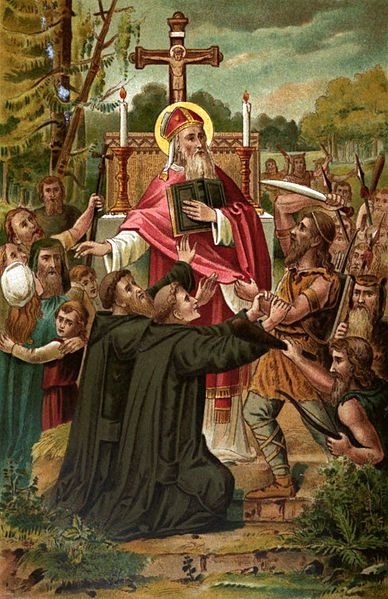
In a famous incident, so the legend goes, to undermine the pagan superstition Boniface in front of an awestruck crowd axed down the sacred oak of Donar called The Oak of Thor which stood at the Summit of Mount Gudenberg. It was an object of pagan worship as sacred to the god Thor. The crowd of onlookers were aghast expecting the heavenly punishment of their gods to rain down in lightning bolts on Boniface for his sacrilege.

When nothing happened, the people interpreted it to mean that Boniface had the more powerful god and so a wave of conversions ensued. Boniface used the wood of the famous tree to build a Christian chapel on that very spot. He named the church Saint Peter’s.

From then on the work of evangelization went on steadily and even more new churches and converts were established throughout the country. He was thus popularly known as the “St. Paul of Germany” because through him Germany became a Christian country.

Founded the Abbey of Fulda
In 735 Boniface and his disciple St. Sturmi founded Fulda, the chief monastery they co-founded, which later became the German Monte Cassino – a great monastic and learning center for northern Europe. Today Fulda is still the annual meeting place for the German Bishops.

Revitalizes the Church in France
In the meantime the Church in France was in great need of revitalization. Under Charles Martel, the Frankish King, the Church was so neglected that many ecclesiastical abuses prevailed and were rampant throughout the country.

Thankfully when he died in 741 his sons were convinced to call a synod to deal with these abuses. Boniface who presided over 4 of such assemblies was able to instill fresh vigor into the Church of Gaul (France).

In just five years he was able to regenerate the Frankish church: to reform and revitalize the Church in France to her former greatness.

So when in 747 Boniface was summoned by Pope Zachary to come once more to Rome he made him not only archbishop of Mainz and designated him Primate of Germany but named him apostolic delegate for Germany and Gaul.

His Martyrdom
Since to his dismay the Germans were “lapsing” Boniface already nearing eighty, resigned his see and once more hit the road to return to his first love – missionary work – to reconvert his Saxon kinsmen in Friesland who had turn pagans.

It was here while quietly reading in his tent at Dokkum while waiting to confirm new converts that a band of hostile pagans came and attacked Boniface and his 53 companions – killing them all.

In the famous monastery of Fulda lies not only his remains but the blood-stained book that Boniface raised over his head to protect himself from the brutal sword cuts that martyred him on June 5, 754.

Boniface’s organizing genius even more than his missionary zeal has left a lasting mark upon the German and French churches throughout all the middle ages.

Archbishop Cuthbert of Canterbury wrote of Boniface, his contemporary: “We in England lovingly count him as one of the best and greatest teachers of the true faith.”

He is rightfully called the patron and Apostle of Germany because to him belongs the credit of “systematically evangelizing and civilizing the great regions of central Germany . . .” so that through him Germany became a Christian country. It’s no wonder he is popularly known as “St. Paul of Germany.”

His other great achievement was the regeneration of the Frankish Church.

His feast day (June 5) was extended to the universal church by Pope Pius IX in 1874.

SOURCES of REFERENCE
ST. BONIFACE
June 5

Butler’s Lives of the Saints – Vol. II pp 477 – 481
The Illustrated World Encyclopedia – pp 129
Pocket Dictionary of Saints – pp 82 – 83
The Watkins Dictionary of Saints – pp 38 – 39
A Calendar of Saints – p. 107
All Saints – pp 246 – 247
Saints for Everyday – pp 190 – 192
A Year With the Saints – June 5
Butler’s Saint for the Day – pp 261 – 263
Illustrated Lives of the Saints – Vol. I pp 239 – 240
My First Book of Saints – pp 118 – 120
Saint Companions – pp 203 – 205
Saints for Our Time – pp 119 – 121
Saint of the Day – pp 130 – 131
Lives of the Saints Part I – pp 169 – 175
Children’s Book of Saints – pp 115 – 118
Saints – A Visual Guide – pp 190 – 191
Voices of the Saints – pp 298 – 299
Ordinary People, Extraordinary Lives – Group 6 Card 14
The Everything Saints Book – pp 76 – 77
The Lion Treasury of Saints – p 211, 124 – 125
Best – Loved Saints – pp 61 – 64
The Way of the Saints – pp 82 – 83
Book of Saints – Part 4 pp 18 – 19

Categories
Random Thoughts by Peachy Maramba

R A N D O M T H O U G H T S Voices from yesterday and today. . . by Peachy Maramba

2

ST. BEDE THE VENERABLE
Father of English History and Doctor of the Church

672 – 735
May 25

Did you know that our current way of dating time from the birth of Christ as B. C. and A. D. or anno domini which means “in the year of the Lord” is attributed to St. Bede, probably the most learned man of his time and the only English Doctor of the Church? Although Bede himself tells us that it was a system actually devised by Dionysius (Denis), an aged Roman abbot. It had laid unused for 200 years until Bede popularized it by adopting it in his works on time and histories.

Early Life
It is interesting to note that what little we know of St. Bede’s life comes from a short account written by Bede himself and from a description of his last hours written by Cuthbert, a monk who was one of his disciples.

He was born at Monkton, in the county Durham within the territory of Wearmouth, Northumbria, England in 673. Nothing is known about his parents or family except that at age seven his relatives or parents, who lived in the lands of that monastery, gave to-be- educated Bede to Benedict Biscop, abbot of Wearmouth and one of the leading scholars of his time. He and later Abbot Ceolfrid took charge of Bede’s education. (This happy combination of Bede’s inquiring intellect and willing able teachers made him undoubtedly one of the most learned men of his time.)

Like the other fellow oblates he would help in the kitchen or barn gathering eggs. However his chief interest would be prayer and study.

When St. Benedict Biscop built a second monastery dedicated to St. Paul at Jarrow on the River Tyne Bede went there while still a young boy.

An extra ordinary scholar he soon became well-versed not only in the sciences, natural philosophy and astronomy but in arithmetic, grammar, the philosophy of Aristotle, the lives of saints and history as well. He attributes his great learning to the good men like Ceolfrid who guided him in his younger days.

Little did Bede realize that except for a few visits to other places he would in the sixty or so years he lived, except for the first few years of his life, never leave the monastery, spending the rest of his life behind the cloistered walls in peaceful isolation. This meant that whatever education he had he got while at the monastery. But then at that time the only place where the great intellectual traditions were preserved were the monasteries.

While it seemed that Bede grew up in extreme isolation he surprisingly became “one of the most influential man of his day.”

He was first an oblate in the Benedictine order and later ordained a deacon when he was 19 and finally a priest at the age of 30 “always writing, always praying, always reading and always teaching.” Besides saying the mass he was also a great preacher (about 50 of his authentic homilies that he gave in the last part of his life are still preserved to this day). As our Lady’s homilist he wrote all the lessons for the Common of her feasts.

However he declined the office of abbot because he felt it would interfere with his chosen path of “learning, teaching and writing.” Because of his dedication he never held positions of great dignity devoting all his efforts to the study of Scriptures and in charge of the daily singing in the Church. His title of “venerable” by which he is most popularly known is a traditional term of respect for his scholarship and also on account of his holiness. Imagine being honored as a saint even in your own lifetime!

His Learning
It’s no wonder that because he had the mind, aptitude, interest and dedication to his vocation he became one of the most learned men and influential people of his day. His writings covered almost all fields of human knowledge at that time. Because he had a universal interest he “collected the treasures of knowledge”. Thus his books covered almost all fields of human knowledge at that time including history, meteorology, physics, mathematics, grammar, astronomy, medicine, music, natural science, poetry, philosophy, rhetoric and prosody. His works on mathematics were regularly used and copied for five centuries after his death!

But it was the Bible that remained the chief study not only of Bede but of his fellow monks. It is no wonder that four-fifths of his writing were commentaries on the Scriptures. Thus Bede wrote in his short autobiography: “I spent the whole of my life within that monastery devoting all my pains to the study of the Scriptures.” Because of this the most correct manuscript of the Vulgate came from this monastery.

His Teaching
Besides learning and writing Bede’s other delight was teaching. He himself taught all the subjects necessary for the service of the church such as music, rhetoric and languages. It is said that he was greatly loved by his pupils because he taught with vivacity and charm. Hundreds of scholars were drawn to him because of his piety, learning and gentle character. Because of his fame as a teacher his monastery and the whole of Northumbria became a great center of learning in Europe.

His Writing
Bede did not actually begin writing until he was ordained a priest and his writing originated from his teaching. The manuals that he wrote and compiled for his pupils were so good that his beloved mentors Ceolfrid and Bishop Acca urged him to write that he might be able to teach a wider group of people.

So he abridged larger works to make acquiring knowledge of them easier for his countrymen. In this way did the Englishmen learn in simplified form the teachings of the four great western Doctors: Sts. Jerome, Ambrose, Augustine and Gregory.

He passed on to countless generations the “sum of the day’s knowledge” as he was especially clever at working out what had actually happened in the past and what was only legend or gossip. His writings are even said to be major influences on English literature.

His writing style was meant for teaching not for show. Thus his words were not ornate but simple with a passion for truth and exactness. His aim was “to lead people to moral goodness, to help them praise and thank their creator better.” His whole effort was to teach history and doctrine exactly.

Besides this, Bede, a voluminous writer, wrote over 40 treatises on almost all fields of human knowledge especially on theology, science and history. He also wrote Latin poetry and a hymn in verse. His writings are thus regarded as major influences on English literature.

Because he wrote the lessons for the common on Our Lady’s feast Bede had the enviable distinction of being Our Lady’s homilist.

Bede’s life was capsulized by an old Benedictine breviary which said, “He always read, he always wrote, he always taught and he always prayed.”

Father of English History
However since he believed that it was not only in Scripture but in the history of his own people and the stories of holy lives that the handwriting of God could be discerned, his most important monumental and authoritative work Historia Ecclesiastica is a complete history up to 731. Ecclesiastical History is not only a history of the English Church but of the English People and nation. His reading of the handwriting of God became his own path to sanctity. Considered one of the greatest history books ever written it is regarded as the primary source of the history of Christianity in England up to that time and is still in print.

Because he wrote this first English language history book he came to be known as the “Father of English history” and became the most respected historian in medieval Western Christendom. As one writer said, “He made his mark on the pages of history and he wrote about history.” Written in Latin but later ordered translated into Early English by King Alfred this most important account of early English history covers from 55 B.C. to 731 A.D. It is considered one of the most valuable, thorough, scholarly and beautiful of historical works. It is said Bede’s simplicity, goodness, zeal, humility and honesty shines through his writings with unusual charity!

However because Bede was always a prayerful man he closes his book with a formal prayer.

Called Venerable
In recognition of his saintliness, holiness, wisdom and learning Bede was called “the Venerable”, a term of respect infrequently bestowed on the religious. But he was officially called this while he was still living by the Council of Aachen in 836 (some say in 853) because of his holiness. When not studying or teaching he would spend long hours in prayer often shedding tears when overcome with devotion.

It is no wonder that noblemen and even the pope sought his advice and counsel.

He certainly merited his name Bede which in Anglo-Saxon means prayer. The title “Venerable” means “worthy” and is given to people who are likely to be made saints in the future. Few people are bestowed this title in their lifetime. He was also called an Admirable Doctor for Modern Times.

But because it seemed peculiarly suitable to a man like Bede it has clung to him even during succeeding centuries. Even to this day it remains his special designation.

It is said that in his later years Bede became blind. He was taken one day as a prank by a boy to a lonely and stony place where he was to preach. Believing there were people there Bede preached his sermon. When he had finished the stones responded with a great cry of “Amen, Venerable Bede.”

His Death
Up to the very end Bede remained a teacher and writer. However during his last years he was constantly ill. When he was already experiencing the pains of his last illness he chided his students several times, “Learn your lesson quickly, for I do not know how long I shall be with you nor whether my Maker will soon take me from you.”

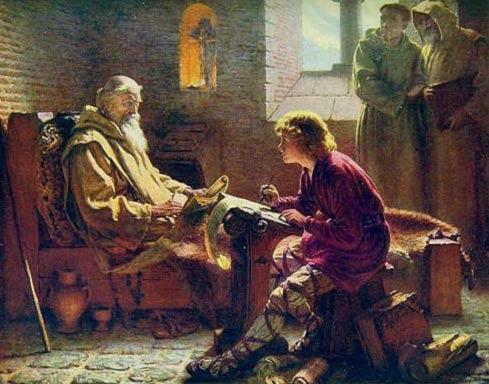
In the forty days before his death on May 25 he managed to dictate two new books. When he thought he had finished his last book, a translation of the gospel of St. John from Greek into English he asked his assistant or scribe to run and get quickly his things of value in his chest such as peppercorns, napkins and incense. Then he told him to bring the other priests to him so that he could distribute among them the gifts that God had given him.

Having done that he asked the priests to pray for him.

But that evening the scribe noticed that the translation was not quite finished missing one sentence untranslated. Hurriedly he dictated the last passage.

Then he said, “All is finished.” He died on the floor of his cell singing, “Glory be the Father. . .” Just as he said “Holy Ghost” he breathed his last. What a happy and peaceful death! Bede had worked and prayed till the very end.

Ironically Bede who was one of the most influential people of his day and who was honored as a saint while still living was not canonized and named a Doctor of the Church until 1899 by Pope Leo XIII. However the title of Venerable remains his special designation to this day. His feast day is celebrated every May 25. His relics are to be found in the Galilee chapel of Durham Cathedral.

He is the only English doctor of the Church and the only Englishman who sufficiently impressed Dante to name him in his Paradiso. He is also probably of all the saints the one doctor of the Church who lived the most peaceful life.

And in spite of the fact that he hardly left his monastery he became well known throughout England and far beyond. In fact his homilies are still read everywhere in the Western church.

It was St. Boniface who aptly described Bede as “a light of the Church lit by the Holy Ghost.” It is aptly said that to know Bede was to love him!

SOURCES of REFERENCE
ST. BEDE

Butler’s Lives of the Saints – Vol. II – pp 402 – 405
The Illustrated World Encyclopedia of Saints – p 126
Pocket Dictionary of Saints – p 66
The Watkins Dictionary of Saints – pp 30 – 31
All Saints – pp 229 – 230
A Year With the Saints – May 25
Butler’s Saint for the Day – pp 237 – 239
Illustrated Lives of the Saints – Vol. I – pp 221 – 222
My First Book of Saints – p 104
Saint Companions – pp 187 – 188
Saints for Our Time – pp 109 – 110
Saint of the Day – pp 114 – 115
Voices of the Saints – pp 292 – 293
The Lion Treasury of Saints – pp 210 – 211, 122 – 123
The Way of the Saints – pp 66 – 67

Categories
Random Thoughts by Peachy Maramba

R A N D O M T H O U G H T S Voices from yesterday and today by Peachy Maramba

22

ST. ISIDORE the FARMER or HUSBANDMAN:
Patron of Farmers and
Patron of Madrid, Spain

1070 – 1130
May 15

His Canonization
Our saint of the day – St. Isidore – always has to have the qualifying title – “the farmer” – after his name to distinguish him from his illustrious namesake St. Isidore, Bishop of Seville who was also their patron saint. Little did his parents dream that their son – poor as they were – would someday become not only a saint, but also a patron saint of Madrid, Spain.

Yet their Isidore who was not well educated and remained a simple farm worker all his life – accomplishing no great deeds, inspiring no disciples, nor leaving behind any profound unforgettable saying or teaching became a saint. In fact he was canonized in a magnificent ceremony by Pope Gregory XV in March 1622 on the same day as four of the giant figures of the Catholic Reformation: St. Ignatius, St. Francis Xavier, St. Teresa and St. Philip Neri.
What, you might well ask, was this obscure, virtually unknown farmer doing among these “great saints”?

His Simple Pious Lifestyle
Born of poor pious parents at Madrid, Spain he spent his entire life working as a simple farm laborer on the same great estate just outside of Madrid of the same rich landowner named John de Vargas. Though his parents were so poor that they could not send him to school, they early instilled in him a great horror of sin and love of prayer.
23
Because his parents instilled in him a great love of prayer he continually prayed while working, loving his communing with God and the saints. He also early developed the habit of waking up at the crack of dawn to go daily to mass.

Because he was an excellent fine hardworking ploughman his boss allowed him to go and worship in church daily and even treated him as a brother.

However when his fellow laborers complained that his daily mass – going and other religious practices such as visiting the other churches of Madrid during holidays caused him to often come late for work, John decided to see for himself if this was really true.

One day as John himself came to watch he observed that Isidore did indeed come in late after his co-workers. But as he stepped out to take him to task for his lateness he noticed something very strange. He saw white oxen plowing the field parallel to that of the team of Isidore. He realized that supernatural help probably from angels was sent by God to help Isidore make up for the work he missed in return for his attending Mass so faithfully.

However Isidore vigorously denied this saying, “I work alone looking only to God for my strength.” As for the accusation that he neglected his work in order to go to mass he told his boss, “I know, Sir, that I am your servant, but I have another Master as well, to whom I owe service and obedience.”

Great Love for the Poor
Isidore was well known for his great love for the poor. Though poor himself he was always generous giving whatever he could to those even poorer than him. His generosity was so great that his table was always open to the indigent only saving for himself and his good wife the scraps of food left over.

One day Isidore came late for a confraternity dinner so his hosts saved his portion. To their consternation Isidore arrived bringing with him a large group of beggars. When the hosts informed Isidore of the lack of food he told them not to worry as there would be plenty for himself and for Christ’s poor. There was – to the extent that there was food left over. So many miracles such as this was attributed to Isidore that he had a lasting influence on the people of Spain.
21
Great Love for Animals
Another of Isidore’s great love was for animals. He was known for his great good care of them. A story often told about Isidore recounts that one wintry day as he was on his way to have his sack of grain to be milled he saw on the branches of a tree some birds who were obviously starving and very hungry. Moved by the sorrowful noise of the hungry birds and ignoring the taunts of his companions Isidore sat his sack down and immediately opened it and shared what he had by pouring out half of its contents for them. The strange thing was that when he reached the mill they found the sack to be still full. Not only that it was discovered to produce double the usual amount of flour.

Other Miracles
So many other similar stories are told about this simple holy peasant who died in May 15, 1130. Since that time many other miracles were attributed to him.

About eighty years after his death Isidore is said to have appeared to the King of Castile who was then embroiled in a fight with the Moors. Because he showed him a hidden path the King’s soldiers were able to surprise and defeat the enemy.

Another intercession of Isidore brought gravely ailing King Philip III of Spain back to good health snatching him from the brink of death simply by the bringing of his relics to the King’s sick room. It was then that King Philip petitioned for his canonization.

So many miracles took place in his shrine in Madrid that his aid has been sought over the centuries and granted to several Spanish monarchs.

But the greatest miracle of all is his being included as one of the “five saints of Spain.” Of the five saints canonized that March 1622 by Pope Gregory XV only Isidore founded no order and accomplished no great deeds. Neither did he not being well educated leave any teachings nor left any disciples. He was just a simple farm worker. But because his faith was attended by visible signs and wonders such as miracles and celestial visions and he was famous for his generosity even to animals he was declared a saint. Not only is he the patron of farmers, but of Madrid, of laborers and of the National Rural Life Conference in the United States. So though just one of the “little ones” so beloved of God living a very ordinary life who was not even a monk his type of sainthood is surprisingly rare in the list of canonized saints. However the Church has an “instinct of celebrating ordinary as well as extraordinary people’s lives.”
24
Isidore’s Message
“It matters not to God what station you have in life as long as you use the talents which He has given to you in His service – in most cases this means service to your neighbor.”
His Wife

Isidore had married a lovely girl named Maria Torribia who was as pious and simple as himself. Unfortunately they had an only child, a boy, who died young. It is said that after his death they agreed to live in continence.

Because Maria shared her husband’s devotion, poverty and generosity she too is honored as a saint under the name Santa Maria de la Cabeza because her head is often carried during a procession in time of drought.

Depictions of Isidore
Generally Isidore is represented as a peasant carrying a farm implement as a spade or a sickle. Sometimes he is depicted at work in the field accompanied by angels.

SOURCES of REFERENCE
ST. ISIDORE the FARMER
May 15

Butler’s Lives of the Saints – Vol. II – pp 323 – 324
Pocket Dictionary of Saints – p 258
The Watkins Dictionary of Saints – p 121
A Calendar of Saints – p 94
All Saints – pp 213 – 214
A Year with the Saints – May 15
Butler’s Saint for the Day – pp 220 – 221
Illustrated Lives of Saints – Vol. 1 – pp 207 – 208
My First Book of Saints – pp 100 – 101
Saints for Our Time – pp 105 – 106
Saint of the Day – pp 106 – 107
Saints – A Visual Guide pp 204 – 205
The Everything Saints Book p 271
Book of Saints – Part 3 – pp 6 – 7

Categories
Random Thoughts by Peachy Maramba

R A N D O M T H O U G H T S Voices from yesterday and today. . . by Peachy Maramba

untitled

ST. IGNATIUS of Laconi:
A Sainted Begging Brother

1701-1781
May 11

St. Francis’ Views on Working and Begging
From the Testament of St. Francis of Assisi we get his views on working and begging:
“With all my heart I want all the other friars to be busy with some kind of work that can be carried on without scandal. Those who do not know how to work should learn, not because they want to get something for their efforts, but to give good example and to avoid idleness.

When we receive no recompense for our work, we can turn to God’s table and beg alms from door to door.”

Since the followers of Francis at Cagliari, Italy worked hard but rarely at jobs which paid enough for them to live on St. Francis allowed them to beg under these conditions.

The Story of a Sainted Begging Brother
The path that St. Ignatius of Laconi took to the Franciscans was unusual. Born the second of nine (some say seven) children of Matthew Cadello Peis and Anna Maria Sannu Casu Peis on 10 (some say 17) December 1701 in Laconi on the island of Sardinia, Italy, he was baptized Francis Ignatius Vincent and known at home by his last name. He had 2 brothers and 7 sisters. While his family was very respectable and very pious they were also very very poor.

So Ignatius had to work hard on his father’s land. Because he was a frail delicate boy this work put a severe strain on his health. He also unfortunately grew up to be illiterate.

It was precisely due to his poor health that led Ignatius to “enter religion.” Evidently when he was born his mother is said to have promised him to St. Francis of Assisi. This is why she would always tell him as he was growing up of one day wearing the habit of Il Poverello.

So when he was about seventeen or eighteen years of age and he got very seriously ill when this happened he offered himself to St. Francis of Assisi to become a Capuchin if he recovered. He did. Unfortunately his father could not spare him from the farm. He kept telling him, “Today or tomorrow, this year or next, it’s all the same. There’s no need to keep your promise at once.” So in spite of his recovery Ignatius had in the meantime to ignore his promise.

However when he had an alarming experience with a runaway horse during which he suffered a severe riding accident, Ignatius once again renewed his pledge as he saw the finger of God. Since he was now 20 years of age he promptly acted on his vow.

Becomes a Capuchin Lay Brother
This time notwithstanding his father’s pleas and arguments Ignatius was firmly resolved to keep his promise. So he made his way to St. Benedict’s friary near Cagliari, Italy. On 10 November 1721 Ignatius was accepted as a Capuchin lay brother and was finally clothed in the habit of St. Francis.

Ignatius underwent the usual trials of the novice. However when it was time for his Profession some serious doubts about his capabilities were raised which made his case seem doubtful.

But because Ignatius doubled his efforts working at fulfilling his tasks to perfection by the end of 1772 he was finally allowed to take his vows. Afterwards he worked as a lay brother in the monastery weaving room.

Appointed Official Beggar
It was when Ignatius was sent to the bigger friary at Iglesias that they noticed that when he was sent out to collect alms people not only gave more but gave graciously and even asked him to come again.

But from Iglesias he was sent to the other neighboring house at Cagliari where for fifteen years he worked again in their weaving shed.

It was in 1741 while at another Franciscan house at Buoncammino that set the pattern for the remaining 40 years of his life.

His reputation for self-denial and charity led to his being appointed as the official beggar for the friars in St. Antony’s. While it was no easy task having doors sometimes slammed in your face, be at the mercy of the weather as well as the moods and whims of the people, it was his acceptance of God’s will for him that enabled him to spend the last forty years of his life fulfilling that task even when he became blind the last two years of his life. This “begging son of St. Francis” made of his humbling task a real apostolate.

Other Jobs
But Ignatius’ life was not entirely spent in the menial task of begging. As he made his rounds he would instruct the street children whom he attracted and who loved him. He would teach them how to pray and to know more about God.

Ignatius would also find the time and opportunity to visit the sick who not only looked forward to his visits but even seemed to regain their health after Ignatius spoke to them. He even reproved sinners, reconciled enemies and taught the ignorant. He was consulted by those in difficulties.

Everyone loved Brother Ignatius especially the children whom he loved and was “gentle and caressing” with them. He was described as being “of medium height, white hair and beard, upright in his gait and carrying a forked stick. His simplicity was truly Franciscan and the assuredness of his speech reflected the serene calm of his mind.”

However begging from door to door on top of all these other jobs didn’t leave him much time for praying. So he cut down on his sleeping time (sleeping barely an hour or two on his shake-down bed with a log for a pillow) so he could spend his nights in prayer.

Ignatius lived such an exemplary life of great humility and holiness that he caused many sinners to repent. Many people too were inspired by his kindness and his faithfulness to his work.

His Many Graces
In the process of his beatification there were many accounts given of the many graces Ignatius received from the Lord. An onlooker testified to his being lifted from the ground while at prayer. So many cures of his healing of ill-health were documented that many said that he seemed to be the general practitioner of the whole neighborhood although he kept telling them that he was not a doctor. All he could do he said was to pray. “If it be God’s will, may you be healed.”

Death and Canonization
Ironically Ignatius who was frail and delicate of health in his early youth remained healthy up to his 80th year. However in the early spring of 1781, he visited his beloved sister Mary Agnes, a Poor Clare, and told her that it was the last time they would meet on earth. It was in 1781 that he was confined to his bed. On 11 May of that year at the hour of our Lord’s agony on the cross he finally breathed his last after putting his hands together and murmuring, “It is the Agony!”

He was canonized on 21 October 1951 by Pope Pius XII. His canonization teaches us that even if we are simple but are pure of heart accepting totally the will of God, we too may become saints. The life of Ignatius reminds us that “everything God considers worthwhile does not have a high-paying salary attached to it.”

SOURCES of REFERENCE
May 11

Butler’s Lives of the Saints – Vol. 3 – pp 281 – 284
A Year with the Saints – May 11
Illustrated Lives of Saints – Vol. 2 – pp 229 – 230; Saint Companions – p 170

Categories
Random Thoughts by Peachy Maramba

R A N D O M T H O U G H T S Voices from yesterday and today. . . by Peachy Maramba

st1

ST. ZITA: PATRONESS of DOMESTIC WORKERS
1218 – 1278
April 27

Her Early Life
Even a servant can become not only a saint but also a patroness of people like her and other domestic workers!

The fact that Zita (surname unknown) was born to an extremely poor farm labourer in Bozzanello, Mon-sagrati near Lucca, Italy did not prevent her from becoming as devout as the rest of her family. In fact her elder sister was a Cistercian nun and her uncle Graziano became a hermit whom the local people regarded as a saint.

Growing up in such a household it is no wonder that besides going to daily mass Zita was ever ready to obey and do God’s will as pointed out by her devout mother who taught her not only how to pray but how to discern right from wrong. Zita consoled herself with the knowledge that if they were extremely poor there were certainly a lot more people worse off than they.

Her Life as a Domestic
When she was just twelve years of age her career and life as a domestic servant began. Hired by Pagano di Fatinelli, a well-to-do weaver in the Tuscan city of Lucca, Italy who lived just eight miles from her native village of Monte Sagrati,the family were so overjoyed that she had landed such a prized position in such a rich household that they brought along with them a basket of fruit to thank them.

Her Troubles
While Zita was so happy at the fact that her new home was just next door to Lucca’s basilica still all was not easy sailing for her. First of all because the city was soon put under an interdict so all churches were closed. So for the next three years Zita had to walk 1.5 miles to Pisa to attend mass. Then the other servants in the house initially resented the fact that because Zita was so hardworking and industrious she made them all look bad. However Zita deeply believed in the adage that, “A servant is not pious if she is not industrious: work-shy piety in people of their position is sham-piety.” She also regarded her job as her Christian vocation.

Besides resenting her diligence and conscientiousness as a silent reproach to themselves they also disliked her for her holiness, austerities and abhorrence of foul language. Thus for some time they succeeded in even prejudicing her employers against her. However she endured every contempt, calumny and trial uncomplainingly with great meekness and patience so that eventually her humility and attitude of forgiveness overcame their enmity.

Instead of eating all of the good food that she was meant to eat or even eating anything at all she would save the great portion of it to give away to the beggars and poor folk of Lucca. Once more at first her fellow servants would make fun of and laugh at her piety and kindness but in the end she won them over and even gained their admiration.

As to her relationship with her employers understandably in the beginning they were upset by her gifts of food to the poor and destitute. Once when there was a local famine Zita had secretly given away much of the family’s store of beans. Unbelievably when her master made a surprise inspection of the kitchen cupboards the beans had been miraculously replaced to the utter relief of the terrified Zita. This was just the first of several miracles that figured in her life.

Besides bearing the cruel insults of her master and the bullying tactics of her mistress and the continued harassment of the children Zita remained ever patient, kind, faithful and sweet of character.
Her Rewards

Finally realizing what a pearl they had in Zita one by one they began to regard and treat her differently. She was entrusted with the care of the whole household, became their close confidant and could even cure her master’s loss of temper with just a look.

Because they all now realized the value of her presence in the household she was allowed to rearrange her time to give her more time to visit the sick and those in prison.

More and more people began to hear of Zita – her good works and even the supernatural heavenly manifestations that appeared to her. Not only did angels supposedly bake her bread while she was busy praying, but even the water in the pitcher that she intended for some pilgrims, turned into wine. It’s no wonder that even the prominent people sought her out.

A Most Phenomenal Experience
But the most phenomenal experience she ever had happened one Christmas Eve after the interdict had been lifted.

Her master upon seeing Zita leave home to go to mass on that freezing Christmas Eve hurriedly followed her and insisted that she borrow his fur overcoat. Of course he told her to be sure to take good care of it.

But when kind-hearted Zita saw this shivering poor old beggar standing outside the church door she unhesitatingly took it off to lend it to him. Imagine her horror and dismay when she couldn’t find a trace of him after the mass!

Naturally her master was visibly irate and extremely furious when he saw her come back without his coat. Some stories say that as he sat down to his Christmas dinner (others say the next day) a stranger – an old man – came to return the fur coat to Zita and then quickly vanished. Since then the portal of the church of St. Frediano, Lucca where he first appeared became known as the “Angel’s Door” or “Angel Portal”.

Her Death and Canonization
Zita was to remain the rest of her life (48 years) with the Fatinellis. When she became fatally ill on April 27, 1278 her now foster family wanted to lavish her with luxuries but she steadfastly refused.
st
However on the night she died at the age of 60 after having served the same family for forty-eight years,the mansion was all lit up by a star as if it were the middle of the day. People took this to mean that Zita was already in heaven and so they acclaimed her already as a saint.

Canonized on 5 September 1696 by Pope Innocent III St. Zita became the patron of domestic workers on 26 September 1933. If you’re losing your keys try calling on her to help you.

St. Zita is also the patron of housewives and waiters. She is venerated for her devotion (being a lifelong servant) and for her care of the poor and condemned convicts.

It is said that if you visit Lucca in the spring you will find the city abloom and fragrant with daffodils. This is supposedly in honor of St. Zita. Her body still lies in the church of San Frediano at Lucca which she attended so regularly during her lifetime.

SOURCES of REFERENCE
ST. ZITA

April 27

Butler’s Lives of the Saints – Vol. II pp 173 – 174
The Illustrated World Encyclopedia of Saints – pp 90, 91, 247
Pocket Dictionary of Saints – p 516
The Watkins Dictionary of Saints – pp 254 – 255
A Calendar of Saints – p 80
Illustrated Lives of the Saints – Vol. I pp 179 – 180
Saint Companions – pp 152 – 153
The Big Book of Women Saints – p 129
Saints – A Visual Guide – pp 224 – 225
The Everything Saints Book – p 270
Book of Saints – Part 7 – pp 10– 11

Categories
Random Thoughts by Peachy Maramba

R A N D O M T H O U G H T S Voices from yesterday and today . . . by Peachy Maramba

random1

ST. FAUSTINA KOWALSKA: Apostle of Divine Mercy
1905 – 1938
April 18

Part One

In these 20th century times which have seen an almost total collapse of moral values and a rise in the spirit of atheism it is essential for God and the church to find an instrument to give the world a much needed message from God: “I am sending someone to all mankind with my mercy. I do not want to punish aching mankind, but I desire to heal it, pressing it to my merciful heart. I want to make known to souls the great mercy I have for them and encourage them to place their trust in the bottomless depths of my mercy. Humanity will not find peace until it turns trustfully to Divine Mercy.”

Apostle of Divine Mercy
God found such an instrument to spread his world-wide mission in Faustina, an obscure young nun. Like St. Margaret Mary Alacoque (1647-1690) whom God had called to make known in the world devotion to the Sacred Heart of Jesus Faustina was a simple, uneducated and lowly but courageous religious who put her complete trust in God.

She too was given a gigantic task: the mission to spread the message of mercy to the whole world thereby to renew within the Church, faith and devotion in the mercy of God.

Her calling was not only to make known the mercy of God to all mankind but for her to practice mercy toward others herself. This is why her constant prayer was, “I want to reflect your Heart, compassionate and full of Mercy. Let your Mercy, O Jesus, be impressed upon my heart and soul as a seal, and that will be my badge in this and the future life.”

Her mission was to convey new forms of devotion to the Divine Mercy and to initiate a great movement of devotees and apostles of Divine Mercy.

Early Life
St. Faustina was born to Marianna and Stanislaus Kowalski on August 25, 1905 in the sleepy village of Glogowiec, Poland. She was the third of ten children of a working-class family. Her father was a poor carpenter who had to work hard at night so he could till the fields during the day. In this way was he able to support his family.

For twenty years until she entered the convent she was known by her baptismal name of Helen or Elena. Even from a very tender age she stood out because of “her love of prayer, work, obedience and also her sensitivity to the poor.”

Since religion was always most important in their family with God and the Church coming first Helen grew up very pious with faith guiding her daily life.

She was only seven when she heard God calling her to a more perfect life in a religious vocation. However this proved to be very difficult as the family was very poor.

Sometimes she could not even go to mass because of all the chores that had to be done. When she managed to go by doing her chores at night she did not have a decent dress to wear to mass. Since the girls had to lend each other their “best” dresses, she, not being selfish or pushy, usually ended staying at home because of lack of proper clothing.

When she grew older she gained permission from her parents to work as a maid to friends of her parents in order to earn money to buy clothes to attend church. However it was different when Helen told her parents her desire to become a religious. They did not agree as they had many debts and no money to pay for the trousseau and dowry then required of novices. Besides they needed her help at home as they were getting on in years.

Helen was in a quandary. Her problem was whether to obey her parents or follow the voice of God. Prostrating herself before the Blessed Sacrament in the Cathedral of Saint Stanislaus Kostka she heard her answer. “Go at once to Warsaw, you will enter a convent there.”

Joins Congregation of the Sisters of our Lord of Mercy
With only enough money for her fare to Warsaw Helen arrived at St. James Church in the Ochota district of Warsaw. The kindly parish priest directed her to his friends Mr. & Mrs. Lipazyc. Here she remained for a year working as a maid servant yet being treated like a member of the family.
Random
It was by no means easy to find a convent to join. It was only after a couple of disappointments and rejections that she found herself at the door of the Congregation of the Sisters of Our Lord of Mercy. She was told by the Mother Superior who met her, “Ask the Lord of the House if He will accept you into the congregation.” Stunned at the strange request she nevertheless went to the tabernacle and did as she was bade. Praying to Jesus she heard this reply, “Yes, I accept you”. So accept her they did.

However she still had to work another year to save up enough money to pay the essential expenses of entering the convent. It was after she saw a vision of the suffering Christ that she entered the convent on August 1, 1925. She lived there for 13 years known as Sister Maria Faustina.

Trial of Suffering
When she first entered the convent it seemed to her as if she had stepped into the life of Paradise. However at the end of the first year of novitiate she began to experience untold sufferings because of the darkness pervading her soul called the “dark night of the soul.” She felt no consolation in prayer nor could she meditate. Fearful of what was happening to her she prostrated herself at God’s feet and begged for mercy. Her soul began to agonize at the thought of God rejecting her. She suffered the trial of trials – absolute abandonment and despair. It seemed as if she had lost God forever.

Why? What was the meaning of these severe trials?

She got her answer when the trial that lasted a year ended. It was as if she were newly born seeing everything with a different perspective.

The call of Jesus and the idea of suffering matured gradually in Sister Faustina’s thinking. Because Faustina’s life as a religious was marked with suffering she realized that union with God is always through the Cross. Suffering not only purifies the soul but makes it possible for the soul to participate in the saving work of Jesus Christ. Suffering then becomes not a curse but an opportunity. If you perceive the loving hand of God suffering will cease to be suffering but a delight.

After the trial her sisters began to look at her suspiciously. Some thought that she was mentally ill or possessed by the devil or the victim of her pride. But all noticed her being very recollected, silent, kind-hearted and with great love for everyone.

But life went on in the convent and in several religious houses with Faustina doing all kinds of menial tasks like cooking, gardening, selling bread and even doorkeeping. This was fine for Faustina as she had no aim for high office and nursed no ambition. Little did the nuns know that in their midst was someone who would bestow new forms of devotion to the Divine Mercy so the world could rediscover ways of a religious rebirth.

The Image of Divine Mercy
Faustina had frequent visions of Jesus. In the evening of February 22, 1931 Faustina who was in her cell first saw Jesus in a white garment. He had one hand upward in a sign of blessing while the other was touching his chest. Faustina saw coming from the garment which was slightly opened at the chest two big rays – one red and another white.

Then Jesus instructed her: “Paint a picture according to the image you see and put these words in writing ‘Jesus I trust in you!’ I wish that this picture be venerated for in your chapel and then in the whole world.:

When Faustina spoke of her vision to her confessor he merely said to her “to paint the image of the Lord in your soul.”

However the Lord told her, “My image is already in your soul.”

However, Faustina’s superiors and confessors just regarded her as a victim of illusions.

It was not until 1933 when Faustina was sent to the convent of Wilnos, heart of Lithuania where she was given a new spiritual director that she began to be taken seriously. Her director who was not only spiritual but learned, prudent and holy but had her first visited by a psychiatrist.

More out of curiosity than conviction her priest sent Faustina to a painter who would paint the image the Lord had asked to be painted under her guidance.

However Faustina was first disappointed in the painting. When she told the Lord about it He just told her, “The value of the picture should not consist in the beauty of the color but in the grace.”

When asked the meaning of the two rays Faustina told her confessor what the Lord had said.

The rays are reminders of the Blood and Water flowing from Jesus’ heart pierced by the soldier’s lance. Pale red stands for Water which is the biblical symbol for the graces of the Holy Spirit that makes souls righteous. Water is found in the two Church sacraments of Baptism and Penance that brings us Jesus’ forgiving love and allows each person to experience mercy in a unique way, that is love which is more powerful than sin.

The red ray stands for the blood which is the life of souls. This is the Holy Eucharist that nourishes the soul with great divine life which is sanctifying grace. It reminds us of the new covenant of God with humanity which was sealed with the precious blood of Jesus Christ. Thus the Holy Eucharist is the Sacrament of Merciful Love which perpetuates the Sacrifice of the Cross.

The words Jesus I trust in You must be with the image. This is because “the essence of devotion to the Divine Mercy requires TRUST in GOD and becoming ever more merciful to others oneself. The person must trust and practice works of mercy.

When the new image was ready Jesus told her of his next incredible request.

Part Two

Feast of Mercy
“I wish a feast of my mercy. I wish that this picture, painted by you, be displayed in the Church of Ostra in Wilnos. It is to be solemnly blessed on the first Sunday after Easter which was to close the Jubilee year of Redemption. I wish this Sunday to be the Sunday of Mercy and that Sunday to be the Feast of Mercy.

The feast of mercy was born in my heart for the consolation of the whole world.

On that day priests are instructed to tell everyone about God’s great and unfathomable mercy.

I desire that this Feast be a refuge and a shelter for all souls but especially for poor sinners.

I am more generous with sinners than with the just because it is for them that I have come to earth. It is for them that I shed my blood. No sinner will ever exhaust my mercy because the more one draws from it, the more there will be. . I am giving them the last hope of salvation, that is recourse to my mercy. If they will not glorify my mercy they will be eternally lost.”

Unbelievably the bishop gave his permission. When people looked at it with awe and wonder they thought it a symbolic representation of the Sacred Heart of Jesus.

The image which became known as Jesus, I trust in you represents not only Divine Mercy but acts as a sign or reminder of our Christian duty to trust God and to love our neighbor.

Unfortunately the original painting was lost in the war. But other pictures were soon made and scattered all over the world.

Chaplet of the Divine Mercy
Our Lord first taught Sister Faustina this form of prayer which is prayed on one’s rosary beads on September 13-14, 1935. It was to be a means of obtaining God’s pardon and thus turning the wrath of God from the sinner. Jesus taught that He would grant everything asked of Him by the saying of this chaplet provided that what they ask it in accord with His will.

The novena of Chaplets to the Divine Mercy is to precede the Feast and to begin on Good Friday.

The 3 o’clock Prayer
Another thing our Lord asked of Sister Faustina was to honor the hour of His death. “As often as you hear the clock strike the third hour, immerse yourself completely in my mercy, adoring and glorifying it. In this hour I will refuse nothing to the soul that makes a request of me in the virtue of the value and merits of my sorrowful Passion for it is the hour of grace for the whole world when mercy triumphed over justice.”

Promises Made
By means of venerating this image God promised to grant many unusual graces to souls like: eternal salvation, great progress on the way to sanctity, the grace of a happy death and whatever other graces people will ask of Him.

For those who spread the message of Divine Mercy and devotion for it Jesus gave a special promise that at the hour of their death He will not be a judge but a merciful savior for them. Hardened sinners will crumble beneath the priest’s words speaking about His unfathomable mercy and about the compassion He has for them in His heart.
Conditions for Gift

However to receive these great gifts certain conditions had to be met: 1. Trust in God’s goodness 2. Active love of neighbor 3. The state of grace following holy confession 4. Worthy reception of the Holy Communion on that Sunday.

Sister Faustina’s Diary
The whole mission of this holy nun is to be found in her “Diary” titled Divine Mercy in My Soul.

It all began in 1933 when imposed on her was the writing of a diary though she knew hardly how to write as she had less than three years of schooling. God told her to write so that the people may learn to love Him and to write about His mercy. So Faustina began to record the spiritual guidance she received through the visions which primarily was the message of the “Divine Mercy of God.” In her diary she wrote: “O my Jesus, each of your saints reflects one of your virtues; I desire to reflect your compassionate heart, full of mercy; I want to glorify it. Let your mercy, O Jesus be impressed upon my heart and soul like a seal, and this will be my badge in this and the future life.

In fact the diary was later published with the title: Divine Mercy in My Soul: The Diary of St. Faustina.” It has since been translated into many languages and is ranked as a spiritual classic.

A New Congregation
In the Diary are repeated requests by our Lord that Sister Faustina found “a new congregation”. This filled her with so much dismay that she kept replying, “Lord, I am not able!”

But Jesus turned a deaf ear and told her, “By yourself alone you will not manage anything but with me you can do anything.”

When asked by her confessor to write the rules of the new Institute she did it under the Lord’s dictation. At the end of it she wrote “Mercy is the greatest attribute of God. All that surrounds me is a testimony of it.” The priest then realized that he was dealing with divine inspirations that could only come from heaven.

Eventually the request of the Lord to found a congregation entirely dedicated to propagate the mystery of the Divine Mercy matured in Faustina’s thinking that it referred to a movement made up of active congregations of men and women – a supra-national community of people making up one family characterized by the desire to have imprinted upon their hearts and works the divine attribute of mercy.

Her Death
Two years before her death on October 5 in 1938 Sister Faustina was plagued by trouble with her lungs that left her often with fever and feeling easily exhausted. The sisters insisted that she was just being spoiled wanting to be a saint.

When her tuberculosis got so bad she was sent to a sanitarium in Cracow. At least here she was given her own cell where she could surrender herself to prayer and contemplation. However when she got back with a clean bill of health she was accused of being capricious. “Either get cured or die”, her superior cruelly told her.

The nearer she came to the end of her life the more she who was misery itself wanted to become “all mercy.” Her last years were spent gasping for breath and in constant pain.

She finally died at the age of 33 the same age of Christ, her spouse. She left us this message: “Love God, because he is good and of great mercy!”

She was beatified in Rome on Mercy Sunday, April 18, 1993 by Pope John Paul II.

Ban on Faustina’s Divine Mercy
It is interesting to note that God had foretold to Sister Faustina that her work would be interrupted someday. And interrupted it was for twenty long years in the form of a Ban to spread the devotion by the Catholic Church itself who wanted time to study the devotion to Divine Mercy as presented by Sister M. Faustina Kowalska.

It was not until April 15, 1978 that Pope John Paul II was influential in having the ban lifted. In his second encyclical of his papal reign he talks about Dives in Misericordia or Rich in Mercy no doubt influenced by our Apostle of Divine Mercy herself.

She is already considered one of the great mystics of the Church comparable if not surpassing even St. Teresa of Avila probably because she was instrumental in giving the world a much needed message for these times.

Sainthood
It was Pope John Paul II who in April 30, 2000 canonized Maria Faustina Kowalska, visionary and Polish mystic, in Rome in front of 100,000 pilgrims. She received sainthood not for being a humble lay sister but for “her heavenly visions, her obedience and her deep devotion to God recorded in her diaries.”

She had offered her own suffering to God to make amends for her sins and the sins of others. She got this idea from a miracle described in John’s Gospel wherein the faith of an invalid of 38 years had banished his disability.

St. Faustina earned her sainthood because she ably fulfilled the three tasks that Jesus entrusted to her: “First, to remind the world of God’s merciful love for every human being. Second, to spread devotion to the Divine Mercy through veneration of the image, instituting a feast of the Divine Mercy, reciting the chaplet of the divine Mercy and praying at the Hour of Mercy (3:00 pm). And third, to proclaim and entreat God’s mercy for the world and an attitude of mercy toward one’s neighbor.”

SOURCES of REFERENCE
ST. FAUSTINA KOWALSKI

April 18 (Oct. 5)

The Illustrated World Encyclopedia of Saints – p 234
Butler’s Saint for the Day – pp 472 – 474
Illustrated Lives of the Saints – Vol. II – pp 460 – 461
Saint Companions – pp 374 – 375
Saints – p 234
Saint of the Day – pp 268 – 269
The Big book of Women Saints – 301
Meditation on the Saints – Vol. 4 pp 60 – 85
Saints and Heroes Speak – Vol 4 pp 18 – 55
Voices of the Saints – pp 716 – 717
Saints for Our Times – pp 160 – 171
Categories
Random Thoughts by Peachy Maramba

R A N D O M T H O U G H T S Voices from yesterday and today . . . by Peachy Maramba

11

ST. FRANCIS of PAOLA:
Founder of the Order of Minims,
Patron of Mariners

1416-1507
April 2

Early Life
Our Franciscan saint St. Francis of Paola is interestingly the namesake of our beloved St. Francis of Assisi.

Francesco Alessio (his real name) was born at Paola, a small town in Calabria, Italy on 2 April about the year 1416. His parents Giacomo d’ Alessio and ViennadaFuscaldo were very poor but outstandingly holy, virtuous and industrious people who made it their chief aim to love and to serve God.

After many years of childlessness they were finally blessed with a son through the intercession of St. Francis de Assisi to whom they had incessantly prayed and appealed to. Naturally they named him Francis.

When St. Francis brought about the healing of infant Francis’ eye they vowed that he would don his “little habit.” This meant that they would send their boy to spend an entire year in a Franciscan monastery. This was in keeping with medieval practice.

Educated by Franciscans
This he did at the age of 13 after having received his early education in the Franciscan friary at San Marco, a town in the same province. In that year he spent with the Franciscans he proved to be an exemplary model to all not only in his abnegation and love of prayer but by his extraordinary humility.

His parents then took him on a pilgrimage visiting Rome, Assisi and other shrines.

Becomes a Hermit
Because he was “horrified by the worldliness and wealth of Rome” though merely 15 years old Francis decided that he wanted to live according to the ideals of poverty the life of a hermit modeled after his namesake.

Choosing to austerely live in a lonely cave by the sea about half a mile from Paola the young eccentric but charismatic fifteen-year-old hermit quickly won the hearts and admiration of his neighbors.

Thus when attracted by his holiness two other men who also wished to live as anchorites joined him. Before he was twenty his neighbors in 1452 helped them build three cells to live in and a chapel. Here they sang psalms and heard Mass said by a nearby priest. The date 1452 is considered to be the foundation of his order.

The three formed the nucleus of what they first called the Order of the Hermits of St. Francis. When many disciples followed him, to accommodate their burgeoning community in 1454, once again neighbors, friends and acquaintanceswho greatly loved him came to the rescue to help them build a church and a monastery. Both common people and nobles personally and enthusiastically carried the building materials to the site.

The Order was confirmed by a bull of Sixtus IV in 1474 as the Order of Hermits of St. Francis of Assisi with Francis as Superior General.
12
It was not till 1492 that they formally changed the name of their ever rapidly growing community to the Order of Minims. They chose that name to signify their desire to be considered the minimi or least important in the Church of God. Like their founder’s namesake and model HUMILITY was to be their hallmark. Because Francis believed with all his heart that obedience is the backbone of faith, his followers were all to always obey with humility. This was the foundation of the Minim Friars.

Order of Minims
Francis set a rather severe rule (though unwritten for the first 57 years) for his followers. In addition to the three monastic vows of penance, charity and humility he added one of fasting and a perpetual Lent with not only total abstinence from meat but from all animal products such as milk, butter and eggs. Thus did they have to observe a perpetual Lent. This was because he considered fasting to be the “royal road to self-conquest.” Charity was his motto and humility the virtue he constantly stressed.

They practiced a life of utter poverty and austerity. Francis himself slept no longer on a rock but still on the ground on a plank using a stone or a log for a pillow. Only when he was extremely old did he allow himself a mat.

In spite of the severity of its rule (penance, charity and humility) the Order grew rapidly with other monasteries being founded in southern Italy and Sicily. Even a Second Order for nuns and a Third Order for those who would continue to live in the world was founded by Francis for whom he also wrote a rule. All Italy was then full of praises for this saint, prophet and wonder-worker.

When Francis died his convents numbered over 400 spread over Italy, France, Germany and Spain.

The Fame of Francis
In the meantime the fame of Francis grew and grew. Numerous miracles were wrought through his prayers. Not only did he have the gift of prophecy but also the gift of reading consciences. It is said that he even had immunity from the effects of fire being able to handle burning coals with his bare hands. It is no wonder that he was regarded as one of the major miracle workers of this time.

Also said was that the “his success in converting hardened sinners was matched by his ability to avert a plague, by miraculous cures of physical diseases and the raising of several dead people to life!”

Francis had even gained a reputation for insight, compassion, wisdom and healing. However because of his outspokenness in reproving the King of Naples for his evil ways he was persecuted to a certain degree.

Goes to France
But it is because of his fame of insight, compassion, wisdom and healing reaching France that in 1482 when King Louis XI of France was at his death-bed Pope Sixtus II ordered Francis to come in answer to the call of the King as he felt that Francis could cure him.

So going there under papal command Francis tried to cure the deeply depressed monarch but was unsuccessful. But what he did was more remarkable. Not only did he effect the King’s entire conversion but he prepared him for a penitent death. He even comforted him when he said, “Even the lives of kings are in the hands of God and have their appointed limits.”

Francis explained to the monarch that praying for the king’s recovery would be against the will of God for even kings have limited life spans and should trust in God to take them at the right time.

In this way did the king learn from Francis how to die in peace with the Lord. During the many inspired conversations they had together it was as if the Holy Spirit was speaking through Francis as he was an unlearned man. This is why the king died peacefully in the humble monk’s arms.

This so delighted Charles VIII, Louis’ son that on his becoming king he chose the saint as his adviser. Because he and Louis XII his successor valued his counsel so much they did not permit Francis to leave the Court.

Francis thus remained in France for 25 years establishing his Order there with Charles VIII and Louis XII as his special benefectors. During that time he was able to restore peace between France and Brittany and to prevent war between France and Spain.

In the meantime the royal family threw their influence behind the Minims endowing them with several monasteries in France and Italy.

In fact Francis spent the rest of his life at the monastery of Plessis, France which Charles had built for him besides another at Amboise, at the spot where they first met. Knowing that his end was near he spent the last three months in complete solitude.

When he took gravely ill on Holy Thursday in 1507 he gathered his friars around him and lovingly encouraged them in their way of life. Then on April 2 on Good Friday after receiving Communion he stood barefoot with a rope around his neck and died. This was a practice developed by his order. He was ninety-one.

It was Pope Leo X who on May 1, 1519 canonized Francis. Because of his numerous sea-related miracles he was declared patron of sea-farers by Pope Pius XII on March 27, 1943.

Today the number of members of the Order of Minims is considerably reduced mostly found in Italy and Spain only.

When the Hugeunots dragged his body from it s tomb in 1562 they found it still incorrupt. Tragically in their ignorant malice they burned it.

SOURCES of REFERENCE
Butler’s Lives of the Saints – Vol. II pp 10 – 13
Pocket Dictionary of Saints – p 197
The Watkins Dictionary of Saints – p. 92 – 93
A Year With the Saints – April 2
Butler’s Saint for the Day – pp 151 – 152
Illustrated Lives of the Saints – Vol. I pp 143 – 144
My First Book of Saints – pp 73 – 74
Saint Companions – pp 122 – 124
Saint of the Day – pp 71 – 72
Voices of the Saints – pp 448 – 449
Ordinary People, Extraordinary Lives Group I Card 30
The Way of the Saints pp 174– 175

Categories
Random Thoughts by Peachy Maramba

R A N D O M T H O U G H T S Voices from yesterday and today . . . by Peachy Maramba

1

ST. CHAD: Outstanding Bishop of early Medieval England
634 – 672
March 2

Holy Family of Priests
If you’re ever in Birmingham, England do pass by the cathedral which bears St. Chad’s name and look for his relics. This is because he did a lot to Christianize this part of early Medieval England.

Chad (also known as Ceadda) came from a holy family which raised 3 other brothers all of whom were priests two of which became distinguished bishops. They were born in the Kingdom of Northumbria, England and were Angles by race. Chad’s elder brother Cedd and he were trained by famous St. Aidan at the great abbey of Lindisfarne. However when St. Aidan died Chad went to Ireland where he lived as a monk spending time with St. Egbert.

Abbot of Lindisfarne
After some years there his brother Cedd who was made Bishop of London recalled him to take charge of the Abbey of Lindisfarne which St. Aidan had founded on a wild and solitary spot on the Yorkshire moors. So Chad returned back to England as Abbot of Lindisfarne Monastery.

Bishop of York
However after only a year there Chad was summoned by King Oswy to become bishop of York as he found him to be “a holy man of modest character, well versed in the Scriptures and practicing with diligence what he had learnt from them.”

Since there was no bishop nearby to consecrate him the King sent him to the archbishop of Canterbury to do so. Unfortunately when he arrived there he discovered the archbishop had just died. So he continued on the Kingdom of the West Saxons where he was finally consecrated as bishop. However the ceremony seemed somewhat dubious in form.

So Chad returned to Northumbria and energetically began to evangelize the region. To show humility he travelled on foot rather than by horseback preaching the gospel everywhere instructing by acting by example.

Problem of Consecration
However another problem arose about his consecration. When King Oswy had appointed him bishop of York, he did not know that his son King Alefrid had already appointed St. Wilfrid bishop of York and sent him to France to be consecrated by St. Agilbert.
2
It was when St. Theodore, the new archbishop of Canterbury, arrived in England in 669 and visited for the first time Northumbria that he discovered what had taken place. He upheld Wilfrid’s claim and gave him the see.

When he met Chad he charged him of being improperly ordained.

Rather than becoming sulky and protesting Chad humbly said, “If you consider that I have not been properly consecrated, I willingly resign this charge of which I never thought myself worthy. I undertook it, though unworthy, under obedience.”

Taken aback and deeply impressed by Chad’s holiness and humility the archbishop supplied whatever was lacking in his Episcopal consecration and retired him back to Lastingham. But as soon as there was an opening when Jaruman, the Bishop of Mercian died he asked King Oswy to let Chad have that see.

However because of his age the Archbishop asked him to give up travelling on foot and go by horseback instead. To ensure his command the Archbishop himself with his own hands lifted Chad on a horse.

Outstanding Bishop of Mercia
The see of Mercia covered a huge area of the Midlands. Chad chose Lichfield as the seat of his diocese. When King Wulfhere gave him land he built a monastery at ‘Ad Barwae’ in the province of Lindsay and the abbey of Bardney. But near the church in Lichfield he built himself a house of retreat where he spent his last days and died there in 672.

Though he only spent two and half years in Mercia he proved to be an outstanding bishop and through unremitting hard work and the example of his virtue he made such a deep impression on his people that he is credited by the famous historian Bede with the Christianization of this ancient English kingdom of Mercia. A truly remarkable monastic founder at his death there were already 31 churches dedicated in his honor. Even several wells bear his name.

His Death
When plague stalked the land in 672, Chad already weakened by his strenuous work, fell victim to it.

Bede tells us a delightful story about his death. Several days before his death as he lay languishing in his retreat house near the church in Lichfield his friend Owen who was staying with him heard heavenly music fill the bishop’s oratory for about half an hour. Even peasants in the field heard it and drew near it in wonder. After this the bishop bade all the others to enter the oratory.

After exhorting them to keep peace among themselves and to practice fervently the rules and regulations, he announced that the day of his death was at hand for today the angels with their heavenly music were calling him home.

Chad was so well loved that even on the very day he died moves were made to declare him a saint as several miracles took place at his graveside.

SOURCES of REFERENCE
ST. CHAD

March 2

Butler’s Lives of the Saints – Vol I – pp 457 – 459
The Book of Saints – p. 63
Pocket Book of Saints – p. 115
The Watkin’s Dictionary of Saints – p. 53
Butler’s Saint for the Day – pp. 99 – 101
Saint Companions – pp 87 – 88

Categories
Random Thoughts by Peachy Maramba

R A N D O M T H O U G H T S Voices from yesterday and today . . . by Peachy Maramba

St. Gab

ST. GABRIEL FRANCIS POSSENTI of Our Lady of Sorrows:
Patron of Clerics and Youth

1838 – 1862
February 27

Did you know that you too can be a saint? You don’t need to have visions, or undergo extraordinary forms of self-torture. It doesn’t matter if you’re fastidious or unusually vain about your dress and personal appearance. Do you love fun, parties, reading novels, theatre and even dancing? Not to worry. Our saint of the day and even his namesake St. Francis of Assisi was all of these in their youth.

His Early Years
Born on March 1, 1838 at Assisi, Italy our saint was even baptized at the very font where six centuries ago St. Francis was christened. It’s no wonder he was given the name Francis.

Though he was only four years old when his beloved and devout mother Agnes died. Francis – the 11th of 13 children – was lovingly brought up by an elder sister Maria Louise. His father Sante, a famous Italian lawyer was a former governor of Assisi. A deeply religious man, he took time out from his busy schedule to instruct his children about the catechism of the Church, the lives of Christ and his Saints.

When his father was assigned supreme court judge in Spoleto Francis continued his education at the Jesuit college there where he excelled in his studies.
St. Gab1
But Francis’s childish mischievous love of fun continued to his teens. Although a diligent student he became obsessed with and attended endless rounds of parties, dramas, operas and concerts. Because of his cheerfulness he was popular, lovable and vivacious. Because he was handsome his friends called him damerino or a “ladies man.”

However again like his namesake Francis would often experience an inner emptiness and vacuum within himself even in the midst of all the fun and gaiety around him. Something was missing.

Under the tutelage of a young cleric his impetuosity was gradually replaced by a resoluteness of character. He also continued his prayers and devotion to the Blessed Virgin Mary begun in his early childhood.

His Conversion
Then Francis became very seriously sick to the point of dying. Desperately he begged the Lord and his blessed mother to please make him well. Should this happen he promised to devote himself entirely to God. However when he miraculously did recover he forgot entirely his promise.

After a year or two when he once more became dangerously ill he again renewed his promise – this time vowing to become a religious if he got well.

Only at this time someone came and showed him a relic of St. Bobola who was a Jesuit martyr. Interpreting this as a sign that he should become a Jesuit he promptly applied to the Society of Jesus who readily accepted him. But because he was not yet of age to be one, as he was not yet seventeen, once more Francis procrastinated about taking the final step.

In the meantime his favorite sister, the one who lovingly took care of him when he was young died during an outbreak of cholera. To stop the dreadful plague the people of Spolero promised the Madonna a great procession carrying her ancient image given to the city by Emperor Barbarossa in 1115. This centuries old Byzantine icon of the Sorrowful Mother was according to tradition said to have been painted by St. Luke himself. When the epidemic did stop and the procession was under way she seemed to be looking straight at Francis who was kneeling by the wayside. Her gaze seemed to penetrate his soul sternly asking him why he was tarrying in this world which was not for him.

This time Francis felt really strongly pulled to become a religious and to fulfill his vow to God he had made earlier. Only maybe – not the Jesuits – but a stricter order with a more penitential life. With the Blessed Mother’s aid and the full approval of his Jesuit confessor he decided to apply to the Passionists, a very strict order in Morrovale.
St. Gab2
However his father refused to grant him his permission even if it was a contemplative and missionary congregation founded in 1720 by St. Paul of the Cross. In fact besides asking everyone to help dissuade his son he hid from Francis his acceptance letter from the Passionists.

This time our determined Francis went in person to apply to the Passionist Monastery at Morovalle, He was accompanied by his brother Aloysius who was a Dominican priest. Imagine his shock and surprise when the door opened and the novice master warmly welcomed him saying, “We had practically lost all hope of seeing you, Francis.”

Thus it was that on September 1856 at the age of eighteen he finally became a novice and was given the name in religion of Brother Gabriel of our Lady of Sorrows. Maybe it was because of the picture of the Sorrowful Mother that finally pushed him to make his promise to become a religious a reality.

A Modern Novitiate
While Gabriel impressed everyone with his joyful submission to the daily humdrum convent life doing all his tasks with great patience and kindness, still he did not do anything extraordinary. He led a very normal life except for the fact that he was always asking permission for self abnegation or self-mortification which were beyond his strength.

In exasperation his director told him that instead of wearing a chain with sharp points next to his body he should wear a chain on his will. Finally giving in to his request his director required him to wear it but on the outside of his habit. He did accept the fact that he became a laughing stock.

If Gabriel lived such a normal childhood and life how could he be considered a saint?

Maybe it was because his life paralled that of his contemporary Therese of Lisieux. Both sought holiness by doing little things lovingly, cheerfully and perfectly. Thus no matter how trivial the tasks they were asked to do they did it cheerfully doing their best to meticulously obey every rule. They impressed everyone with their deep spirit of prayer, consideration for others, charity and ever-willingness to do extra tasks. They are remembered for their great humility and readiness to deny themselves of many small pleasures. Yet in the face of all this they remained bright, cheerful and was supremely happy.

In his notebook Gabriel wrote, “I will attempt day by day to break my will into little pieces. I want to do God’s holy will, not my own.” To his father he wrote, “My life is one of unending joy.”

After His Novitiate
It was after his novitiate that Gabriel was sent to the monastery at Isola de Gran Sasso in the Abruzzi to continue his studies to be a priest. The fact that he was exceptionally studious and had a prodigious memory helped him a lot.

It was here that his devotion to Mary started as a boy deepened and he became a “veritable Apostle of her Sorrows.”

Besides being conspicuous for his particularly strong devotion to Mary he was also extremely devoted to the Lord’s Passion and to the Blessed Sacrament.

Once more like his counterpart St. Therese of Lisieux Gabriel at a very young age contracted tuberculosis. Because he was always so cheerful and smiling inspite of the growing intensity of the suffering caused by the disease, the people around him never realized the gravity of his situation. It was tragic that his health even further deteriorated after receiving the tonsure and minor orders. However because of his deep interior union with God he was able to turn his life of severe pain into a life of continual prayer all the while offering himself as a victim for sinners. Shrinking from being admired thus he even went to the extent of burning his notebooks where he had acknowledged all the blessings he had received from God.

His Death and Canonization
So after a mere six years as a Passionist Gabriel died at the tender age of almost 24 years on February 27, 1862 in just the year he was to be ordained a priest.

It is interesting to note that while Gabriel did not perform any miracles in his lifetime after his death a great number of conversions and miracles happened through his intercession at his tomb in Isola di Gran Sasso, Italy which has since become a place of pilgrimage.

He was beatified in 1908 and canonized in 1920 by Pope Benedict XV. He is the Patron of Clerics and Catholic Youth especially of novice and seminarians. Joy has always been a trademark of this saint for modern times and his noted strengths have been his devotion to the Holy Eucharist and to the Sorrowful Mother.

Sources of Reference
ST. GABRIEL of OUR LADY of SORROWS
1838 – 1862
February 27

Butler’s Lives of the Saints Vol. I pp 429 – 431
The Book of Saints p. 59
Pocket Dictionary of Saints p 417
A Calendar of Saints p 42
Saints for Everyday pp 76 – 77
Lives of the Saints pp 84 – 85
Illustrated Lives of the Saints Vol. I pp 91 – 92
Saint Companions pp 84 – 86
Saints for Our Time pp 70 – 71
Lives of Saints Part I pp 357 – 362
Voices of the Saints pp 652 – 653

Categories
Random Thoughts by Peachy Maramba

R A N D O M T H O U G H T S Voices from yesterday and today . . . by Peachy Maramba

BL. FRA ANGELICO

BL. FRA ANGELICO (Giovanni of Fiesole):
Patron of Christian Artists
1395 – 1455
February 18

Beatification
In 1982 Pope John Paul II not only beatified a painter known to the world today as Fra Angelico but also named him patron of all Christian painters. Considering how many painters there are of Christian art one wonders why Pope John singled him out as their patron and why he was beatified an artist.

Early Years
Unfortunately very little is known about Fra Angelico’s early years. Born c. 1395 Guido di Piero (or Guido da Vicchio) lived in Tuscany, Italy during the fifteenth century. Because in 1417 his name was already listed as a member of a painting fraternity we know that he was by then a painter of some repute.

Becomes A Dominican
But in 1420 he entered the Dominican Order in Fiesole just outside Florence, Italy. As a friar his religious name was Fra Giovanni or Brother John of Fiesole.
FRA ANGELICO
As a priest he was assigned several high positions such as being prior of the convent (1450 – 1452). But because he felt that his true religious vocation lay in painting he declined any further non-painting positions even that of being archbishop of Florence.

Painting in San Marco
Around the time that Friar John took major orders the community moved into the convent of San Marco in Florence. This is where Fra Angelico lived all his life. It is thanks to the generosity of the patronage of the Medicis that over the next fifteen years the convent of St. Dominic in San Marco was rebuilt and enlarged. This led to Fra Angelico’s undertaking his unique work of painting almost all of the walls of the monastery. He even painted a sacred scene in each friar’s cell as well as at the end of each corridor.

Fra Angelico mostly painted frescoes which are pictures painted directly on a wall that has been covered with wet plaster.

These series of paintings in the Florentine monastery of San Marco which comprises the bulk of his work is one of his best works and where his fame rests. Thankfully they have been preserved in their original setting.

GOAL of his Works
However Fra Angelico’s purpose was not to decorate the cells but to use his paintings as aids to the monk’s meditation and devotion. So that the occupant of the cell could visualize himself in the scene before him, our gifted artist usually included the figure of a friar or a man.

Nearly all of his frescoes in the monastery include Dominican Saints (especially St. Dominic himself) who were dressed identically as the friars viewing the paintings. This enabled the viewer to imagine himself in the scene in front of him and hopefully to identify himself also with the attitude of devotion displayed in the painting itself.

So while his paintings and frescoes were stunningly beautiful featuring great technical virtuosity the goals of our extraordinary artists was not the aesthetic. Rather his intended purpose was to stir up in the onlooker:

1. Feelings of religious devotion
This is in fact what makes his works religious, not the subject matter. Fra Angelico used his style of narrative painting as visual sermons showing them what should be adored and the meaning of the beatitudes. Thus in one of his most famous fresco he painted St. Dominic adoring Christ on the Cross.

2. To appreciate nature
To show the people that nature was to be enjoyed rather than feared he introduced landscapes in his paintings.

3. To tell sacred stories
But one of the primary aims of his painting was to tell sacred stories which was his favourite subject matter as shown by his paintings.

Favorite Themes

MADONNA AND CHILD• Blessed Mother
One of the Angelico’s favourite theme found in his paintings was Madonna and Child. Because he used this theme time and time again his painting of Madonna and Child with a group of saints became known as a “sacred conversation.”

aNNUNCIATION
• Annunciation
Another favorite theme of Fr Angelico was the Annunciation such that he painted several versions of it.

crucifixion
• Crucifixion
To demonstrate the saintly attributes of the saints he painted the Crucifixion with Saints.

tRANSFIGURATION• Transfiguration
His famous painting of the Transfiguration establishes the fact that Christ was the foremost prophet of Christianity.

His Art
Robert Ellsberg in his book All Saints beautifully describes the art of Fra Angelico. He says:
“Fra Angelic was one of the great early precursors of the Florentine Renaissance. His frescoes and paintings featured vivid color, startlingly lifelike portraits, an ingenuous use of perspective and realistic backgrounds.”

Bernard Beremson on other hand wrote this of his work:
“Perfect certainty of purpose, utter devotion to his task, a sacramental eagerness in performing it.”

His Style
His distinctive style was marked by “compassion and luminosity.” Because he was an outstanding colorist his painting are full of vivid color. It was only later when his paintings became more and more simple that he left large areas of flat color.

However because of his developing simplified approach he kept details in his painting to a minimum leaving out the many extraneous details found in most religious paintings of the time.

By using the new techniques of perspective he stood out as an important figure in the development of early Renaissance narrative painting.

Fame
While his paintings and frescoes in the monastery of San Marco are some of his most famous ones he also painted several altar pieces outside the convent.

By then he was already the most celebrated painter of his time. Soon his fame spread to Rome so Pope Eugenius IV asked him to decorate 2 chapels in the Vatican. Unfortunately only one survives to this day – that showing scenes in the lives of St. Stephen and St. Laurence – a painting he did for the chapel of Pope Nicholas (Pope Eugenius’ successor).

Asked to do a huge fresco cycle depicting the Last Judgement in Orvieto Cathedral – he unfortunately never completed it as he was asked to return to Rome to start work in St. Peter’s and in the pope’s private study.

FRA ANGELICO: “Angelic Brother“
Shortly after his death in 1453 this extraordinarily holy and gifted man was given the apt name of Fra Angelico or Angelic Brother as indeed he was. It was a tribute to both his angelic piety and artistic talents filling all his paintings with God’s light and God’s love.

Because he firmly believed that to be able to really portray Christ one must be Christlike himself he proceeded to do just that. His paintings that reflect the beauty of God’s love in what He created made one of his friends say this of him: “No one could paint live that without first having been to heaven.”

Only a person who is absolutely sure that God is love could paint like him. His mystical vision reflected in almost all of his paintings was that the religious life is one liked in the presence of Christ.

Michelangelo himself tells us that “Clinging always to Christ he expressed in pictures what he contemplated inwardly, so as to raise people’s minds to the highest things.”

Truly this extraordinarily gifted holy painter was as Ruskin called him: AN INSPIRED SAINT!

Sources of Reference:
The Book of Saints – pp 50 – 51
All Saints – pp 82 – 83
Bulter’s Saint for the Day – pp 81 – 82
Children’s Book of Saints – pp 62 – 64

St Dominic

Design a site like this with WordPress.com
Get started