Categories
Articles Fr. Robert Manansala

“THINK, FEEL, DO” A Lenten Recollection By Javier Luis Gomez

untitled

“The only tragedy in life is not to be saint.” – Léon Bloy

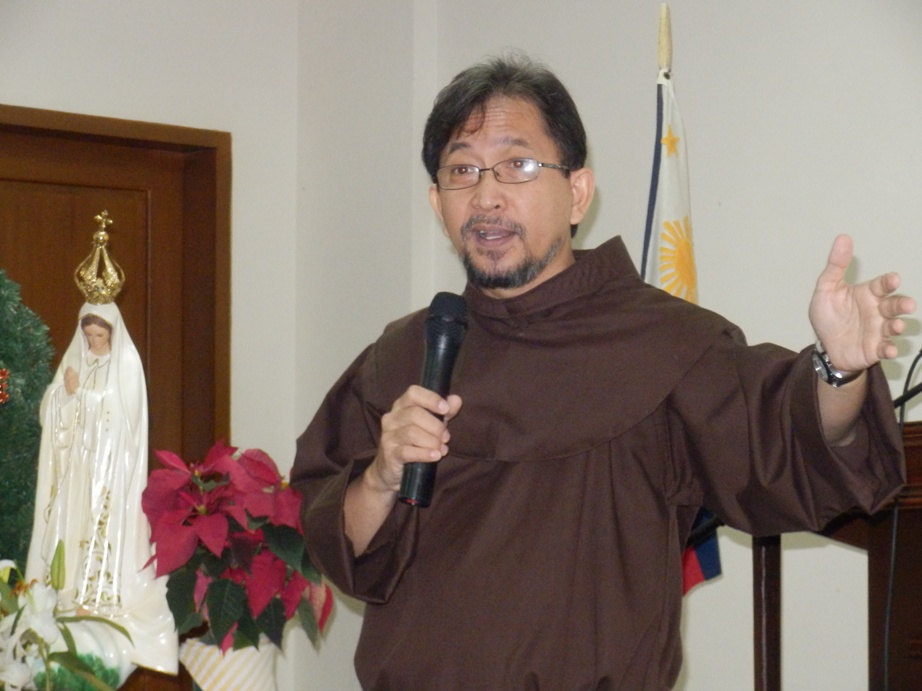
At this year’s Lenten Recollection, Fr. Robert Manansala, OFM delivered a stirring reminder of the message of Pope Francis and how we can each internalize the Holy Father’s teachings. The message he focused on was Francis’ call to use the threefold human language of the mind, the heart and the hands. As Christians, we need to be able to strike this threefold balance in order to authentically live out our calling.
Fr. Robert
Fr. Robert starts out by saying that the wisdom of Pope Francis is as ancient as the Church itself. According to our Lord, the greatest command is to “love the Lord your God with all your heart, and with all your soul, and with all your strength, and with all your mind; and your neighbor as yourself.” (Lk 10:27) In that statement, we can already see the idea of the necessity of the mind, the heart and the hands – to think, to feel and to do.

But how are we supposed to apply this pattern of “think – feel – do” to our lives? Fr. Robert suggests that we can understand this from the background of Pope Francis as a Jesuit – rooted in the teachings of St. Ignatius on discernment. In his writings, Ignatius emphasized the necessity of these three faculties in order to effectively carry out the will of God.

The first step is to think: In other words, to use our intellect to understand the situation that is presented before us. To consider all the possibilities, the risks, the benefits, the consequences all one or more situations.

Thinking is not enough though, we are also called to feel. In this step Ignatius says that we are to pay attention to the stirrings in our heart. He believes that God can speak to us through the deep emotions we feel. If thinking about a situation fills us with consolation, then it may be that is what God desires for us as well.
1
The final step is to act! Ignatius with his military background was a man of action, and he applied this to the spiritual life as well.

It is not enough to strategize and plan all day. As in battle, there must necessarily come a time for execution. Once we have considered the possibilities and reflected on our inner stirrings, we are to act – trusting that we are responding to the will of God.

Categories
Fr. Robert Manansala

Lenten Recollection Alert! By Javier Gomez

OLYMPUS DIGITAL CAMERA
We would like to invite anyone interested to a short Lenten Recollection this coming Saturday, March 7 from 10am to 12noon to be given by Fr. Robert Manansala OFM.

Our goal for this brief talk is to take some time to reflect a little on the seeds that have been sown by Pope Francis. We’re soon approaching the two-month mark since Pope Francis’ historic visit to the Philippines. For most of us by now, the spiritual euphoria that everyone felt has subsided and we’ve gone back to our everyday routines. There is a danger then that we will start to treat the graces of this visit like lightning in a bottle – something that happened once and we cannot recapture ever again. Certainly this is not the goal of Pope Francis himself! It would be more fruitful to think of the graces we have received as seeds – planted deep down by Francis the laborer. Thus, these seeds need to be nurtured, cared for and allowed to grow and blossom.

Our vinedresser will be Father Robert, and he will guide us in nurturing the seeds of Pope Francis’ visit. He will lead us in reflecting on the wisdom that Pope Francis gave us while he was here. Together, let us explore the words of Francis to use the language of the mind, the heart and of the hands in our Christian lives. “To think – To Feel – and to Do.” This is the wisdom that Pope Francis has given us.

Let us reflect on these words together, and see how we can apply them to our lives during this season of Lent. Again, March 7 from 10am to 12nn at the Parish Center. We hope to see you there!

Categories
Fr. Robert Manansala

A Homily for Ash Wednesday by Fr. Robert B. Manansala, OFM

(Excerpts from Coming Home to God, a homily for Ash Wednesday by Fr. Robert B. Manansala, OFM)

Ashes are a symbol of repentance and cleansing in the Bible…The imposition of ashes is not just a pious decoration so we can say we are abiding Catholics. No, it is a powerful, evocative and penitential symbol of our response to God’s invitation to return to Him with all our hearts. What is seen in our foreheads should reflect the intentions and longings of our hearts, and the new behaviors and changes that we want to implement in our lives.

The Rite of the Imposition of Ashes has a double meaning: the first meaning is about conversion and repentance. The first formula goes with the imposition of ashes elucidates this: “Turn away from sin and be faithful to the Gospel” (Mk 1:15). Simply put, it exhorts us to turn away from our sinful ways and to turn to God and his ways.

What are we planning to turn away from, to give up for the Lord during this season of Lent that starts with the celebration of Ash Wednesday? Are we giving up popcorn, chocolates or soft drinks? These questions and the items intended to be given up are commendable. But the more important question is: “What does God want to give us during this Season of Lent?”

The second meaning of the Rite of Imposition of Ashes is a reminder of our precarious human condition: “From dust you came, unto dust you shall return” (Gen 3:19). It is a reminder of our limitations, of our own death and end. As psalm 90 says, “O Lord, teach us how short our life is so that we may become wise” (Ps 90:12). We are reminded not only of our sinfulness but also of our death and finitude, so that we will start living well because we do not have the luxury of time.

During the season of Lent, we are invited to make a forty-day spiritual journey, a time of spiritual retreat. We are called to make Lenten programs, to discern what God is offering and asking from us, and to resolve to do concrete practices and strategies to turn away from sin and to turn more and more to God and His ways.

_________________________________________________

Coming Home to God, a homily for Ash Wednesday is just one of the many homilies Fr. Robert Manansala, OFM offers in his book Echoes of God’s Love. The book is available at the parish book store for only P375. Proceeds go to the Our Lady of the Angels Library Renovation and Upgrade Project.

Categories
Fr. Robert Manansala

February 18 is Ash Wednesday

(Excerpts from Coming Home to God, a homily for Ash Wednesday by Fr. Robert B. Manansala, OFM)

Ashes are a symbol of repentance and cleansing in the Bible…The imposition of ashes is not just a pious decoration so we can say we are abiding Catholics. No, it is a powerful, evocative and penitential symbol of our response to God’s invitation to return to Him with all our hearts. What is seen in our foreheads should reflect the intentions and longings of our hearts, and the new behaviors and changes that we want to implement in our lives.

The Rite of the Imposition of Ashes has a double meaning: the first meaning is about conversion and repentance. The first formula goes with the imposition of ashes elucidates this: “Turn away from sin and be faithful to the Gospel” (Mk 1:15). Simply put, it exhorts us to turn away from our sinful ways and to turn to God and his ways.

What are we planning to turn away from, to give up for the Lord during this season of Lent that starts with the celebration of Ash Wednesday? Are we giving up popcorn, chocolates or soft drinks? These questions and the items intended to be given up are commendable. But the more important question is: “What does God want to give us during this Season of Lent?”

The second meaning of the Rite of Imposition of Ashes is a reminder of our precarious human condition: “From dust you came, unto dust you shall return” (Gen 3:19). It is a reminder of our limitations, of our own death and end. As psalm 90 says, “O Lord, teach us how short our life is so that we may become wise” (Ps 90:12). We are reminded not only of our sinfulness but also of our death and finitude, so that we will start living well because we do not have the luxury of time.

During the season of Lent, we are invited to make a forty-day spiritual journey, a time of spiritual retreat. We are called to make Lenten programs, to discern what God is offering and asking from us, and to resolve to do concrete practices and strategies to turn away from sin and to turn more and more to God and His ways.

_________________________________________________

Coming Home to God, a homily for Ash Wednesday is just one of the many homilies Fr. Robert Manansala, OFM offers in his book Echoes of God’s Love. The book is available at the parish book store for only P375. Proceeds go to the Our Lady of the Angels Library Renovation and Upgrade Project.

Categories
Fr. Robert Manansala

“Echoes of God’s Love” Book Launching

This slideshow requires JavaScript.

November 30, 2014, Saturday, marked a milestone in the life of SSAP guest friar priest, Fr. Robert Manansala, OFM. He launched his first book, Echoes of God’s Love (Homilies for Liturgical Cycle B) at the packed St. Bonaventure Room. The room was filled with parishioners, Franciscans, seminarians, family and friends, who came to show their love and support for Fr. Robert.

Echoes of God’s Love is a compilation of homilies for the Sundays and major Solemnities and Feastdays for the Liturgical Year Cycle B, which started with the first Sunday of Advent.

Echoes of God’s Love is meant for spiritual reading to accompany us in our spiritual journey towards God. It speaks to the heart about the amazing love of God. Further, it challenges us to respond to His love by the way we live and love.

Despite Fr. Robert’s hectic schedule, he was able to complete the book and launch it in time for Advent. Fr. Robert heart-warmingly thanked the people who have supported him to see this dream of his turn into reality.

The official launch of the book were led by parishioners Mrs. Petrona Lim and Nanette Jalandoni. Assisting them were Ambassadors Howard Dee and Francisco del Rosario.

All proceeds of the book sale and donations have been pledged for the Library Upgrade and Renovation project of the Our Lady of Angels Seminary-College.

Interested parties may contact Bernadette Andulte at the parish office or visit the parish bookstore.

This article was written with contributions from Jaja Ledesma and Fr. Robert Manansala, OFM.

About Fr. Robert and his reflections.

Categories
CWL Fr. Robert Manansala

CATHOLIC WOMEN’S LEAGUE (CWL) ADVENT RECOLLECTION

This slideshow requires JavaScript.


The Catholic Women’s League (CWL) held its yearly advent recollection with Fr. Robert Manansala, OFM as facilitator. Fr. Robert spoke on advent spirituality to the CWL members, and reminded them that the spirit of advent helps us to live a Christ-like life and to share with others the Christ we have received. Fr. Robert explained that the advent spirit is a contemplative spirit. Seeing God in all things and seeing all things in God.

Fr. Robert also said that advent is a sense of joy. Joy is never received directly, it is a by-product of a deep relationship with God. When we are most true to ourselves, when we are most loving, we then experience glimpses of joy.

The recollection ended on a note from The Joy of the Gospel: The joy of the Gospel fills the hearts and lives of all who encounter Jesus. Those who accept his offer of salvation are set free from sin, sorrow, inner emptiness and loneliness. With Christ, joy is constantly born anew.

November 18, 2014
Theme: Advent Spirituality
Facilitated by Fr. Robert Manansala, OFM

• Advent is Adventus. This means Coming.
• The season of advent is 4 weeks. It is a time of expectant waiting. and preparation for the celebration of the nativity of Jesus at Christmas.
• Plarousia is at the end of time, all will be transformed by God.
• Advent is the waiting of Christians for Christ’s coming.
• Mother Mary is the model disciple.
• There are three types of the coming of Our Lord:
1. Historical coming of Jesus.
2. Second coming of Jesus at the end of time to judge the living and the dead.
3. Different comings of Jesus in between: Incarnation and parousia by the power of the Holy Spirit; in the sacraments, scriptures, prayer.
 In the events of ourlives, in the church, in society, in the person and lives of the poor.
• “God is at home, it’s me who has gone out for a walk.” (Meister Eckhart, Dominican mystic)
• “Advent means a heart that is ready and awake.” (Fr. Alfred Delp, SJ., priest, , outspoken critic of the Nazi regime who was martyred in a concentration camp in 1945.)
• The starting point – we are already intimately connected with God.
• The advent spirit is to celebrate Christmas more meaningfully so that we receive Christ more and more in our hearts, in our lives, in our families and in our society.
• The spirit of advent helps us to have a Christ-like life and to share with others the Christ we have received. (Fr. Robert Manansala, OFM homily, 1st Sunday of advent, Dec. 26, 2011)
• The advent spirit is about meeting Christ in the sacraments and in the scriptures and in the many other ways through which he comes to us.
• The advent spirit is a contemplative spirit. “Seeing God in all things” and “Seeing all things in God.”
• You can experience a great sense of joy even in the midst of much trouble if we know God is with us.
• The more we receive Christ, the light of the world, the more we become a light to the world.
• Only God can satisfy the vacuum in our hearts.
• Advent is a sense of joy.
• “A sad saint is a bad saint.” (St. Francis of Assisi)
• “A sense of joy is a hallmark of holiness.”
• You experience joy if you truly experience God in your lives.
• When we are most true to ourselves, when we are most loving, we experience glimpses of joy.
• Real joy is never received directly; it is a by-product of a deep relationship with God.
• Joy = Jesus – others – yourself.
• Fear, worry, anxiety – are all forms of atheism.
• Let Go, Let God.
• The mystic spirit/heart is a lived experiential awareness of God’s uniting and transforming presence, immediacy and intimacy.
• “Advent is a time of being deeply shaken, so that man will wake up to himself…The shaking is what sets up the secret blessedness of this Season and enkindles the inner light in our hears, so advent will be blessed with the promise of the Lord. The shaking, the awakening: with these, life merely begins to become capable of Advent…that the golden threads running during the season may reach us.” (Fr. Alfred Delp, SJ)
• Three advent figures: (1) John the Baptist – “The voice calling in the wilderness.” (2) Archangel Gabriel – “The angel of the Annunciation.” (3) The Blessed Mother – “A heart ready for the word to become flesh.”
• From acquiring advent spirit to becoming advent people – “Our hearts must be keenly alert for opportunities in our own little corners of daily life. May we stand in this world not as people in hiding, but as those who help prepare the way of the only-begotten Song of God.” (Fr. Alfred Delp, SJ)
• Advent wreath/candles: “Light the candles wherever you can, you who have them. They are a real symbol of what must happen in advent, what advent must be, if we want to live.” (Fr. Alfred Delp, SJ)
• “This is a peaceful, reticent, but constant shining. This is giving light at the cost of one’s own substance, so that one is consumed in the process. Anyone who wants to comprehend Christ’s message of light…must comprehend this one thing: the mission, the duty to shine, to draw others, to seek, to heal, to do good at the cost of one’s substance…(Fr. Alfred Delp, SJ. Feb. 2, 1941)
• From advent spirit to advent people to advent life: “All of life is advent” (Fr. Alfred Delp, SJ)
• “The entire life is a spiritual journey.”
• “Our hearts are restless until they find rest in you.” St. Augustine
• Joy: St. Paul – To rejoice in the Lord always in the midst of tribulations. (Phil 4:4)
• Joy – more than a feeling state or a mere heightened sense of pleasure. In Christian life it refers to a basic disposition and a fundamental attunement to the self-giving of God in Jesus Christ.
• To rejoice in the midst of suffering puts a strain on our ordinary conception of joy and enjoyment.
• The peculiar object of joy in scripture and church tradition – the revelation of God in Jesus.
• Joy is the ingredient in the very pattern of life constituted by trust in God, in, with, and through Jesus Christ. Every activity and relationship in the service of God and neighbors shares in a joyful quality.
• Serving the neighbor becomes an “enjoyment,” one of the chief ends of human existence.
• Joy is not contingent upon fortune, good or bad, but is grounded in faith that God is creator and redeemer of the world.
• In sum, joy occupies a central place among the Christian affections, yet is also characteristic of all activities begun and completed in faith.
• While ecstatic states of joy may be sought after and experienced from time to time, the principal aim of the Christian life is to serve God and neighbor joyfully. In the spiritual life, God is the supreme joy and the greatest delight.
• Third Sunday of Advent has been traditionally called Gaudete Sunday because the first word of the Entrance Antiphon of the Mass is Gaudete, the Latin word for “Rejoice.”
• The opening prayer asks us to “experience the joy of salvation.”
• The alternative opening prayer asks God to “remove the sadness that hinders us from feeling the joy and hope which Christ’s presence bestows.”
• Third Sunday of Advent, it would be a good thing to reflect on what “hinders us from feeling joy and hope.”
• Many specialists of the human heart tell us that the enemies of joy are fear, worry and anxiety.
• Ann Landers, a well-known newspaper editor with a decade old advice column in the Washington Post received an average of ten thousand letters every month. She said that in those letters, the predominant problem were fear, worry and anxiety.
• Charles Swindoll (Laugh Again): “Of all the joy stealers that can plague our lives, none is more nagging, more agitating, or more prevalent than worry.”
• Swindoll: “ We get our English word worry from the German wurgen, which means ‘to strangle, to choke.” Our Lord mentioned that very word on one occasion, ‘The sower sows the seed and the worries of the world, and the deceitfulness of riches, and the desires for other things enter in and choke the word and it becomes unfruitful.’ (Mk. 4:1 4-19)
• In a nutshell, when worry strangles our thinking, choking out the truth, we become unfruitful and unproductive. Along with becoming harassed mentally and paralyzed emotionally, we find ourselves throttled spiritually. Worry cuts off our motivaton, inspiration and sense of joy.
• John O’Brian (The Art of Courageous Living): “Worry is debilitating. Fear paralyzes the springs of action. The need for a remedy that will release soul and body from the grip of these twin evils is the paramount need of our day.”
• Luke 12:22-34 (Do Not Worry) 22 Then Jesus said to his disciples: “Therefore I tell you, do not worry about your life, what you will eat; or about your body, what you will wear. 23 For life is more than food, and the body more than clothes. 24 Consider the ravens: They do not sow or reap, they have no store room or barn; yet God feeds them. And how much more valuable you are than birds! 25 Who of you by worrying can add a single hour to your life? 26 Since you cannot do this very little thing, why do you worry about the rest? 27 Consider how the wild flowers grow. They do not labor or spin, yet I tell you, not even Solomon in all his splendor was dressed like one o these. 28 If that is how God clothes the grass of the field, which is here today, and tomorrow is thrown into the fire, how much more will he clothe you – you of little faith! 29 And do not set your heart on what you will eat or drink; do not worry about it. 30 For the pagan world runs after all such things, and your Father knows that you need them. 31 But seek his kingdom and these things will be given to you as well.
• 32 “Do not be afraid, little flock, for your Father has been pleased to give you
the kingdom. 33 Sell your possessions and give to the poor. Provide purses for yourselves that will not wear out, a treasure in heaven that will never fail, where no thief comes near and no moth destroys. 34 For where your treasure is, there your heart will be also.
• The First Reading tells us that we can rejoice heartily when “the spirit of the Lord is upon us” (Is 61:1) because God is the joy of our souls.
• In the Gospel, we have a glimpse of joy in the life and example of John the Baptist. John the Baptist is the one who knows his identity and mission before God; he knows he is not the Messiah; neither is he Elijah. He is the voice crying out for the coming of the Messiah. When we know who we are before God, when we know our identity and place in the world, when we know and do what God wants us to do with our lives, then we find real joy ad happiness.
• True joy is a by-product of having a deep relationship with God and Jesus. It is a by-product of making Jesus the center of who we are, of what we do, of what we have, and of all our relationships, endeavors, and plans. Joy is found in living a holy and loving life. It is found in love, simplicity, innocence, trust, service of God and of others. It is found in losing ourselves in Christ and others.
• Did not Jesus Christ say that the person who loses his life, because of the love he has for Christ, will find it? (cf. Mt 16:25; Lk 17:33) Joy and its increase in our hearts come directly from Jesus Christ, working through the Holy Spirit, His first gift to those who believe in Him. On the night before He offered His life for us, He said, “I have told you this so that my joy may be in you and your joy may be complete.” (Jn 15:11) Joy is a by-product and not something that we pursue directly. It is a God-given gift.
• “If we let Christ into our lives, we lose nothing, nothing, absolutely nothing of what makes life free, beautiful and great…Only in this friendship are the doors of life opened wide. Only in this friendship do we experience beauty and liberation. And so, today, with great strength and great conviction, on the basis of long personal experience of life, I say to you: Do not be afraid of Christ! He takes nothing away and He gives you everything. When we give ourselves to Him we receive a hundredfold in return. Yes, open wide the doors to Christ – and you will find true life.” (Pope Benedict XVI, April 24, 2005)
• “The joy of the Gospel fills the hearts and lives of all who encounter Jesus. Those who accept His offer of salvation are set free from sin, sorrow, inner emptiness and loneliness. With Christ, joy is constantly born anew. “ (The Joy of the Gospel)

Categories
Fr. Robert Manansala Reflections

LOVING THE DEAD BEYOND THEIR EARTHLY LIFE, by Fr. Robert B. Manansala, OFM

The Commemoration of all the Faithful Departed (All Souls’ Day),
Cycle B
Wis 3:1-9; Ps 23:1-3a, 3b-4, 5, 6;Rom 5:5-11 or Rom 6:3-9; Jn 6:37-40

The Commemoration of all the Faithful Departed echoes a very important message: no human life is perfect, not even Christian life. And the Good News on this Commemoration of the Dead is that God in Jesus loves us, even as we are not perfect, and that the love of God does not abandon the souls of our departed brothers and sisters in the faith, even as they did not measure up to the ideals of Christian perfection. In the Gospel of John, Jesus says, “Do not let your hearts be troubled. You have faith in God; have faith also in Me. In my Father’s house there are many dwelling places. If there were none, would I have told you that I am going to prepare a place for you? And if I go and prepare a place for you, I will come back again and take you to myself, so that where I am you also may be” (Jn 14:1-3). The redemptive and loving action of God in Jesus extends beyond death.

The Commemoration of the Dead is very much connected to two articles of faith in our Christian tradition: the Communion of Saints, and the Doctrine of Purgatory. The Catechism of the Catholic Church explains the belief in the Communion of Saints in the following words: “We believe in the communion of all the faithful of Christ, those who are pilgrims on earth, the dead who are being purified, and the blessed in heaven, all together forming one Church; and we believe that in this communion, the merciful love of God and His saints is always [attentive] to our prayers’” (CCC 962).

On All Saints’ Day we honor all the saints, the blessed, the venerable and the holy who are with God in heaven. There they intercede for us, assisting us by their prayers. On All Souls’ Day we remember all the faithful departed – those who have died, and are being prepared for their entrance into eternal glory by being purified in purgatory.

Again, we read in the Catechism: “All who die in God’s grace and friendship, but still imperfectly purified, are indeed assured of their eternal salvation; but after death they undergo purification, so as to achieve the holiness necessary to enter the joy of heaven…” (CCC 1030). The same Catechism describes purgatory as the “final purification of the elect, which is entirely different from the punishment of the damned” (CCC 1031).

Some modern theologians suggest that purgatory may be an “instant” or progressive purification immediately after death varying in intensity from soul to soul, depending on the state of each individual.

The teaching on purgatory as the final purification is based on the practice of prayer for the dead. The Book of Maccabees describes how Judas, the military commander, discovered those of his men who had died in a particular battle had been wearing forbidden pagan amulets. His men at once “prayed that the sinful deed might be fully blotted out” (2 Mc. 12: 42). Judas then “took up a collection from all his soldiers, amounting to two thousand silver drachmas, which he sent to Jerusalem to provide for the expiatory sacrifice” (2 Mc. 12: 43). The narrator continues, ”If he were not expecting the fallen to rise again, it would have been superfluous and foolish to pray for the dead. But if he did this with a view to the splendid reward that awaits those who had gone to rest in godliness, it was a holy and pious thought. Thus he made atonement for the dead that they might be absolved from their sin” (2 Mc 12: 44-46).

The above verses clearly illustrate the existence of purgatory that, at the time of the Reformation, Protestants had to cut the Books of the Maccabees out of their Bibles in order to avoid accepting the doctrine. Not only can we show that prayer for the souls of the departed was practiced by the Jews at the time of the Maccabees, but also we can show it has been retained by Orthodox Jews today. They recite a prayer known as the Mourner’s Kaddish for eleven months after the death of a loved one, so that the loved one may be purified.

As Christians, we believe in the so-called Four Last Things: death, judgment, heaven and hell. Purgatory is not mentioned as one of the “last things,” because, strictly speaking, purgatory is a part of heaven. Purgatory is the “remedial class” for heaven-bound souls. Souls who go to purgatory are those who have been judged worthy of heaven, but not straight away. They still need some purification or purgation before they are ready for heaven because, according to Revelation 21:27, “nothing unclean shall enter it.” A very good illustration for this is the set-up in many churches in the west. Before we get to the main church, we have to go through the vestibule first. We are already in the church but not yet in the main church.

In James Boswell’s famous biography of Samuel Johnson, a great eighteenth century British author, a passage deals with purgatory and Masses for the dead. Boswell writes that the idea of purgatory made eminent sense to Johnson. His reasoning is that the vast majority of people who die should not be judged so bad as to deserve hell or so good as to deserve heaven. So, he concluded, there must be a kind of state where some sort of cleansing takes place before one finally enters heaven.

When asked about Masses for those in purgatory, Johnson replied that praying for them is as proper as praying for our brothers and sisters who are alive. Praying for the dead, like praying for the living, is a manifestation of love. St. Augustine noted: “If we had no care for the dead, we would not be in the habit of praying for them.” For us, believers, praying for a loved one is a way of bridging any distance, even death. In prayer we stand in God’s presence in the company of the people we love, even as these persons have gone before us.

The Catechism of the Catholic Church recommends prayer for the dead in conjunction with the offering of the Eucharistic Sacrifice (CCC1032). Pope Leo XIII, in his 1902 encyclical Mirae caritatis, states: “The grace of mutual love among the living, strengthened and increased by the Sacrament of the Eucharist, flows, especially by virtue of the Sacrifice [of the Mass], to all who belong to the communion of saints.”

The Catechism also encourages “almsgiving, indulgences, and works of penance undertaken on behalf of the dead.” All these prayerful acts are to be conducted as matters of faith, and not as something magical. The greatest act is to offer Mass for the dead, because in this One Sacrifice, the merits of our Lord Jesus are applied to the dead. Hence, this reconciling offering of the Lord is the greatest and most perfect prayer we can offer our dead in their state of purification. Let us not forget to pray for our dearly departed, have Masses offered for them, visit their graves, and make daily sacrifices for them.

Our prayers and other sacrifices for the dead are capable not only of helping them, but also of making their intercession for us effective. The Church chooses the entire month of November for increased prayers on behalf oft he souls in purgatory. Our ideas about purgatory are usually frightening. This should not be the case. Fr. Leonard Foley, a Franciscan theologian, gives us a very good insight on purgatory in terms of God’s purifying act of love. He writes, “We must not make purgatory into a flaming concentration camp on the brink of hell – or even a hell for a short time.’ It is blasphemous to think of it as a place where a petty God exacts final punishment… Saint Catherine of Genoa, a mystic of the fifteenth century, wrote that the ‘fire’ of purgatory is God’s love ‘burning’ the soul so that, at last, the soul is wholly aflame. It is the pain of wanting to be made totally worthy of One who is seen as infinitely lovable, the pain of desire for union that is now absolutely assured, but not yet fully tasted.”

Purgatory may be a form of “blazing enlightenment” which penetrates and perfects our very being. God can anticipate and apply the merits of our present and future prayers for the dead in favor of the souls we pray for at the time of their purification. Purgatory is thus “the fringe of heaven, a state where heaven’s eternal light has a refining effect on the “holy souls” (not ‘poor souls’), who are held in the arms of Divine Mercy.”

Let us end with something to keep us reflecting. The Church has a rite declaring someone is in heaven. This is officially the meaning of the process of canonization. This is also in essence what we celebrate on All Saints’ Day. Also, the Church has a special day dedicated to those who are heaven-bound– all souls in purgatory, those in transit to heaven. November 2nd, All Souls’ Day, is especially dedicated to this. A good thing about our November 2 commemoration of the dead, like our November 1st commemoration of all the saints, is that we pray not only for our dead relatives and friends, but also for all the dead. We remember even those who have no one to pray for them.

Let us take note though that we do not have any rite or ceremony declaring someone is in hell. The Church can never and should never do this– not even for the most despicable person in the world. We leave it to the merciful prerogative of God. Thus, our prayers should be for all the dead – including those who may have lived despicable lives here on earth.

About Fr. Robert and his other reflections…

Categories
Fr. Robert Manansala Reflections

“WE WILL BE JUDGED ON LOVE”, A Reflection for the 30th Sunday in Ordinary Time, Cycle B, By Fr. Robert B. Manansala, OFM

Ex 22:20-26; Ps 18:2-3, 3-4, 47, 51; 1 Thess 1:5-10; Mt 22:34-40

In January 2011, a picture of Dr. Richard Teo circulated in the internet. Together with it, a transcript of his talk on his life experiences went viral as well. He was a general medical practitioner turned cosmetic surgeon and he died of lung cancer on October 18, 2012, nine months after his talk.

Already suffering from cancer in January, he shared his life experiences with a class of students. In the beginning, just like many people, he thought of happiness in terms of success, and success was about wealth. As a young doctor, he saw that becoming a cosmetic surgeon was the fastest way to success and wealth. So instead of healing the sick and the ill, he shifted to glorifying aesthetic looks. True enough, after a year, he was raking in millions and could very well afford the luxuries of life. Then in March 2011, at the pinnacle of life according to the world’s standards, he was diagnosed with lung cancer. He got very depressed and realized that his success and everything that he had acquired could not give him genuine happiness and joy.

Dr. Teo recalled a college friend named Jennifer. Whenever she saw a snail on the pathway, she would pick it up and put it along the grass path. At that time, he could not understand what Jennifer was doing, getting her hands dirty for the sake of a snail. It was just a snail. Besides, it deserved to be crushed if it went the pathway of humans.

Dr. Teo said that as a doctor, he should have been steeped in compassion even for non-human creatures, but he was not and could not. In fact, his exposure to sufferings and deaths in the cancer department as a young doctor deadened his feelings and capacity to empathize. Everything became simply a job for him. While he knew all the medical terms to describe the sufferings of people, how they felt and what they were struggling through, in truth, he did not really know how they felt – until he became a cancer patient himself. He said that if he could only relive his life, he would have been a different doctor – a truly compassionate one. A cancer patient himself, he began to understand how other patients felt, something that he learned the hard and irrevocable way.

Dr. Teo reminded his listeners never to lose their moral compass along the way of life and in the practice of their professions, something that he lost as he got obsessed with wealth, viewing his patients as merely sources of income. As doctors, they should serve people and have compassion on the sufferings of their patients. Society and media should not dictate on them how they should live.

True happiness does not come from serving oneself but from serving others. And it comes from knowing God, not simply knowing God but knowing God personally, and having a genuine relationship with God. He said that is the most important thing he learned: to set our priorities at an earlier stage of our lives – to trust in the Lord and to love and serve others, not just ourselves.

Dr. Richard Teo ended his talk with a quote from the book Tuesdays with Morrie. It says: “Everyone knows that they are going to die; every one of us knows that. The truth is none of us believe it because if we did, we will do things differently. When I faced death, when I had to, I stripped myself of all stuff totally and I focused only on what is essential. The irony is that a lot of times, only when we learn how to die then we learn how to live.”

On this 30th Sunday in the Ordinary Time, Jesus reminds us that love of God and neighbors is the summary of all the laws, commandments and teachings of the prophets, the summary of religion itself. It is very significant that we are hearing these two greatest commandments right after All Saints’ Day and All Souls’ Day. The saints are known for the holiness of their lives. As Christians, this is our fundamental calling – this universal call to holiness, which consists in the practice of the love of God and neighbors.

Lumen Gentium, one of the Vatican II documents, tells us that all of us are called to holiness by virtue of baptism. Holiness consists in the perfection of charity – in other words, in the growth and practice of the love of God and neighbors according to our states and circumstances of life. Leon Bloy, a French writer, declares, “The only tragedy in life is not to be a saint.” We may not all become canonized saints, so All Saints’ Day is also for the countless holy men and women who are not officially declared saints of the Church.

A parishioner once remarked that All Souls’ Day is a good reminder to pray for our dead relatives and friends and also of our own mortality. Indeed, all of us will come to the point of our final surrender to the Lord, the final offering of our last breath, of our entire life, of all our deeds and personal history.

St. Francis of Assisi desired to die naked to dramatically show that, like Job of the Old Testament, he came into this world with nothing. He wanted to go back to the Lord in utter nakedness and complete dependence on Him and on His mercy. Everything is grace. Everything and everyone is a gift and there is nothing and nobody that we can really appropriate for ourselves. In Pilipino, “Hiram sa Diyos ang ating buhay.” In fact, “Hiram sa Diyos ang lahat-lahat.” We must be ready to make that final surrender of everything. It is in this light, that we can appreciate the reminders of Dr. Richard Teo, Jim Castle and of all the saints, especially that of St. John of the Cross who said: “In the evening of life, we will be judged on love.”

The scribe in the Gospel was sincere in his questioning of Jesus. He was really searching for the truth that would guide him in living his life and in practicing religion. A total of 613 commandments had accumulated and developed through the years of interpretation of the Ten Commandments and other precepts of the Law and the Prophets. Jesus’ response to the scribe was an invitation to see what was already there in the Scriptures. All they needed to do was to practice them truthfully.

The love of God with all one’s heart, soul and strength is found in the Book of Deuteronomy, and constitutes the Shema, the most important prayer of the Israelite religion (cf. Dt 46:4-5). The love of neighbor as oneself is found in the Book of Leviticus (cf. Lv 19:18). What we find separated in the Old Testament has been put together by Jesus in the New Testament (cf. Mk 12:28-34; Mt 22:34-40; Lk 10:25-28).

Indeed, the love of God and the love of neighbors, though distinct, are interrelated and inseparable. The love of God takes priority over everything else, but it must flow into the love of neighbors, especially the needy, and those suffering and in pain.

When Blessed Mother Teresa accepted the Nobel Peace Prize in Oslo in 1979, a part of her acceptance speech went like this: “It is not enough for us to say: ‘I love God, but I do not love my neighbor.’ St. John says that you are a liar if you say you love God and you don’t love your neighbor (1 Jn 4:20). How can you love God whom you do not see, if you do not love your neighbor whom you see, whom you touch, with whom you live? And so this is very important for us to realize that love, to be true, has to hurt.”

For Blessed Mother Teresa, love is something that is very concrete, something that begins where we are, without ending there. In this regard, she said: “Spread love everywhere you go: first of all in your own house. Give love to your children, to your wife or husband, to a next door neighbor… Let no one ever come to you without leaving better and happier. Be the living expression of God’s kindness; kindness in your face, kindness in your eyes, kindness in your smile, kindness in your warm greeting.”

We end with some revealed insights of St. Catherine of Genoa on purgatory. Purgatory, according to the saint, has something to do with the cleaning and purifying love of God upon souls wherein stains of sin still remains. Only a soul purified from all sinfulness can be completely united with God who is Divine Love.

About Fr. Robert and his other reflections.

Categories
Fr. Robert Manansala Reflections

19th Sunday in Ordinary Time, Year C, A Reflection by Fr. Robert Manansala, OFM

The gospel passage this Sunday, which contains a teaching on treasures in heaven and three parables on vigilance and faithfulness, can be summarized by the following line that we read in the text: “For where your treasure is, there also will your heart be.” The Jesuit biblical scholar Joseph A. Fitzmeyer says “this maxim has parallels in secular Greek literature, but none of them is so succinctly put as this.”

Gerald Cowen, in his beautiful elaboration of the significance of the heart in the Bible, speaks of the heart as “the center of the physical, emotional, mental, moral and spiritual life of humans.” According to him, “the conscience, for instance, is associated with the heart.” On the negative side, depravity is said to issue from the heart. In Matthew 15:19, Jesus speaks that out of the heart comes evil thoughts, murder, adultery, fornication, theft, false witness, slander. “In other words, defilement comes from within rather than from without.”

Cowen further notes that “because the heart is at the root of the problem, this is the place where God does His work in the individual.” For example in Romans 2:15, St. Paul speaks of the work of the law as “written in their hearts,” and conscience is the proof of this. In some gospel parables, “the heart is the field where seed or the Word of God is sown. Finally, the heart is the dwelling place of God. God resides in the heart of the believer.

Jesus does not say in the Gospel, “Where your heart is, there will be your treasure also.” He says, “Where your treasure is, there also will your heart be.” Jesus knows that if we want to know what is in people’s hearts, we first find out what is in their treasure boxes or what they consider as their treasures.” Considered as the seat of human yearning or longing, the heart is attracted and directed towards that which it considers its treasures.

Etymologically, treasure comes from the English term “thesaurus,” a word that refers to a “storehouse.” Literally, it means “a receptacle of valuables.” What one keeps, maintains, safeguards, protects and accumulates as his valuables are his treasures. Indeed, what we store is our treasure. Denis McBride is right in saying that if we want to know the condition of one’s heart, find out what one stores in his treasure box. Tell me what you consider as your greatest treasures and I will tell you about the condition of your heart.

Last Sunday, Jesus warned against storing treasures up that do not last. More concretely, he warned against greed and strongly reminded that one’s life does not consist of possessions. What is important is to be rich in what matters to God.

Biblical revelation, Christian spirituality and theology tell us that the heart’s proper and prime attraction must be God. The New Catechism of the Catholic Church starts by declaring that the longing for God is planted in the heart of every person. In Matthew 6:33, Jesus tells us “to seek first his Kingdom and his righteousness, and all these things will be given to you as well.” In the gospel today, Jesus says that the Father is giving us this treasure of the Kingdom of God, “the inexhaustible treasure in heaven than no thief can reach nor moth destroy.”

If we anchor the rest of the Gospel on this fundamental challenge of receiving and making the God and Kingdom of God as the greatest treasure of our hearts, we then find at least three important lessons on the basis of our gospel passage.

First, everything, including material possessions and even basic needs that we have, becomes relative to the absoluteness of God’s Kingdom. We seek God and His Kingdom first and above all else. If we truly believe that God’s Kingdom has already started with the coming of Jesus, and the present is oriented towards the completion of this Kingdom in Jesus’ return or second coming, we strive to cooperate with God’s grace to really make God the center of our lives. One of the results of this is that we become more trusting in the providence of God and we acquire a more non-clinging and non-accumulative attitude towards everything, including possessions.

The gospel passage last Sunday made it very clear, “One’s life does not consist of possessions” and thus, we must avoid greed in any forms. In the spirit of St. Francis of Assisi and many other saints, everything is a gift from God and everything ultimately belongs to God. Obsessive and greedy appropriation and accumulation of goods are not traits of people who trust in God as their loving and benevolent Father. If God takes care of the sparrows, how much more he will take care of us.

Second, knowing that one’s greatest treasure is God’s Kingdom leads one to share what one has and possesses with others, especially with the poor. The relative and fleeting character of possessions makes one share with others and impels him to work for transformation of the world so that what truly reign in the world are the Kingdom values of love, peace, justice and equality. God the Father of all humans and of all creation has given the resources of the world to be shared by all. This experience of the Fatherhood of God and the absoluteness of his Kingdom makes us work for a new world order where no one is neglected, oppressed, abused and dehumanized.

Finally, because God and His Kingdom are our greatest treasure, the proper disposition in this world is that of a faithful and prudent servant and steward who is always ready to make an accounting to the Lord for the life and resources that He has given us and for the quality of lives that we have lived and the quality of persons that we have become. The gospel passage has a strong reminder on this: “Much will be required of the person entrusted with much, and still more will be demanded of the person entrusted with more.” At the hour of our death and at the eschatological coming of Jesus at the end of time, an accounting has to be made. Blessed is the servant and steward who is faithful, prudent and wise for living well and for relating well with others, especially the poor and the weak, according to the Kingdom values of love, peace, justice and equality.

A faithful and prudent servant and steward is vigilant. The first reading from the Book of Wisdom reminds us of the need for preparedness for the ultimate coming of the Lord as the Israelite people waited and prepared for their liberation from the slavery of Egypt.

A faithful and prudent servant and steward also possesses faith. The person who knows that his real treasure is God and His Kingdom will possess the faith exemplified by Abraham as recounted in the Letter to the Hebrews. Maryanne Williamson says that “the greatest treasures are those invisible to the eye but felt by the heart.” One can only apprehend these treasures by faith for “faith is the realization of what is hoped for and evidence of things not seen.”

We find in St. Augustine of Hippo, the sinner turned saint, an embodiment of the heart’s search for what can truly satisfy it. In his life story, we find a succession of desperate searches for fulfillment: excessive pleasures, false religions, philosophy, dissipation and distractions—futilities that left him so weary of himself he could only cry out, “How long, O Lord, how long?” In the midst of this cry for divine help, the Scriptures showed him that he could be freed from sin and that he could start living a godly life. The transformation of St. Augustine began when he finally believed in and surrendered himself to God.

In his beautiful work entitled Confessions, considered one of the greatest autobiographical testimonies of God’s interaction with a soul that has found rest in its Creator, with a heart bursting with the reality of God, St. Augustine directly addresses the Lord. He declares: “Great are you, O Lord, and greatly to be praised, great is your power, and your wisdom is infinite.

In contrast to God, he asks, “What is man?” Yes, he finds the connection between God and man. In spite of sin, each person feels the longing to reach out to his Creator. Whys is this so? St. Augustine realizes that this itself is God’s doing: “You have made us for yourself, and our hearts are restless, until they find rest in you.”

Blaise Pascal, the 17th century mathematician, philosopher and author declared: “There is a God-shaped vacuum in the heart of every person which cannot be filled by any created thing, but only by God, the Creator made known through Jesus.”

Our hearts know that nobody and nothing in this world can completely satisfy us. St. Poemen knew this very well when he said, “Give not your heart to that which does not satisfy your heart.” If we give our hearts to God, we give God everything and God becomes our All.

Almighty God,
you have made us for yourself,
and our hearts are restless till they find their rest in you:
pour your love into our hearts and draw us to yourself,
and so bring us at last to your heavenly city
where we shall see you face to face;
through Jesus Christ your Son our Lord,
who is alive and reigns with you,y
in the unity of the Holy Spirit,
one God, now and for ever.

About Fr. Robert and his reflections

Categories
Fr. Robert Manansala Reflections

“The Transfiguration of Jesus: A Cosmic Disclosure” Second Sunday of Lent, Year A, by Fr. Robert B. Manansala, OFM

The late Bishop Ian Ramsey of Durkham, who wrote extensively on the problem of religious language, Christian ethics, the relationship between science and religion, and Christian apologetics, often used the term “cosmic disclosure.”

A cosmic disclosure is when you encounter an incident or a person and this brings about infinite dimension and meaning, that without this incident or person, one’s whole life makes no more significance or is changed drastically. An example of this is when, for the first time in your life, you truly recognize how much you love your husband or wife and children, and without them, your life will have no more meaning or will already be completely different. If this happens to you and this incident changes you and your life, you are experiencing a cosmic disclosure.

The spiritual author Anthony Bloom, according Fr. Gil Guillimette, SJ, describes what Bishop Ian Ramsey is trying to say in the following words: “There are moments when things which surround us – people, situations – suddenly acquire depth, become transparent, as it were, and allow us to see them with a new significance… We see people apparently as they are, and someday we suddenly spot something else…. All of a sudden a face… appears to us completely new, lending us a depth of meaning, depth of significance. In such moments occurs what Ian Ramsey calls ‘cosmic disclosure.’”

The transfiguration incident in the life of Jesus can very well be described as a cosmic disclosure of who Jesus Christ really is. It is a moment of cosmic disclosure for the apostles Peter, James and John who accompany Jesus on Mt. tabor. Found in all the synoptic gospels, it basically deals with the issue concerning the divinity of Jesus and with the connection between Jesus’ appearance in glory and his passion and death.

Historically and chronologically, the transfiguration of Jesus took place after Peter’s confession of Jesus as “the Messiah, the Son of the living God.” Peter’s confession, in turn, took place on the Jewish Feast of Yom ba-Kippurim, the great feast of atonement. On this Jewish feast, for the one time in the year, the high priest solemnly pronounced the name YHWH in the Temple’s Holy of Holies. It is significant that Jesus is pronounced by Peter as the Messiah and the Son of the living God on the day that the Jews can only mention the personal and direct name of God, Yahweh. And on the day of the transfiguration, it is the divine identity of Jesus that is revealed in glory.

It is also significant to note that the transfiguration of Jesus took place on the last day of the Jewish Feast of the Booths, a commemoration that lasted for a week. This feast commemorates the journey of the Israelite people in the desert. In Hebrew, the feast is called Sukkot, which means huts, in reference to the huts or booths in which the Israelites lived during their forty years of sojourn after the exodus from Egypt. In this desert journey, the Israelites were people on the go, unable to build permanent structures but only temporary huts. The Promised Land was their final destination; the desert, as a place of journey, was only transitional.

That the transfiguration event took place on the last day of the feast of the booths, which was considered its high point and the synthesis of its inner meaning, highlights for us the journey that Jesus is undertaking at this point in his life. The mountain top experience of the transfiguration on Mt. Tabor is only transitional, although a much needed boost before embracing his passion and death. His destiny is the Cross in Jerusalem. We can understand here Jesus’ refusal to allow Peter to build three tents on the mountain in his desire to stay put and to freeze the glorious moment and not to proceed to the destiny of the cross. Just like the Israelites on the desert, Jesus and the disciples with him cannot stay permanently on the mountain of glorification; they must proceed to Jerusalem and there face the cross of passion and death.

That the transfiguration incident is a manifestation of the divinity of Jesus is further shown by some theophanic elements in the passage. As in the case of the many mountain experiences of Jesus throughout his life, Mt. Tabor serves as a locus of God’s manifestation of presence, identity and closeness. On this day on Mt. Tabor, the three closest disciples encounter the Son of God in his glory. Matthew tells us that Jesus’ “face shone like the sun, and his clothes became white as light” (Mt. 17:2). According to Diane Bergant, the transformation of Jesus “before Peter, James and John is more than a vision of the future glorification of Jesus but an insight into his identity during his public life.” Jesus’ inner reality shines forth and his outer appearance is transfigured. Like Moses in the Book of Exodus (Ex. 34:35), Jesus’ face shines brightly, revealing his divine identity as the Son of God.

As in the other biblical instances, the cloud mentioned in the incident also symbolizes the presence of God. From the cloud God the Father identifies Jesus as the Son of God and lends authority to his teaching. The heavenly Father’s voice says, “This is my beloved Son, with whom I am well pleased, listen to him.” The Father’s voce and words remind us of the baptism of Jesus, wherein the divine identity of Jesus is first revealed.

The presence of two of most important figures of the Old Testament, Moses and Elijah, further adds to the significance of the transfiguration event of Jesus. While Matthew is silent about the matter of the discussion between Jesus and Moses and Elijah, the Lukan account of the transfiguration incident alludes to the Cross. In the gospel of Luke, we find that Moses and Elijah “appeared in glory and spoke of his departure which he was about to accomplish in Jerusalem” (Lk 9:31). Pope Benedict XVI, commenting on this detail, says: “Their topic of conversation is the Cross, but understood in an inclusive sense as Jesus’ Exodus: a departure from his life, a passage through the ‘Red Sea’ of the Passion, and a transition into glory – a glory, however, that forever bears the mark of Jesus’ wounds.”

Thus, we find in the transfiguration incident that the divine identity of Jesus is not only revealed in glory but also in the Cross. Jesus’ appearance is intimately connected with his passion and death. Pope Benedict XVI writes: “Jesus’ divinity belongs with his Cross – only when we put the two together do we recognize Jesus correctly. John expressed this intrinsic connectedness of the Cross and glory when he said that the Cross is Jesus’ ‘exaltation,’ and his exaltation is accomplished in no other way than in the Cross.” What the Holy Father says is confirmed by the fact that the transfiguration of Jesus takes place just before his entry triumphal entry into Jerusalem and the beginning of his passion.

Moses and Elijah are themselves representatives and witnesses of the passion. This scene of Jesus speaking with Moses and Elijah does not only show that Jesus is the fulfillment of all the Law and the Prophets, of the entire Old Testament and, in fact, the entire biblical tradition and revelation, it also shows that “Jesus’ passion,” according to Pope Benedict, “brings salvation that is filled with the glory of God; that the Passion is transformed into light, into freedom and joy.”

At this point in the life journey of Jesus, he has been making predictions of his passion and death. Right after Peter’s confession, Jesus makes it clear that the Son of must undergo his passion and death. Peter and the disciples cannot understand and take this. They resist that the Messiah and the Son of God can and must suffer passion and death to bring salvation. The voice of the Father, addressing the disciples, appeals to them to listen to Jesus, to listen to what he has been telling them all along.

Peter, James and John are overwhelmed by the immensity of the transfiguration incident. They fall prostrate and are very afraid. But Jesus assures them, “Rise and do not be afraid.”

Jesus needs this cosmic disclosure of his divine identity as the beloved Son of God before he faces his passion and death in Jerusalem. It is just like a spiritual shot in the arm, so that assured of his grounding in the love of the Father, he can courageously and faithfully embrace the will of the Father for the salvation of the world.

The transfiguration is a prayer event and it shows to us what happens when Jesus is united with his Father. There is an interpenetration of his being with the Father, and, as a result, his being becomes pure light. His true identity is revealed and he is able to face and embrace the mission entrusted to him by the Father.

If the true divine identity of the Son of God is revealed on the cross, the true identity of a Christian, a follower of Jesus, is also seen in his or her faithful and loving carrying of his or her own cross and in participation in the Cross of Jesus. This feast reminds us that we too can only be truly transformed by encountering the Lord, in prayer and in the events of our lives marked by the Cross. It is only by denying ourselves and taking up our crosses that we become disciples or imitators of Christ, reflections of Jesus. Jesus can only shine in and through us when we ourselves become truly conformed to him and transformed into his likeness.

Dasmarinas Village, Santuario de San Antonio, Manila Polo Club
March 15/16/2014

About Fr. Robert and his reflections

Design a site like this with WordPress.com
Get started