
On June 13th, 2015, our parish will receive a first class relic of our beloved patron Saint Anthony of Padua and Lisbon in the Fiesta Mass of our Church. It was precisely a year ago, when I jokingly told my aunt if it is at all possible for our parish Santuario De San Antonio to have a relic of St Anthony similar to what I saw in his birth place in Lisbon and his resting place in the Basilica Padua. Little did I know that my aunt began asking her friends in Rome and through the good graces of our saint, we got not one but two relics sent to us for our veneration.
What is a Relic?
A relic is something connected with a saint or blessed, including a part of their body (e.g. hair or a piece of bone), their clothing, or an object that the person used or touched.
Relics are classified as 1st Class – a part of the person’s body, for example: blood, hair, or bones; 2nd Class ‑ an article touched by the person or touched directly to part of his or her body; and 3rd Class ‑ something touched indirectly to the person, that is, to a 1st or 2nd Class relic, to the tomb, etc.
It is not the kind of relic or how big it is that is important, but rather the faith and prayer that the relic occasions. By the communion of saints, it is that person who is close to us, blessing and praying for us

Why Do We Venerate Relics?
The veneration of relics is an ancient custom dating from the reverence shown at the graves of the martyrs even in the time of the apostles. Miracles have been worked by God in association with relics – “…not that some magical power existed in them, but just as God’s work was done through the lives of [holy people], so did His work continue after their deaths. Likewise, just as [others] were drawn closer to God through the lives of [holy people], so did they (even if through their remains) inspire others to draw closer even after their deaths. This perspective provides the Church’s understanding of relics.” (Fr. W. Saunders, “Keeping Relics in Perspective”, © 2003 Arlington Catholic Herald)
“In all, relics remind us of the holiness of a saint and his cooperation in God’s work; at the same time, relics inspire us to ask for the prayers of that saint and to beg the grace of God to live the same kind a faith-filled life.” (Saunders)
What Do We Express When We Venerate Relics?
“To venerate the relics of the saints is a profession of belief in several doctrines of the Catholic faith: (1) the belief in everlasting life for those who have obediently witnessed to Christ and His Holy Gospel here on earth; (2) the truth of the resurrection of the body for all persons on the last day; (3) the doctrine of the splendor of the human body and the respect which all should show toward the bodies of both the living and the deceased; (4) the belief in the special intercessory power which the saints enjoy in heaven because of their intimate relationship with Christ the King; and (5) the truth of our closeness to the saints because of our connection in the communion of saints — we as members of the Church militant or pilgrim Church, they as members of the Church triumphant.” (Fr. W. Saunders, “Church Teaching on Relics”, © 2003 Arlington Catholic Herald)
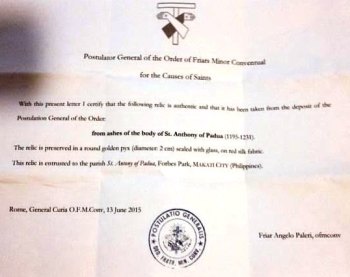
I have served as the Worship Coordinator for our parish for almost 4 years…. I am truly grateful to have been given the opportunity to be a servant in our parish. I am extremely happy too that one of the last liturgical events we are organizing is the instillation of the relic of our patron Saint Anthony of Padua in our church… I wish to express special thanks to My aunt Miss Amparo Lim, National President of the CWL, Fr. Jess Dajac in Rome and our parish priest, Fr. Reu for making the installation of the relic of our patron saint possible.
Looking forward, we hope that the arrival of St Anthony will deepen our devotion to our patron saint and pray that we can become a shrine to our most beloved saint and live up to our theme, “We care because we pray.”


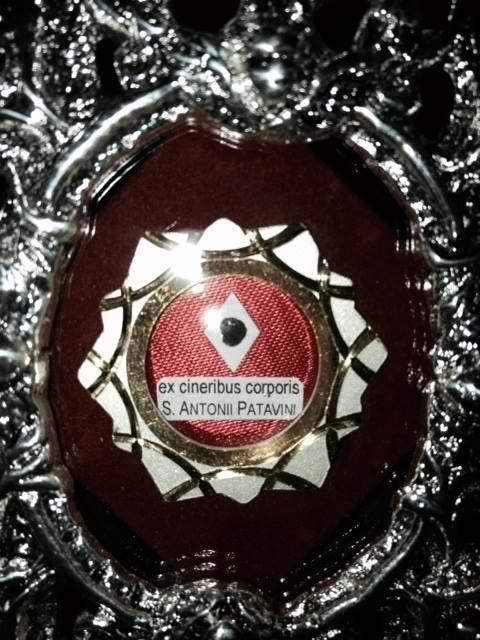


 Santuario de San Antonio Parish