Categories
Cathechism of the Catholic Church

CATECHISM OF THE CATHOLIC CHURCH

“You shall not have strange Gods before me.” What does that mean?

This commandment forbids us: to adore other gods and pagan deities or to worship an earthly idol or to devote oneself entirely to some earthly good (money, influence, success, beauty, youth, and so on) to be superstitious, which means to adhere to esoteric, magic, or occult or New Age practices or to get involved with fortune telling or spiritualism, instead of believing in God’s power, providence, and blessings to provoke God by word or deed to commit a sacrilege to acquire spiritual power through corruption and to desecrate what is holy through trafficking (simony).

Is esotericism as found, for example in New Age beliefs, compatible with the Christian faith?
No. Esotericism ignores the reality of God. God is a personal Being; he is love and the origin of life, not some cold cosmic energy. Man was willed and created by God, but man himself is not divine; rather, he is a creature that is wounded by sin, threatened by death, and in need of redemption. Whereas most proponents of esotericism assume that man can redeem himself, Christians believe that only Jesus Christ and God’s grace redeem them. Nor are nature and the cosmos God (pantheism). Rather, the Creator, even though he loves us immensely, is infinitely greater and unlike anything he has created.

Many people today practice yoga for health reasons, enroll in a meditation course so as to become more calm and collected, or attend dance workshops so as to experience their bodies in a new way. These techniques are not always harmless. Often they are vehicles for doctrines that are foreign to Christianity. No reasonable person should hold an irrational world view, in which people can tap magical powers or harness mysterious spirits and the “initiated” have a secret knowledge that is withheld from the “ignorant.” In ancient Israel, the surrounding peoples’ beliefs in gods and spirits were exposed as false. God alone is Lord; there is no god besides him. Nor is there any (magical) technique by which one can capture or charm “the divine,” force one’s wishes on the universe, or redeem oneself. Much about these esoteric beliefs and practices is superstition or occultism.

Categories
Cathechism of the Catholic Church

Catechism of the Catholic Church: Holy Orders

Holy Orders
How does the Church understand the sacrament of Holy Orders?
The priests of the Old Covenant saw their duty as mediating between heavenly and earthly things, between God and his people. Since Christ is the “one mediator between God and men,” (1 Tim 2:5) he perfected and ended that priesthood. After Christ there can be an ordained priesthood only in Christ, in Christ’s sacrifice on the Cross, and through a calling and apostolic mission from Christ.

A Catholic priest who administers the sacraments acts not on the basis of his own power or moral perfection (which unfortunately he often lacks), but rather “in persona Christi.” Through his ordination, the transforming, healing, saving power of Christ is grafted onto him. Because a priest has nothing of his own, he is above all a servant. The distinguishing characteristic of every authentic priest, therefore, is humble astonishment at his own vocation.

What happens in episcopal ordination?
In episcopal ordination the fullness of the sacrament of Holy Orders is conferred upon a priest. He is ordained a successor of the apostles and enters the college of bishops. Together with the other bishops and the Pope, he is from now on responsible for the entire Church. In particular the Church appoints him to the offices of teaching, sanctifying, and governing.

The episcopal ministry is the real pastoral ministry in the Church, for it goes back to the original witnesses to Jesus, the apostles, and continues the pastoral ministry of the apostles that was instituted by Christ. The Pope, too, is a bishop, but the first among them and the head of the college.

How important for a Catholic Christian is his bishop?
A Catholic Christian feels that he is under an obligation to his bishop; the bishop is appointed for him, too, as Christ’s representative. Moreover, the bishop, who exercises his pastoral ministry together with priests and deacons as his ordained assistants, is the visible principle and the foundation of the local Church (diocese).

Who can receive the sacrament of Holy Orders?
A baptized, Catholic man who is called by the Church to be a deacon, priest, or bishop can be validly ordained to that ministry.

Is it demeaning to women that only men may receive the sacrament of Holy Orders?
The rule that only men may receive Holy Orders in no way demeans women. In God’s sight, man and woman have the same dignity, but they have different duties and charisms. The Church sees herself as bound by the fact that Jesus chose men exclusively to be present at the Last Supper for the institution of the priesthood.

Pope John Paul II declared in 1994 “that the Church has no authority whatsoever to confer priestly ordination on women and that this judgment is to be definitively held by all the Church’s faithful.” Like no one else in antiquity, Jesus provocatively affirmed the value of women, bestowed his friendship on them, and protected them. Women were among his followers, and Jesus highly valued their faith. Moreover, the first witness to the Resurrection was a woman. That is why Mary Magdalene is called “the apostle of the apostles.” Nevertheless, the ordained priesthood (and consequently pastoral ministry) has always been conferred on men. In male priests the Christian community was supposed to see a representation of Jesus Christ. Being a priest is a special service that also makes demands on a man in his gender-specific role as male and father.

It is, however, not some form of masculine superiority over women. As we see in Mary, women play a role in the Church that is no less central than the masculine role, but it is feminine. Eve became the mother of all the living. (Gen 3:20) As “mothers of all the living,” women have special gifts and abilities. Without their sort of teaching, preaching, charity, spirituality, and guidance, the Church would be “paralyzed on one side.” Whenever men in the Church use their priestly ministry as an instrument of power or do not allow opportunities to women, they offend against charity and the Holy Spirit of Jesus.

Why does the Church require priests and bishops to live a celibate life?
Jesus lived as a celibate and in this way intended to show his undivided love for God the Father. To follow Jesus’ way of life and to live in unmarried chastity “for the sake of the kingdom of heaven” (Mt 19:12) has been since Jesus’ time a sign of love, of undivided devotion to the Lord, and of a complete willingness to serve. The Roman Catholic Church requires this way of life of its bishops and priests, while the Eastern Catholic Churches demand it only of their bishops.

Celibacy, says Pope Benedict, cannot mean “remaining empty in love, but rather must mean allowing oneself to be overcome by a passion for God.” A priest who lives as a celibate should be fruitful inasmuch as he represents the fatherly character of God and Jesus. The Pope goes on to say, “Christ needs priests who are mature and manly, capable of exercising a true spiritual fatherhood.”

How is the universal priesthood of all the faithful different from the ordained priesthood?
Through Baptism Christ has made us into a kingdom of “priests to his God and Father.” (Rev 1:6) Through the universal priesthood, every Christian is called to work in the world in God’s name and to bring blessings and grace to it. In the Upper Room during the Last Supper and when he commissioned the apostles, however, Christ equipped some with a sacred authority to serve the faithful; these ordained priests represent Christ as pastors (shepherds) of his people and as head of his Body, the Church.

Using the same word, “priest,” for two related things that nevertheless “differ essentially and not only in degree” (Second Vatican Council, LG 10, 2) often leads to misunderstandings. On the one hand, we should observe with joy that all the baptized are “priests” because we live in Christ and share in everything he is and does. Why, then, do we not call down a permanent blessing on this world? On the other hand, we must rediscover God’s gift to his Church, the ordained priests, who represent the Lord himself among us.

Categories
Cathechism of the Catholic Church

Catechism of the Catholic Church

???????????????????????????????
Why did God dispose man and woman for each other?
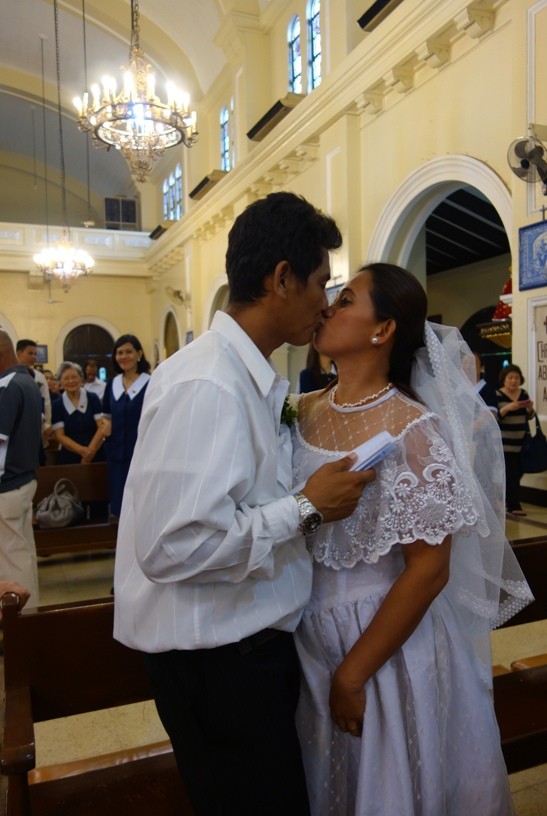
God disposed man and woman for each other so that they might be “no longer two but one.” (Mt 19:6) In this way they are to live in love, be fruitful, and thus become a sign of God himself, who is nothing but overflowing love.

What is necessary for a Christian, sacramental marriage?
A sacramental marriage has three necessary elements: (a) free consent, (b) the affirmation of a life- long, exclusive union, and (c) openness to children. The most profound thing about a Christian marriage, however, is the couple’s knowledge: “We are a living image of the love between Christ and the Church.”
The requirement of unity and indissolubility is directed in the first place against polygamy, which Christianity views as a fundamental offense against charity and human rights; it is also directed against what could be called “successive polygamy,” a series of non-binding love affairs that never arrive at one, great, irrevocable commitment. The requirement of marital fidelity entails a willingness to enter a lifelong union, which excludes affairs outside the marriage. The requirement of open- ness to fertility means that the Christian married couple is willing to accept any children that God may send them. Couples who remain childless are called by God to become “fruitful” in some other way. A marriage in which one of these elements is excluded at the marriage ceremony is not valid.

Why is marriage indissoluble?
Marriage is triply indissoluble: first, because the essence of love is mutual self-giving without reservation; second, because it is an image of God’s unconditional faithfulness to his creation; and third, because it represents Christ’s devotion to his Church, even unto death on the Cross.

At a time when 50 percent of marriages in many places end in divorce, every marriage that lasts is a great sign – ultimately a sign for God. On this earth, where so much is relative, people ought to believe in God, who alone is absolute. That is why everything that is not relative is so important: someone who speaks the truth absolutely or is absolutely loyal. Absolute fidelity in marriage is not so much a human achievement as it is a testimony to the faithfulness of God, who is there even when we betray or forget him in so many ways. To be married in the Church means to rely more on God’s help than on one’s own resources of love.

What threatens marriages?
What really threatens marriages is sin; what renews them is forgiveness; what makes them strong is prayer and trust in God’s presence.

Conflict between men and women, which sometimes reaches the point of mutual hatred in marriages, of all places, is not a sign that the sexes are incompatible; nor is there such a thing as a genetic disposition to infidelity or some special psychological disability for lifelong commitments. Many marriages, however, are endangered by a lack of communication and consideration. Then there are economic and societal problems. The decisive role is played by the reality of sin: envy, love of power, a tendency to quarrel, lust, infidelity, and other destructive forces. That is why forgiveness and reconciliation, in confession as well, is an essential part of every marriage.

May a husband and wife who are always fighting get a divorce?
The Church has great respect for the ability of a person to keep a promise and to bind himself in lifelong fidelity. She takes people at their word. Every marriage can be endangered by crises.

Talking things over together, prayer (together), and often therapeutic counseling as well can open up ways out of the crisis. Above all, remembering that in a sacramental marriage there is always a third party to the bond, Christ, who can kindle hope again and again.

Someone for whom marriage has become unbearable, however, or who may even be exposed to spiritual or physical violence, may divorce. This is called a “separation from bed and board,” about which the Church must be notified. In these cases, even though the common life is broken off, the marriage remains valid.

Indeed, there are also cases in which the crisis in a marriage ultimately goes back to the fact that one spouse or both was not eligible at the time of the wedding or did not fully consent to the marriage. Then the marriage is invalid in the canonical (legal) sense. In such cases an annulment procedure can be introduced at the diocesan tribunal.

Categories
Cathechism of the Catholic Church

Catechism of the Catholic Church

But we have Baptism, which reconciles us with God; why
then do we need a special sacrament of Reconciliation?

Baptism does snatch us from the power of sin and death and
brings us into the new life of the children of God, but it does not
free us from human weakness and the inclination to sin. That is
why we need a place where we can be reconciled with God again
and again. That place is confession.

It does not seem like a modern thing to go to confession; it can
be difficult and may cost a great deal of effort at first. But it is one
of the greatest graces that we can receive again and again in our
life, it truly renews the soul, completely unburdens it, leaving it
without the debts of the past, accepted in love, and equipped
with new strength. God is merciful, and he desires nothing more
earnestly than for us, too, to lay claim to his mercy. Someone
who has gone to confession turns a clean, new page in the book
of his life.

Who instituted the sacrament of Penance?
Jesus himself instituted the sacrament of Penance when
he showed himself to his apostles on Easter day and
commanded them, “Receive the Holy Spirit. If you forgive
the sins of any, they are forgiven; if you retain the sins of any,
they are retained.” (Jn 20:22a-23)

Nowhere did Jesus express more beautifully what happens
in the sacrament of Penance than in the parable of the
Prodigal Son: We go astray, we are lost and can no longer cope.
Yet our Father waits for us with great, indeed, infinite longing;
he forgives us when we come back; he takes us in again,
forgives our sins. Jesus himself forgave the sins of many
individuals; it was more important to him than working miracles.
He regarded this as the great sign of the dawning of the
kingdom of God, in which all wounds are healed and all
tears are wiped away. Jesus forgave sins in the power of
the Holy Spirit, and he handed that power on to his apostles.
We fall into the arms of our heavenly Father when we go to
a priest and confess.

Who can forgive sins?
God alone can forgive sins. Jesus could say “Your sins
are forgiven” (Mk 2:5) only because he is the Son of God.
And priests can forgive sins in Jesus’ place only because
Jesus has given them that authority.

Many people say, “I can go directly to God; why do I need
a priest?” God, though, wants it otherwise. We rationalize
our sins away and like to sweep things under the rug. That is
why God wants us to tell our sins and to acknowledge them
in a personal encounter. Therefore, the following words from
the Gospel are true of priests: “If you forgive the sins of any,
they are forgiven; if you retain the sins of any, they are retained.”

What sins must be confessed?
Under normal circumstances, all serious sins that one remembers after
making a thorough examination of conscience and that have not yet been
confessed can be forgiven only in individual sacramental confession.
Of course there will be reluctance before making a confession. Overcoming it
is the first step toward interior healing. Often it helps to think that even the Pope
has to have the courage to confess his failings and weaknesses to another priest –
and thereby to God. Only in life-or-death emergencies (for instance, during an
airstrike in wartime or on other occasions when a group of people are in
danger of death) can a priest administer “general absolution” to a group
of people without the personal confession of sins beforehand. However,
afterwards, one must confess serious sins in a personal confession at the
first opportunity.

When is a Catholic obliged to confess his serious sins? How often should
one go to confession?

Upon reaching the age of reason, a Catholic is obliged to confess his serious sins.
The Church urgently advises the faithful to do this at least once a year. At any
rate one must go to confession before receiving Holy Communion if one has
committed a serious sin.

By “the age of reason”, the Church means the age at which one has arrived at the
use of reason and has learned to distinguish between good and bad.

Can I make a confession even if I have not committed any serious sins?
Confession is a great gift of healing that brings about closer union with the Lord,
even if, strictly speaking, you do not have to go to confession.
In Taizé, at Catholic conferences, at World Youth Day celebrations – everywhere,
you see young people being reconciled with God. Christians who take seriously
their decision to follow Jesus seek the joy that comes from a radical new beginning
with God. Even the saints went to confession regularly, if possible. They needed it
in order to grow in humility and charity, so as to allow themselves to be touched
by God’s healing light even in the inmost recesses of their souls.

Why are priests the only ones who can forgive sins?
No man can forgive sins unless he has a commission from God to do so and the
power given by him to ensure that the forgiveness he promises the penitent
really takes place. The bishop, in the first place, is appointed to do that and, then,
his helpers, the ordained priests.

Are there sins that are so serious that not even the average
priest can forgive them?

There are sins in which a man turns completely away from God and at the
same time, because of the seriousness of the deed, incurs excommunication.
When a sin results in “excommunication”, absolution can be granted only by
the bishop or a priest delegated by him, and, in a few cases, only by the Pope.
In danger of death, any priest can absolve from every sin and excommunication.
A Catholic who, for example, cooperates in an abortion automatically excludes
himself from sacramental communion; the Church simply acknowledges this fact.
The purpose of “excommunication” is to correct the sinner and to lead him
back to the right path.

May a priest later repeat something he has learned in confession?
No. Under no circumstances. The secrecy of the confessional is absolute.
Any priest who would tell another person something he had learned in the
confessional would be excommunicated. Even to the police, the priest cannot
say or suggest anything.

There is hardly anything that priests take more seriously than the seal of the
confessional. There are priests who have suffered torture for it and have gone
to their deaths. Therefore, you can speak candidly and unreservedly to a priest
and confide in him with great peace of mind, because his only job at that moment
is to be entirely “the ear of God.”

What are the positive effects of confession?
Confession reconciles the sinner with God and the Church.
The second after absolution is like a shower after playing sports, like the
fresh air after a summer storm, like waking up on a sunlit summer morning,
like the weightlessness of a diver … . Everything is contained in the word
“reconciliation” (from a Latin verb meaning “to bring back together, to restore”):
we are at peace with God again.

Categories
Cathechism of the Catholic Church

Catechism of the Catholic Church

(continued from the Parish Bulletin June 8, 2014 Issue)

What does Sacred Scripture say about the sacrament of Confirmation?
In the Old Testament, the People of God expected the outpouring of the Holy Spirit upon the Messiah. Jesus lived his life in a special Spirit of love and of perfect unity with his Father in heaven. This Spirit of Jesus was the “Holy Spirit” for whom the people of Israel longed; this was the same Spirit whom Jesus promised to his disciples, the same Spirit who descended upon the disciples fifty days after Easter, on the feast of Pentecost. And it is again this same Holy Spirit of Jesus who descends upon everyone who receives the sacrament of Confirmation.

In the Acts of the Apostles, which were written a few decades after the death of Jesus, we see Peter and John traveling about to confirm new Christians by imposing hands on those who previously “had only been baptized in the name of the Lord Jesus,” so that their hearts might be filled with the Holy Spirit.

What happens in Confirmation?
In Confirmation the soul of a baptized Christian is imprinted with a permanent seal that can be received only once and marks this individual forever as a Christian. The gift of the Holy Spirit is the strength from above in which this individual puts the grace of his Baptism into practice through his life and acts as a “witness” for Christ.

To be confirmed means to make a “covenant” with God. The confirmand says, “Yes, I believe in you, my God; give me your Holy Spirit, so that I might belong entirely to you and never be separated from you and may witness to you throughout my whole life, body and soul, in my words and deeds, on good days and bad.” And God says, “Yes, I believe in you, too, my child and I will give you my Spirit, my very self. I will belong entirely to you. I will never separate myself from you, in this life or eternally in the next. I will be in your body and your soul, in your words and deeds. Even if you forget me, I will still be thereon good days and bad.”

Who can be confirmed, and what is required of a candidate for Confirmation?
Any Catholic Christian who has received the sacrament of Baptism and is in the “state of grace” can be admitted to Confirmation.
To be “in the state of grace” means not to have committed any serious sin (mortal sin).
By a serious sin a person separates himself from God and can be reconciled with God only by making a good confession. A (young) Christian who is preparing for Confirmation finds himself in one of the most important phases of his life. He will do everything possible to grasp the faith with his heart and his understanding; he will pray alone and with others for the Holy Spirit; he will reconcile himself in every way with himself, with the people around him, and with God. Confession is part of this, since it
brings one closer to God even if one has not committed a mortal sin.

Who may confirm?
The Sacrament of Confirmation is normally administered by the bishop. For weighty reasons when necessary, the bishop can also delegate a priest to do it. In danger of death, any priest can administer Confirmation.

Categories
Articles Cathechism of the Catholic Church

Catechism of the Catholic Church

Who can be baptized, and what is required of a candidate?
Any person who is not yet baptized can be baptized. The only prerequisite for Baptism is faith, which must be professed publicly at the Baptism.

A person who turns to Christianity is not just changing a world view. He travels a path of learning (the catechumenate), in which he becomes a new man through personal conversion, but especially through the gift of Baptism. He is now a living member of the Body of Christ.

Why does the Church adhere to the practice of infant Baptism?
From antiquity the Church has practiced infant Baptism. There is one reason for this: before we decide on God, God has decided on us. Baptism is therefore a grace, an undeserved gift of God, who accepts us unconditionally. Believing parents who want what is best for their child want Baptism also, in which the child is freed from the influence of original sin and the power of death.

Infant Baptism presupposes that Christian parents will raise the baptized child in the faith. It is an injustice to deprive the child of Baptism out of a mistaken liberality.

One cannot deprive a child of love so that he can later decide on love for himself; so too it would be an injustice if believing parents were to deprive their child of God’s grace in Baptism. Just as every person is born with the ability to speak yet must learn a language, so too every person is born with the capacity to believe but must become acquainted with the faith. At any rate, Baptism can never be imposed on anyone. If someone has received Baptism as a little child, he must “ratify” it later in life – this means he must say Yes to it, so that it becomes fruitful.

Categories
Articles Cathechism of the Catholic Church

Catechism of the Catholic Church

Why does the Church celebrate the liturgy so often?
The people of Israel interrupted their work “seven times a day” (Ps 119:164) in order to praise God. Jesus participated in the liturgy and prayer of his people; he taught his disciples to pray and gathered them in the Upper Room so as to celebrate with them the liturgy of all liturgies: the gift of himself in the Last Supper. The Church, which calls us to the liturgy, obeys his command, “Do this in remembrance of me.”

Just as a man breathes air in order to stay alive, so too the Church lives and breathes by celebrating the liturgy. God himself is the one who breathes new life into her day by day and enriches her with gifts through his Word and his sacraments. We can use another image, too: every liturgy is like a rendezvous of love that God writes on our calendar. Anyone who has already experienced God’s love is glad to go to church. Someone who from time to time feels nothing and goes nevertheless shows God his faithfulness.

Design a site like this with WordPress.com
Get started