Categories
The ABC’s of Catholic Doctrine

Buried Alive! The ABC’s of Catholic Doctrine By Lianne Tiu

11There is a story in the newspaper about a woman who was buried alive in trash, which she had accumulated for the past thirty years. When she was rescued, she explained that the trash was really her treasure. We may be somewhat like her when we avoid going to confession. The “trash” of our sins keep piling up until we are buried alive in them.

Sometimes we do not want to get rid of our sins because we are attached to those “earthly treasures.” We are afraid the priest will ask us to make changes of our sinful lives.

Moreover, many of us tend to disguise, ignore, or glamorize sins by giving them other names or interpretations. We refuse to see them for what they really are – that sins are the rejection of God and His laws. St. John Paul II said, “learn to call sin, sin. And do not call it liberation or progress, even if the whole of fashion and propaganda are against you.” He tells us “…to rediscover the sense of sin.”
13
Sin weighs us down. It prevents us from soaring high to God. Sin clips our wings spiritually because it clouds our intellect, weakens our will to do good and avoid evil, and prevents us from loving God.

Many of us consider ourselves good people. When asked to go to confession, we believe that we have not committed any sins. This self-assessment is so different from that of the saints. The greatest saints actually considered themselves the greatest sinners. Their humility and love for God made them acknowledge that they were less than perfect and that they needed improvement.
12
We cannot remain buried alive in sin. The first step is to acknowledge that we are sinners! It hurts to admit the truth. Next step is to be sorry for our sins (because they offend God), resolve to change our evil lifestyle, and go to the sacrament of Penance. God’s love and mercy will rescue us from the trash of sins and give us spiritual strength to seek instead heavenly treasures.

(Reference: “You can become a Saint” by Mary Ann Budnik; Pope John Paul II, General Audience, April 1981 and September 1986)

Categories
Fr. Laurian Janicki

24th Sunday in Ordinary Time SUNDAY GOSPEL REFLECTION By Fr. Laurian Janicki, OFM

At this time in September many of us are beginning to see changes that remind us Fall is near. The leaves are changing to glorious colors, but this bit of pleasure is merely a reminder of the dying that is happening in all of nature, a reminder of the bleakness and deadness of winter. Nature moves relentlessly in a rhythm in which the lushness of life gives way to the starkness of death. Today’s gospel is a pivotal one, not only in Mark’s account but also in the liturgical year. It marks a clear change in the unfolding story of Jesus.

Immediately in the very opening line of the gospel today clues us to a shift. Jesus sets out with his disciples to Caesarea Philippi…moving towards Jerusalem. We all know what happens in Jerusalem. For St. Mark, the disciples are still clueless. From now on Jesus openly begins to teach his disciples what is in store for him (he spoke this openly)…but also what is in store for those who follow him (the disciples).

Jesus turns the conversation – to begin informing his followers towards the real demands of discipleship. Jesus asks the question, “Who do people say I am?” He asks about his identity. Peter responds: “You are the Christ.” Peter indeed recognizes Jesus as more than the prophets: Jesus is the long awaited Messiah. Messiah means the anointed…Peter’s understanding of anointed…most likely was that of a king who would restore Israel as a great nation.

Jesus’ meaning of Messiah was quite different. He “warned them not to tell anyone about him” since he did not want the disciples to raise false expectations of what was to come. Jesus’ reign – his kingdom, would be something quite different from power and wealth.

And so he began to teach them: he would suffer, be rejected, killed and rise after three days. Jesus’ identity as the suffering servant (the First Reading) has implications for us as his disciples. We too must deny ourselves; we too must take up our cross and follow Jesus. This is telling us that the first image of the cross in Mark’s Gospel is not in relation to Jesus’ cross but to our cross – our own difficulties, our own commitments, our own choices, in following Jesus as the Messiah.

Our denying ourselves, our taking up our cross and following Jesus is not about a showy response. Rather it is about how we live every single day: dying and rising in our ordinary simple circumstances. In other words we must die to our way of thinking, and embrace how God thinks, meaning, carrying the cross of goodness, righteousness, justice, integrity, wholeness, fullness of life. It means as St. James puts it, in todays Second Reading, demonstrate your faith by your works. Faith of itself – if it does not have works – is dead.

About Fr. Laurian and his reflections…..

Categories
OFS

Francisfest 2015 Beneficiaries: St. Francis Friendship Home Livelihood & Spirituality Center

1
The St. Francis Home Livelihood & Spirituality Center is a safe haven where the Secular Franciscans (OFS) of our Parish serve needy mothers and their children living in the poor communities of West Rembo, Makati City. The OFS and involved parishioners of Santuario de San Antonio support, animate and encourage spiritual growth as well as provide livelihood opportunities to its constituents. The Center now serves 12 mothers and their children aside from occasional members and other community residents who drop in.

Following in the footsteps of our Patron St. Francis, the Center encourages members to live the Franciscan way of life by providing a venue where they learn to serve God and their community, and to care for and enhance the environment whenever possible. They also learn and share how to simplify lifestyles, develop compassion for one another by listening and understanding, thus becoming brothers and sisters in Christ.

The Center maintains the twin projects of Santuario de San Antonio Parish Foundation (SSAPF) organized on September 10, 1991: the St. Francis Friendship Home and La Ermita de San Nicolas de Tolentino, often referred to simply as the Center or the St. Francis Friendship Home. The compound was once used to house the Trichet Learning Center for handicapped children who were taught basic hygiene and education. When the Learning Center transferred to a bigger venue in Taguig in the summer of 2011, the Center immediately started its new mission, the St. Francis Friendship Home Livelihood & Spirituality Center on September 9, 2011.

The Center welcomes members of all ages, from infants to the elderly, making a vibrant interactive community that enriches physical, spiritual and character value formation. It now tends a veggie malunggay mini-garden, a modest National Bookstore Library for the young, and a Friendship Home Library for all ages. The Center conducts Bible study and sharing sessions, summer activities for mothers and the youth, holds feeding program, provide other means of community support as well as participates in Franciscan and community based fiesta celebrations. Very important too are the counselling services, the livelihood and job placement opportunities.

The Center also maintains a Thrift Shop where donated items are available at affordable prices – used clothing, various household articles, office equipment and other useful, miscellaneous goods. We encourage our parishioners to rummage through their closets, kitchen cupboards and office equipment for useful items that they can donate.

Above all, the St. Francis Friendship Home Livelihood & Spirituality Center can enrich our own lives when we listen with compassion and genuinely understand the common problems faced by the poor. We cannot always provide solutions to many of life’s problems but with the Spirit of Christ guiding us, we can truly share a willing ear, an understanding heart and a helping hand.

The Center needs financial and moral support to keep the St. Francis Friendship Home Livelihood & Spirituality Center going. Our urgent need is to provide more livelihood opportunities and a medical care assistance program for our community of poor families.

Categories
Francisfest

Francisfest 2015

Cecile Buencamino Licad’s unique natural pianistic talent was recognized early. She began her piano studies at the age of 3 and made her debut as a soloist with the Philharmonic Orchestra of the Philippines in her native Manila at 7. When she was 12 she auditioned for Rudolf Serkin and was admitted to the Curtis Institute in Philadelphia. Ms. Licad’s international career was launched in 1981 after she had been awarded with the prestigious Leventritt Gold Medal.

Her solo repertoire ranges from the early classical to the contemporary period. Ms. Licad’s discography includes piano concertos by Chopin (Grand Prix du Disque Frédéric Chopin 1985), Saint-Saens, and Rachmaninoff; chamber music by Beethoven, Tchaikovsky, Brahms, Franck, Korngold, and Fauré; and solo piano music by Schumann, Chopin, Ravel and Gottschalk. The late Rudolf Serkin said about Ms. Licad: “She has an incredible instinct for all kinds of music and seems equally at home in any style.”

PIANIST CECILE B. LICAD

“This, I thought, must have been what it was like to hear Liszt himself play, making audiences swoon.”
— David Bratman, San Francisco Classical Voice

“She plays with such intensity that she gets lost in the music. Her audiences tend to get lost in her.”
— Cathalena E. Burch, Arizona Daily Star

Maestro Gerard Salonga
GERARD SALONGA is a multi-awarded musical director, conductor, arranger, and multi-platinum record producer. He has collaborated with some of Asia’s finest musical artists including Lea Salonga, Regine Velasquez, Wang Leehom, Elisa Chan, and Cecile Licad.

Born in Manila, he earned his Bachelor’s Degree in Interdisciplinary Studies from the Ateneo De Manila University, and in 1998 graduated summa cum laude from Berklee College of Music in Boston, Massachusetts. After returning to the Philippines in 1999, he instantly became recognized as one of the most-in-demand and versatile musicians in Manila’s music scene, earning himself the Aliw Award for Best Muscial Director in 2001, 2002, 2004, and 2008. In 2010 he was inducted into the Aliw Hall of Fame. A new force to be reckoned with in the classical conducting world, Gerard has recently begun his work as music director of the newly-formed ABS-CBN Philharmonic Orchestra and has received rave reviews from music critics for his interpretations of the great symphonic works.

In December 2012, Gerard was honoured as one of The Outstanding Young Men (TOYM). He is married to violinist Divina Francisco, and they make their home in Manila with their children Antonio and Carmen.

ABS-CBN Philharmonic Orchestra

The ABS-CBN Philharmonic Orchestra is a joint venture of ABS-CBN and First Philippine Holdings. The orchestra is composed of 40 musicians under the baton of Music Director Gerard Salonga and the guidance of Executive Director Mickey Munoz. The orchestra was created for the sole purpose of connecting and reinstating symphonic music into the lives of the Filipino people and its younger generation.

The ABS-CBN Philharmonic Orchestra, through its live performances, aims to retain this part of our culture that has always been appreciated since time immemorial. The orchestra wishes this culture to thrive for future generations and dreams of inspiring the youth to continue this endeavor.

5

FRANCISFEST 2015
A celebration of St. Francis of Assisi as a
MAN of MERCY and COMPASSION

For nineteen years now, our parish has kept the wonderful tradition of holding a special Church concert to celebrate our annual FrancisFest, a festival in honor of St. Francis of Assisi, beloved founder of the Franciscan Movement.

This year we celebrate also the 40th ruby Anniversary of Santuario de San Antonio as a Parish. Let’s make this year a banner year by donating generously to support the Outreach and Charity Programs of Santuario de San Antonio Parish Foundation. Let’s all be like our model – St. Francis of Assisi – by being like him, a MAN of MERCY and COMPASSION!

Please come to the Francisfest concert on October 2nd at 7:00 pm at the Parish Church. Listen and be enthralled by the music Cecile Licad produces from the piano. Complementing her exciting musix is well-known ABS-CBN Philharmonic Orchestra conducted by gifted Gerard Salonga. Get your tickets NOW! Amelita Guevara, this year’s hardworking chairman of Francisfest 2015 guarantees you a wonderful night of music. So see you there!

2

Download Press Kit or Sponsorship Forms, below:
Francisfest 2015 Press Kit
FrancistFest Sponsorship Form

FRANCISFEST 2015 REMINDERS
Masses Moved to Parish Center

To give way to FrancisFest 2015, all masses will be held at the Parish Center from September 30, 2015 to October 02, 2015. First Friday Mass on Oct. 2 will be at 5:00 p. m. Please be guided accordingly.

*TICKETS ARE AVAILABLE AT THE PARISH OFFICE *FRANCISFEST COMMITTEE RESERVES THE RIGHT TO ADJUST THE RED AND BLUE SECTION LINE AREA DEPENDING ON TICKET SALES

FRANCISFEST 2015 SEATPLAN
Click to enlarge

*TICKETS ARE AVAILABLE AT THE PARISH OFFICE
*FRANCISFEST COMMITTEE RESERVES THE RIGHT TO ADJUST THE RED AND BLUE SECTION LINE AREA DEPENDING ON TICKET SALES
RED: P5,000.
BLUE:P3,000.
GREEN:P1,000.
YELLOW-BALCONY:P500.

Francisfest 2015 Ticket Committee Guidelines

1. No ticket, no entry.
2. Seat reservation is not allowed.
3. Caregivers and bodyguards must have a ticket to enter the Church.
4. 50% discount for students (valid school ID must be presented)
5. Professional ushers will be present to guide guests.
6. Gates open at 6:00 p.m.
7. Church doors close at 7:00 p.m.

Individual Donations and Corporate Sponsorships are still accepted. For more details, please call the Parish Office at 843-8830 up to 35.

About this year’s beneficiaries:
Hospital Ministry
JPIC Scholarship Ministry
Prison Ministry
Ecology Ministry
Friendship Home Livelihood Assistance Program
Basey Samar Housing Project
Franciscan Poor/Rural Parishes in the Philippines & Sri Lanka

FRANCISFEST 2015 LADIES COMMITTEE 2015

 Seated L-R: Tessie Luz, Menchu Bautista, Amelita Guevara, Fr. Reu Jose C. Galoy, OFM, Fortune Ledesma, Tingting Cojuangco, Olga Martel  Standing L-R: Bingbing Quiros, Marion Coscolluela, Fanny Blanco, Lulu Castañeda, Rose Lazaro, Carina Lebron, Susie Madrigal Bayot, Jackie Ejercito, Brenda Reyes, Caron Macasaet, Chuchu Madrigal Eduque,  Carrie Bautista Not in Picture: Bambi Harper, Daisy Payumo, Thelma Gana, Eleanor Esteban, Letty  Laurel, Nena Rosales, Tessa Prieto Valdes, Marites Tanjangco, Nympha Valencia, Helen Ong, Susie Madrigal Bayot and Lala Rosales
Seated L-R: Tessie Luz, Menchu Bautista, Amelita Guevara, Fr. Reu Jose C. Galoy, OFM, Fortune Ledesma, Tingting Cojuangco, Olga Martel Standing L-R: Bingbing Quiros, Marion Coscolluela, Fanny Blanco, Lulu Castañeda, Rose Lazaro, Carina Lebron, Susie Madrigal Bayot, Jackie Ejercito, Brenda Reyes, Caron Macasaet, Chuchu Madrigal Eduque, Carrie Bautista Not in Picture: Bambi Harper, Daisy Payumo, Thelma Gana, Eleanor Esteban, Letty Laurel, Nena Rosales, Tessa Prieto Valdes, Marites Tanjangco, Nympha Valencia, Helen Ong, Susie Madrigal Bayot and Lala Rosales
The Francisfest Ladies Committee has been tasked to approach parishioners and friends of SSAP to understand the need for everyone to contribute to ensure the success of FrancisFest. To those to whom much is given, let us continue to support the FrancisFest beneficiaries and make them realize that they are not alone – there are people who care!

FRANCISFEST WORKING COMMITTEE 20151

Categories
CCD

CCD TEACHERS’ WORKSHOP By Marga Gregorio

CCD
To kick off the new CCD (Continuing Catholic Development) school year, 2015- 2016, CCD organized a special workshop for its teachers last August 08, 2015, from 9:00 am – 4:00 pm in the Parish Center.

In the light of our fast-paced age of technology and digital world, which our students have lived in since birth (digital natives in fact), teachers were equipped with more updated teaching techniques, principles and tools to more relevantly and effectively transmit God’s truths to their students.

The speakers were Mary Ann Tantoco-Eala, 31 years in the academe, the Director for Academic Affairs in Assumption College San Lorenzo, Basic Education Division; her daughter , Mara Eala , also in the academe; Marie Anne Carina Villalon (Rina), 12 years in the academe, an Academic Assistant of Assumption College San Lorenzo Basic Education Division, also an English Teacher and a former team leader of the English/Literature Department; and Marie Katherine Villarruz, 15 years in the academe, a team leader of the Social Studies Department of the Basic Education Division of Assumption San Lorenzo.

The focus of the workshop was Brain-Based Learning (BBL) – Its essence is to learn in ways that are compatible with the way the humans naturally function. Thus, BBL is the purposeful Engagement, of effective Strategies, derived from Principles.

The workshop tackled seven main principles. The first principle focuses on Attention and Input Limitations with the mantra “Too Much Too Fast Won’t Last.” This challenges educators to keep things brief, and yet maintain the students’ attention by creating a connection between the lesson and the lives of the students. The second principle spoke of Rough Drafts, which suggests that our brain makes sketchy “rough drafts” until there is a better reason to hold, revise or drop the new learning. The third principle is Developmental Learning, which teaches that there are ideal types of learning for each stage of our developing brain. With teens for example, the basic recipe is lots of love, bonding and good nutrition. The fourth principle is “Emotions Rule,” which asserts that emotions organize and create our reality. It stresses that emotions release hormones, which affect our memory and preferential retention thereof. The tool “Emotional punctuation,” for example, is a tool to evoke an emotion so the brain “locks in” a memory of the event. Principle 5 is Mind and Body, which says “ body influences mind and mind influences body”. It points out that physical exercise improves classroom behavior, academic performance, social skills, motor fitness and attitude toward school. Exercise and physical activity can actually change brain structure and increase brain cells. The sixth principle is Adaptive and Flexible. The good news in this principle is the concept of Neurogenesis, where humans grow neurons or brain cells, such that enrichment programs can actually increase IQ. It maintains that our brains are not static or fixed; they are constantly changing.

This means that SMART and GOOD teaching can positively affect brains for the better. The seventh principle is “Perception, not Reality” which, explains that “brains only know what it takes in perceptually”. Also, “how you see yourself and your life” determines how you see and treat others. On “tips” on how to change students’ perceptions about themselves, they listed * Affirmations * Structured Journaling*Framing (redirecting attention and focus, which can alter states) * Stories/Biographies *Experiences debriefed * Sharing your own personal experiences.

Overall, the very engaging workshop ended by highlighting the Ideal attitude in GRATITUDE, that unlocks the “fullness of life,” and turns…
What we have into enough and more
Denial into acceptance, chaos to order, confusion to clarity
A meal into a feast, a house into a home, a stranger into a friend

Organized by the CCD Committee (Katty R.C. Qua, CCD Chairperson, with the CCD Committee Members, Lia Te & Marivic Borromeo), assisted by Nancy Gonewai and Office Assistant Leah Azarcon, under the guidance of Fr. Reu Jose C. Galoy, SSAP Parish Priest – who opened our workshop with a prayer – the Teachers’ Workshop was an enormous success. It was indeed a deep and enriching learning experience for all the teachers, an excellent opportunity to bond with co-teachers highlighted with a sumptuous lunch that recharged, inspired and delighted the entire CCD team. The Workshop facilitators were indeed engaging, dynamic and effective in transmitting this very novel, timely and necessary concept of Brain Based Learning, which elicited vibrant, lively and spirited interactions between the facilitators and the teachers.

Categories
Random Thoughts by Peachy Maramba

R A N D O M T H O U G H T S Voices from yesterday and today . . . by Peachy Maramba

14“Why after you? Why after you?” asks Brother Masseo of Francis. “. . . You are not a very handsome man, nor possessed of great learning or wisdom. So why is all the world running after you?” (Little Flowers of St. Francis, Ch.10).

——————————————-

Each year at this time – a few weeks before the feast day of our beloved St. Francis on October 4 – we pause a while to reflect on this question and all the possible answers.

Little Known Facts About St. Francis
Founder of the Franciscan Orders

Willing or not St. Francis was to found a religious order that was to have one of the widest Christian following in the world.

The warmth of his personality combined with his joyous preaching soon caused him to have followers and it is an interesting coincidence that like Jesus he started off with twelve disciples. Although unlike Christ who got his Apostles from the common people – mostly fishermen, the followers of Francis were mostly well-to-do citizens like Francis was himself.

His first followers joined him because they were attracted by his fine example. However the first disciple was an unknown Assisian who for some unknown reason, maybe dissuaded by Francis himself, parted from him.

However his next disciple was Bernard da Quintavelle of noble blood and as similarly wealthy as the Bernardones. A good man but extra cautious and a little older than Francis, Bernard must have been really impressed by this self-made spiritual tramp that he was willing to give all his worldly possessions to the poor and follow in Francis’s footsteps.

A young man with knightly ambitions next eyed Francis with keen interest. How could this half-mad man attract two staunch solid sensible citizens of the town? Was this the way to be the true Knight that he wanted to be? Seeking his answer in prayer Giles went to St. George to pray for light. When he came across Francis and got to know him he told himself that in this simple person with the smiling eyes he saw his true Knight of the Round Table. So humbly he asked Francis to allow him to become a member of his company.

Bernard, Peter and Giles. These were the first three Franciscans. Others, including a priest, were to follow until they reached twelve. Thus haphazardly the first little company was formed. Peter Catanel, a lawyer, was the next recruit.

Together with Bernard and Francis they went to the church of St. Nicholas to consult the Gospels as God’s will for them now that they had become a body or society.

After praying together, Francis opened at random the book of the Gospels. Asking the parish priest to explain the first passage he saw they were told: If thou hast an eye to be perfect, go then and sell all that belongs to thee; give it to the poor and so the treasure that thou has shall be in heaven; then come back and follow me.”

Closing the book shut and then opening it again at random the new message read: “Take nothing with you to use on your journey, staff or wallet or bread or money; you are not to have more than one coat apiece.”

A third time the book was closed, open and read: “If any man has a mind to come my way, let him renounce self and take up his cross and follow me.”

This was it. This was how they would live. Thus started out the life and rule for all those who wished to join their company. Left to Francis alone, he would have insisted on the strictest literal sense of the Gospel as they read it and this would have been the sole essential rule of the order.

When Francis’s two new companions had settled their earthly affairs they donned a similar rough tunic cinched only at the waist by an old rope and thus began their life of poverty and humility.

Two by two the brothers, as they were called, set off down the countryside to do their mission: Preach as you go telling them that the Kingdom of Heaven is at hand. These were the golden days as they followed the example of Francis’s exuberant, enthusiastic happy self.

The Good News was being preached again. No, not formally in churches but as they passed through little clusters of huts this delightful band asked the people to love, fear God and be sorry for their sins. And wherever they went they preached “Peace.” When asked who they were they simply answered “The penitents of Assisi.”

But life was hard and food was in short supply so that one night the brothers were awakened by the moans of one of them who cried, “I am dying. I am dying. I am dying of hunger.”

And the crowds that listened to them were not always so kind. In fact while some gladly accepted what they had to say – they were more the exception than the rule. For the most part the crowds laughed and jeered at them mocked and opposed them.

However because the number of beggars had now increased at an alarming rate, the people began to complain to the Bishop. Once more he called Francis and suggested to him a more practical way of earning a living. But Francis was adamant and gave his now famous argument against the possession of wordly goods: “Possessions cause disputes and lawsuits, troubles well calculated to destroy the love of God and our neighbour. That is why we are agreed about having no wordly goods in this world.” Bishop Guido must have been a most exceptional bishop because he allowed Francis to have his way.

Even the Benedictine abbot who had control over the little chapel of Porziuncola allowed Francis to keep it permanently. However Francis insisted it merely be a loan, not a gift, paying the Abbot yearly a jar full of lasche, the little fish found abundantly in Lake Trasimeno. The Abbot, in turn, sent back every year, too, a jar of oil.

Given thus permission to stay in what Francis long ago felt was home, the brothers built crude huts of wattle under the trees of Porziuncola. An alternative home was a rough horse and cattle shelter at Rivotorto, a mile or so from Porziuncola.

Interestingly, the shelter was divided into cells just by pieces of chalk.

11

Part 2

Francis and the Pope
Now that Francis had companions living the religious life that he felt to be the right way – that is, God’s way – Francis wanted to seek not only advice but approval and who else could better give it to him than the head of the church on earth – the Pope himself. Here one can see how Francis’s simple mind worked.

Never mind that he was the formidable Pope Innocent III. He, Francis had been commissioned by someone greater than the Pope – God himself – to repair His church. So Francis made up his mind to see the Pope and ask his permission to continue along his religious way.

So in the early summer of 1210 the little company trudged southward a little over a hundred miles to Rome.

Fortunately for Francis his good friend Bishop Guido of Assisi was in Rome at the same time and “received them with delight.” He introduced them to the Cardinal of Sabina who was greatly impressed when Guido related to him the whole story of Francis and his friends.

The Cardinal, deeply moved by these strange but sublime penitents, told the Pope, “I believe I have found a man of truly perfect life who only desires to live according to the life and ideals of the Gospel. He, I think, is someone whom the Lord can use to reform the Holy church across the face of the world.” Because the Pope had the highest regard for the Cardinal and because he was also worried about the Church’s growing lack of spirituality and morality wanted to see this man of whom the Cardinal spoke so highly of.

So it was that the humblest man in Christendom (he even made Bernard the head of the delegation) was to speak to the most powerful of all the Popes. You can just imagine how shocked and startled the Pope must have been to see this shabby group of barefooted men dressed in the coarse tunic worn by Umbrian peasants. Francis, himself, who he heard so much of, was a “short thin man with burning eyes whose face bore the marks of penitential self denial.”

However when Francis kneeling at the Pontiff’s feet, explained their way of life and their purpose, it was Francis’s turn to be taken aback when he heard the Pope – like Bishop Guido before – admonish and tell him that maybe the life they were leading was too hard. Never mind Francis himself – maybe he could take it. But he had to think of those who would follow his footsteps but lacked his fervour, grit and enthusiasm.

As usual Francis was adamant. He argued that Jesus, who had promised eternal life and everlasting happiness to all, would not begrudge them the few crumbs which was all they needed in this earthly life.

However the Pope asked him to rethink what God wanted of him because he, the Pope, knew how frail human nature was.

Once more it was the Cardinal who came to Francis’s aid. After the audience the Cardinal reminded the Pope that if he refused the request of these poor penitents just because their ideals seemed to be too harsh and unpractical, it was as if he were condemning the evangelical life itself. Furthermore since it was Christ himself who was the author of evangelical perfection – then to deny it would be blasphemous. Since the Pope couldn’t argue against that he agreed to see Francis again.

The Fairytale of Francis
But before the Pope could even speak Francis told him a fairytale. “Once upon a time,” he said, “there was a very beautiful lady who was extremely poor and lived in the desert. However, upon seeing her, the King fell deeply in love with her and married her, but she refused to leave the desert. Their children, who were as beautiful as their mother, were told not to be ashamed that they were so poor because they were the children of a great king. The time came for them to present themselves at the court.

The King upon being informed who they were, greatly admired their beauty. He told them, ‘Don’t be afraid. I am your father. If I invite strangers to my house, how much more ready I am to invite my own sons.’ He then asked his wife to send all her children to court.”

Francis then explained that he was the lady of the desert and God was the King of Kings who assured him that he would look after them all (his disciples). Francis further argued that if God was ready to provide for everybody, how much more would he be ready to provide for those who followed His Gospels.

The Pope’s Dream
We are not certain if this fairy tale did the trick in changing the Pope’s mind. What we do know was that recently the Pope had had a vivid dream. In it he saw the Lateran Palace shaken to its foundations, with its tower leaning over and its walls on the verge of collapse. Vainly the Pope tried to cry out but even his hands refused to clasp themselves together in prayer. Then, out of the blue, came this strange ugly man with a cord-tied waist who ran toward the church. Leaning on its tottering walls he suddenly grew larger and larger till he became strong enough to prop up the walls and thus save the church.

Approval of Rule of St. Francis
So Francis’s Primitive Rule was approved by the Pope. However there is to be found no exact wording of this rule – only a collection of Gospel texts (probably the ones he opened at random when the Franciscan order was just starting).

“My brothers,” said the Pope, “go with God and preach penance as the Lord leads you. When the Most High has multiplied your small numbers, come and see me again without hesitation and I will grant you more favors and entrust you with more important missions.”

5

Part 3

Franciscan Life After Rome
And so Francis and his companions on their return from Rome continued their life as itinerant preachers, sleeping in abandoned churches and leper houses, possessing no property and begging for their food whenever they could not obtain it by honest labor.

Actually there was no need for their rule which was little more an ideal than a rule in the traditional sense. It was just a papal sanction for them – now officially called the “fratres minores” or minors or lesser brethren – to live in evangelical poverty and what a poverty it was!

Franciscan Poverty
Different from the poverty of other religious orders that while accepting their novices’s renouncement of personal possession, the order itself didn’t, Franciscan poverty, on the other hand, was a new concept. It required them to own but one tunic and no books (too expensive). It forbade travel on horseback (travel of the rich) as well as the comfort of their own home. The rude crude wooden houses of the friars were called loca (places) not convents and were considered not homes but merely stopovers or places of transit. Thus poverty encompassed not only the individual members but the whole order itself.

No wonder Francis decided to call his motley group “lesser brethren” so that they would always be poor and humble folk subject to all seeking to do the lowly menial things despised by others.

As if this discomfort was not enough the first friars and the ones that came after them not only abstained from eating and drinking for long periods but kept long vigils, endured bitter cold and performed manual labor that taxed their bodies to the very extreme. They chose to wear the roughest and harshest hair shirts hiding them from view under their tunic.
4
Money was to be avoided at all cost as it was the symbol of man’s enslavement to the false values of the world and the cause of envy, hatred and war. In fact, it was the exact opposite of love and peace.

Yet while these Franciscans were poor in body and material possessions they were unbelievably rich in their lightness of heart and gladness of spirit that thus enabled them to endure without a complaint or grumble their chosen harsh life style.

To them perfect joy was enduring all the hardships in life patiently and without dismay. Thus the spirit of simplicity and gladness animated the followers of Francis who gradually grew and grew that in barely ten years after they obtained papal sanction for their Rule, the original dozen now numbered three thousand all trying to live up to Francis’s ideal of a “new people, small, special unlike their former selves in life and words, content only to have God.”

As for Francis he kept on preaching the word of God before thousands and thousands bringing his message of peace. Now that word had gotten around that he had not only been received by the Pope but given his approval – the status of Francis suddenly changed. Now there was a clamor for him to preach in the different churches even in the cathedral itself!

Though his rundown tunic was torn and patched, his appearance pitiful and his face unbeautiful, his words rang out dissolving the hatred of ancient grudges and restoring peace through reconciliation. He hardly ever slept and he generously shared whatever little he possessed.
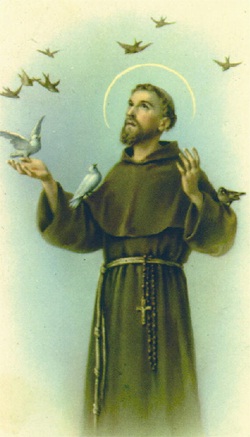
2

Part 5: Coming Home
Poor Francis, though still a young man (in his early forties) his “brother body” (as he fondly referred to his physical person) was worn out. Having a naturally frail constitution since his youth Francis made matters worse by the vigorous demands and abuses he made on his poor body. Besides the pain from ulcer, malaria and trachoma, he now suffered the open Stigmata on his body.

While in the past he was able to push his body to go on in spite of the terrible sufferings that he bore in silence – now there was no way he could go on. All his friends and brothers were deeply worried and concerned about him.

Succumbing to their wishes and pleadings he underwent several drastic medical treatments that seem terribly cruel and primitive by today’s standards. His eyes were cauterized by supposedly the best physicians of the papal court. Proclaimed unsuccessful Francis submitted to an even more painful and gruesome operation wherein they cut all his veins from the ear to the eyebrow and even perforated both ears! Again with no positive result. Soon his stomach, legs and feet became swollen and the pain in his stomach became so intense that he could hardly take in any food at all.

At no other time had Francis suffered so terribly. Suffering a pain that was more than a mere mortal could endure Francis tried to find solace in music. He begged a brother to please find a harp so that like saintly men of old they could use music to praise God and at the same time to soothe their spirits. He felt that by singing the praises of creatures and other songs his pain would be changed to joy and his spirit consoled. However the brother hesitated to do his bidding fearful of a scandal (making joyful music instead of praying and reflecting in contemplation of death).

That night Francis heard from afar a harp that played music far lovelier than any earthly music. God had granted him his wish and played him a heavenly serenade.

On the last spring of his life the doctors, having decided that they could do no more for him, prescribed a change of scene. Francis was taken to Siena where he vomited so much blood that everyone expected him to die right then and there. So the brothers knelt around his bed, asked for his blessing and for his last message.

After blessing them and all his brothers now and in time to come, Francis had a brother write down his last three wishes for them: First, he wanted them to love one another as he had loved them. Second, he desired that they forever love and observe Lady Poverty and finally that they remain ever faithful and loyal to the Church.

But Francis did not die then as expected. So Brother Elias, seeking this opportunity to glorify the Franciscan Order of which he was head, had the living skin and bones of their Founder brought home to Assisi. But fearful that their old enemy the Perugians would try to snatch their Saint who was now considered a living relic and bring him to their city, they passed a long, circuitous and rough road passing through Gubbio, the city where Francis first tramped, prayed, laughed and sang after his conversion.

Instead of taking him to Porziuncola they brought him to Bishop Guido’s palace where his body could be heavily guarded. It seemed as if Francis was tracing his roots back to where he first stripped himself in order to wear the rags of poverty.

It was while he lay in the palace that he dictated his Testament, the document which revealed his ideals. It was here, too, where Francis when he felt too weak to sing would ask his brothers to sing for him the “Canticle of Creatures,” a song he composed in which all creatures of God whom he loved so much were named in praise of the Lord. (This song is considered the most ancient and precious Jewel of Italian poetry). When chided by Elias to keep recollected and silent rather than singing Francis said, “O let me rejoice in God and in praising Him in all my sufferings, since by a wonderful grace, I feel myself so close to my Lord that, in the knowledge of His mercy, I can sing again.”

Thus it was that the dying Francis comforted himself by singing even when he was told by the doctors that his end was near. He felt a joy so great that he wrote this final verse of his Canticle of the Sun:

Praised be my Lord, for our Sister mortal death,
From whom no man alive will escape
Woe to those who die in mortal sin!
Blessed those who are found walking in your most holy ways
For the second death will bring them no evil.

Knowing that he had but a few day left, Francis requested that he might be transferred to his beloved Porziuncola “so that the life of the body should end where the life of the soul had begun.” Once there he lost no time in dictating a letter to his faithful friend Lady Giacoma die Settisoli. Scarcely had the letter been sent than she arrived bringing all the things he asked her to bring. The End

When he had but a few hours to live Francis made a very shocking request. He said, “When you see that the end has come, put me naked on the bare earth again as you did the day before yesterday; and leave me there after death for the time it takes to cover a mile walking.” This was Francis’s concluding rite to his beloved bride, Lady Poverty.

He then asked two of his brothers to sing for him once again his Canticle of the Sun. As they sang Francis vainly tried to sing with them. He had come full circle starting his life singing and dancing in the streets of Assisi and ending it with the song of praise of God on his lips. As he died a flock of skylarks rose above the roof as if to accompany his soul on his journey to God, his maker.

As the brothers carried his open bier back to his native city of Assisi, the skylarks again once more appeared and sang overhead. As per the request of Francis the procession stopped outside the convent of San Damiano so that Clare and her sisters could bid him a fond farewell.

It is only fitting that the funeral services were held at the church of St. George where Francis first learned the meaning of chivalry. God’s own knight had truly come home.

Why Saint Francis?
Brother Masseo was actually teasing Francis, whom he loved dearly, when he asked him this question because he very well knew the answer. To Brother Masseo, Francis was John the Baptist come to life again! (How ironic that Francis was actually given the name John at baptism only his father, who was away at that time, didn’t like the Name. So disregarding that name he gave him a second name of Francesco or Francis. Thus Francis was the first saint to be called by his nickname.)

Like John the Baptist, St. Francis called God’s people to repentance and to newness of life in Christ. And like Christ himself, he came among us “to make the good News come alive again in human hearts.”

In this time of parish renewal and as we approach the feast day of our dearest patron saint we reopen our hearts and minds to Christ by following (like St. Francis) the Lord’s command to, “Repair my house.”

Please come and join us to observe the Feast of St. Francis.

Categories
The ABC’s of Catholic Doctrine

Be Happy! The ABC’s of Catholic Doctrine By Lianne Tiu

6Everyone has his own definition of happiness. For some, it is to own a big and beautiful house; for others, it is to play great golf games. For some, it is to travel to different countries; for others, it is to have unity in the family. We all want to be happy and we are created to be such.

We’ve heard about the fall of Adam and Eve. It brought about original sin which caused us to be ignorant, to lose our self-control, and to be strongly inclined to evil. Moreover, media bombard us with false formulas for happiness. We are made to think that happiness can be bought; that all celebrities are people to imitate; that God is a “killjoy” to our fun with His Commandments.3Flaunt the latest gadgets, sign up on some online dating services even when married, be the dynamic executive and let the maids take care of the family – this generation, with its deformed outlook on life, on the family, on religion and on morality, seeks a life free from boredom, discomfort, and pain. It glorifies material riches, power, and fame. 9People, after intoxicating themselves with pleasure, soon experience boredom and emptiness – a proof that we are created for something which cannot be fulfilled on earth. Pope Paul VI pointed out that the “technological society has succeeded in multiplying the opportunities for pleasure, but has great difficulty in generating joy.” An unhappy king was told that he would find happiness by wearing the shirt of the poorest man; and he discovered that the poorest man was cheerful and had no shirt at all. Our hearts are made for something intangible.
8 St. Augustine stated, “Our heart is restless until it rests in our Lord.” However, let’s admit it. Many of us find God boring. The Mass is meaningless and the prayers are mechanical recitation of Our Father’s, Hail Mary’s and Glory Be’s. So how can we discover happiness in God?4 They say that beneath the turbulent sea is a calm and beautiful world. Christianity is similar to that. Externally, it may not attract us but as we plunge deep in our spiritual lives, we discover that there are so much beauty, goodness, and love that are beyond our imaginations. St. Thomas Aquinas, a genius, did not finish his Summa Theologiae, the best theological book ever written, because when he was looking at the crucifix, he realized that what he had written was nothing compared to what God truly is.

In this era where there are so many distractions, we need to make time for silence – to reflect and to pray more. We will learn that the secret of happiness is to recognize how much God loves EACH ONE OF US as if each one were the only child. We, in turn, fall in love with Him and forget about ourselves. Blessed Teresa of Calcutta preached: “We can find true happiness and peace when we are in love with God.” She also taught: “By forgetting yourself, you find yourself.”5 Happiness is accepting the “undeserved” sufferings, such as an incurable illness, the loss of fortune, the death or infidelity of a loved one, and trusting that our all-loving and all-wise Papa knows what is best for us.

Happiness is realizing the horror of sin and experiencing God’s mercy and compassion as He welcomes us back when we are sorry for having offended him.

And perfect happiness? We are not far from it if we struggle one step at a time in this journey of love (of doing God’s will) until our hearts rest in our Lord in heavenly paradise. 10

Categories
Francisfest

Francisfest 2015 Beneficiaries The Hospital Ministry

“For it is in giving that we receive.” – St. Francis of Assissi

It was more than 20 years ago when Steve Lopez (may he rest in peace) founded the PGH Adopt-A-Child-Program. Over the years, it has transformed until its current form as the Hospital Ministry supporting the Philippine General Hospital, Rizal Medical Center, and Our Lady of Porziuncola Hospital.

It is our privilege to bring the love of God and the love of San Antonio parishioners to the indigent patients of the aforementioned 3 hospitals. The Hospital Ministry members have become a channel through which patients and their watchers are able to feel the love of God in a very concrete way: Through our weekly visits, we extend medical assistance in cases where the patients cannot afford to buy medicines or antibiotics, nor go through much needed diagnostic tests for lack of funds. We are also able to extend Pastoral Care Service–listening to the concerns of the patients and relatives. We sometimes provide non-medical assistance, providing food for the watcher when necessary and transportation money for home conduction of discharged patients who are invalid and with no watcher.

Though the procedure may vary per hospital, the patients are pre-screened by the doctors and social workers to ensure that the patient is qualified. The background of the patient and family is provided, along with a picture. After scrutinizing the prescriptions, we procure the medicines from the pharmacy, and then deliver it directly to the patient. We walk an extra mile to ensure that your donation goes to the proper person and that not a centavo is wasted.

Aside from these regular visits, we have a variety of activities throughout the year – such as the healing mass, Stations of the Cross, Flores de Mayo, art contests, field trips, Christmas gift giving, and more – supporting the wards and the school.

The Hospital Ministry would not be possible without the kind hearts and generosity of the donors / parishioners who share their blessings of time, talent, and treasure. Many of our parishioners who have the resources are willing to help, but do not have the time to go to the hospitals. By donating to the San Antonio Parish, their love is freely delivered to the indigent patients.

In 2014, we disbursed PhP3M to 464 patients covering the 3 hospitals. Almost all patients were discharged in PGH and RMC, with a mortality of 15 and 4 respectively for the 2 hospitals.

Testimonial –
2Cheyceljoy E. Calosor
Hospital Ministry Beneficiary since 2005

JPIC Scholar
3rd year College
BS Social Work
Phil. Christian University

Ako po si Cheyceljoy E. Calosor, 20 years old na nakatira sa probinsya ng Mindoro. Ang aking ama ay isang mangingisda at ang aking ina naman po ay isang maybahay lamang. Tatlo po kaming magkakapatid. Noong ako ay nasa ikalimang baitang noong September 21, 2005, nawalan po ako ng paningin at nag-seizure sa hindi malamang kadahilanan. Pinatignan ako sa doctor sa aming probinsya at sinabi hindi na daw ako aabutin ng umaga. The doctor diagnosed that I have brain cancer stage 4. Sa Manila, nakarating kami sa PCMC hospital. In God’s Grace, tinanggap ako sa hospital dahil sa taas ng blood pressure ko sa kadahilanan na ever since, wala pa silang naging pasyenteng bata na may mataas na blood pleasure sa edad na 10-taong gulang. 3 months akong na-admit sa hospital na ito. Lahat ng baon naming pera na inutang sa mga kapitbahay ay naubos sa mga laboratory tests na isinagawa sa akin at napagtanto na ako ay may sakit na Takayasu’s Artiritis. Napag-usapan ng aking mga doctor na ilipat ako sa PGH kung saan maraming magagaling na doctor at mas kumpleto ang mga kagamitan.

Sa PGH lahat nagbago ang pananaw ko sa buhay. May isang doctor na nanghihinayang sa pag-aaral ko kaya pinasok nya ako sa PGH Silahis ng Kalusugan School for the Chronically Ill (SNK) upang mapagpatuloy ang aking pag aaral.

Nakilala din namin ang Hospital Ministry na tumutulong sa mga naka-admit sa PGH wards. Nabigyan po ako ng antibiotic for infection at lalo na po ang prednisone. Natulungan po nila ako sa mga gamot na pangangailangan ko agad. Hindi na po kami maghihintay ng kung kailan mare-release yung gamot na hinihingi namin sa guarantee letter na matagal, lalo na pag may laboratory tests na pinapagawa ang aking mga doctor at wala kaming pera. Natutulungan po nila kami, sa pamumuno dati ni Sir Steve Lopez, at ngayon po ay ni Ma’am Sabrina Soriano. At sa iba pang mga tao na tumutulong sa programang ito, kagaya ni Sir Vincente Pacheco at ng mga SYAers.
Hindi lang pagpapagamot ang naitulong sa akin ng Hospital Ministry ng Santuario De San Antonio Parish.

Sa kasalukuyan po ay nasa 3rd year college na ako kumukuha ng kursong BS-Social Work sa Philippine Christian University sa tulong ng Santuario De San Antonio Parish JPIC scholarship program. Taos puso po akong nagpapasalamat sa kanilang pagbibigay inspirasyon sa buhay at sa paggabay nila sa akin nung ako ay nasa secondary level pa lamang, hindi lang sa pag-aaral pati na din sa pagpapagamot ng aking sakit.

Nais ko balang araw ay makatulong ako kagaya ng mga butihing mga taong ito na walang sawang naglilingkod sa mga may sakit.

At para sa may mga sakit never give up, there is no such thing as an ending, just a new beginning to start again.

Categories
Fr. Jesus Galindo

“He has done all things well!” 23rd Sunday in Ordinary Time B SUNDAY GOSPEL REFLECTION By Fr. Jesús Galindo, OFM

Today’s gospel is unique for several reasons: 1) It is proper to Mark, i.e., not found in any other gospel; 2) The cure took place in pagan territory; 3) It was the people who brought the sick man to Jesus (stress on the role of the Christian community); and 4) Jesus performed an unusually elaborate ritual: “He took him apart; put his finger into his ears; spat; touched his tongue; looked up to heaven; groaned, and said ‘ephphatha’ (be opened).” Usually, Jesus performed cures and expulsions of demons by a word of command: “Be cured.” “Go out of him.” Why this elaborate ritual in today’s gospel? Several explanations are given: One: The man could not hear, so this was for him some sort of sign language. Two: That’s what faith healers at the time of Jesus used to do. Jesus wanted to act like one of them in order to conceal his divine power.

In today’s first reading, prophet Isaiah foretells the coming of the Messiah in terms of healing and abundance of water — healing of persons and healing of the land. Health is our most precious possession (health is wealth, we say). We give anything in exchange for it, and spend any amount of money in order to regain it. Hence healing is the greatest sign of God’s presence. By healing the sick, Jesus made God’s presence felt among the people, hence their remark: “He has done all things well” (Cf. Gen 1:31). When John the Baptist’s disciples asked Jesus: “Are you the one who is to come or shall we wait for someone else?” Jesus simply said: “Go and tell John what you see. The blind see, the deaf hear, the lame walk,” (Mt. 11:3-5). In other words, the prophecy of Isaiah is being fulfilled by Jesus: The Lord is here!

The Church carries on the healing ministry of Jesus. Wherever it is established, the first thing the Church does is to set up clinics, hospitals and leprosaria (in the Philippines, San Lazaro and San Juan de Dios were put up by the early Franciscan missionaries). It is not true that the Church’s mission is just to “save souls.” It cares for the bodies as well. We must remember that Jesus left to us the sacrament of healing for us to carry on his healing ministry. Too bad this sacrament has been known as the Extreme Unction and is (wrongly) believed by many to be reserved for the dying.

Today’s readings remind us that we are all in need of healing, both physical and spiritual. In the second reading, St. James warns us against practicing selective behavior and discrimination. And that is precisely a sickness most of us suffer from: selective hearing, selective seeing and selective speaking. We hear what we want to hear. Once a parish priest heard the confession of his sacristan. When the latter had mentioned his sins the priest told him: “You forgot to mention that you made kupit from the collection and drank Mass wine in the sacristy.” Complete silence. The priest went out of the confessional and said, “You are not answering; can’t you not hear me?” “Not a word, Father,” replied the sacristan. “How about exchanging places?” said the priest, “you do the talking and I will listen.” The sacristan, in a solemn voice, said, “Father, why are you not giving me my sick leave benefit, SSS, living allowance…?” “You are right,” said the priest, “I cannot hear anything from this side.” (Bel San Luis, Word Alive, Year B, p. 104). Selective hearing!

We gladly listen to news, music, gossip, etc., but we are deaf to God’s voice and to the cry of the poor, the sick and the aged. We talk no end about money, about politics, and about other people, but we are mute when it comes to talking about God, about religion, and about Christian values. That is our illness: selective hearing, seeing and talking.

As we approach the table of the Eucharist, may the Lord touch our eyes, our ears and our lips so that we may see, hear and speak only what is pleasing to him.

About Fr. Jesus and his other reflections…..

Categories
Marian Cenacle

Angels By Letty Syquia

1Recently, the Marian Cenacle Group of the Contemplative ministry of our parish organized a talk on the angels and invited one of the few real experts on angels. He is Fr. Winston Cabading, O.P., a Dominican priest and the secretary general of UST. He is a professor of Theology at the UST Central Seminary and a member of the official team of exorcists of the Archdiocese of Manila. Fr. Winston gave his talk before an overflowing audience at our parish center. He cited teachings and beliefs on angels and identified his basis and sources, and whether they are based on dogma, doctrine, traditions and teachings of the early Fathers, Doctors of the Church, revelations made to saints, Papal dissertations, teachings of the Magisterium etc. In other words, he made it clear that his talk was not drawn from his own conclusions but from the teachings/catechism of the Catholic Church.

Fr. Winston divided his talk into 2 parts since there are two kinds of angels: The Good Angels and the Fallen Angels (demons and unclean spirits). Fr. Cabading starts by saying that the reality of human greatness and the tragedy of human misery in the face of death cannot be fully grasped without the understanding of the world of spirits – the angels. God created angels from the beginning of time and being spirits, they have no end.

The Assumption of the Virgin by Francesco Botticiniat the National Gallery London shows three hierarchies and nine orders of angels, each with different characteristics.
There is a hierarchy of angels in heaven wherein the highest angel minister to the Most High and these are the seraphims, cherubims and thrones. There are those who implement the blessings of God given to the material world and enable God’s will be present to mankind; these are the principalities, the archangels and the angels. St. Michael the archangel is chief of the heavenly hosts. Angels after the archangels are closest to mankind and the material world. God has assigned to each one a guardian angel from the moment of conception and stays with him to the end of his earthly life. At death, it is they who bring us to God for judgment; whether they will accompany us to purgatory to console and to pray for us, or lead us happily to heaven or to separate from us sadly if the judgment is of eternal damnation.

2Our angels respect our free will but when they are invoked, they come to our aid immediately. If we fall into sin, they inspire us to repentance. They protect man and expel demons that seek to destroy a child of God. We have only to call them. The prayer to our guardian angel, taught to us in childhood, must always be prayed every morning and before we go to bed. The prayer to St. Michael by Pope Leo XIII is very powerful.

We may not ask the angels for their names.; only God can reveal it to us. We must be very careful in guarding ourselves from deceptions regarding devotions to the angels. Many deceptive New Age practices have come out naming them or asking for their names or an angel’s revelation that he is St. Michael or a seraphim.

There are only two kinds of spirits – the good spirits or the faithful angels, and the bad spirits or the fallen angels. These are the demons that were thrown to earth after their fall and we know them as elementals. God warns us against pagan practices and their idols that are in reality the evil spirits who are raring to be worshipped like God.

We communicate with the good angels through prayer and never through techniques or incantations, never through spirit questing, mediumship, witchcraft or any of those New Age pagan practices resorted to by many.
4 Who comes when these spirits are invoked? The devil disguised as a loved one, a relative, an angel of light or even Sto. Nino or the Blessed Mother.

Lucifer, the fallen angel
The story of the fall of the angels shows the great love God has for man, even above the angels. Lucifer assumed that because of his angelic nature – closer to the nature of God – he should be the most eminent of all God’s creatures. But instead he saw that God gave this eminence to a woman. The incarnation was central to God’s plan in the creation. Lucifer’s attitude toward the incarnation was: Non Serviam. He rejected the incarnation because the word of God would assume human nature which was infinitely inferior to that of angelic nature. By rejecting the incarnation, he rejected the plan of God to have the presence of that ‘Lady’from whom the word is to be made flesh, and seated at His Right Hand as Queen of Heaven and Earth, of angels and of men. He rejected Mary’s elevation to be higher than the seraphims and the elevation of humanity to the level of the cherubims and the thrones. All these were too much for his pride and he rebelled. He is the cause of the sin against God because he wanted to be equal to God and to be worshipped. He sinned against Man (Jesus) because he saw himself far superior to Man (Jesus) and therefore more fitting of “divinization.” And so Lucifer declares: “I will not serve. (He will not serve the God-Man.)

Fallen angels have only one intention for man – to murder him by seducing him to pride and disobedience, which leads to sin which leads to death. Fr. Winston, an exorcist of the Archdiocese of Manila, cited examples of the devil’s trickery which he has seen and experienced during rites of exorcism that he performed and how the devil humiliates man by making a possessed person growl and crawl like an animal.

Fallen angels battle against man’s salvation. They torture men on earth but they torture those they have won over much more terribly in hell. Fallen angels are tortured by the knowledge that they are totally vanquished forever, they cannot attain beatitude, their power is limited by Divine governance, and that despite their efforts to bring men to hell, these men may yet go to heaven.

Seraphim Isaiah
Seraphim Isaiah

Fr. Winston says the devil is very active today, but we have our guardian angels and the saints and Our Blessed Mother to help us. The devil especially hates man because God loves us so much that He gave His only Son to ransom us from death. Satan only seeks our destruction and we must never be deceived by the seeming benefits he baits us with. Let us not be complacent especially when everything seems to be going well in our lives.

The battle of the angels is now brought down to earth. It is now the battle for souls. That is why to speak about the devil is not old fashioned or outdated or something of the imagination. We must be warned again. To win the battle we must know the enemy and his strategies. It is a reality and Jesus Himself warned us. By expelling them, He showed we must not co-exist with them.

The Whirlwind: Ezekiel's Vision of the Cherubim and Eyed Wheels (Illustration to the Old Testament, Ezekiel I 4–28), Museum of Fine Arts, Boston.
The Whirlwind: Ezekiel’s Vision of the Cherubim and Eyed Wheels (Illustration to the Old Testament, Ezekiel I 4–28), Museum of Fine Arts, Boston.
God has gifted us with intellect and free will to choose which side we want to be. He and all the good angels will always respect our choice. However, He has given us all the necessary weapons and help we need to recognize the devil and thus to reject him and his many deceptions, for the devil will never come to us as devils with all their monstrosity and hideous darkness. They come to us as spirits of light and beauty. But let us not be deceived!

The faithful angels will play a major role at the end of the world; they will be the ones to execute God’s final judgment.

By God’s gift of free will, the choice depends on us – which battle line shall we be?

Design a site like this with WordPress.com
Get started