Categories
The ABC’s of Catholic Doctrine

“Late for Mass – A Sign of Lack of Love for God?”, The ABC’s of Catholic Doctrine by Lianne Tiu

7
Sunday after Sunday, many of us arrive late for Mass. Some of us justify: “It is our day of relaxation; and well, at least we still attend Mass.” An hour of the 168 hours a week is too precious to waste on a boring and repetitious Sunday obligation. And we ask: At what point can we get away and not be considered really late for Mass?

There is no official teaching of the Church on this issue. But before Vatican Council II, some moral theology manuals placed arrival before the Offertory as the dividing line on whether we fulfill the Sunday Mass* obligation. But if we consider the importance of the Liturgy of the Word and the unity of the Mass, the cut-off point should be at the beginning of the readings. Yet, it is difficult to give a precise cut-off moment as it gives a wrong message that some parts of the Mass are not that important.
5
Mass begins with the entrance procession and ends after the final dismissal. We should be there from beginning to end (and until the priest leaves, as a sign of respect for the priesthood). Each part of the Mass relates and complements the others in a single act of worship even though some parts are essential while the others are merely important. Ideally, it is good to arrive some time before the Mass begins in order to recollect our selves and to prepare for it in silent prayer.

During Sunday, to miss a small part of the Mass (for example, coming in at the readings or leaving at the last blessing) is a venial sin. To miss the principal parts of the Mass (Offertory, Consecration, or Communion**) is a mortal sin, if our failure to be present is deliberate. It is because it is almost equivalent to missing the entire Mass. Thus, if we are late for Sunday Mass, it is better to attend another Mass so that we are present for the entire Mass.

If we arrive late for Mass, we have to honestly ask ourselves, Why? If it is because of some justified reason or an unforeseen event, such as blocked traffic due to an accident, we have acted in good conscience and are not strictly obliged to attend another Mass (but may do so, if it is possible).
6
If we arrive late due to culpable negligence, and especially if we do so habitually, we have to examine ourselves, change our ways, and go to confession.

St. Josemaría wrote: “You say the Mass is long and, I add, because your love is short.” Let us seriously think about it.

*It also applies to Holyday of Obligation Mass and anticipated Mass.
**We are not obliged to receive Communion at Mass; more so if we have mortal sin in our souls.

8

(Reference: “My Catholic Faith” by Rev. Louis LaRavoire Morrow; “The Faith Explained” by Leo Trese; “Question Time 2” by Fr. John Flader; “Liturgy: Communion for Late Arrivals at Mass?” by Fr. Edward McNamara; “If Mass Is Boring” By Jesus Colina)

Categories
Pope Francis

PapalVisit.ph

OLYMPUS DIGITAL CAMERA

Browse the official website of the Apostolic Visit of Pope Francis to the Philippines at PapalVisit.ph launched by the Catholic Bishops’ Conference of the Philippines (CBCP). The website will have the latest news and updates on the pope’s visit and will be the main resource for catechesis, official prayers, songs and liturgy guides.

You can also see Pope Francis’ life size cardboard cutout picture at the parish office. This was distributed by Radio Veritas to generate “papal fever” among selfie-loving Filipinos before the pope’s visit in January.

Categories
Reflections

“THE GENEROUS EMPLOYER” A SUNDAY GOSPEL REFLECTION By Fr. Serge Santos, OFM for the 25th Sunday in Ordinary Time

The gospel today by Matthew is a perplexing parable. In the present –day labor standards, this parable looks like a case of unfair labor practice.

The employer here is God or Jesus Christ. At the time of Jesus Christ, it was customary for workers to assemble at dawn in the plaza of cities and towns, where vine growers and farmers could hire them for one day’s work. The employer hired workers at 6 a.m., 9 a.m., 12 noon, 3 p.m., and 5 p.m. Work ended at 6 p.m.

The employer signed a contract with the first workers to work one full day for a denarius (silver coin), which was the standard wage. The rest of the workers did not have a contract but a verbal agreement of a just wage.

The employer paid first those who worked one hour with a full-day wage. So the workers hired at dawn expected to receive 12 denarii but only received 1 denarius; they became angry and demanded more. To them the employer answered, “ Are you envious because I am generous?”

The parable shows the employer to be both just and generous. He was just to the first workers. He did not violate agreement with them by being so generous to the later workers. For him the first workers have sufficient money to keep them going for another day i.e. no food on the table. His action was motivated by compassion for the poor workers. All workers are treated on equal terms.

Some of us may feel uneasy about this parable. What is wrong? In this day and age no employer pay wages out of pity. If anyone ever did, he would stay in business only for a short period of time; besides the regular employees would protest. In real life this parable would not hold ground.

This gospel teaches us a lesson: There is something wrong with human pettiness. In the first reading, God says, “My thoughts are not your thoughts, nor are your ways my ways.”

Would you like to know what God is like? God is compassionate and generous. No one can compete with God’s compassion and generosity. God’s generosity cannot be judged by human standards. We could appreciate and be thankful for God’s tremendous generosity.

By virtue of our baptism we are co-workers in the vineyard of our Lord Jesus Christ. And this is grace because it is a gift freely given by God. It is purely grace that we share in the compassionate mission of our Lord Jesus Christ while we are journeying on earth. Some of us were called first to work, others later in life. We agree with our Lord Jesus Christ to live a life of faithfulness and love for Him, with the expectant hope He would give us a just reward.

In the meantime, sometimes some of us judge what and how others are doing or not doing. Some of us get envious at gifts or graces other people receive from God. There is a tendency to compare and thereby become disappointed and distressed. Many struggle to live a good life in Christ. Around us in the world are people who “get away with murder,” greed, theft, violence, murder, human trafficking, moral degradation, idolatry, “raping of natural resources,” graft and corruption, unjust war, yet live prosperous lives; they are better off financially, physically and socially. Some cannot help but be envious of them. Some youth nowadays have fallen away from church because they cannot help but be angry and ask our Lord Jesus Christ: “Where are you in all these transgressions? Why don’t you take control?” If Jesus Christ would respond, He would probably answer: “Am I not free to do as I wish? Are you envious because I am generous?”

Of course our Lord Jesus Christ would like us to be happy as children of our Father and the Blessed Virgin Mary. While on earth as pilgrims and co-workers in the vineyard of God, we do our best to be faithful, hoping expectantly to receive our just reward of eternal life, acknowledging that we cannot attain this reward by our own merits, but by the grace and generosity of our Lord Jesus Christ and the Holy Spirit.

Categories
Random Thoughts by Peachy Maramba

R A N D O M T H O U G H T S Voices from yesterday and today. . . by Peachy Maramba

9

ST. PETER CLAVER:
atron of the Negroes in America

1581 – 1654
September 9

His Ambition
Peter was born in 1581 at Verdu, in Catalonia near Barcelona, Spain of impoverished farmers but descended from ancient and distinguished families. He had always nursed an ambition of one day becoming a missionary in the New World. So the first step he took into making his dream a reality he set out after only a few years of study at the University of Barcelona (where he later graduated about the year 1601 with distinction) to apply and was received into the novitiate of Tarragon hoping to be a Jesuit priest of the Society of Jesus. He was then sent to the college of Montesione at Palma in Majorca. His fateful meeting with Alphonsus Rodriguez the holy doorkeeper in the Jesuit college was to set the future direction of his life.

It was his humble lay brother who not only taught him about the saints but fired in him the idea of going to the New World to help save “millions of those perishing souls.”

Moved by the fervor of Alphonsus Peter offered himself in 1610 to his provincial for assignment to the West Indies. However it was to the South American city of Cartagena (now the republic of Columbia) then thriving principal slave market of the New World, where he was sent to complete his theological studies. It was there he was ordained in 1615 a Jesuit priest. He was to spend the next forty years of his life working there.

At that time Cartagena was a great and major port of entry for the African slave trade which had been established in the Americas for nearly a hundred years. Every year thousands of them sold by petty kings in Africa reaching to 10,000 would arrive at this major clearing-house to be sold to buyers from inland – there to work as slaves either in the mines or in the plantations (work considered “too onerous” for the native Indian). It was a very profitable business each slave being bought for about four crowns a head and sold for approximately 200 crowns!

His Apostolate
It was after Peter had worked under Father Alfonso de Sandoval whom he met at his ordination and who was a great Jesuit missionary who himself had spent forty years in the service of the slaves that Peter declared himself “the slave of the Negroes forever.” Thus he devoted his apostolate joining Father de Sandoval to help him to alleviate the plight of the poor slaves who were transported to the New World from West Africa under the harshest foul and inhuman conditions imaginable.

Not only were they packed into the dark sunless holds of the ships like sardines for the whole of the three-month journey but like cordwood were chained together in packs of six to lie in their own filth. Fed daily with a mash of water and maize – just barely enough to keep them alive – with no medicines or treatment when they were sick it’s a wonder that 2/3 of them managed to survive the journey.

It was to these wretched souls that survived that Peter probably the first white man to concern himself with these unfortunates dedicated 33 years of his life to. Following the simple formula of modeling himself after the compassionate Jesus, Peter reached out to the slaves. As soon as he heard the canon blast that heralded the arrival of a slave ship with a new batch of slaves, Peter would hurriedly make his way to the docks. After talking his way past the captain he would finally get to meet the “cargo” in the yards where the scarcely alive slaves were crammed and penned with hardly room to breathe after being disgorged from the long arduous trip from West Africa. There they were displayed and sold until they were shipped out to the estates or mines.

It was here where the now “half-crazed fear-struck” new arrivals would be “broken” – that is prepared for the mines and plantations where they would work the rest of their lives.

Deeds First
Moving swiftly among the half conscious and half-dead stinking Africans Peter would first immediately greet them in the “horribly fetid hold,” distribute food and drink and minister to the sick and wounded.

Words Later
It was only when they were clothed, fed, treated, encouraged and comfortable that through the help of black catechists, interpreters, pictures (to convey Christ’s life and His promise of redemption) and impromptu sign language as well as the universal language of friendly gestures and brotherly smiles would he try to communicate to them the message of the Gospel and some of the rudiments of Christianity. As he said to his assistant “We must speak to them with our hands first, before we try to speak to them with our lips.”

Then in the large town square he would baptize them presenting each one with a treasured medal of Jesus and Mary.

Powerful Advocate
It was when Peter tried to instill in the slaves a sense of their human dignity and preciousness in the eyes of God that he got into trouble with the business and civil authorities who suspected that Peter might be undermining their lucrative commerce through his ministry.

However Peter was tireless in his efforts to improve the lot of the slaves who kept coming month after month in spite of repeated papal censure. Not only did he work unceasingly for the abolition of the slave trade but he would plead with the owners to be more humane and Christian. He would journey from one village to another regularly visiting where the slaves lived in the plantations to make sure that the few laws protecting them were being enforced. He would even bed down with them in the slave quarters. Peter thus became a forceful advocate for his wards continuously seeking better treatment from the authorities and slave owners.

Great Evangelizer
Besides preaching powerful and hard hitting sermons to them in the church, marketplace and plazas he would spend as much as 15 hours a day hearing confession and instructing them in the faith. It is no wonder that he is said to have baptized as many as over three hundred thousand slaves in his 33 years career of being “a slave to the Negroes forever.” He would also solemnize their weddings and baptize their babies.

Peter also worked among prisoners who were condemned. It was said that during Peter’s lifetime no one was executed at Cartagena without his spiritual assistance.

Peter also worked among lepers ministering to them in the St. Lazarus Hospital.

Furthermore Peter became known as one blessed with such supernatural gifts as “prophecy, the power to perform miracles and the ability to read men’s minds.”

Each week Peter would visit the two hospitals of Cartegena. It is said that here he worked miraculous cures among the sick and dying.

Apostle of Cartagena
But Peter was not only apostle of the slaves but of the whole Cartagena. It is said that sometimes Peter would spend the whole day preaching to all who would stop to listen at the great square of the city or in the church or even at the market place.

As if working in repulsive circumstances were not enough mortification he would often pray alone in his cell with a crown of thorns on his head and a heavy cross weighing down his shoulders.

His Death
Unfortunately in 1650 Peter was struck by an outbreak of a plague that beset Cartagena. While he managed to survive he never fully recovered. In fact for the rest of his life he was weak and incapacitated and pain was his constant companion. Despite his illness he tried to continue his work although on a much reduced scale. The tragedy was that a trembling in his limbs made it impossible for him to celebrate Mass.

Poor Peter lived in extreme poverty and eventually succumbed and died in his cell four years later in 1654 virtually alone largely forgotten and neglected by all except for Dona Isabel de Urbina and her sister who came to nurse him. He finally got his wish to imitate the example of the Ass who never complains in any circumstances as he is only an ass. So also must God’s servant be. He died on September 8, the day we celebrate the birthday of Mary whom he dearly loved.

Rewards After Death
It is ironic that the rumor of his approaching end made everyone suddenly remember the extraordinary priest they considered a saint. Not only did they kiss his head before it was too late but they stripped his cell of anything that could be considered a relic. After Peter died the city and the church which had previously treated him with some reserve and even disdain now competed to honor his memory. They ordered a great and grand funeral and burial with much pomp for him at public expense and even the slaves arranged for a Mass to be said in his honor. He was never again forgotten and his fame spread throughout the world!

By ministering to victims of the African slave trade and by opening the people’s eyes to the evils and horrors of slavery and by starting charitable societies among the Spanish people to help the slaves Peter Claver achieved sainthood.

He was canonized in 1888 at the same time as his friend St. Alphonsus Rodriguez and named special patron saint of all Catholic Black missions – that is of all missionary activities to Negroes not only in Africa but in whatever part of the world by Pope Leo XIII in September 9, 1896. However he is also patron of Columbia and can be invoked also as patron by all who suffer from cruelty and scorn of the powerful. His feast is celebrated on this day and observed throughout the United States.

He is also the patron of Columbia and all of the Negroes in Africa.

10

SOURCES of REFERENCE
ST. PETER CLAVER
September 9

Butler’s Lives of the Saints – Vol. 3 – p 519 – 524
The Illustrated World Encyclopedia of Saints – p. 192
Pocket Dictionary of Saints – pp 121
A Calendar of Saints – p 176
All Saints – pp 391 – 392
A Year With the Saints – September 9
Butler’s Saint of the Day – pp 234 – 236
Illustrated Lives of the Saints – Vol. 1 – pp 404 – 405
My First Book of Saints – pp 205 – 206
Saint Companions – pp 336 – 337
Saints for Our Time – pp 191 – 193
Butler’s Saint for the Day – pp 427 – 429
Children’s Book of Saints – pp 119 – 122
Voices of the Saints – p 546 – 547
The Flying Friar – pp 63 – 65
The Way of the Saints – pp 371 – 372
Book of Saints Part 1 – pp 20 – 21

Categories
The ABC’s of Catholic Doctrine

The ABC’s of Catholic Doctrine: Do We have to Make “Beso-Beso” with Priests? by Lianne Tiu

4

“Beso-beso” which originated from the Spanish word for “kiss,” has become a common greeting in the Philippines. It is a cheek-to-cheek kiss between a man and a woman, a parent and a child, two women, or two men. For many upper class- Filipinos, it is a normal greeting among relatives and close friends, and there is no squeamishness about it. However, there are situations which we can ask ourselves if this social gesture extends to people we meet for the first time, to casual acquaintances, to business people, or to church leaders? There are instances when we notice older men taking advantage by making “beso-beso” with younger or pretty girls. Would not a smile or a handshake be a better alternative in these situations?

7a

With regards to clerics, we have to be aware that they have a vow of chastity. In fact, Canon 277 reminds them: “Clerics are to conduct themselves with due prudence in associating with persons whose company could endanger their obligation to observe continence or could cause scandal for the faithful.” Women and young girls should have a delicate reserve in their dealings with priests. Instead of making “beso-beso,” they may greet the priests with a smile or a handshake and a “Good morning/afternoon/evening, Father.” Men may give them a hug (if they are the hugging type). It is also good to be familiar with some forms of address to show respect to them. We greet the Pope as “Your Holiness,” “Most Holy Father,” or “Holy Father;” the Cardinal as “Your Eminence;” the Archbishop and Bishop as “Your Excellency;” a Monsignor as “Monsignor;” and the Priest as “Father.”

8

Avoiding “beso-beso” with the priests is our way of showing deep respect for them – these men who are entirely consecrated to Christ and to the Church.

Reference: “How to Address Church Officials” by Father William Saunders; “Priestly Celibacy in the Code of Canon Law;” “Training for Priestly Celibacy” by Pope Paul VI; Wikipedia

Categories
Articles

The Pope’s 10 tips for Happiness By Jay Parini Reprinted from CNN Aug. 5, 2014

3

Just when I thought my amazement with Pope Francis had run its course, he did it again. In a long interview with an old friend who was writing for an Argentine magazine, the pope put forward a 10-point plan for happiness. From where I sit, it seems, well, pretty good if not perfect. Here are Pope Francis’ tips for a happy life and my comments on them:

1. Live and let live. It’s an echo of the Pope’s earlier remark on gays: “Who am I to judge?” Moreover, it’s what Jesus said in the Sermon on the Mount: “Judge not, unless you want to be judged yourself.” (Matthew 7:1)

2. Give yourself to others. That is, give your money and your time to those in need. Don’t just sit around like stagnant water. Give all you have and then some.

7

3. Move quietly in the world. The Pope quotes from a favorite novel by an early 20th-century Argentine writer, Ricardo Guiraldes, in which the novelist writes that in one’s youth, a person is “a rocky stream that runs over everything,” but as one gets older, one becomes “a running river, quietly peaceful.” It’s very like the Native American suggestion that one should walk “in balance and beauty” on the ground, making the least disturbance.

4. Enjoy leisure. The Pope says that consumerism has brought with it unbearable anxieties. So play with your children. Take time off. And don’t spend all your time thinking about your next acquisition. Spend your time well, not your money.

5. Sunday is for families. This is actually one of the Ten Commandments. Honor the Sabbath. (Exodus 20:8) Once a week, give a whole day to meditation, worship, family life, tending the needs of the spirit. This is healthy living.

6. Find jobs for young people. Who would have guessed that job-creation would be on a list for happiness? But the Pope is right. Honest, simple work for young people is essential to their well-being. Somewhat surprisingly, in this moment in the interview, the Pope connected job creation to the degradation of our environment: “the tyrannical use of nature.” He links the lack of good jobs to the lack of respect for ourselves and the Earth itself.

5

So creating jobs doesn’t mean ruining the environment. It doesn’t mean, as the politicians chant, “jobs, jobs, jobs.” Good and productive labor is valuable, and it doesn’t mean you have to have a fancy job description. You don’t have to become rich. You can be ordinary. Happiness lies there. Do good work, create good work for others.

Writer: ‘What would Jesus do in Gaza?’

Pope Francis to visit U.S. in 2015

Pope meets death sentence Christian
7. Respect nature. This follows from No. 6. “Isn’t humanity committing suicide with this indiscriminate and tyrannical use of nature?” the Pope wonders. Not surprisingly, this is what Henry David Thoreau, a founding father of the environmental movement, said. “Most people live lives of quiet desperation,” he said. He went into the woods, to Walden Pond, because he wanted “to live deliberately” and to “front only the essential facts of life.”

A proper respect for nature means that you can’t pollute the air, poison the rivers and chop down the forests indiscriminately without suffering greatly. I suspect that a huge amount of the anxiety and suffering that we see around can be closely traced to our wanton misuse of our resources. Just look at any garbage dump and see what is wasted. In a sense, we’ve wasted our souls.

8. Let go of negative things quickly. The Pope tells us not to complain about people who annoy or frustrate us, to let go of things as rapidly as we can. I have an old friend who used to say, “Put the bad things in your back pocket and leave them there.” This may sound like escapism or putting your head in the sand, but it’s more interesting than that. Life throws rotten things our way each day. People say nasty things to us, often about others. This stuff makes them miserable, of course. It makes us miserable, too. Flush it.

9. Don’t preach your religion too forcefully. Proselytism brings on paralysis, the Pope tells us. Wow. I’m a Christian myself, and I don’t mind saying so. But each person sees the world before them in his or her own way. The Pope says this. As a teaching, it seems to run counter to the so-called Great Commission (Matthew 28:16-20). Jesus said to get out there and spread the word. But the Pope takes a relaxed view of this activity, preferring that we should teach by example. Perhaps that really is what Jesus would do?

10. Work for peace. The Pope has preached this message from the beginning of his time as pontiff. He has gone to Jerusalem and worked to bring together Jews and Palestinians. He has prayed for peace and worked for peace. He has listened closely to Jesus, who said, “Blessed are the peacemakers.”

The Pope asks us to take in refugees, to think innovatively about how to create peace in the world. Jesus, of course, invites us to turn the other cheek when struck. This is a complex teaching. But it’s essential to Christian faith. The Pope, once again, calls on us to take the teachings of the Sermon on the Mount seriously. This is very hard but crucial work.

Pope Francis has, in this unlikely venue, given us his own Sermon on the Mount, his Ten Commandments for happiness and inner peace. One can only be grateful for his wisdom, which is rooted in a sincere faith, in hard-earned wisdom, and a very practical knowledge of human needs and potentials.

Editor’s note:Jay Parini, a poet and novelist, teaches at Middlebury College in Vermont. He has just published “Jesus: The Human Face of God,” a biography of Jesus. Follow him on Twitter @JayParini. The opinions expressed in this commentary are solely those of the author.

Categories
Articles

All About Mary By Letty Jacinto-Lopez

She’s beautiful but never uses beauty to impress anyone except perhaps to make one aware of one’s own beauty. Whenever I catch the sweet scent of roses, I remember her. It makes me wonder whether she’s having a nice day as she works ever so gently to make afflictions easier to bear.

Meet Mary, daughter of Joachim and Anne, cousin to Elizabeth, auntie to John, wife to Joseph, mother to Jesus, and ours, too. Through her many apparitions and icons, she strengthens our faith to trust in her Son. Mary is:
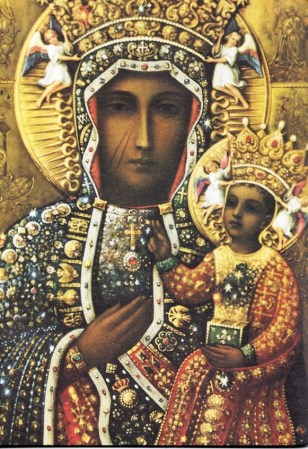
1)  Our Lady of Czestochowa

Our Lady Of Czestochowa, Poland: The icon of the Black Madonna is enshrined since 1382 on the Jasna Gora (hill of light), a monastery run by Pauline fathers in Poland. The painting was damaged with a sword by thieves. The marks can still be seen on Mary’s face to this day. In the years under the Communist rule, the shrine became a rallying point for the Polish people who were persecuted for their faith.

2a)  Our Lady of Guadalupe feast day

Our Lady Of Guadalupe, Mexico: On 9 December 1531, the Blessed Virgin appeared to Juan Diego, a native Indian convert, on the Tepeyec Hill, three miles outside of Mexico City. She asked for a shrine to be built there. When Juan relayed this message to Bishop de Zumárraga, he didn’t believe Juan, instead he asked for a sign. The Virgin appeared before Juan again and told him to gather roses with his tilma or cloak even if December was not the season for roses. The bishop was astounded. Juan’s tilma was not only filled with roses but also bore the image of the Lady. Pope Pius XII declared the Lady of Guadalupe as the Patroness of the Americas.
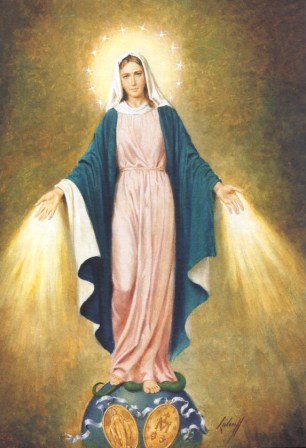
3)  Our Lady of the Miraculous Medal

Our Lady Of The Miraculous Medal, France: This devotion was begun by Catherine Laboure, a French sister of the Daughters of Charity in the 1820s. In one of her apparitions, Catherine saw a picture of Mary standing on a globe with light streaming from her hands. Around the Virgin were the words ‘O Mary conceived without sin, pray for us who have recourse to you.’ Mary asked Catherine to strike a medal made with this picture. As people begun wearing the medal, miracles started happening. The medal soon was called The Miraculous Medal.

4) Our Lady of Knock stampita

Our Lady of Knock, Ireland: The apparition at the small village of Knock, County Mayo, took place on 21 August 1879. Mary McLoughlin and Mary Beirne were walking in the rain and took the backside route past the town church. There, against the wall of the church, the Blessed Virgin Mary appeared with St. Joseph, St. John the Evangelist, and an altar with a lamb and a cross on it. Flying around the altar were several angels. Many more witnesses saw the beautiful woman garbed in white and wearing a large brilliant crown. Her hands were raised in prayer. There were reports of inexplicable healings associated with visits to the church.

Knock gradually gained official support from the Church culminating in the 1979 Papal visit. The symbolism of the lamb, cross and altar has been seen as pointing to the sacrificial death of Christ and the holy Mass, with Mary as our mediator.
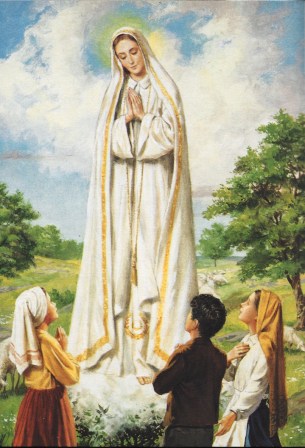
5)  Our Lady of Fatima

Our Lady Of Fatima, Portugal: Mary appeared in May 1917 to three peasant children Lucia, Francisco and Jacinta Marta near Fatima. They saw the figure of a lady brighter than the sun, standing on a cloud in an evergreen tree. They were granted six apparitions. When Lucia asked the Lady who she was and what she wanted, she replied, “I am our Lady of the Rosary. I wish to have a chapel in my honor on this spot. Continue to recite the Rosary every day.”
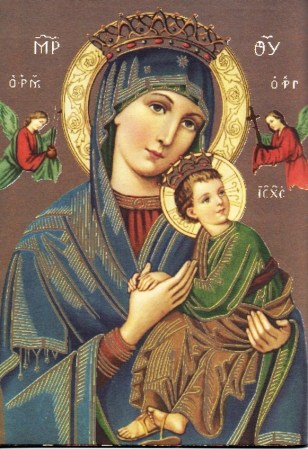
6)  Our Lady of Perpetual Help

Our Lady Of Perpetual Help, Rome: This title is connected with a Byzantine icon which was stolen from Crete, brought to Rome and according to tradition – upon the instructions of the Lady – was placed in the Augustinian Church of Saint Matthew. After the destruction of the church in 1798, the image was given to the Redemptorists and placed in the church of Sant’Alfonso di Liguori built on the same site. The inscription in Greek above our Lady means, Mother of God; above the child, Jesus Christ; above the angels with the instrument of the Passion of Christ, Michael and Gabriel. The Child Jesus looks with fear at the instruments of his future passion while tightly holding on to the hand of His Mother.

Mary understands our wishes and dreams, even the pain and loneliness of the heart. When you talk to her today, ask her to stay near and to hold your hand, “Intercede and pray with me, Mama Mary. Never let go.”

She won’t.

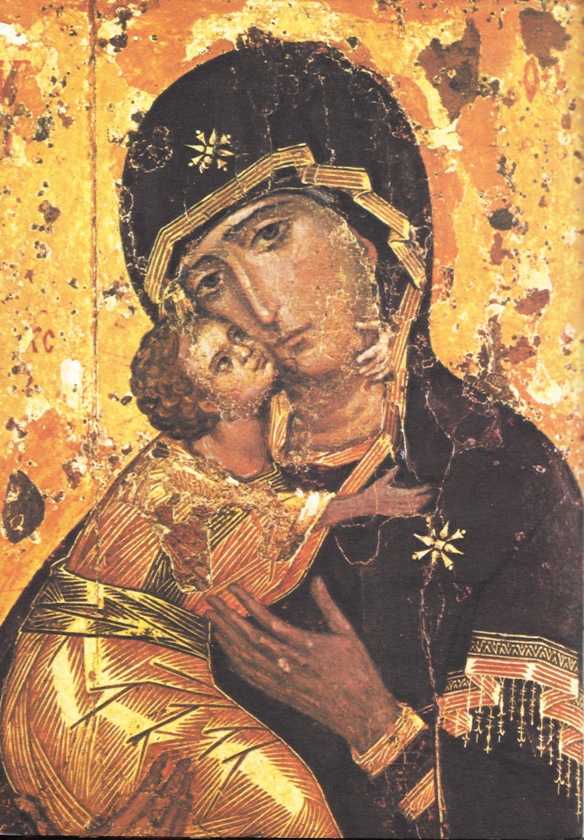
7)  Our Lady of Vladimir

Our Lady Of Vladimir is one of the more beautiful icons where Mary is shown with the Christ Child snuggling up to her, cheek to cheek, symbolizing the tenderness exchanged between Mother and Child.

It was first seen in Kiev in 1155 in the city of Vladimir. It became famous for miracles and was venerated as Russia’s most sacred image.

Several times, the invading Tartars were beaten back under its inspiration and it was carried to critical places in times of distress, the last being at the battlefront during World War I. Until the Russian revolutions, all the tsars were crowned and patriarchs installed in the presence of this image.

The latest representation of this icon also known as Theotokos, is found at the Tretyakov Gallery in Moscow. (A trivia: film producer Mel Gibson used a detail of the Virgin’s left eye and nose for his company’s Icon Productions).

The Russian calendar commemorates the feast of our Lady of Vladimir on 21 May.
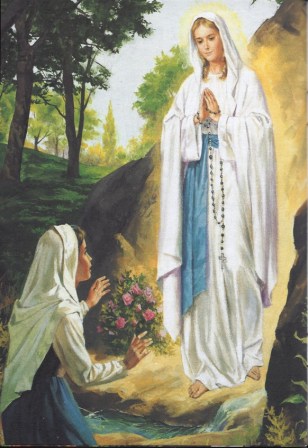
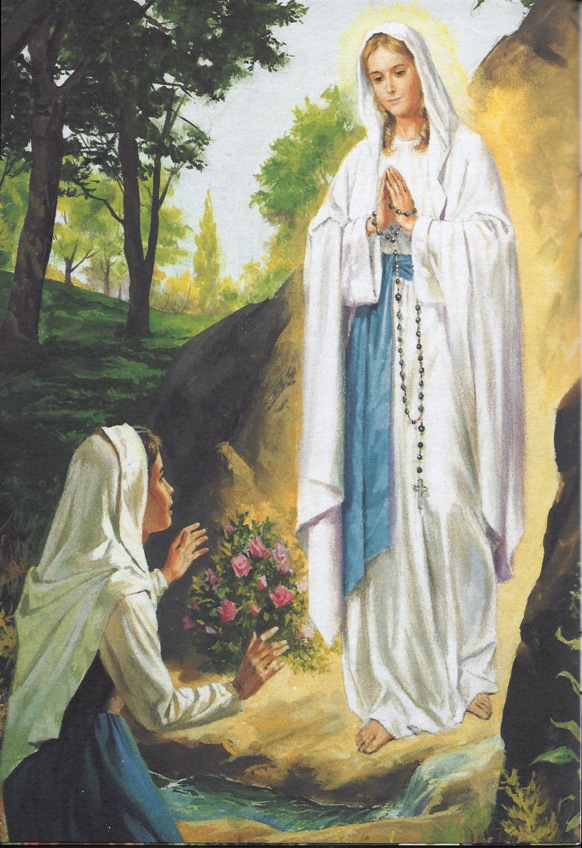
8)  Our Lady of Lourdes

Our Lady Of Lourdes, France: The Virgin appeared 18 times to a young girl named Bernadette Soubirous, in a cave on the edge of a mountain stream. On the ninth apparition, the Lady asked Bernadette to drink from a spring; none was visible so she scooped away sand at the back of the cave, knelt and drank of the water that welled up. The next day, a spring was flowing that produced abundant supply of water to this day. Mary asked for prayers and penance for the conversion of sinners. A chapel was built at the Grotto in 1862 fulfilling Mary’s request. Many miraculous cures were attributed to the spring water from Lourdes.

9) Our Lady of Lasalette

Our Lady of Lasalette, French Alps: On 19th September 1846, the feast day of Our Lady of Sorrows, the Virgin Mary appeared in a small village at LaSalette, located 1800 metres above sea level, about 35 kilometres from Grenoble in France. Melanie Calvat and Maximin Giraud were at the Mont sous-les-Baisses, urging four cows up the mountain, “Our cows were lying down placidly chewing cud,” she said. “Suddenly I saw a beautiful light, much brighter than the sun and felt full of tremendous wonder and respect. In that light I saw a very beautiful woman with her head resting in her hands. The lady stood up and said, ‘Come nearer children, do not be afraid, I am here to tell you great news.’ She looked very sad and had tears streaming down her cheeks. She folded her arms over her breast and said, ‘If My people do not obey God, I shall be forced to let go of My Son’s Hand.’ This statement points to the end of the world.

9a)  Weeping Lady of Lasalette in bronze

The children were moved by the Lady’s tears and her sad expression, “She asked for prayers to save the world, to confess our sins, turn away from our evil ways, and to do penance. She pointed out the great blessings and mercy of the holy rosary and begged us: ‘Be reconciled with God’.”

10a)  Close up of the Lady of Akita

Lady of Akita, Japan: The extraordinary events began on 12 June 1973 when a frail and deaf nun, Sister Agnes Katsuko Sasagawa, saw brilliant mysterious rays emanating suddenly from the tabernacle. Shortly afterwards, a cross-shaped wound appeared on Sister Agnes’ left hand that bled profusely and caused her much pain. When she was praying, Sister Agnes heard a voice coming from the 3-feet tall statue of the Blessed Virgin Mary in the chapel. (The statue was carved from a single block of wood from a Katsura tree). On the same day, a few of the sisters noticed drops of blood flowing from the statue’s right hand. On four occasions, this act of bleeding was repeated. The wound in the statue’s hand remained until 29 September, when it disappeared. The sisters noticed the statue had now begun to sweat on the forehead and neck.

In June 1988, Joseph Cardinal Ratzinger Prefect, Congregation for the Doctrine of the Faith (eventually elected as Pope Benedict XVI), declared that the apparition in Akita was reliable and worthy of belief.

The church of the Lady of Akita was built in typical Japanese design, with scented wood, sliding doors and green surroundings. In this idyllic setting, Father Jerry Orbos celebrated mass for our small group of pilgrims, “Do you remember the image of our Lady with her head slightly tilted to one side? That’s because one ear was listening to you while the other ear was attuned to God.” I thought it was nice to be reminded that our Lady calls each one of us her irreplaceable daughter (and son).

11)  Mary is crowned Queen of Heaven and Earth

In all the apparitions of the Virgin Mother, it is to be understood that the Virgin Mary is not God. “She has no power of her own, but she is (and always) the mother of the most powerful Person who ever walked the earth.” When she was assumed body and soul to heaven, she was crowned Queen of Heaven and Earth and of all Angels and Saints. Sometimes, she comes to earth as a heavenly messenger, sent by her Son.

“She brings no new messages, nothing that is not contained in the biblical teachings of her Son, Jesus. She calls on us to avoid sin, to repent and return to God.”

To our heavenly mother, we pray: Dearest Mama Mary, Strengthen our faith on the mercy and love of God and His promise of our own resurrection made possible by the precious blood that His Son, Christ Jesus spilled for us. Amen.

These are just a few of the known Marian apparitions. Online reference material was used for this article as well as the author’s personal notes. Some parts were lifted from an article originally published at Philippine Star

Categories
Special Events

Amorsolo Art Restoration Contract Signing

This slideshow requires JavaScript.

Last August 26, 2014, the Santuario San Antonio Parish signed a contract agreement with the Lopez Museum for the art restoration of the two works of art, by renowned Filipino National artist Fernando Amorsolo. His paintings entitled “Stigmatization of St. Francis” and “Sermon to the Birds” are the two sizeable paintings located at the side main entrances of the church.

Representing our parish is Fr. Reu Jose C. Galoy, OFM, Chairperson Ms. Helen Ong and PPC President Jayme Blanco whilst the Lopez Museum was represented by its Director Ms. Mercedes Lopez Vargas. Also present were Assistant Chairperson Ms. Carina Lebron, PPC Vice President Mr. Edmund Lim, PPC Secretary Ms. Cristina Teehankee, SSAP Finance Ms. Lita Ascalon, Past PPC President Mr. Michael Limpe, Lopez Museum Exec. Asst. Ms. Margarita Villanueva, Lopez Museum Conservationist Ms. Maita Reyes. Likewise, the donors were invited to witness the said event.

Ms. Mercedes Lopez Vargas explained that the conservation of the two Amorsolo murals will be undertaken by the Roberto M. Lopez Conservation Center of the Lopez Museum. The project is estimated to take place in three phases over the course of 18 months. The first phase entails project preparations where the contract will be finalized, teams assembled, requirements constructed, and special materials ordered and prepared. The second and third phases each entail the protection, de-installation, transportation, conservation and re-installation of the painting and frame, as each mural will be conserved one at a time.

Categories
Reflections

“Exaltation of the Cross” A Sunday Gospel Reflection by Fr. Efren Jimenez, OFM

1
History of the Feast
Early in the fourth century St. Helena, mother of the Roman Emperor Constantine, went to Jerusalem in search of the holy places of Christ’s life. She razed the Temple of Aphrodite, which tradition held was built over the Savior’s tomb, and her son built the Basilica of the Holy Sepulcher over the tomb. During the excavation, workers found three crosses. Legend has it that the one on which Jesus died was identified when its touch healed a dying woman.

The cross immediately became an object of veneration. At a Good Friday celebration in Jerusalem toward the end of the fourth century, according to an eyewitness, the wood was taken out of its silver container and placed on a table together with the inscription Pilate ordered placed above Jesus’ head. Then “all the people pass through one by one; all of them bow down, touching the cross and the inscription, first with their foreheads, then with their eyes; and after kissing the cross, they move on.”

To this day the Eastern Churches, Catholic and Orthodox alike, celebrate the Exaltation of the Holy Cross on the September anniversary of the basilica’s dedication. The feast entered the Western calendar in the seventh century after Emperor Heraclius recovered it from the Persians, who had carried it off in 614, 15 years earlier. According to the story, the emperor intended to carry the cross back into Jerusalem himself, but was unable to move forward until he put off his imperial garb and became a barefoot pilgrim.

Brief Comment
The cross is today the universal image of Christian belief. Countless generations of artists have turned it into a thing of beauty to be carried in procession or worn as jewelry. To the eyes of the first Christians, it had no beauty. It stood outside too many city walls, decorated only with decaying corpses, as a threat to anyone who defied Rome’s authority – including the heretic sect which refused sacrifice to Roman gods. Although believers spoke of the cross as the instrument of salvation, it seldom appeared in Christian art unless disguised as an anchor or the Chi-Rho until after Constantine’s edict of toleration.

Spirituality of the Cross: Passion of Christ, Passion of Humanity
Scripture is clear that Jesus, Son of the Father, came to this world to fulfil his mission on the cross. The Prophet Isaiah (chp.53) described mournfully the suffering servant – “Like a Lamb that is led to the slaughter, and like a sheep that before its shearers, he opened not his mouth. He was wounded for our transgressions, he was bruised for our iniquities – upon him was the chastisement that made us whole, and with his stripes we are healed…”

The servant who is extolled by Isaiah lives in the heart of our modern world and challenges it. The myths of money, power, revolutions, violence, diverse forms of socialism, politics, become embedded in the minds of people of today and mislead us to the truth of the purpose of life. This gives rise to aggressive anxiety, the strong and clever (devious) ones win and everybody loses out.
The twentieth century has been described as the most violent of all time and in the opening decades of the twenty-first century, the violence continues unabated. Whether it be the travesty of warfare, conflict of ethnic cleansing, and barbarity of street crimes, the apparent disregard for human life, the cruelty continues unabated. The newly formed IS (Islamic State) brings terror and unimaginable cruelty to all humanity.

The Servant who foreshadows Christ on the cross actually lives and is present in the world challenges power, violence, and even greed and selfishness and all forms of egoism. But Jesus, who is betrayed, rejected and crucified, opened to us the power of resurrection and glory – “See my servant shall prosper. He shall be raised high and greatly exalted.”

In faith we know two things, as we celebrate the exultation of the cross. First, Jesus saves the world by the mystery of His humiliation and His Resurrection. Secondly, Jesus identifies himself with the humble and the lowly. What is important for us? Is it to let ourselves be captivated and impressed by worldly prestige, or to seek Jesus where he is actually to be found? Is it to wonder aimlessly following our own ways and inclinations or to be close to Him who because of His afflictions saw light and was filled.

The Servant Jesus Christ, by identifying himself with human suffering, gives meaning to our suffering. By dying on the cross, he gives meaning to human existence. He alone saves! The man on the cross leads us to the glorious heights of love, life, and eternal peace in God.

“How splendid the cross of Christ! It brings life, not death; light, not darkness; Paradise, not its loss. It is the wood on which the Lord, like a great warrior, was wounded in hands and feet and side, but healed thereby our wounds. A tree has destroyed us, a tree now brought us life.” (Theodore of Studios)

About Fr. EJ and his reflections.

Categories
Articles CWL

CWL Inducts New Members

This slideshow requires JavaScript.

The Catholic Women’s League (CWL) inducted 4 new members: Mary Ann Cedo, Carla Lesaca, Beryl Lim and Jehan Rodriguez. Leading the ceremonies were CWL National President Amparo Lim and CWL-SSAP President J’net B. Zulueta together with the other members of the league. Fr. Baltazar ‘Tasang’ Obico, OFM presided over the induction ceremony.

Design a site like this with WordPress.com
Get started