Categories
The ABC’s of Catholic Doctrine

The ABC’s of Catholic Doctrine by Lianne Tiu

Marriage, like diamond, is forever.

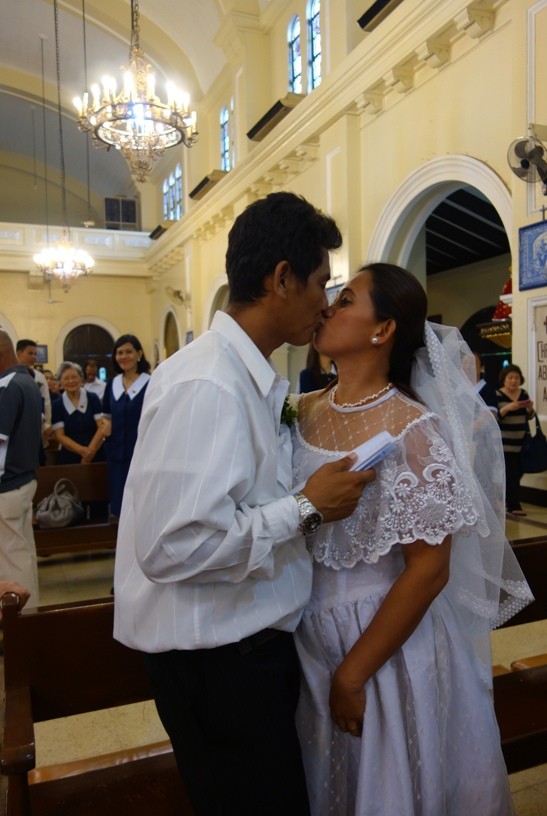
Most videographers capture the most important part of the wedding rite when the bride and groom express their consent in church, “…for better, for worse, for richer, for poorer, in sickness and in health, until death do us part.”

As years go by, the “happily ever after” seems to exist only in fairy tales, but not in real life. We realize that loving someone for one’s entire life can actually be difficult. These difficulties, which come in all shapes and sizes, may be an aspect of the other’s personality that gradually emerged when the knot is tied, differences in beliefs, priorities, and value systems, different ways of dealing with conflict, changes in mind and body as we age, etc.

Today, there is prevalence of marital infidelity and extra-marital affairs, of marriages ending in separation or divorce (especially in the Western world). The blame is not entirely with the couple, however, but with the narcissistic society that promotes the violation of marital vows, which is no longer pleasurable or easy to fulfill. The media and a “Me” generation contribute to a kind of mind-set, which seeks a life that is free from pain, discomfort, boredom, or unhappiness. Short-term affairs or extra-marital affairs become normal; while divorce becomes acceptable, and even commendable.

It’s about time we lovingly remind people of the word “commitment” – that we honor a marriage vow for life. In the present age, people are getting used to trendier terms, like “freedom,” ”choice,” and “having it our way.” Commitment, however, is to stay married because we vowed we would. It requires self-giving to continue when we don’t always “feel like it.” It entails patience to bear with each other’s faults until death. It needs loyalty to be faithful as long as we live. It requires humility and forgiveness to continue when there are hurt and anger. And most of all, commitment needs help from God, the author of marriage, to continue being one in flesh through prayers and the sacraments.

Our family, which we claim we truly love, is worth the struggle in spite of the obstacles and differences. Our children and grandchildren may gather some fortune and fame from us, but they will definitely inherit an immeasurable trust through our examples of faithfulness and commitment.

Pop star Rihanna sings about shining bright like a diamond. Marriage is like this precious diamond, which comes the Greek word adámas meaning “unbreakable”. It is a beautiful partnership; it is a lifetime commitment.

(Reference: “Raising Catholic Children” by Mary Ann Kuharski; “Marriage is Love Forever” by James Socias; Catechism of the Catholic Church; Wikipedia)
Categories
Cathechism of the Catholic Church

Catechism of the Catholic Church

???????????????????????????????
Why did God dispose man and woman for each other?
God disposed man and woman for each other so that they might be “no longer two but one.” (Mt 19:6) In this way they are to live in love, be fruitful, and thus become a sign of God himself, who is nothing but overflowing love.

What is necessary for a Christian, sacramental marriage?
A sacramental marriage has three necessary elements: (a) free consent, (b) the affirmation of a life- long, exclusive union, and (c) openness to children. The most profound thing about a Christian marriage, however, is the couple’s knowledge: “We are a living image of the love between Christ and the Church.”
The requirement of unity and indissolubility is directed in the first place against polygamy, which Christianity views as a fundamental offense against charity and human rights; it is also directed against what could be called “successive polygamy,” a series of non-binding love affairs that never arrive at one, great, irrevocable commitment. The requirement of marital fidelity entails a willingness to enter a lifelong union, which excludes affairs outside the marriage. The requirement of open- ness to fertility means that the Christian married couple is willing to accept any children that God may send them. Couples who remain childless are called by God to become “fruitful” in some other way. A marriage in which one of these elements is excluded at the marriage ceremony is not valid.

Why is marriage indissoluble?
Marriage is triply indissoluble: first, because the essence of love is mutual self-giving without reservation; second, because it is an image of God’s unconditional faithfulness to his creation; and third, because it represents Christ’s devotion to his Church, even unto death on the Cross.

At a time when 50 percent of marriages in many places end in divorce, every marriage that lasts is a great sign – ultimately a sign for God. On this earth, where so much is relative, people ought to believe in God, who alone is absolute. That is why everything that is not relative is so important: someone who speaks the truth absolutely or is absolutely loyal. Absolute fidelity in marriage is not so much a human achievement as it is a testimony to the faithfulness of God, who is there even when we betray or forget him in so many ways. To be married in the Church means to rely more on God’s help than on one’s own resources of love.

What threatens marriages?
What really threatens marriages is sin; what renews them is forgiveness; what makes them strong is prayer and trust in God’s presence.

Conflict between men and women, which sometimes reaches the point of mutual hatred in marriages, of all places, is not a sign that the sexes are incompatible; nor is there such a thing as a genetic disposition to infidelity or some special psychological disability for lifelong commitments. Many marriages, however, are endangered by a lack of communication and consideration. Then there are economic and societal problems. The decisive role is played by the reality of sin: envy, love of power, a tendency to quarrel, lust, infidelity, and other destructive forces. That is why forgiveness and reconciliation, in confession as well, is an essential part of every marriage.

May a husband and wife who are always fighting get a divorce?
The Church has great respect for the ability of a person to keep a promise and to bind himself in lifelong fidelity. She takes people at their word. Every marriage can be endangered by crises.

Talking things over together, prayer (together), and often therapeutic counseling as well can open up ways out of the crisis. Above all, remembering that in a sacramental marriage there is always a third party to the bond, Christ, who can kindle hope again and again.

Someone for whom marriage has become unbearable, however, or who may even be exposed to spiritual or physical violence, may divorce. This is called a “separation from bed and board,” about which the Church must be notified. In these cases, even though the common life is broken off, the marriage remains valid.

Indeed, there are also cases in which the crisis in a marriage ultimately goes back to the fact that one spouse or both was not eligible at the time of the wedding or did not fully consent to the marriage. Then the marriage is invalid in the canonical (legal) sense. In such cases an annulment procedure can be introduced at the diocesan tribunal.

Design a site like this with WordPress.com
Get started